The temperature outside Carver & Sons Auto Repair had fallen to twenty-three degrees by the time Ethan Carter finished tightening the last bolt on a customer’s pickup truck. The heater above Bay Three coughed out more noise than warmth, and cold air slipped beneath the garage doors in thin, relentless streams. Ethan barely noticed it anymore; after eleven years as a mechanic, discomfort had become another background sound, like rattling tools or the fluorescent lamp that flickered every few seconds. What he noticed instead was his six-year-old daughter, Lily, sitting on an old army cot between two shelves of spare parts.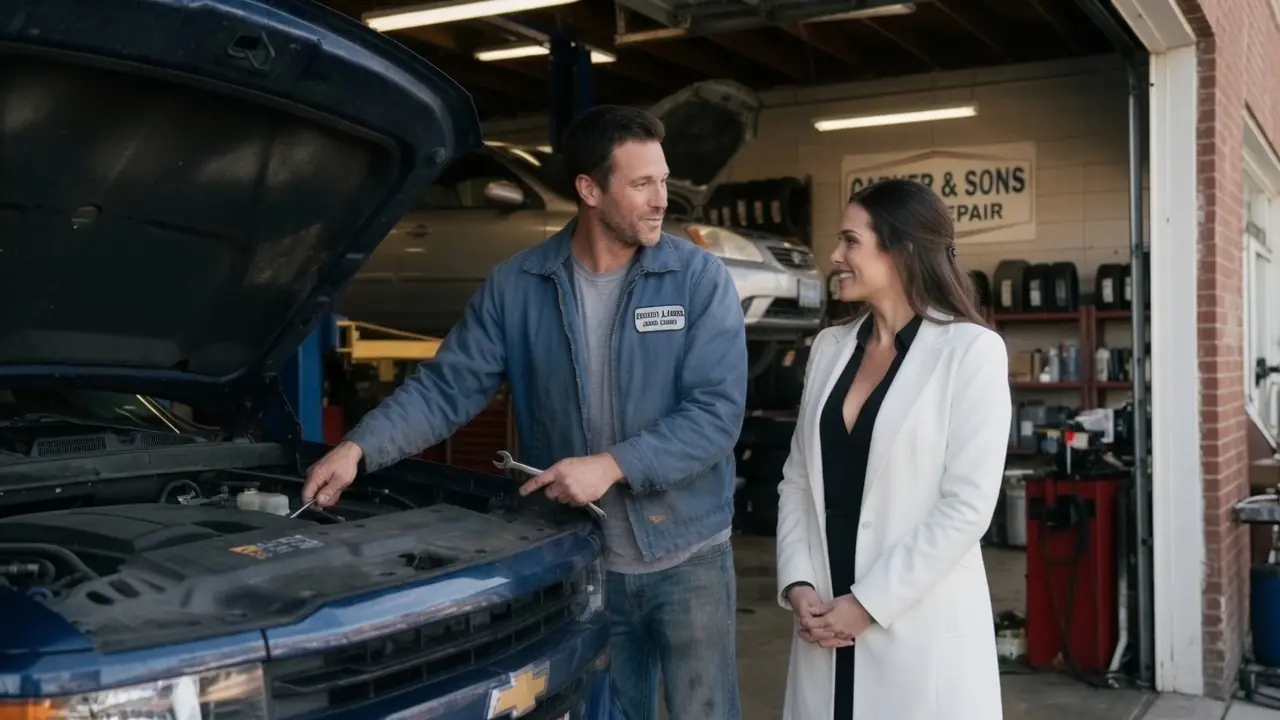
Lily wore Ethan’s faded Red Sox cap sideways, the oversized brim nearly covering one eye as she struggled through a math worksheet. Her mother had left four years earlier, leaving Ethan to learn how to rebuild engines, pack school lunches, braid uneven ponytails, and explain why some people did not stay. He never complained in front of Lily, even when the mortgage was late or his shoulder ached from an old workshop injury. To her, Ethan could repair anything, and he worked hard to protect that belief.
“Dad,” Lily called, pressing her pencil against the paper. “Is seven plus eight fourteen or fifteen?”
“Fifteen,” Ethan replied as he wiped grease from his hands.
“Are you completely sure?”
“Mechanic’s guarantee.”
Lily nodded solemnly and wrote down the answer. Ethan smiled, but the expression faded when he glanced at the day’s invoices hanging from the clipboard near the office. The numbers were not terrible, yet they were never quite enough, especially after the Carver family had announced that the struggling repair chain was being sold. Rumors had spread that the new owner would close weaker locations, and everyone knew their aging shop would be near the top of that list.
At five forty-five, bright headlights swept across the garage entrance. Ethan expected another driver hoping for an emergency repair after closing, but then he heard the quiet click of an expensive car door. A woman appeared beneath the raised bay door, holding her coat tightly around her body as the wind lifted strands of dark hair from her face. She looked polished and confident, but exhaustion sat behind her eyes.
“I’m sorry,” she said. “My car stopped at the light down the street.”
Ethan looked beyond her and saw a dark blue Mercedes resting awkwardly near the curb. “Did any warning lights come on?”
“The battery symbol appeared a few days ago. I kept meaning to have it checked.”
“That symbol usually doesn’t believe in waiting.”
For the first time, the woman almost smiled. Ethan pulled on his jacket, grabbed a flashlight, and followed her into the cold. The alternator belt had snapped, leaving the battery to carry the electrical system until its remaining charge disappeared. It was a simple repair, but a tow truck, dealership labor, and an emergency appointment could easily cost her several hundred dollars.
“I have the right belt inside,” Ethan explained. “Give me forty minutes.”
“How much will it cost?”
“Eleven dollars for the part.”
“And the labor?”
Ethan studied her face. Her clothes suggested that money was not a problem, yet her hands were trembling, and something about her controlled breathing told him the broken car was only one item in a much heavier evening. “No labor charge tonight,” he said. “Just cover the belt.”
The woman stared at him as though kindness had become an unfamiliar language. “I can afford to pay you.”
“I never said you couldn’t.”
“Then why would you work for free?”
“Because sometimes a person needs help more than they need another bill.”
Ethan rolled the Mercedes into the first bay and began removing the damaged belt. The woman sat on a metal stool nearby, watching him work instead of checking the phone resting silently in her lap. Her name was Olivia Harper, though Ethan did not know it yet. She was a respected corporate turnaround executive who had spent fourteen years rebuilding failing companies, negotiating acquisitions, and making decisions that affected hundreds of employees.
Olivia was accustomed to people studying her title before deciding how to treat her. Business partners praised her ideas because they wanted contracts, employees laughed at her jokes because she controlled promotions, and strangers became unusually helpful once they recognized her from financial magazines. Ethan had no idea who she was, and that made his quiet generosity feel strangely significant. He saw only a stranded woman standing alone in the cold.
Lily climbed down from her cot and cautiously approached the visitor. “Are you a princess?”
Olivia blinked. “No.”
“You look like one because your coat is fancy.”
“It’s only a coat.”
“My coat has a dog on it,” Lily said. “Dad picked it because he’s good at presents.”
Ethan glanced over his shoulder. “Lily, let the woman breathe.”
“She can breathe and talk at the same time,” Lily replied.
Olivia laughed softly, surprising herself. “What’s your name?”
“Lily Carter. Are you in trouble?”
“My car broke down.”
Lily pointed confidently toward Ethan. “Dad fixes everything.”
Olivia watched the mechanic leaning beneath the hood, his movements efficient and patient. “Does he?”
“Yes. He even fixed our toaster, but it still burns the corners.”
“That sounds like a partial victory.”
Twenty-five minutes later, Ethan lowered the hood and started the engine. The Mercedes came back to life with a smooth hum, and Olivia released a breath she had been holding since arriving. Ethan warned her that the tensioner was worn and should be replaced within the month, adding that any reputable repair shop could do it. His recommendation that she visit a competitor confused her almost as much as the free labor.
“You really don’t want anything from me?” Olivia asked.
“Drive safely and get the tensioner checked.”
“You don’t even know my name.”
Ethan looked toward Lily, who was watching closely from her cot. “I know you were alone in the cold and needed help. That’s enough.”
Olivia paid for the belt, thanked Lily for the conversation, and stood beside the Mercedes for several seconds before leaving. Her eyes lingered on Ethan as though she wanted to say something more, but she eventually slid behind the wheel and drove away. Ethan watched the taillights disappear, then returned to cleaning the garage. He told himself the woman would soon become another brief memory from another long day.
The following morning, senior technician Marcus Webb stood beside the coffee machine with his phone in his hand. A company-wide email confirmed that Carver & Sons and fourteen associated service centers had been purchased by Harper Meridian Group. A new executive would conduct operational reviews, restructure failing locations, and determine which employees would remain. Marcus had searched the company online and found stories about ruthless cost cutting, leadership changes, and struggling businesses transformed through aggressive reform.
“We’re probably finished,” Marcus muttered. “This building is older than half the customers.”
Ethan poured coffee into a chipped mug. “The building still works.”
“Bay Four’s lift has been broken for two months.”
“Then they should fix it.”
“You’re strangely calm for a man who may be unemployed next week.”
“Worrying won’t repair the lift.”
Four days later, two black vehicles entered the parking lot shortly after eight in the morning. Security personnel stepped out first, followed by several executives carrying laptops and folders. Then Olivia emerged from the second vehicle wearing a structured navy jacket, her dark hair neatly tied back. The stranded woman from Thursday evening had disappeared, replaced by someone whose arrival made conversations stop and shoulders straighten.
Ethan nearly dropped the brake rotor in his hands. Marcus leaned closer and whispered, “That’s Olivia Harper. She owns the company now.”
Olivia entered the garage while assessing every detail—the broken hydraulic lift, the handwritten scheduling board, the overdue inventory sheets, and the rusting ventilation system. When her eyes reached Ethan, recognition passed between them for the briefest moment. She did not smile or mention the Mercedes. Instead, she introduced herself to the staff and announced a full operational review.
Derek Pullman, the shop’s general manager, immediately appeared at Olivia’s side. Derek had worked at Carver & Sons for only two years, yet he behaved as though he had personally built the company from the foundation up. He wore his finest shirt, praised his own leadership, and blamed every visible problem on budget restrictions or uncooperative technicians. Ethan had never trusted him, especially after noticing unexplained customer complaints and unusually high parts charges.
Olivia’s analysts spent the next several days studying invoices, payroll records, customer complaints, and electronic access logs. The broken lift was repaired within forty-eight hours after Olivia discovered that Derek had never placed the replacement order he claimed was delayed. New scheduling software was installed, and several customer accounts were reviewed. By Thursday morning, the audit uncovered thirteen invoices containing consistent, deliberate overcharges.
All thirteen transactions had been authorized under Ethan’s employee login.
At four fifteen that afternoon, Ethan was summoned to the conference room. Olivia sat at the head of the table with Derek, two analysts, and legal counsel. Copies of the suspicious invoices had been placed in front of her, each displaying Ethan’s name and authorization number. Derek wore an expression of practiced disappointment.
“This is difficult for all of us,” Derek began. “Ethan has been here for years, but loyalty cannot excuse theft.”
Ethan stared at the documents. “I didn’t enter these charges.”
“They were entered under your credentials,” Derek replied.
“Then someone used my credentials.”
“Do you have proof?”
Ethan examined the dates and immediately recognized one of them. On September fourteenth, while several of the fraudulent transactions were entered, he had attended a parent-teacher conference at Lily’s school. He remembered sitting across from her teacher and asking whether Lily’s reading difficulties were related to confidence or comprehension. There had been parking receipts, appointment forms, and school security records.
“I can prove I wasn’t here,” Ethan said.
Derek’s confidence flickered for half a second. Olivia noticed.
“Bring everything tomorrow morning,” she instructed. “Until then, you are suspended from system access.”
Ethan looked directly at her, searching for the woman whose car he had repaired. Her expression revealed nothing. For one painful moment, he wondered whether the kindness he had offered meant anything to her at all. He left the room without defending himself further because he knew truth sounded weakest when shouted.
That night, Ethan sat at the kitchen table assembling evidence while Lily slept down the hallway. Her teacher answered his message immediately and confirmed the exact time of their meeting. Ethan found the parking receipt in an old jacket pocket, retrieved location records from his phone, and printed the photograph Lily’s teacher had taken of them beside a classroom reading chart. By midnight, he had arranged everything inside a plain folder.
Lily appeared at the doorway holding her blanket. “Are you losing your job?”
Ethan’s heart tightened. “Who told you that?”
“You look like you did when the bank called.”
He pulled her onto his lap. “Someone made a mistake and put my name on it.”
“Can you fix it?”
“I’m going to try.”
She rested her head against his chest. “You fix everything.”
Friday morning, the entire staff gathered in the waiting area. Derek repeated his accusation with words such as “systemic misconduct” and “breach of trust,” making the alleged theft sound larger each time he described it. Ethan stood near the rear holding his folder while Olivia listened in silence. When Derek finished, she opened a laptop.
“My team reviewed more than the invoices,” Olivia said. “We examined access logs, workstation activity, badge records, and internal emails.”
Derek shifted in his seat.
“Mr. Carter’s credentials were used from Bay Two,” Olivia continued. “However, his employee badge never entered the building during several of those transactions.”
She turned the screen toward the staff. “Your badge did, Mr. Pullman.”
The room became completely still.
Olivia explained that Derek’s badge had accessed the terminal minutes before Ethan’s credentials were entered. Security records showed that twelve of the thirteen fraudulent invoices originated from Derek’s workstation or a terminal he had personally opened. The final charge occurred while Ethan was at Lily’s school, a fact confirmed by location history, parking records, and the teacher’s statement.
Derek stood abruptly. “Someone must have copied my badge.”
“Then perhaps they also copied your management email,” Olivia replied. “Two customers received written messages from that account confirming charges you knew were false.”
“This is being taken out of context.”
“Stealing from customers and framing an employee requires no helpful context.”
Olivia’s voice remained calm, yet every word landed with finality. She terminated Derek immediately and announced that the records would be turned over for legal review. Security escorted him from the building while the technicians watched in stunned silence. The man who had expected Ethan to leave carrying a cardboard box was the one forced to surrender his badge.
After the staff returned to work, Olivia asked Ethan to remain behind. The conference room felt smaller without the crowd, and for several seconds neither of them spoke. Ethan placed his folder on the table even though she no longer needed it.
“I owe you an apology,” Olivia said.
“You had the access logs before yesterday, didn’t you?”
“By Tuesday evening.”
“You let me believe I might lose my job.”
“I needed to see whether Derek would strengthen the false accusation once he thought it was working.”
“You could have warned me.”
“Yes.”
Her immediate agreement surprised him. There was no corporate excuse, no attempt to soften her responsibility. “I made a calculated decision and forgot that you were the person carrying its cost,” she said. “I’m sorry.”
Ethan thought about Lily standing in the doorway with her blanket. “I’m still angry.”
“You should be.”
“Then why did you come here first? You own fifteen shops.”
Olivia glanced through the window toward the garage. “Because a mechanic here repaired my car without knowing my name and reminded me that businesses are made of people before they are made of numbers.”
Ethan’s expression softened slightly. “Lily would want to know the princess isn’t in trouble.”
Olivia smiled. “She called me a princess?”
“Only because your coat was fancy.”
During the following weeks, Carver & Sons began to change. The broken lift returned to service, outdated equipment was replaced, and the handwritten scheduling clipboard disappeared. Ethan accepted a promotion to lead technical supervisor, giving him authority over repairs, inventory, and customer safety standards. The salary increase allowed him to catch up on the mortgage and replace the unreliable heater in Lily’s bedroom.
Olivia insisted that the promotion was not repayment for the alternator belt. Ethan insisted he would resign if it became charity. They argued for twenty minutes before Olivia placed performance reports in front of him proving he had already been doing the supervisor’s job for years without the title. He accepted only after reading every page.
Two weeks later, Ethan received a call from an unfamiliar number while making dinner. Olivia’s Mercedes had developed a clicking sound when turning left, and she wanted his opinion. He identified a worn CV joint from her description, then heard a nervous silence on the line.
“Are you free Saturday?” she asked.
“The shop closes at four.”
“I didn’t mean for the car.”
Olivia invited Ethan and Lily to dinner at a small Italian restaurant in Boston. Lily asked the waiter seventeen questions about handmade pasta and officially renamed Olivia “the pasta lady.” Instead of appearing offended, Olivia laughed until tears gathered at the corners of her eyes. Ethan realized he had never heard her laugh without restraint.
Their relationship developed slowly, unevenly, and honestly. Olivia traveled often, yet she called Lily from airports and sent photographs of unusual pasta shapes from different cities. When Lily became ill in February, Olivia arrived with soup and an audiobook, sitting outside the child’s bedroom until she fell asleep. Ethan watched her reading beside the half-open door and recognized that she was no longer simply visiting their lives.
There were difficult moments as well. Ethan feared Olivia saw him as another struggling business she could rescue, while Olivia struggled to believe that someone might remain after seeing her uncertainty. Their worst argument began when Ethan accused her of solving emotional problems with money. Instead of leaving, she admitted that money and authority were the only tools she had trusted for years.
“I don’t know how to need people without feeling weak,” she confessed.
“I don’t need you to be weak,” Ethan replied. “I need you to be honest.”
“I’m trying.”
“Then keep trying with us.”
By summer, Olivia knew where Ethan kept the good coffee mugs, how Lily preferred the crust removed from sandwiches, and which floorboard creaked outside the child’s bedroom. She attended school events without bringing an assistant and learned to sit through long explanations about dinosaurs. Lily began leaving drawings inside Olivia’s briefcase, usually showing the three of them beside a car with impossibly large wheels.
The repair shop flourished under Ethan’s leadership. Customer trust returned, repeat business increased, and employee turnover dropped. Olivia’s analysts began consulting Ethan about other locations, recognizing that his understanding of people was as valuable as his mechanical knowledge. He helped redesign repair processes across the company without ever pretending to be anything other than a mechanic who cared about doing work correctly.
One September morning, Lily watched Olivia pour coffee into the blue mug she always used. “Are you going to live here?”
Olivia nearly spilled the coffee.
Ethan looked up from the stove. “That’s a serious question.”
“She already knows where the good mugs are,” Lily explained. “That means she belongs here.”
Olivia lowered herself beside Lily. “Would you want me to?”
“Yes, but you have to keep liking pasta with ridges.”
“That seems fair.”
The following October, Ethan and Olivia married in a converted carriage house outside Boston. They invited only the people who had genuinely mattered through the long year—Marcus and his wife, Lily’s teacher, Olivia’s closest friends, and employees who had helped rebuild the shop. Lily walked down the aisle carrying marigolds, whispering to every guest that her dress was uncomfortable but important.
Ethan’s vows were simple. He reminded Olivia that their story began with an eleven-dollar belt and a woman standing alone in the cold. He told her that she had entered a life he already believed was complete and shown him that love did not replace what was there; it expanded it. Olivia cried before he finished.
“I spent my life rebuilding companies,” she said during her vows. “You taught me that people cannot be rebuilt like systems. They must be trusted, listened to, and loved without knowing exactly what the result will be.”
She looked toward Lily, who was holding both wedding rings with intense concentration. “I didn’t know I needed a family until the two of you treated me like I was already allowed to belong.”
After the ceremony, Lily fell asleep clutching a marigold while music drifted through the carriage house. Ethan and Olivia stepped outside into the cold October air and stood beneath a clear sky. She leaned against him, and he wrapped his arms around her.
“Thank you,” Olivia whispered.
“For what?”
“The alternator belt.”
Ethan laughed. “You paid eleven dollars for it.”
“You gave me everything else for free.”
He kissed her forehead and looked back toward the building where Lily slept. On a freezing evening nearly one year earlier, Ethan had helped a stranger because his daughter was watching and because kindness was the person he wanted her to see. He had expected nothing in return.
Yet the broken car had carried Olivia into his garage, into his company, and eventually into the small, imperfect family that became her home. What changed their lives was not wealth, promotion, or power. It was one person choosing to help before asking who the other person might become.