The kiss lasted only a heartbeat before thunder split the sky above them.
Daniel Mercer tightened one arm beneath Claire Whitmore’s knees and carried her toward his blue pickup while floodwater rushed across the road behind them. Rain struck his face hard enough to sting, and the wind bent the pine trees toward the pavement as though the entire forest were trying to escape the storm. Claire clung to his neck, trembling inside her soaked white blazer, while her abandoned black sedan sat half-submerged near the ditch.
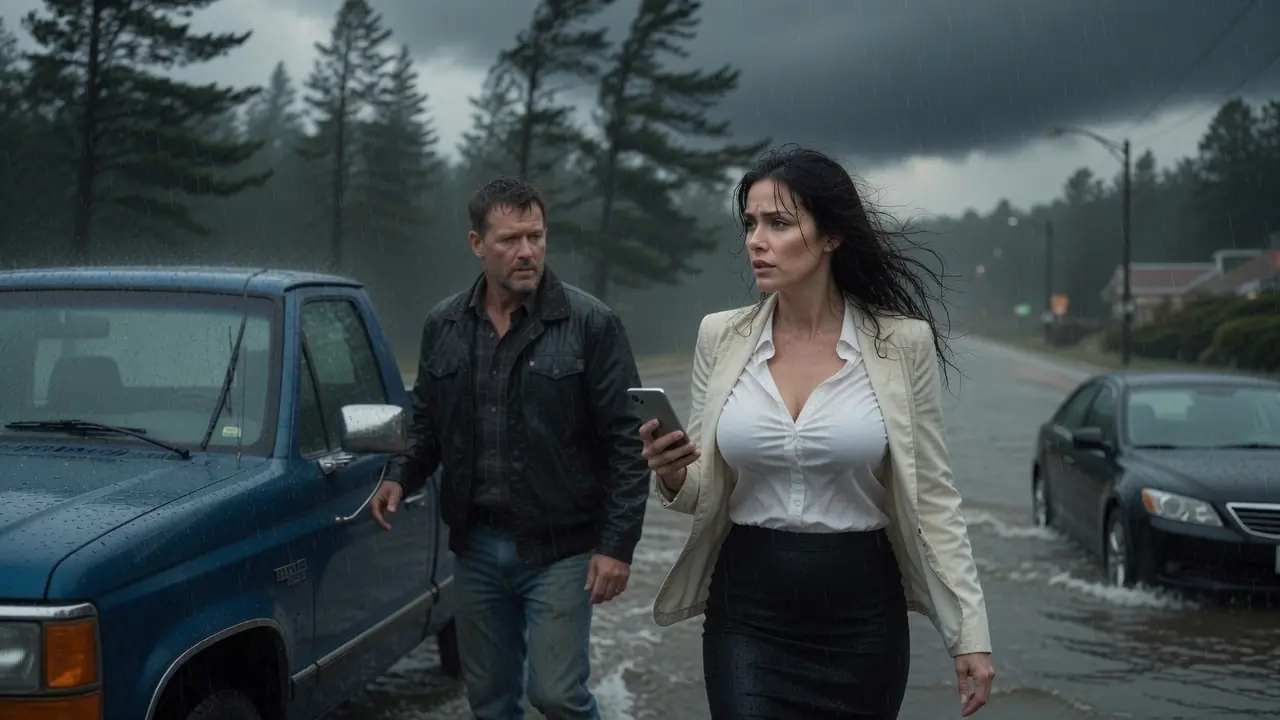
“Keep your eyes open,” Daniel said.
“I’m awake.”
“You’re freezing.”
“I’m embarrassed.”
“That can wait.”
He placed her carefully on the passenger seat, pulled his wet jacket around her shoulders, and slammed the door against the wind. By the time he reached the driver’s side, water had risen above the sedan’s lower wheels and carried branches across the road. Daniel started the truck, shifted into four-wheel drive, and turned toward the narrow county bridge visible through the rain.
His phone showed no service.
Claire stared at her own screen, which flickered between emergency alerts and a confidential corporate message she had never been meant to see outside the office. She read the address twice before looking toward Daniel.
118 Cedar Mill Road.
It was the address printed on the registration card clipped near his dashboard.
Her company planned to seize his home at nine the following morning.
Daniel drove slowly through the moving water. He was forty-one, broad-shouldered, with short dark hair, weathered skin, and the exhausted eyes of a man accustomed to carrying responsibilities without announcing their weight. His left hand remained steady on the wheel, but Claire noticed how often he glanced toward the clock.
“Is someone waiting for you?” she asked.
“My daughter.”
“How old is she?”
“Nine.”
Claire pulled the jacket tighter. “She’s home alone?”
“With my neighbor, Mrs. Alvarez. I was supposed to pick her up before the storm reached the county.”
“Then why did you stop for me?”
Daniel looked toward her briefly. “You were standing in floodwater beside a dead car.”
“You could have called for help.”
“There was no signal.”
“You still could have kept driving.”
“So could everyone else.”
The answer silenced her.
They reached the bridge just as the county warning siren began wailing in the distance. Water pushed violently beneath the wooden structure, carrying fencing, trash cans, and pieces of a shed downstream. Daniel slowed before the entrance and studied the current.
Claire looked toward the dark woods behind them. “Can we cross?”
“Maybe.”
“That doesn’t sound reassuring.”
“It wasn’t meant to.”
A sudden crash echoed from the hill. Daniel checked the mirror and saw a pine tree fall across the road they had just traveled, completely blocking the way back.
The bridge became their only route.
He shifted into first gear.
Claire caught his arm. “Wait.”
Daniel looked at her hand, then at her face.
“If the truck gets swept away—”
“It won’t.”
“You don’t know that.”
“No.”
“Then why are you moving?”
“Because my daughter is on the other side.”
There was no recklessness in his voice. Only certainty.
Claire released him.
The pickup crawled onto the bridge as water sprayed through the boards below. Wind pushed against the passenger side, and the old structure groaned beneath the truck’s weight. Halfway across, a section of railing broke loose and disappeared into the current.
Claire reached for Daniel again.
This time, he took her hand.
“Don’t look down,” he said.
“I wasn’t planning to.”
“You’re looking down.”
“I make poor decisions under stress.”
Daniel almost smiled.
The rear tires slipped.
Claire gasped as the truck moved several inches toward the broken railing. Daniel turned into the slide, eased the throttle, and allowed the tires to catch without spinning. The pickup straightened and moved forward again.
When they reached solid pavement, Claire realized she had dug her fingernails into his palm.
“I’m sorry.”
“Keep holding on.”
She did.
The Mercer house stood on higher ground beyond Cedar Mill, a modest two-story farmhouse with a metal roof, wide porch, and an old red barn behind it. Water covered the lower pasture but had not reached the foundation. A small girl in yellow pajamas burst through the front door before Daniel finished parking.
“Daddy!”
Daniel stepped from the truck and caught Lily as she ran toward him. He lifted her into his arms, holding her so tightly that she complained she could not breathe.
“You were late,” she said.
“I know.”
“I heard the bridge siren.”
“I know.”
Mrs. Alvarez appeared on the porch carrying a lantern. Her relief turned to curiosity when Claire climbed from the passenger side wearing Daniel’s jacket over her soaked business clothes.
“This is Claire,” Daniel said. “Her car flooded.”
Mrs. Alvarez studied the woman, the torn heel of one shoe, and the expression Daniel was trying not to reveal.
“Of course it did,” she said. “Storms always bring something through the door.”
Claire was given dry clothes that once belonged to Daniel’s late wife. The gray sweater was slightly too large, but the black cotton pants fit well enough. When she returned downstairs, Lily was sitting at the kitchen table with crayons spread around her while Daniel checked weather reports on an old battery radio.
The home was warm but simple. Children’s drawings covered one wall, boots lined the entrance, and photographs of Daniel with Lily stood beside a picture of a smiling blonde woman whose absence could be felt without explanation.
Claire stopped near the photograph.
“My wife, Anna,” Daniel said behind her. “She died four years ago.”
“I’m sorry.”
“So am I.”
There was no polished response after that. No attempt to turn grief into something inspirational. Daniel moved toward the stove and heated soup while Lily asked Claire whether rich businesswomen always became stranded in storms.
Claire looked at her. “How do you know I’m a rich businesswoman?”
“You dress like the women on Dad’s news.”
Daniel placed bowls on the table. “Lily.”
“What?”
“That wasn’t polite.”
Claire sat beside her. “It was accurate.”
Lily smiled.
For ten minutes, the storm existed only beyond the windows. They ate tomato soup with grilled cheese, and Claire watched Daniel cut Lily’s sandwich diagonally because she insisted it tasted better that way. He listened when his daughter spoke, even when she explained the entire plot of a book about a horse solving crimes.
The tenderness between them made Claire’s chest ache.
Her own father had measured affection through achievement. Good grades earned attention, promotions earned dinner invitations, and mistakes earned silence. Claire became executive vice president of land acquisitions at Whitmore Development partly because she wanted to prove she could become indispensable to a man who treated love like a performance review.
Her phone vibrated.
The confidential message remained open.
Daniel’s property address appeared beneath the heading:
Cedar Mill Flood Mitigation Acquisition — Final Enforcement List.
Claire’s appetite disappeared.
She opened the attached documents while Daniel carried dishes to the sink. Whitmore Development had partnered with Prairie County Bank to acquire distressed properties along Cedar Mill Road. The official explanation claimed the land would become part of a flood-control and residential-renewal project.
Daniel’s home was categorized as abandoned agricultural collateral.
It was neither abandoned nor solely agricultural.
The file claimed he had ignored fourteen notices and defaulted on a redevelopment loan signed two years earlier. A court-approved seizure was scheduled for the following morning, with county deputies authorized to remove occupants if necessary.
Claire examined the signature.
Daniel Mercer’s name appeared at the bottom.
She looked toward him.
“Have you ever borrowed money from Whitmore Development?”
Daniel stopped beside the sink.
“No.”
“Did you sign a redevelopment agreement two years ago?”
His expression changed. “Why?”
Claire placed the phone on the table.
Daniel read the first page without moving. Then he scrolled through the supporting documents, his face becoming harder with every line.
“What is this?”
“My company’s enforcement order.”
Lily looked between them. “What does enforcement mean?”
Daniel locked the phone and handed it back. “It means grown-ups made a paperwork mistake.”
Claire did not correct him in front of the child.
Mrs. Alvarez understood immediately. She guided Lily toward the living room, promising a movie and popcorn despite the late hour. When they were alone, Daniel turned toward Claire.
“Your company is taking my home?”
“According to those files, yes.”
“At nine tomorrow?”
“Yes.”
“You knew this when I found you?”
“No. The message arrived while we were on the road.”
“Why was my property in your phone?”
“I oversee acquisitions.”
Daniel stepped away.
The emotional distance appeared faster than the physical one. Minutes earlier, he had kissed her beneath the storm and carried her as though losing her would wound him. Now he looked at her as someone connected to the threat against his daughter.
“I didn’t know,” Claire said.
“You approved these projects.”
“I approve regional budgets. The individual files go through local teams.”
“Convenient.”
“I deserve that.”
“You deserve worse if you’re lying.”
Claire accepted the anger. “I’m not.”
Daniel took the documents from her and enlarged the signature. “That isn’t mine.”
“You’re certain?”
“My name has one L in the middle stroke. Whoever copied this added two.”
He retrieved a metal file box from the pantry and placed it on the table. Inside were the mortgage, insurance papers, tax receipts, and every letter he had received concerning the property.
There was no redevelopment loan.
No default notice.
No communication from Whitmore Development.
Claire compared his real signature to the document on her phone. Daniel was right. The forged version appeared to have been copied from an old equipment-financing agreement, then reconstructed imperfectly.
“Who benefits from taking this land?” he asked.
Claire opened the development map.
Cedar Mill Road contained fourteen properties marked for seizure. Together, they formed a continuous corridor from the highway to the river. Whitmore Development had publicly described the project as affordable housing with flood protection.
The internal plans showed something else.
A luxury commercial district, private marina, and gated residential development.
Daniel’s home stood where the main entrance would be built.
“The flood-control project is a cover,” Claire said.
“For what?”
“A resort development worth nearly six hundred million dollars.”
Daniel stared at her. “And your family owns the company.”
“My father is chairman.”
“Do you expect that to make me feel better?”
“No.”
Thunder shook the windows.
Claire called the company’s legal director, but the line went straight to voicemail. She tried the local project manager, Samuel Crane. He answered on the third ring.
“Claire? Are you all right? We heard your car signal went offline.”
“I’m safe.”
“Where are you?”
She ignored the question. “Why is Daniel Mercer’s property on tomorrow’s enforcement list?”
Silence.
“Samuel?”
“The county approved the acquisition.”
“His signature is forged.”
“That is a serious accusation.”
“I’m looking at his original records.”
Another silence.
Then Samuel’s voice changed.
“Claire, listen carefully. The storm has created an emergency condition across Cedar Mill. Several homes may be declared unsafe by morning. We need possession before residents return and complicate liability.”
Claire looked toward Daniel.
“You expected the flood to empty the road.”
“We expected the county to enforce its orders.”
“Orders based on forged agreements.”
“You do not know that.”
“I do now.”
Samuel lowered his voice. “Your father approved this timeline personally.”
The words landed with more force than the thunder.
Claire had spent years believing Whitmore Development operated aggressively but lawfully. She knew her father pressured owners, bought distressed debt, and exploited deadlines. She had told herself that harsh business remained different from theft.
That difference had just disappeared.
“Cancel the enforcement,” she said.
“I don’t have that authority.”
“I do.”
“Not after tonight.”
Claire’s body went cold. “What does that mean?”
“The board voted to place you on temporary leave after your car was found near the project corridor. Your father believes you may have accessed confidential files while impaired.”
“He knew where I was?”
“Your vehicle is company-tracked.”
Claire ended the call.
Daniel looked at her. “They followed you.”
“Or they expected me not to leave the road.”
The storm no longer felt accidental.
Claire had visited the Cedar Mill project site that afternoon after discovering financial inconsistencies in the acquisition budget. Her brakes began failing shortly after she left the local office. She barely guided the sedan onto the shoulder before the engine died.
At the time, she blamed floodwater.
Now she remembered the warning light had appeared before the rain became heavy.
Daniel went outside with a flashlight despite Claire’s protests. The wind had weakened, but rain still fell steadily. Twenty minutes later, he returned holding a small metal component sealed inside a plastic bag.
“This came from your brake line.”
The cut was clean.
Not storm damage.
Someone had disabled her car before she left the project office.
Claire sat down slowly.
Daniel placed the evidence beside her phone. His anger had not disappeared, but something protective returned to his expression.
“They weren’t only trying to take my house,” he said.
“They were trying to stop me from examining the project.”
“Who knew you were coming?”
“My father. Samuel. Corporate security.”
Daniel looked toward the road outside. “Then they know where you are.”
As if summoned by the words, headlights appeared beyond the rain.
A black SUV stopped at the end of the driveway.
Daniel turned off the kitchen lights.
Mrs. Alvarez muted the television and pulled Lily close. Claire stood beside the window, recognizing the vehicle as one used by Whitmore Development’s security division.
Two men stepped out.
Neither wore a uniform.
Daniel unlocked a cabinet and removed an old shotgun. “Take Lily upstairs.”
Claire caught his arm. “They came for me.”
“They came onto my land.”
“You could lose everything by protecting me.”
“They’re already taking everything.”
One man knocked hard against the front door.
“Ms. Whitmore,” he called. “Your father sent us to bring you home.”
Claire moved beside Daniel.
“I am not going with you.”
The man tried the handle.
Daniel raised the shotgun without pointing it directly at the door. “You are trespassing on private property.”
“We are authorized company security.”
“You have no authority here.”
The second man walked toward the electrical box mounted beside the porch. Daniel saw the movement through the window.
“Call the sheriff,” he told Mrs. Alvarez.
“No signal,” she replied.
The first man struck the door with his shoulder.
The wood held.
Daniel moved Claire toward the hallway. “Take Lily through the cellar. There’s an old farm road behind the barn.”
“I’m not leaving you.”
“This isn’t romance, Claire.”
“No. It’s the first honest choice I’ve made in years.”
She opened her phone and activated the emergency satellite feature installed for executives. Instead of calling company security, she sent the forged documents, project plans, brake-line photographs, and Samuel’s recorded phone conversation to a federal investigator whose contact she had saved months earlier during another compliance case.
Then she began a live video.
The men outside saw the camera through the window.
They stopped.
Claire spoke loudly enough for them to hear.
“This is Claire Whitmore, executive vice president of Whitmore Development. Two company security contractors are attempting to enter an occupied home connected to a fraudulent acquisition project. The footage is transmitting to federal authorities and three independent news organizations.”
The men looked at each other.
One lifted his phone.
Thirty seconds later, both returned to the SUV.
They drove away without another word.
Daniel lowered the shotgun.
“You sent it to reporters?”
“Yes.”
“That may end your career.”
Claire looked toward Lily standing in the hallway. “Some careers deserve to end.”
County deputies arrived shortly before dawn after Mrs. Alvarez reached emergency services through the restored landline. By then, the rain had weakened, though Cedar Mill had overflowed into the lower fields.
The enforcement team arrived at eight fifty.
They came with court documents, two deputy marshals, a locksmith, and Samuel Crane inside a company vehicle. Samuel stepped onto the porch expecting an empty house.
Instead, he found Daniel, Claire, Lily, Mrs. Alvarez, the county sheriff, two federal agents, and a news crew parked across the road.
Claire stood beside Daniel wearing Anna’s gray sweater and Daniel’s heavy boots.
Samuel stopped at the gate.
“You are on administrative leave,” he said.
Claire held up the forged agreement. “You are under investigation.”
He looked toward the federal agents.
The seizure order was suspended within minutes. A judge reviewed Claire’s evidence and froze all Cedar Mill acquisitions pending authentication of signatures and notices.
Investigators searched the local project office that afternoon.
They found templates for forged borrower agreements, returned certified letters that had never been delivered, and a spreadsheet ranking residents by how easily they could be displaced. Single parents, elderly owners, and families with limited legal resources were marked as low resistance.
Daniel’s name carried a note:
Widower. Medical debt history. Apply school-district pressure if necessary.
He read it once, then placed the page facedown.
His life had been reduced to vulnerabilities inside someone else’s project file.
The investigation reached Whitmore Development’s headquarters within a week. Claire’s father, Charles Whitmore, denied authorizing illegal tactics, but emails showed he demanded complete possession of the corridor before the company’s quarterly meeting.
When an attorney warned that several signatures appeared inconsistent, Charles replied:
Resolve ownership first. Legality can be cleaned afterward.
Samuel accepted a plea agreement and testified that local teams were rewarded for removing homeowners quickly. Brake-line damage on Claire’s sedan was traced to a security supervisor who believed frightening her away from the site would protect the project.
He claimed he never intended to kill her.
The storm made that distinction meaningless.
Claire resigned before the board could dismiss her. She surrendered her company stock to a restitution trust for the Cedar Mill families and testified against her father during federal proceedings.
Charles was convicted of conspiracy, fraud, obstruction, and authorizing unlawful property seizures. Whitmore Development entered court-supervised restructuring, and its Cedar Mill assets were transferred into a public flood-restoration program.
Every targeted property was returned.
Daniel’s home remained his.
But survival did not immediately create happiness.
Claire moved into a small rental apartment in town rather than accepting Daniel’s offer to stay. Their roadside kiss had happened inside fear, exhaustion, and rising water. Neither wanted rescue to become an obligation pretending to be love.
She visited often.
At first, she came to help organize legal files. Then she began attending Lily’s school events, repairing the garden after the flood, and eating dinner at the kitchen table where Daniel still cut sandwiches diagonally.
Daniel kept his promise from the storm in quieter ways.
He did not allow Claire to face reporters alone. He waited outside every hearing, drove her home after difficult testimony, and sat beside her when she finally admitted she had built her entire identity around earning approval from a father who had used her loyalty as camouflage.
“You still have a home,” he told her one evening.
Claire looked toward the farmhouse. “This is yours.”
“I wasn’t talking about the building.”
A year after the flood, Cedar Mill Road reopened with reinforced bridges, restored wetlands, and public protections preventing private companies from seizing land through emergency declarations.
Claire established a legal-defense foundation for homeowners facing fraudulent foreclosure. Daniel became one of its community advisers, though he refused every formal title she offered.
Lily designed the foundation’s first logo.
It showed a small house beneath a large umbrella.
On the anniversary of the storm, Claire drove to the same roadside where Daniel found her. The damaged sedan was gone, but the broken pine still lay beyond the ditch, and water marks remained on the bridge supports.
Daniel was waiting beside his blue pickup.
“You followed me,” Claire said.
“You sent me the location.”
“I hoped you would come.”
He stepped closer. “Why?”
She touched the front of his jacket, remembering how it felt wrapped around her while rain froze against her skin.
“Because I told you not to let go when the storm ended.”
“And I didn’t.”
“You gave me space.”
“That isn’t letting go.”
Claire rested both arms around his neck. “What is it, then?”
“Making sure you can choose to come back.”
She kissed him slowly.
No thunder interrupted them this time. No water rose around their feet, no company vehicle watched from the road, and no frightened child waited beyond a collapsing bridge.
When they separated, Daniel rested his forehead against hers exactly as he had during the storm.
“Come home,” he said.
Claire smiled through tears. “Your home?”
“Our home, if you still want it.”
She looked toward the winding road, the rebuilt bridge, and the fields the company had once planned to bury beneath luxury towers.
“Yes.”
Daniel opened the passenger door.
Claire did not need to be carried this time, but he lifted her anyway when she laughed and wrapped her arms around him.
The storm had taken roads, fences, machinery, and years of certainty from the people of Cedar Mill. It had also exposed every false signature hidden beneath clean corporate language.
Claire had once believed home meant property protected by wealth.
Daniel taught her something different.
Home was the person who turned back when everyone else kept driving—and stayed long enough to help you become someone capable of choosing the road forward.