Caleb felt every word land like a wrench to the chest.
He was nineteen years old, standing alone in a garage that smelled like old oil and broken promises, staring at a blood-red 1947 Harley-Davidson Knucklehead that five other shops had already refused.
A mountain of a man named Grip was walking out the door like the devil himself had somewhere better to be.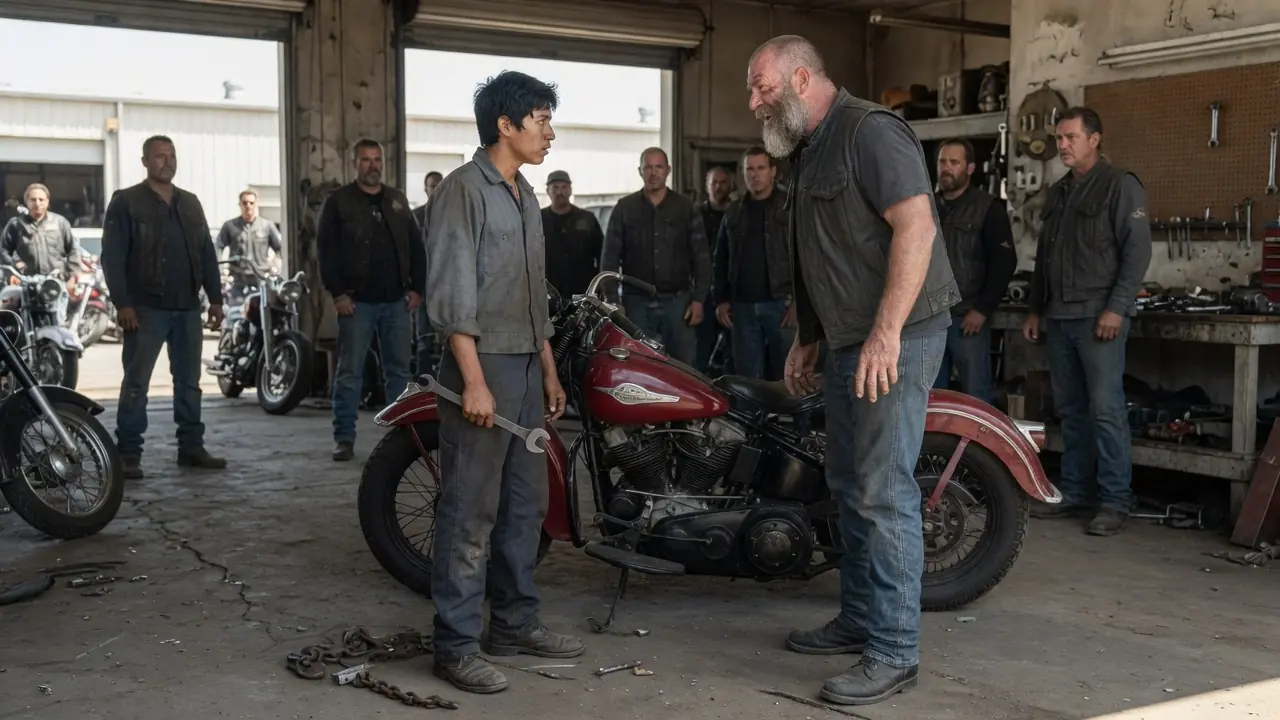
The bay doors were still rattling from where Grip had pulled them open.
Not kicked.
Pulled, with one hand.
The chain lock had snapped clean off its bracket, and now it lay on the concrete floor like something that had given up trying.
Caleb had not moved.
He stood with his arms at his sides, watching a man the size of a refrigerator climb off a motorcycle and look around the garage the way a judge looks around a courtroom, like he had already decided the verdict and was just taking inventory of what he was going to take.
Silas Henderson.
Everyone called him Grip.
Caleb had heard the name. Everybody in Oildale had heard the name.
You did not need to look him up. The jacket with the patch on his back told you everything.
Hells Angels. Sergeant-at-Arms. Bakersfield Charter.
The way the other two riders who had come with him stayed outside, not talking, not moving, just watching the street like they were paid to notice things, told Caleb the rest.
“You Hector’s nephew?” Grip asked.
He walked around the Knucklehead slowly, not looking at Caleb yet, just looking at his own bike.
The way a man looks at something he loves and is furious at.
“Yes, sir,” Caleb said.
He did not know why he said sir.
It just came out.
“Hector’s dead.”
“Six months ago. Yes, sir.”
Grip finally looked at him.
The man’s eyes were pale gray, which was somehow worse than if they had been dark. Dark eyes you could hide from. Pale gray eyes followed you.
“You’re running this shop now.”
Caleb looked around at the cracked concrete floor, the workbench with the three-legged stool propped against it, and the pegboard on the wall where tools hung in the shapes of tools that used to be there but were not anymore, sold off one by one over the last four months to keep the lights on.
“Yes, sir.”
“How old are you?”
“Nineteen.”
Grip made a sound that was not quite a laugh.
It was the sound a man makes when something confirms exactly what he already suspected.
He looked back at the Knucklehead.
“I’ve had this bike into five shops. Sacramento, Fresno, Modesto, two in Bakersfield.”
He paused.
“You know what every one of them told me?”
Caleb shook his head.
“They told me the bike was fine.”
Grip’s jaw tightened.
“Rode it out each time thinking it was fixed. At highway speed, it tries to kill me.”
He turned back to Caleb.
“Third shot, I came off the bike at sixty-two miles per hour on the 99. Walked away barely.”
He held up his left hand.
Two fingers were bent at angles fingers were not supposed to bend.
“That was eight months ago. They’re still crooked.”
Caleb looked at the hand.
He looked at the bike.
Something in his brain, the part his uncle had spent twelve years training without either of them knowing it was training, started moving.
A quiet, methodical clicking, like tumblers in a lock.
“What kind of misfire?” he asked.
Grip blinked like the question surprised him.
“What?”
“The misfire. Is it a stutter, like a skip? Or does it grab and then let go? Or does it feel like the whole motor just drops out for a second?”
A long pause.
Grip tilted his head.
“Drops out,” he said slowly. “Like somebody pulled the plug. Then it comes back. At higher speed, it gets worse.”
Caleb nodded.
He walked toward the bike.
“How long before it happens from the moment you get up to speed?”
“Maybe four or five minutes.”
“Consistent every single time?”
“Like clockwork.”
Caleb crouched beside the front wheel and looked up the frame without touching anything.
“Does it get worse in heat?”
Grip stared at him for a moment.
Then quietly, he said, “Yeah, it does.”
Caleb stood.
“I’ll need until sundown.”
“It’s eleven in the morning.”
“I know.”
Grip stepped closer.
Not aggressively, just enough that Caleb could smell leather and motor oil and something metallic underneath.
“Let me be real clear with you, son. I am not in the habit of leaving my bike with people I don’t know. But every shop I’ve trusted with this has sent me back out there to die on it.”
He leaned in slightly.
“So if you touch this bike, and you send me out there, and it tries to kill me again, that’s the end of this shop. You understand what I’m telling you?”
“Yes, sir.”
“And if you find something, if you actually find what’s wrong, I pay cash. Whatever the number is. I don’t negotiate on work that saves my life.”
Caleb nodded.
His mouth was dry.
His hands were steady.
Grip reached into his cut and pulled out a folded piece of paper.
He set it on the workbench.
“That’s my number. You call when it’s done.”
He looked around the shop one more time.
“You got a dyno?”
“Out back.”
Something shifted in Grip’s expression.
Not respect.
Not yet.
But acknowledgment.
A nineteen-year-old kid in a shop that was clearly falling apart still had a dynamometer.
“All right,” he said.
He walked toward the bay doors and stopped without turning around.
“Don’t let me down, kid.”
Then he was gone.
The sound of three motorcycles leaving faded out slowly like a storm moving off.
Caleb stood in the silence for exactly ten seconds.
He counted them.
His uncle used to tell him, “When something big hits you, give yourself ten seconds to feel it. Then you go to work.”
He felt it.
The fear, the pressure, the impossible weight of that deadline.
He felt all of it rise up through his chest like a wave.
Then he exhaled and went to work.
He started at the top and worked down.
That was the discipline.
You do not chase symptoms.
You start at the beginning and let the machine talk to you.
Spark plugs first.
He pulled all four. The left front was carbon-fouled slightly. He set it aside, noted it, and kept moving.
Not the problem.
A fouled plug would cause a consistent issue, not a speed-dependent one.
He checked compression on each cylinder with his uncle’s old gauge. The dial face was cracked but still accurate.
Numbers came back strong and even.
Not the problem.
Fuel lines came next. He traced every inch from the petcock to the carb, looking for cracks, kinks, or any place where heat could cause trouble under pressure.
Nothing visible.
He pulled the carburetor and broke it down on a clean rag on the workbench.
Needle, jets, float bowl. Everything looked right.
He cleaned it anyway, reassembled it, and set it back.
He checked the points, the condenser, the coil.
He tested the wiring harness with a meter, going section by section.
Everything read within spec.
An hour in, and he had found nothing.
He wiped his hands and looked at the bike.
The Knucklehead sat there, blood-red and silent, like it was keeping a secret.
These old bikes were not like modern machines. They did not have computers to lie to you or codes to read. They had their truth hidden in iron and steel, and you had to earn it with your hands.
Caleb’s uncle had told him that once, sitting right here in this same garage, when Caleb was maybe nine years old, too small to reach the top of the engine but big enough to hand tools and listen.
“The machine always tells the truth,” Hector had said. “You just have to learn how to listen.”
Caleb rolled the Knucklehead out back to the dyno.
He strapped it down, mounted the rear wheel to the drum, and started the motor.
It fired immediately.
The engine had beautiful startup character, deep and crisp.
He let it warm up for five minutes, watching the gauges. Temperature climbed steadily. Oil pressure settled. Nothing unusual.
He put it in gear through the dyno and started building RPM.
Forty miles per hour equivalent.
Fifty.
Smooth.
Sixty.
Still smooth.
The motor sang that old Knucklehead song, the exhaust note bouncing off the back fence.
He pushed it to seventy.
Smooth.
Seventy-five.
The engine dropped out.
Not a stutter.
Not a gradual fade.
It just vanished.
One moment, full power.
The next moment, nothing.
A deep stumble shook the whole frame, and Caleb’s hand came off the throttle instantly.
He let it settle back down and sat there listening to the idle.
At seventy-five miles per hour, if you were on the open road and that happened, you would have two seconds to react before the rear wheel started trying to pass you. On a 1947 rigid frame with no modern suspension, that was enough to throw a man across the highway.
He looked at the frame.
Not the engine.
The frame.
Something his uncle had said once about a bike that came in years ago, a problem nobody could trace. Hector had found it in the last place anyone looked.
The frame itself.
Caleb had not thought about it in years, but now, standing here watching this bike idle after nearly killing him on the dyno, it came back.
“Sometimes the problem isn’t in the parts,” Hector had said. “Sometimes the problem is in the bones.”
Caleb got down on the concrete and looked at the frame from underneath.
He ran his hand along the main down tube, the large central spine that everything hung from.
And he felt it.
Not saw it.
Felt it.
A seam.
Subtle.
Barely there.
A difference in the surface where no difference should have been.
He got up, got his flashlight, got back down, and shined it up inside the tube from the lower opening.
His blood went cold.
There was something inside the main down tube.
A machined insert.
Precise.
Deliberate.
It had been placed in a way that, at rest, at low speed, and under normal vibration, it seated correctly and caused nothing obvious. But under sustained highway speed, heat, and the kind of vibration this old engine produced, it shifted just enough to interfere with the bike’s stability and power delivery.
This was not a manufacturing defect.
Manufacturing defects were random.
This was exact.
This was someone who knew motorcycles.
Someone who knew this specific motorcycle.
Someone had placed that piece deliberately.
This was not a bike that was simply broken.
This was a bike that had been sabotaged.
Caleb sat up.
He set the flashlight down.
He looked at the phone number on the folded piece of paper sitting on his workbench.
He thought about calling Grip right now and telling him what he had found.
He thought about what Grip would do when he heard the words.
He thought about who might have done this and whether calling Grip would start something that would end badly for people who had nothing to do with it.
He thought about the two crooked fingers on Grip’s left hand.
He thought about the fact that whoever put that insert in there had known exactly what they were doing.
This was not meant to slowly damage the bike.
It was meant to cause failure at speed.
It was designed to get a man killed.
Caleb looked at the clock.
It was 1:47 p.m.
He had maybe five and a half hours until sundown.
He picked up the phone.
He put it back down.
Then he picked up a wrench instead.
He was not going to call.
Not yet.
Because if he called and said, “Someone sabotaged your bike,” without being able to show the fix, without being able to prove he could make it right, he was handing Grip a lit fuse and stepping back.
That helped nobody.
What Grip needed was not an explanation.
Grip needed a safe bike.
And Caleb was going to give him one.
He started clearing a path to the frame.
He unbolted both headers carefully, setting each nut in a tray in order.
Methodical.
Everything went back exactly where it came from.
His uncle’s voice came again.
“You can be in a hurry and still be precise. You’ve got to be both.”
The transmission came next.
He did not need to remove it completely, but he needed clearance at the lower frame junction. He loosened the motor mounts, felt the engine settle slightly in the frame, and now he had access to the area around the down tube.
He opened the section carefully, exactly where he needed to.
The hidden insert came out.
He held it in his palm and looked at it.
It was smooth, accurate, and professional.
Someone with access to proper machine tools had made this.
This was not a careless sabotage job.
This was skilled.
Calculated.
Intentional harm.
Caleb felt something he had not expected to feel.
Anger.
Not fear.
Pure, cold anger on behalf of a man he had known for forty-five minutes.
He set the insert on the workbench and went to his steel stock.
He found the right material and prepared a proper reinforcement.
He was not going to patch over the damage.
He was not just going to remove the dangerous piece and leave the tube weakened.
He was going to replace it with something honest, reinforce the frame properly, weld it solid, and make this bike stronger than it had been when it rolled into his shop.
If someone had gone to the trouble of engineering a death trap, Caleb was going to engineer it back to life.
He fired up the welder, checked his settings, and steadied himself.
He thought of Hector teaching him to weld right here on the same machine with scrap pieces of flat stock back when Caleb’s arms still shook with the weight of the gun.
“Slow down,” Hector had said. “You’re fighting the machine. Stop fighting it. Move with it.”
Caleb stopped fighting.
He moved with it.
The weld laid down smooth and even, fusing the reinforcement into place. He ran another pass, checked the penetration with his flashlight, and let it cool.
Solid.
He ran his hand over it.
Tapped it with the handle of a screwdriver.
It rang like iron.
Like truth.
He reassembled in reverse order.
Transmission.
Motor mounts torqued to spec.
Headers.
Connections.
Wires.
Fuel lines.
Bolts.
He checked everything twice.
The afternoon light moved through the high window of the garage, stretching long and orange across the concrete floor.
Time was moving.
He could feel it in his chest like a second heartbeat.
At 4:30 p.m., the Knucklehead was whole again.
He rolled it back to the dyno, strapped it down, fired it, and the motor came up with the same beautiful deep bark.
He let it warm.
Five minutes.
He put it in gear.
Built the RPM.
Climbed through the speed range.
Sixty.
Sixty-five.
Seventy.
Seventy-five.
The motor did not drop out.
He held it there.
Five seconds.
Ten.
Thirty.
He pushed it to eighty.
Still clean.
Eighty-five.
He could feel the dyno drum vibrating under his feet, the whole apparatus shaking with the power of a seventy-five-year-old engine running at full song.
And it was clean.
Clear.
Smooth.
Not a stumble.
Not a hesitation.
He cut the throttle and let it spin down.
He sat in the sudden quiet and thought about what he had found.
He thought about the insert.
He thought about who had put it there and what they had intended.
And he made a decision about what he was going to tell Grip when the man walked back through those bay doors.
He was not going to hide it.
He was not going to soften it.
He was not going to pretend it had been a manufacturing issue or a mysterious electrical fault.
He was going to tell the truth, show the evidence, and let the man decide what came next.
Because whoever had done this, that was a problem bigger than a garage in Oildale.
And Grip deserved to know his life had been in someone’s crosshairs.
Caleb rolled the Knucklehead back inside.
He wiped it down.
Every surface.
Every chrome fitting.
Every spoke.
Then he cleaned his own hands.
He looked at the clock.
5:52 p.m.
The sun was still up, but it was leaning.
The heat had started to give up the worst of itself, settling into that late valley afternoon weight that pressed on everything but did not burn quite as hard.
Caleb sat on his three-legged stool and looked at the bike.
He felt something he had not felt in six months.
Not pride.
Not quite.
Something quieter than that.
Something that felt like his uncle watching from somewhere just out of sight and not looking disappointed.
He picked up the phone and dialed the number on the folded piece of paper.
It rang twice.
“Done?” Grip’s voice said.
Just that one word.
“Done,” Caleb said. “But I need you to come back alone, or with one other person you trust completely, because I found something on your bike, and you need to hear it before anybody else does.”
A silence lasted long enough for Caleb to wonder if he had made a mistake.
Then Grip said, “I’ll be there in twenty minutes.”
Caleb set the phone down.
He looked at the insert sitting on the workbench.
He looked at the Knucklehead.
He looked at the bay doors.
Outside, the valley was going gold in the evening light.
Somewhere in the distance, he could just barely hear the sound of engines.
Not close yet, but moving like weather building at the edge of a clear sky.
Like something coming that you could not stop and could not run from, and had no choice but to stand in front of.
He folded his hands in his lap and waited.
Grip came back in nineteen minutes.
Not twenty.
Nineteen.
That told Caleb something about the kind of man he was.
The kind who, when something mattered, showed up early.
Grip did not come alone.
There was one other man with him.
Older, shorter than Grip by half a foot, but built like something carved rather than grown, with a white beard trimmed close and eyes that moved around the garage the way a hawk’s eyes move over a field.
Not threatening.
Just cataloging.
He wore the same cut as Grip. His center patch said the same thing. But above the chapter rocker, where Grip’s patch said Sergeant-at-Arms, this one said President.
Caleb stood up from his stool.
“This is Iron Jack Crowley,” Grip said. “He goes where I go on something like this.”
Caleb nodded at Crowley.
Crowley did not nod back.
He just looked at Caleb the way you look at a door before you decide whether to open it or walk through the wall next to it.
Then he looked at the bike, then back at Caleb.
“You said you found something,” he said.
His voice was even quieter than Grip’s, that same flat register that did not need volume because the weight was already there.
“Yes, sir.”
“Show me.”
Caleb had set the insert on a clean white rag on the workbench.
He picked up the rag and held it out so both men could see it.
The piece sat there, machine-smooth, a short cylinder of steel. Unremarkable to anyone who did not know what they were looking at.
Both men looked at it without touching it.
“What is that?” Grip asked.
“It was inside your main down tube,” Caleb said. “Hidden where nobody would see it from outside the frame. Even with a flashlight, most people would miss it unless they knew what they were looking for.”
He paused.
“It was precision-machined. Whoever made it had access to proper tools and knew exactly what they were doing.”
Crowley’s eyes moved from the insert to Caleb.
“And what does it do?”
Caleb set the rag down.
“At low speed, nothing. That’s why nobody found it. Under sustained speed and heat, the vibration changes. That piece was sized to interfere at that point, not dramatically enough to be obvious, but enough to cause the kind of failure you described.”
He looked at Grip.
“Enough to drop the motor out at speed every time, consistently.”
Grip was very still.
His face had not changed, but something behind his eyes had.
“This wasn’t an accident,” Caleb said.
He needed to say it plainly.
“This was put there deliberately by someone who understood this bike well enough to know how to make it fail in a way that looked like a ghost problem. Something no quick diagnostic would catch. Something that would send you back out onto the road thinking it was fixed over and over until eventually the failure happened at the wrong moment on the wrong road and you didn’t walk away.”
The silence in the garage was total.
Even the sounds from outside, the distant traffic, the late birds, seemed to press back from the walls.
Crowley reached out and picked up the insert.
He turned it in his fingers.
His expression did not change either, but his jaw moved once slowly, like he was chewing on something that tasted like every bad thing he had ever suspected about the world being confirmed at once.
He set it back down on the rag.
“How’d you find it?”
“My uncle told me once that sometimes the problem isn’t in the parts. It’s in the bones.”
Caleb paused.
“I ran it on the dyno and reproduced the failure at seventy-five miles per hour. Then I looked at the frame itself instead of the systems. I felt the seam when I ran my hand along the down tube. Once you know what you’re feeling for, you can’t unfeel it.”
Crowley looked at Grip.
Something passed between the two men that had no words in it. A whole conversation conducted in the half second of eye contact between people who had known each other long enough that language was almost redundant.
Then Crowley looked back at Caleb.
“And the fix?”
“I opened the tube at the hidden piece, removed it, and installed a proper steel reinforcement. Welded it solid. Then I reassembled the drivetrain and ran it on the dyno again.”
Caleb’s voice was steady.
“I pushed it to eighty-five miles per hour. It held clean. No drop, no stutter, no hesitation. The frame is stronger now than when it came in.”
Grip turned and looked at the bike.
He walked toward it slowly, like a man approaching something he was not sure he recognized anymore.
He ran his hand along the down tube the same way Caleb had, from the lower junction upward. He felt the weld, stopped, and pressed his thumb against it.
The weld did not flex.
It did not give.
It was solid in the way a thing is solid when someone put his whole attention into making it so.
Grip kept his hand on the frame and did not turn around when he spoke.
“Five shops,” he said. “Eight months. Three times it came off the road with me on it.”
His voice was quiet, controlled, but there was something underneath it.
Not quite grief.
Not quite rage.
Something that sits in the space between the two when you realize you have been hunted and did not know it.
“Every one of those shops sent me back out on a bike that had a machine kill switch in the frame.”
“They didn’t find it because they were looking at systems,” Caleb said. “Standard diagnostics. Plug-and-play. Nobody looked at the bones.”
Grip finally turned around.
His pale gray eyes found Caleb’s and held them.
“You’re nineteen years old,” he said.
Not as a question.
More like a man saying something out loud to help himself accept it.
“Yes, sir.”
“Why didn’t you call me when you found it? Why’d you fix it first?”
Caleb thought about how to answer that honestly.
“Because if I called you and said someone sabotaged your bike without a solution in my hands, I’d be handing you a problem and nothing else. You’d want to know who. You’d start moving. And the bike would still be sitting here broken.”
He met Grip’s eyes.
“You needed the bike safe first. Everything else comes after.”
Another silence.
Then Grip made a sound.
Not the almost-laugh from before.
Something different. Something that came from somewhere deeper.
He looked at Crowley.
Crowley was looking at Caleb with an expression that had changed from assessment to something approaching careful respect.
“The kid’s not wrong,” Crowley said.
Grip pulled his phone out.
His crooked fingers moved across the screen.
He stepped outside and made a call.
His voice was low out there, controlled, only three sentences.
Then he hung up and came back in.
“I need to make a few more calls,” he said to Crowley.
Not to Caleb.
“Tonight.”
Crowley nodded once.
Grip looked at Caleb.
“What do I owe you?”
Caleb had thought about this number while he was waiting.
He had thought about it carefully.
He could name a number that reflected the emergency, the complexity, the evidence of sabotage, the dyno time, the materials. He could name a number that would help him make three months of back payments on the shop’s debt.
“Four hundred,” he said.
Grip stared at him.
“Say that again.”
“Four hundred. Parts and labor.”
“You cut my frame, welded in a reinforcement, ran a full dyno test, and found a machined assassination device in my motorcycle,” Grip said flatly. “And you want four hundred dollars?”
“The parts cost me sixty. The labor was about seven hours. Shop rate is...”
“I know what shop rates are,” Grip said.
He reached into his cut, pulled out a folded stack of bills, peeled from it, and set the money on the workbench without counting it aloud.
“That’s two thousand, and that number is an insult to what you just did, and we both know it.”
He put the rest of the stack back.
“You tell me what keeps this shop running. You tell me what you’re behind on. We’ll talk numbers that actually matter.”
Caleb blinked.
“You don’t have to.”
“I know I don’t have to.”
Grip’s voice was not gentle exactly, but it had lost its edge.
“How much is the shop behind, boss?”
Caleb looked at the floor.
This was the part that burned.
Not the fear.
Not the pressure of the deadline.
The shame of the numbers.
“Four months of mortgage payments on the property. Three months behind on the equipment loan. Creditors have sent two notices. There’s a foreclosure letter.”
He stopped.
“Total is around thirty-eight thousand.”
Nobody spoke.
Caleb felt the number sit in the air like something physical.
Crowley picked up the insert again.
He looked at it for a long moment.
Then he slipped it into his jacket pocket.
He said to Grip simply, “Call it in. Full charter meeting tonight.”
He looked at Caleb.
“You got coffee?”
Caleb almost laughed.
“Almost. I’ve got a pot that might technically qualify as coffee.”
Crowley’s mouth moved in something that was not quite a smile, but was in the same neighborhood.
“Put it on.”
What happened in the next hour was something Caleb could not have anticipated and could not have explained to anyone who had not been in that garage to witness it.
Grip made calls.
Crowley drank bad coffee, sat on the workbench, and asked Caleb questions.
Not about the bike.
Not about the money.
About Hector.
About how Caleb had learned.
About what the shop had been before the debt and grief had started pressing it from all sides.
Caleb answered honestly, which was the only way he knew how to answer things.
He told Crowley about being eight years old and handing Hector a half-inch socket, and Hector saying, “You’ve got good instincts, mijo. Don’t let anybody take them from you.”
He told him about teaching himself to weld from library books because Hector said they could not afford a class, but a book never expired.
He told him about the morning six months ago when he had gotten the call from the hospital, then had come into this garage afterward and just sat on the floor for four hours because he did not know what else to do with his hands.
Crowley listened to all of it without interrupting.
When Caleb finished, Crowley set down his coffee cup and said, “Your uncle built something real here.”
He looked around the garage.
“You can feel it.”
“It’s falling apart,” Caleb said.
“Walls and roof. The thing inside it isn’t.”
Crowley tapped his own chest.
“That’s in here. You put it there today.”
Before Caleb could respond, the sound started.
Not close.
Not yet.
But unmistakable.
The sound of multiple motorcycles.
Not one or two or five.
Many.
Moving in a coordinated way that you only heard when riders were traveling together with intention.
The sound rose and fell with the distance, but it was definitely getting closer.
Caleb went to the bay doors and looked out into the early evening.
The street was empty in the immediate block, but at the far end, he could see headlights.
Multiple headlights coming slow.
He looked back at Grip.
“How many people did you call?”
Grip was looking at his phone.
His expression had settled into something unreadable.
“The full charter shows up when the sergeant-at-arms calls a meeting,” he said. “That’s the rule.”
“How many is the full charter?”
Grip looked up.
“Bakersfield alone is sixty-three riders.”
He paused.
“I also called Fresno.”
Caleb felt something drop in his stomach.
“How many is Fresno?”
“Eighty-eight.”
“That’s a hundred and fifty.”
“I called Sacramento too,” Grip said. “And Modesto. The clubs that had the bike. The shops that missed what you found.”
His voice had gone flat again. But this time, the flatness was not aimed at Caleb. It was aimed at something farther away.
“Those riders deserve to know what went through their chapter territory on a death trap while their shops waved it through.”
Caleb pressed his back against the wall of the garage and breathed.
His brain was doing math he did not want to do.
“How many total?”
Grip looked at Crowley.
Crowley looked at Caleb.
“Two hundred seventy-five,” Crowley said. “Give or take.”
The sound from outside had grown from a rumble to a roar.
Caleb could feel it in his feet now, the collective vibration of hundreds of cylinders entering the neighborhood block by block.
He heard voices outside, the sound of boots on pavement, engines cutting off one by one in a rhythm that spread down the street like a slow wave.
“They’re going to think I did something wrong,” Caleb said.
He heard the slight tightness in his own voice and hated it.
“Two hundred seventy-five guys surrounding a garage. That’s not what a good outcome looks like from the outside.”
“It’s not the outside you need to worry about,” Crowley said.
He stood up from the workbench, straightened his cut, and became a different version of himself.
Still the same man, but carrying himself differently now, the way a person carries himself when he is in his element.
He walked to the bay doors and stepped outside.
Caleb heard him speak a single sharp word that carried over the whole street and brought the last of the engines to silence.
In the quiet that followed, Crowley spoke to the assembled charter, all of them.
Caleb could see some through the bay doors. Most he could not.
Crowley’s voice carried without shouting.
He told them what Caleb had found.
Held up the insert.
Told them where it had come from, what it had been designed to do, and who had found it.
When he said the name Caleb Hector Torres, nineteen years old, Oildale Customs, and when he said, “He is the reason your sergeant-at-arms is still alive,” the sound that came from the street was not applause.
It was not cheering.
It was something lower and more solid than either of those.
A collective rumble of recognition that Caleb felt in his sternum, like the first note of a very deep song.
Grip put his hand on Caleb’s shoulder.
Not gently.
Firmly.
Like a man staking a claim on behalf of someone who did not know he needed protecting.
“Come outside,” he said.
Caleb looked at him.
“I’m not sure that’s...”
“Come outside, son.”
He went outside.
Two hundred seventy-five men and women in leather cuts standing on a residential street in Oildale in the last light of a July evening looked at a nineteen-year-old kid in a grease-stained shirt.
A kid who had spent eleven hours fixing a bike that five shops had failed.
A kid who had found a machine-made death trap and extracted it with his bare hands.
A kid who had charged four hundred dollars, made no calls for help, and asked for nothing except to be allowed to do the work.
Nobody moved for a long moment.
Then a man near the front, a heavyset rider with a gray beard and Fresno patches, reached up and removed his sunglasses and tucked them into his cut.
Just that.
A small gesture of acknowledgment.
The man next to him did the same.
Then it moved through the crowd, person to person, like something passing through water, until everyone who had sunglasses had taken them off.
It was the kind of thing you did not have a word for.
It did not need one.
Grip was still standing beside Caleb.
He spoke quietly, just for Caleb.
“That piece in Jack’s pocket. We’re going to find out who made it. We’re going to have some conversations that are going to answer some questions that have been sitting open for about eight months.”
His voice was calm.
The way a man is calm when he is absolutely certain about what comes next.
“That’s our business, not yours. Your business was this bike. And you did your business right.”
Caleb nodded.
He did not trust himself to speak.
“One more thing,” Grip said.
He looked out at the assembled crowd, then back at Caleb.
“You said you’re thirty-eight thousand in the hole.”
“Grip, you don’t need to.”
“I didn’t ask if I needed to.”
He raised his voice just enough to carry to the riders nearest the door.
“This shop is going to need some work done on the property. Roof, I’d say from looking at it. Maybe electrical. Jack, what do we know about trades in the charter?”
Crowley, who had come back to stand on the other side of Caleb, made a sound that was almost amusement.
“We’ve got four electricians, two roofers, a structural engineer, and a contractor out of Modesto who owes me a favor from 2019.”
“Good.”
Grip looked at Caleb.
“Starting this weekend, if that works for you.”
Caleb looked at these two men.
He looked at the street.
He looked at his uncle’s garage.
He thought about Hector sitting on a milk crate in here thirty years ago with nothing but a used set of tools and a belief that his hands were enough to build something that would last.
He thought about six months of trying to hold on to that belief while everything pressed against it.
“Yeah,” he said.
His voice came out rougher than he intended.
“That works for me.”
Crowley looked at him with those cataloging eyes.
Then quietly, he said, “You did good today, kid. Your uncle would have something to say about it.”
He paused.
“I’m going to guess he would have kept it short.”
Caleb almost laughed.
“He would have just handed me a rag and told me to clean up.”
Crowley nodded slowly.
“That’s about right.”
He turned back toward the crowd.
“All right. Let’s get these bikes off this man’s street.”
The engines came back to life in a wave.
A sound that rolled from one end of the block to the other, then moved like a tide pulling back out into the evening streets of Oildale.
It took several minutes for all of them to go.
The street went quieter by degrees.
Then it was quiet.
Caleb stood in the bay doors of his uncle’s garage and watched the last taillights disappear around the corner.
The money was on his workbench.
The hidden insert was in Iron Jack Crowley’s pocket.
The Knucklehead was inside, silent and still.
Finally, after eight months, three near deaths, and five failed shops, it was honest.
Caleb turned around and walked back in.
He picked up the rag from the workbench.
He started cleaning.
He cleaned for twenty minutes before he let himself stop.
That was always how it worked with Caleb.
The hands needed to keep moving after something big because if he stopped too soon, the thinking would catch up with him, and the thinking was always louder than the work.
He wiped down the workbench, coiled the welding lead, swept the concrete in long, even strokes, and tried not to think about the fact that two hours ago he had been a nineteen-year-old kid on the edge of losing everything.
And now he was what, exactly?
He did not have a word for it.
He was not sure the word existed yet.
His phone buzzed.
Unknown number.
He almost did not answer it.
Then he did.
“Is this Oildale Customs?”
The voice was male, middle-aged, with a careful quality to it. The voice of someone who had rehearsed the call before making it.
“Yes,” Caleb said.
“I’m looking for the mechanic who worked on a 1947 Knucklehead today. Red. Belongs to a man named Henderson.”
Caleb’s hand tightened on the phone.
“Who’s asking?”
A pause.
“My name is Ray Delgado. I used to work with Hector Torres, your uncle, about twelve years ago.”
Another pause.
“I need to talk to you about that bike tonight. It’s important that it’s tonight.”
Caleb stood very still in the middle of his clean garage floor.
He thought about what Grip had said.
We’re going to find out who made that piece.
He thought about the hidden insert itself, machine-clean and deliberate, the work of someone with skill and access and intent.
He thought about the word tonight and the specific weight it carried.
“How do you know about the bike?” he said.
“Because I know who put what was in it,” Delgado said. “And I know why. I’ve been carrying that for eight months, and I can’t carry it anymore.”
His voice cracked on the last word.
Just slightly.
Just enough.
“Your uncle was a good man, Caleb. He deserved better than what happened to his shop. And Henderson deserved better than what was done to his bike. I need to tell somebody who isn’t going to make it worse.”
Caleb’s mind moved fast.
He could call Grip right now. Hand this off. Let the people with two hundred seventy-five riders handle a man who claimed to know about the sabotage.
That was the logical move.
That was the safe move.
But something in Delgado’s voice, that crack, that particular texture of a man who had been holding something corrosive for too long and could feel it burning through, made Caleb pause.
“Where are you?” he said.
“Parking lot of the Valero on Norris Road. Ten minutes from you.”
“Come to the shop.”
“You sure about that?”
“No,” Caleb said honestly. “Come anyway.”
He hung up.
He stood there for three seconds.
Then he called Grip.
Grip picked up on the first ring.
Caleb told him about the call, Delgado’s name, and what he had said.
When he finished, Grip was quiet for four full seconds.
Caleb counted.
“Ray Delgado,” Grip said finally.
His voice had a quality Caleb had not heard in it before.
Not anger.
Something older than anger.
Recognition.
“I know that name.”
“From where?”
“From eight months ago. From the week before my bike went into the first shop.”
He stopped.
“He was a mechanic at a shop in Bakersfield. Did some work for the charter a few years back. Then he stopped. We didn’t know why.”
A pause.
“If he’s coming to you tonight, it’s because he’s scared enough to move and not scared enough to run. That’s a narrow window.”
Grip’s voice settled.
“Keep him there. I’m twenty minutes out.”
“He might not stay if he sees you coming.”
“Then keep him talking until I get there.”
The line went dead.
Caleb put the phone in his pocket.
He went to the small office off the back of the garage, barely a room, more of a closet with a desk in it, and sat in Hector’s chair.
The chair still had the shape of his uncle in it, the way old chairs hold the memory of whoever spent the most time in them.
He put his hands flat on the desk and breathed.
Ray Delgado arrived in a twelve-year-old pickup that he parked on the street rather than in the lot.
That told Caleb something.
A man who parks on the street instead of where he is supposed to is a man thinking about which direction he might need to leave from.
He came through the bay door slowly, looking around the garage the way people look at places they half recognize.
He was smaller than his voice had suggested.
Late fifties.
A mechanic’s hands, the kind of hands that no amount of washing fully cleans.
A face that had been tired for a while and was just now beginning to look like it was sorry about something too.
He looked at Caleb for a moment.
“You look like Hector,” he said.
Not as a compliment or a condolence.
Just as a fact that surprised him.
“People say that,” Caleb said. “Sit down.”
Delgado sat on the stool.
He put his hands on his knees and looked at the Knucklehead for a long moment without speaking.
Then he said, “You fixed it.”
“Yes.”
“They told me nobody could fix it. That’s what I was told. That the problem was unfindable. That it would keep failing. And eventually...”
He stopped and pressed his lips together.
“I believed them. I needed to believe them. I think it was easier.”
Caleb leaned against the workbench.
He kept his voice even.
“Who told you that?”
Delgado looked at his hands.
“A man named Dennis Pruitt. He ran a shop in Bakersfield. Legitimate operation. Mostly restoration work, high-end stuff. He had a contract with the charter for a few years. Tune-ups, builds, some custom work. But about two years ago, he started having money problems. The kind of money problems that make a man start listening to people he shouldn’t.”
He looked up at Caleb.
“You have to understand, Pruitt wasn’t a bad man. He was a scared man. And scared men do things.”
“What did he do?”
“Someone came to him. I don’t know who. Pruitt never told me the name, and I think that was deliberate because he knew if he told me the name, I’d recognize what kind of trouble it was.”
Delgado’s fingers pressed against his knees like he was trying to hold something down.
“This person had a job for him. They wanted Henderson’s bike compromised in a way that would look mechanical. Nothing traceable, nothing obvious.”
His voice was steady, but his hands were not.
“Pruitt came to me because I knew Knuckleheads. I knew that generation of Harley engineering better than most people alive. He said it was theoretical, a mechanical question. What would cause a specific kind of failure in an old Knucklehead frame at speed? I talked theory. I thought it was theory.”
Caleb said nothing.
He let the silence do the work.
“Three weeks later, I found out Pruitt had made the piece. Had it machined at a shop in Fresno where nobody knew him. I confronted him, and he told me it was already done. It was already in the bike. Henderson had already ridden it twice.”
Delgado’s voice dropped.
“I told him to take it out. He said he couldn’t. The bike was already back with Henderson, and if he went to retrieve it, he’d have to explain why. He said nobody would find it. He said it would look like mechanical failure. He said Henderson would be fine, that it would just slow him down, that the charter would be distracted dealing with the bike problem.”
He looked at Caleb directly.
“He lied to himself about what it was. And I let him because I didn’t know what else to do.”
“And then Henderson came off the bike at sixty-two miles per hour,” Caleb said.
Delgado closed his eyes.
“Yes.”
“With two fingers that still don’t sit right.”
“Yes.”
The word came out like something being set down after being carried a very long distance.
“And you said nothing.”
“I said nothing.”
His voice was barely above a whisper.
“Because by then, Pruitt had told me that the person who commissioned the job, the person behind all of it, had made it very clear that silence was the only option for both of us. And I was frightened. I have a daughter. I have a house. I convinced myself that Henderson was alive, that he’d recovered, that the charter would find the problem on their own.”
He opened his eyes.
“But they didn’t find it. And he kept riding it. And it kept trying to kill him. And every day for eight months, I woke up knowing that.”
He stopped.
His jaw worked.
“Your uncle died six months ago. I knew Hector. Not well, but I knew him. When I heard, I thought about how he’d raised you in this garage, and how this shop was struggling, and how you were just a kid trying to hold on to something your uncle built.”
He looked at Caleb.
“Then today, I heard through people who talk that Henderson’s bike had gone to Oildale Customs, to a nineteen-year-old kid. I thought if that kid finds it, he’s going to be in the middle of something that could get him killed. And if he doesn’t find it, Henderson dies. Either way, I carry it forever.”
Caleb looked at him for a long moment.
“So you called.”
“So I called.”
“What do you want, Mr. Delgado?”
The man looked genuinely surprised by the question, like he had not gotten far enough in his planning to answer it.
“I want...”
He stopped, then started again.
“I want to tell someone the truth. I want Henderson to know it wasn’t random. I want to stop being the only person alive who knows how close we came to something that can’t be undone.”
The sound of a motorcycle reached them from down the street.
One bike moving at a careful pace.
Not a group.
One.
Grip had come alone after all, or sent someone ahead.
Caleb made a decision in the two seconds before the engine cut.
“He’s going to want to know who commissioned it,” Caleb said. “Not the person behind Pruitt. Do you know?”
Delgado’s face changed.
Fear moved through it cleanly, like weather.
“I have a name. Pruitt let it slip once. Just once. Just a fragment. He’d been drinking, and he said something he shouldn’t have, then caught himself.”
He hesitated.
“The name was Carver,” he said. “Carver.”
The bay door opened.
Grip walked in.
He looked at Delgado.
Delgado looked at him.
Neither man spoke for a moment that felt much longer than it was.
Grip’s face was unreadable.
His body was still.
He looked at a man who had known for eight months that his motorcycle was trying to kill him and had said nothing.
He stood in the doorway of a nineteen-year-old kid’s garage and did not move.
“Silas,” Delgado said.
He used Grip’s first name, which told Caleb they had more history than Grip had let on.
“Ray,” Grip said.
Just the name.
Nothing attached to it.
Delgado stood up from the stool.
He did not step back and he did not step forward.
He just stood there, which took a particular kind of nerve given who was in the doorway.
“I’m going to tell you everything,” Delgado said. “I should have told you eight months ago. I know that. I’ve known it every day since.”
His voice was steady now.
Steadier than it had been with Caleb.
The way a person becomes steady when he has finally stopped running from something and turned to face it.
“I’m not asking you for anything. I’m just going to tell you the truth, and then you can do what you’re going to do.”
Grip looked at him for a long time.
Then he walked to the workbench, picked up the mug of cold coffee Crowley had left earlier, looked at it, and set it back down.
He turned to face Delgado.
“Sit down, Ray,” he said. “And start from the beginning.”
Delgado sat.
And he started from the beginning.
All of it.
The commission.
Pruitt.
The hidden piece.
The Fresno machine shop.
The eight months of silence.
Everything he told Caleb, and more that he had not.
Grip listened without interrupting.
Caleb stayed at the workbench and said nothing.
He watched the two men and thought about how strange it was, this garage that had felt like it was collapsing for six months, now holding this conversation, this weight, this truth that had been looking for somewhere to land.
When Delgado said the name Carver, something happened in Grip’s face.
Not surprise.
The opposite of surprise.
A confirmation of something he had suspected long enough that it had calcified into certainty.
His jaw tightened.
His hands, resting on his thighs, went very still.
“Say that name again,” he said quietly.
“Carver,” Delgado said. “I don’t have a first name. Just Carver.”
Grip nodded slowly.
He looked at the floor.
He was doing something internal that Caleb could not quite read, processing or deciding, or both.
When he looked up, he looked at Caleb, not Delgado.
“You did the right thing calling me.”
“I figured you’d want to hear it from him,” Caleb said.
“I did.”
He looked back at Delgado.
“Pruitt. Where is he now?”
“He sold the shop in Bakersfield. Moved to Arizona. I have an address.”
He reached into his jacket and pulled out a folded piece of paper, not unlike the one Grip had left on this same workbench that morning, which felt to Caleb like a lifetime ago.
He held it out.
Grip took it without looking at it and put it in his cut.
“And you, Ray?”
Grip’s voice had shifted, not warmer exactly, but less compressed.
“What are you going to do?”
Delgado spread his hands.
“Whatever I need to do.”
Grip studied him.
“You came here tonight. You told the truth. That counts for something.”
He stood up from the stool.
“I’m going to ask you to stay in the area for a few days. Don’t travel. Don’t call out. Don’t talk to anyone about this conversation.”
He paused.
“Can you do that?”
“Yes.”
“All right.”
He looked at Caleb.
“You good?”
The question was simple.
Everything underneath it was not.
Caleb thought about what good meant after a day like this one.
After eleven hours of work on a death trap.
After two hundred seventy-five motorcycles.
After a confession in a garage.
After a name that meant something to a man who did not share what things meant to him lightly.
He thought about his uncle’s chair in the back office holding the shape of a man who was not in it anymore.
He thought about the thirty-eight thousand dollars and the two thousand on the workbench, and the question of what tomorrow looked like.
“I’m good,” he said.
Grip nodded.
He went to the bay doors, then stopped without turning.
“Caleb.”
“Yeah?”
“Lock up tonight. Both locks.”
He paused.
“The name Carver. Don’t carry it. That’s ours to carry. You put it down.”
Then he was gone.
The sound of his bike starting up, pulling away, fading into the Oildale night.
Delgado sat for another minute without moving.
Then he stood, adjusted his jacket, and looked at Caleb with an expression that mixed exhaustion and something that might, in time, become relief.
“Thank you,” he said.
“For what?”
“For answering the phone.”
He left.
Caleb listened to the pickup start on the street and pull away.
He stood alone in the garage.
The Knucklehead sat where he had left it, quiet and still, catching the light the way old red paint catches evening light. Deep and complicated, like something that had been through more than it showed.
Caleb went to the back office.
He sat in Hector’s chair.
He put his hands flat on the desk the way he had earlier.
But now it felt different.
Not like steadying himself for what was coming, but like making contact with something that was already there.
Something solid.
He thought about Hector.
He thought about theory and application, and the gap between knowing something intellectually and knowing it in your hands.
He thought about a machine-made insert and the word Carver, and two crooked fingers, and a charter of two hundred seventy-five people who had shown up because the truth was worth showing up for.
His phone buzzed.
A text from an unknown number.
Four words.
You should have quit.
Caleb read it twice.
He set the phone face down on the desk.
He picked up the rag he had been cleaning with and turned it in his hands.
He breathed in through his nose and out through his mouth, slow and even, the way Hector had taught him to breathe when a job was harder than expected and quitting was not on the table.
Then he picked the phone back up and called Grip.
“I just got a text,” he said when Grip picked up.
He read it aloud.
The silence on the other end lasted two seconds.
“Screenshot it. Don’t delete it. Don’t respond.”
Grip’s voice had gone very flat.
The specific flatness of a man shifting into a different mode entirely.
“And Caleb, I need you to understand something.”
“Okay.”
“The name Carver, the person behind...”
He paused.
“They know the bike got fixed today. They know it got fixed there, and they know we showed up.”
Another pause.
Shorter.
“You’re not just the kid who fixed the bike anymore.”
Caleb sat in his uncle’s chair, in his uncle’s office, in his uncle’s garage that was also now somehow his own.
He felt the weight of that sentence settle into him.
Not with panic.
With the same quality of stillness that had come over him eleven hours ago, when a mountain of a man had rolled a blood-red Knucklehead through his bay doors and said, “Fix it by sundown.”
“What do I do?” Caleb said.
“Tonight? Nothing,” Grip said. “Tonight, you already did everything. Tomorrow we figure out the rest.”
A pause.
“You got people you can call to stay with you there? Family? Friends?”
Caleb looked around the office at the old photographs on the wall.
Hector at twenty-five, grinning, elbow-deep in a Panhead.
Hector and a young Caleb, maybe ten years old, both of them looking at something off camera with identical expressions of concentration.
“I’ve got the shop,” Caleb said.
Grip was quiet for a moment.
“All right,” he said.
The way he said it, two words, quiet and absolute, felt like a promise Caleb did not have a precise name for but recognized the shape of.
“All right. You know how to reach me.”
The call ended.
Caleb sat in the quiet for a long time.
Then he got up and went back out to the garage.
He checked both locks on the bay doors, the new chain, and the dead bolt on the side entry.
He turned off the main overhead lights and left just the single work light on above the bench.
The one Hector had wired himself years ago.
The one that buzzed faintly when it first came on and then settled.
He stood in that partial light and looked at the Knucklehead.
At the solid red frame.
At the down tube where a weld now sat that had not been there that morning.
A weld that had replaced something designed to kill a man with something designed to hold.
He thought about the text.
You should have quit.
He picked up his wrench from the bench, turned it in his hand once, and set it back.
He had never known how to quit.
Hector had not taught him that.
Caleb did not sleep.
He tried.
He stretched out on the old army cot in the back office that Hector had kept there for long jobs, the ones that ran past midnight and made driving home pointless.
He lay on his back and stared at the ceiling and listened to the garage settle around him.
The way old buildings settle.
Small creaks and pops that in daylight meant nothing and at two in the morning sounded like footsteps.
Every twenty minutes or so, he got up, walked the perimeter of the garage floor, checked both locks, and looked through the small side window at the street.
Empty each time.
Just the orange wash of the streetlight, the parked cars, and the quiet of a neighborhood that had no idea what had moved through it earlier that evening.
At 4:15, he gave up on sleep entirely.
He made coffee, real coffee this time, from the bag he kept in the back of the desk drawer for emergencies. He sat in Hector’s chair and looked at the screenshot of the text on his phone.
Four words.
You should have quit.
He had looked at it probably thirty times since Grip told him to screenshot it.
Each time he looked, he tried to read something new in it.
Not just the threat.
The timing.
Whoever sent it knew the bike had been fixed, knew it fast, which meant either they were watching the shop, or they had someone inside the circle who had talked, or they had resources that let them know things quickly and from a distance.
None of those options was comforting.
His phone rang at 6:47.
Grip.
“You sleep?” Grip asked.
“Some,” Caleb said.
The lie was transparent, and they both knew it, and neither of them addressed it.
“I need you to open the shop today. Normal hours. Act like yesterday was just a job.”
A pause.
“Can you do that?”
“What’s happening?”
“Things are moving. I don’t want to get into it on the phone.”
Grip’s voice was careful in a way it had not been before.
Measured.
Choosing each word before it landed.
“Iron Jack is going to send someone by around nine. His name is Decker. He’s going to look like a customer. He’s going to bring his bike in for a carb adjustment that doesn’t need adjusting.”
Another pause.
“He’s going to be there for other reasons. Let him work. Don’t ask him questions in front of anyone.”
“Understood.”
“And Caleb, that text. Nobody outside of you, me, and Jack knows about it. Keep it that way.”
“Okay.”
He hesitated.
“Grip.”
“The name Carver. Last night, you recognized it. I could see it.”
A silence lasted long enough to be its own answer.
“I told you to put that name down.”
“I know what you told me. I’m asking anyway.”
Another silence.
Then, quietly, Grip said, “Carver is a name that’s been at the edge of some bad business in this valley for about four years. Not a man who gets his hands dirty personally. A man who arranges things, pays for outcomes.”
His voice went flat and careful.
“There was a situation three years ago involving a charter member in Sacramento. Accident. Everybody said accident. Some of us always thought it was arranged.”
He stopped.
“If Carver commissioned what Delgado described, if this was about the charter and not just about me personally, then we’ve been living next to something for years that we only just found the edge of.”
Caleb absorbed that.
“What does he want? What’s the motive?”
“That’s what we’re figuring out today.”
A pause.
“Open the shop. Let Decker do his job. And Caleb...”
His voice shifted, dropped a register.
“You did something yesterday that most grown men with twice your experience wouldn’t have done. I need you to keep doing it today. Just be exactly what you are. That’s enough.”
The call ended.
Caleb drank his coffee.
Then he unlocked the bay doors, rolled them up, and opened for business.
Decker arrived at 8:52 on a black Softail that genuinely did not need a carb adjustment.
Caleb could tell from the exhaust note before the man even cut the engine.
He was compact and quiet, maybe forty, with a stillness about him that reminded Caleb of certain tools, the ones that looked simple and turned out to do the most precise work.
He introduced himself as Decker, gave Caleb a handshake that was firm without being demonstrative, and handed over the bike without ceremony.
“Jack said you’d know what to do,” he said.
“Carb adjustment,” Caleb said.
“Right.”
Decker’s eyes moved around the garage once quickly in that same cataloging way Crowley had. The charter seemed to breed men who looked at rooms the way engineers looked at blueprints.
He went to the bench, took a stool, and got out his phone.
To any outside observer, he was a biker waiting on a tune-up.
To Caleb, watching from the corner of his vision while he worked, the man was conducting a surveillance operation from a vinyl-top stool.
At 9:40, a car Caleb did not recognize pulled slowly past the open bay doors.
It did not stop.
It just rolled past at a speed that was slightly too deliberate for casual traffic.
Caleb kept his head down over the Softail’s carburetor and said nothing.
Decker’s thumb moved on his phone screen.
Three minutes later, another pass.
Same car, different direction.
Caleb set down a screwdriver.
“Same car,” he said without looking at Decker.
“I know,” Decker said.
His voice was unhurried.
“Gray Accord. Partial plate. Two occupants. Driver male. Passenger female or young male, hard to say.”
He did not look up from his phone.
“They’re not very good at this.”
“Make them more dangerous or less?”
Decker considered the question seriously, which Caleb appreciated.
“Depends on who sent them,” he said. “Professionals who are told to be subtle usually are. Amateurs told to watch something tend to get nervous.”
He paused.
“Nervous people make decisions fast and bad.”
Caleb thought about that.
He went back to the carburetor.
His hands were steady.
He noticed they were steady and found it strange.
The previous day had shaken him in ways he could still feel in his chest, but his hands had not participated in the shaking then, and they were not participating now.
He thought about Hector telling him once, “Your hands are smarter than the rest of you. When everything else panics, let the hands lead.”
At 10:15, his phone rang.
Unknown number.
Different from the text.
Different from Delgado.
He looked at Decker.
Decker looked at the phone and nodded once.
Caleb answered.
“Oildale Customs.”
“You the kid that worked on the Henderson bike?”
The voice was male, flat, with a deliberate casualness that was performed rather than natural.
The voice of a man pretending to be relaxed.
“I work on a lot of bikes,” Caleb said.
“The red Knucklehead yesterday.”
“What about it?”
A pause.
“Word is, people are saying you’re good. I’ve got a bike that needs some work. Thought I might bring it in.”
“What kind of work?”
“Frame work mostly. Some welding.”
Another pause.
Slightly too long.
“Heard you do good frame work.”
Caleb felt the cold move through him, quick and clean from his chest outward.
Frame work.
It was not a coincidence.
Whoever this was knew what he had found, knew how he had fixed it, and was telling him so in a way that could not be easily recorded as a threat.
It was a message dressed as a service inquiry.
“I’m pretty backed up this week,” Caleb said.
His voice came out even.
He was proud of that.
“Try me next week.”
“I’ll try you today,” the voice said.
The casualness dropped slightly.
“I can be there in an hour.”
“Shop’s closed for a private appointment this morning. Call back this afternoon.”
He ended the call.
Decker was already on his feet.
He had not appeared to move quickly, but he was standing now with his phone at his ear, speaking in a low, rapid voice that Caleb could not fully hear.
Caleb stayed at the bench.
He picked up his screwdriver.
He put it back down.
He picked up the wrench.
He held it.
Decker finished his call.
He came to stand beside Caleb at the bench and spoke without looking at him.
Both of them faced the bay doors.
“That was them,” he said.
Not a question.
“Had to be.”
“What did the voice sound like? Age? Accent? Anything specific?”
Caleb thought carefully.
“Forties, maybe. No strong accent. Flat like someone who’d worked at being flat. He said frame work specifically. He wanted me to know he knew.”
Decker nodded slowly.
“They’re compressing the timeline. Something Grip did last night rattled somebody, and now they’re moving faster than they planned.”
He pulled his phone back out.
“I need to make a call. Don’t go anywhere near those doors for a few minutes.”
Caleb stayed at the bench.
He looked at the Softail, half finished.
He looked at the empty space where the Knucklehead had been.
Grip had taken it the previous evening, ridden it out himself, which had struck Caleb at the time as an act of deliberate reclamation.
A man taking back something that had been turned against him.
He thought about that image, Grip’s big frame on the blood-red bike rolling out into the evening on a machine that was finally honest, and something about it steadied him.
Decker came back.
“Change of plan. Jack’s coming here. Thirty minutes.”
He paused.
“Grip too. Both of them and six others.”
He looked at Caleb directly.
“Something broke open this morning. The name Delgado gave last night. Carver. Grip ran it through some people he knows. Got a response faster than expected.”
He stopped.
“I’m not going to tell you the details because it’s not mine to tell. But the short version is this isn’t just about the bike. It never was.”
Caleb looked at him.
“Then what is it about?”
Decker was quiet for a moment, like he was deciding how much was appropriate.
“Property,” he said finally. “There’s a piece of commercial property at the edge of Oildale, about eight acres. Zoning that could go industrial or residential depending on who pushes it which direction. The charter has had an informal claim on part of that land for years, not legal, but historical. A presence. Carver wants that land for a development deal worth several million. The charter’s presence is the obstacle.”
He met Caleb’s eyes.
“If the sergeant-at-arms dies in what looks like a mechanical accident, the charter destabilizes. Leadership questions open up. The presence weakens. The obstacle moves.”
Caleb stood very still.
He thought about the hidden piece, about its precision, about the patience of placing a device in a frame and waiting for velocity and heat and physics to do the work.
He thought about a land deal worth several million dollars.
He thought about the fact that Grip’s crooked fingers and three near-fatal accidents at highway speed were not personal.
They were transactional.
A man’s life had been placed on one side of a balance sheet.
The weight on the other side was acreage and zoning law.
Something hardened in Caleb’s chest.
Not rage.
Something colder and more durable than rage.
A kind of clarity.
“The text I got last night,” he said. “You should have quit. They think if I’m scared enough, I’ll stay quiet about what I found.”
“That’s right.”
“They don’t know I already told Grip everything.”
“They’re figuring that out right now,” Decker said. “Which is why they’re moving.”
The gray Accord made a third pass.
This time it stopped briefly, engine running, no one getting out, and then moved on.
Decker photographed it through the side window without stepping near the glass.
Caleb watched him and thought about how different this was from what the previous morning had been.
From eleven hours of solo work.
Just him and a machine and a hidden truth waiting to be found.
Now the truth was out, and the world it had disturbed was reorganizing itself around the disturbance.
Caleb was at the center of it whether he had chosen to be or not.
He thought about quitting.
Not because he wanted to, but because he wanted to understand what it would mean if he went quiet.
If he told Grip he had said all he had to say and stepped back, the shop would still have thirty-eight thousand dollars of debt. Grip’s life would still have been in someone’s crosshairs. Delgado would still be carrying his eight months of silence, and somewhere, a man named Carver would recalibrate and try again with more patience and less detectable method.
He picked up the screwdriver again.
He went back to the Softail’s carburetor.
Whatever was coming in thirty minutes, the bike still needed finishing.
Crowley arrived first.
He came through the side door rather than the bay doors, which told Caleb he had parked elsewhere and walked.
He looked at the Softail, looked at Decker, and looked at Caleb.
“You good?” he said.
“People keep asking me that,” Caleb said.
“People keep meaning it,” Crowley said.
He went to the back office and closed the door.
Caleb could hear the low sound of his voice through the wall, making calls with the specific rhythm of a man coordinating multiple moving pieces.
Grip came eleven minutes later with five others, not riding in formation, arriving in ones and twos over a span of four minutes in a way that was clearly deliberate.
Each one came through a different entrance or approach.
Caleb watched and understood they had been thinking about surveillance, about the gray Accord, about what it meant to gather in a place that was potentially being watched.
They were managing their own visibility.
Grip came to Caleb first.
He looked at him with those pale gray eyes and did a quick scan. Hands, face, posture. The kind of check a person does when he wants to assess actual condition rather than just accept a verbal answer.
“The call this morning,” he said.
“Frame work,” Caleb said. “He said frame work.”
Grip’s jaw tightened just slightly.
“They’re rattled. When they’re rattled, they get sloppy. And when they’re sloppy, they get dangerous.”
He put his hand on Caleb’s shoulder.
The same gesture as the previous evening.
Firm and claiming.
“I need you to understand what’s happening, and I need you to decide something.”
“Okay.”
“What Decker told you about the land, about Carver’s play, that’s confirmed. We got corroboration this morning from a source in the county planning office who’s been watching this deal move for two years.”
Grip’s voice was even.
“Carver has a partner in the development group. Someone who has been quietly buying up parcels adjacent to the land in question for eighteen months. The deal depends on the charter moving. The charter doesn’t move.”
He paused.
“Last night, I made some calls that Carver’s people would have noticed. This morning, they started watching your shop. That’s not coincidence. That means someone connected us to this location faster than I expected, which means either the phone is compromised, or there’s a person in a peripheral position passing information.”
Caleb thought about Delgado.
He thought about the folded piece of paper with Pruitt’s address in Arizona.
He thought about how quickly the gray Accord had appeared after Delgado left.
“Delgado,” he said.
Grip looked at him.
“Why?”
“He came here. He told the truth. I believe that. I think he genuinely came to clear his conscience. But the person who commissioned this job, Carver, had a hold on him for eight months. Fear is a powerful leash.”
Caleb looked at the floor.
“What if he called someone after he left here? Not to betray us deliberately. Just scared. Checking in. Making sure he was safe. One call to the wrong person.”
Grip was quiet for three seconds.
“That occurred to me at two in the morning,” he said. “I sent someone to talk to Delgado at six this morning. He made one call at 11:47 last night. Burner phone. Couldn’t trace the recipient.”
Grip’s expression did not change, but something in it settled into a kind of tired resignation, the look of a man who had given someone partial trust and had it partially confirmed and partially spent.
“He didn’t do it maliciously. He did it because he was scared and needed to know he wasn’t alone in knowing what he knew. But the result is the same.”
“Is he safe?”
The question seemed to land differently than Grip expected.
He looked at Caleb for a moment.
“We moved him this morning,” he said. “He’s with someone from the charter. He’s not in danger. Carver’s play has always been deniable and clinical. He doesn’t move on people directly when there’s exposure.”
He paused.
“But I appreciate you asking.”
Crowley came out of the back office.
He had a quality of resolution about him now, a man who had just finished the last call he needed to make and was ready to speak plainly.
He came to the bench where Caleb and Grip were standing and looked at them both.
“Carver’s full name is Thomas Allen Carver,” he said without preamble. “Fifty-three years old. Real estate developer. San Joaquin Valley operations. Three LLCs. Clean public record. Active in two county planning committees.”
He let that sit for a moment.
“He also has a private relationship with a man named Vincent Shea, who runs contract security services out of Visalia. Shea is who makes the calls. Carver never touches the mechanics of any of it.”
“Shea,” Grip said.
The name had weight in his mouth.
“You know him?” Caleb asked.
“The Sacramento situation three years ago,” Grip said. “The one I mentioned. The name Shea came up in a conversation after. We couldn’t connect it. Now we can.”
He looked at Crowley.
“This is enough.”
Crowley nodded.
“It’s enough.”
He looked at Caleb.
“What we do with it, that’s charter business. You understand that?”
“Yes, sir.”
“But there’s a piece that involves you directly.”
Crowley held his gaze.
“The text you received last night came from a number registered to a prepaid phone purchased in Bakersfield six weeks ago. Same time frame Carver’s people would have started contingency planning after the bike kept failing to produce the outcome they needed. That text was not from Shea. His people don’t communicate directly, which means someone lower in the structure sent it.”
He paused.
“Someone who knew your shop specifically, who knew you’d worked on the bike, who knew you’d found something.”
He let the implications settle.
Caleb felt it settle.
Someone local.
Someone who had known about the bike coming to Oildale Customs before it happened, or who had found out fast enough to send a text the same evening.
His mind moved through the possibilities with the same methodical quality it moved through a diagnostic.
Not rushing.
Not jumping.
Following the chain.
Who had known?
Grip had known.
The people Grip called for the charter meeting had known the bike was here.
And then his breath caught slightly.
The five shops that had worked on the bike before him.
Sacramento.
Fresno.
Modesto.
The two in Bakersfield.
Shops that had sent the bike back to Grip unfixed over and over.
Shops that, if one of them was connected to Shea, would have known within hours that the bike had been brought somewhere new.
“One of the other shops,” he said.
Crowley looked at him, not with surprise, but with the careful attention of a man watching someone arrive at the right answer.
“Which one would have the most to lose if you found what they missed?” he said.
He was not answering the question.
He was guiding Caleb to answer it himself.
Caleb thought.
Five shops.
The hidden piece had been in the bike for eight months.
The first shop, Sacramento, had seen it first before the first accident.
If any one shop had a connection to Shea, it would be the shop that either placed it or was paid to miss it.
“The Sacramento shop,” he said. “First in. If they were paid to miss it, or if they placed it, they’d be watching every subsequent shop, waiting for the bike to come back to someone who might actually find it.”
Crowley said nothing.
But the quality of his silence was confirmation.
Grip put his hand flat on the workbench.
Not in anger.
In finality.
The gesture of a man closing a chapter.
“The shop in Sacramento is called Valley Iron Works,” he said. “Owned by a man named Patrick Reed, who has been doing contract work for a Visalia-based security company for two years.”
He looked at Caleb directly.
“We found that this morning.”
The room was quiet.
Outside, a car passed.
Not the gray Accord.
Just a car.
A dog barked somewhere down the street.
The ordinary sounds of a Tuesday in Oildale doing what Tuesday mornings do, indifferent to the fact that a teenager’s garage had become the fulcrum of something that had been moving for four years.
Caleb thought about Patrick Reed in Sacramento, looking at a blood-red 1947 Knucklehead and choosing to miss what was in the frame.
He thought about the craftsmanship it had taken to make that hidden piece and the deliberateness of placing it there.
He thought about eight months of watching it fail to produce the death it was designed to produce.
He thought about a land deal, acreage, zoning law, and several million dollars arranged against one man’s life.
He thought about his uncle, about Hector building this shop with used tools and a belief that good work was its own justification.
About how Hector had never known that the garage he was building would one day be the place where the thread that unraveled all of this got pulled.
“What happens now?” he said.
Grip looked at him.
“Now we handle our business,” he said. “Carver, Shea, Reed, that’s ours. That’s always been ours.”
He paused.
“For you today, I’m going to have two people stay in the area of the shop. Not inside, not visible, but close. The gray Accord won’t make another pass.”
His voice was certain in a way that did not require elaboration.
“And we’re going to make some things official.”
Crowley reached into his cut and produced a folded document.
Actual paper.
Actual document.
Official-looking.
He set it on the workbench.
“Charter has a standard agreement for authorized repair facilities,” he said. “You sign this. Oildale Customs becomes the official mechanical services provider for the Bakersfield chapter. Fresno chapter has already indicated they want a parallel agreement.”
He paused.
“The work volume alone will cover your debt service inside of eighteen months. We also have a structural engineer coming Saturday to assess the property. Whatever the roof and electrical need, the charter will cover materials. The trades inside the membership will cover labor.”
Caleb looked at the document.
He did not pick it up yet.
He looked at Crowley, then at Grip, then at the five other men standing at various distances around his uncle’s garage.
These men in their leather cuts, with their patches and their history, and their two hundred seventy-five riders who had filled a street the previous evening and then left without breaking a single thing.
He thought about what Hector would make of all this.
He thought Hector would probably make the same sound as always, somewhere between a grunt and a laugh, and hand him a pen.
Caleb picked up the pen from the bench.
He signed the document.
He set the pen down.
Grip extended his hand.
Caleb shook it.
Grip’s grip was exactly what you would expect from a man called Grip.
Total.
Certain.
Not brief.
His crooked fingers pressed into Caleb’s palm, and Caleb felt the permanent record of eight months of danger in the texture of that handshake.
He held it without flinching.
“Welcome to the family,” Grip said.
Then, because he was not a man who let sentiment linger longer than it needed to, he added, “Now finish Decker’s carb adjustment. I’m paying for that too.”
Caleb almost laughed.
He picked up the screwdriver.
He went back to the Softail.
His hands moved with the ease of someone who had been doing the same thing since he was old enough to hold the tools.
Around him, the garage filled with the low sounds of men talking and the distant sound of the valley waking up into another hot morning.
And somewhere under all of it, under the voices and the traffic and the hum of the work light Hector had wired himself years ago, was the sound of something that had been broken beginning slowly and without ceremony to hold.
Decker’s carburetor took forty minutes.
It had not needed adjusting when it came in, and it did not need much when it left.
But Caleb went through it completely anyway.
Cleaned the bowl.
Checked the needle seat.
Reset the float level to factory spec.
When he handed the Softail back, the engine note was cleaner than it had been by a margin that Decker noticed immediately.
He revved it once in the lot.
Listened.
Revved it again.
He looked at Caleb.
“You didn’t have to do all that.”
“Bike needed it,” Caleb said.
Decker looked at him for a moment, the way people look at someone when they have just confirmed a suspicion they had from the beginning.
He nodded once, put it in gear, and rode out.
No ceremony.
Just the clean sound of an engine that had been properly attended to fading down the street.
By noon, the two men Grip had stationed near the shop had become invisible.
Caleb could not see them, but he knew they were there.
That knowledge changed the quality of the morning in a way he did not expect.
Not comfort exactly.
More like the feeling of knowing the ground beneath you had been tested and held.
He worked through the afternoon on a neighbor’s truck that had been sitting in the lot for two weeks waiting on parts that had finally arrived, a front wheel bearing and a CV axle on a 2008 Silverado belonging to a retired schoolteacher named Mrs. Patton, who called him young man and brought him a sandwich wrapped in wax paper every time she came by.
He ate the sandwich on the tailgate of the truck and thought about the document he had signed that morning, and what it meant for the next year and the year after that.
At 2:15, Grip called.
Caleb put down the torque wrench and answered.
“Shea has been located,” Grip said, no preamble. “Visalia. He’s been approached. Not by us directly, by someone who carries more weight in certain conversations than we do.”
A pause.
“He’s cooperating fully. He rolled on Carver inside of two hours, which tells you something about Vincent Shea’s actual courage when the situation reversed.”
There was a flatness in Grip’s voice that was not contempt exactly, more like the recognition of a thing being exactly as small as you always suspected it was.
“Carver is currently being interviewed by people who have badges. That’s all I’m going to say about that.”
Caleb leaned against the Silverado and breathed.
“The Sacramento shop?”
“Patrick Reed closed Valley Iron Works this morning. The sign was down before nine. He’s lawyered up.”
Grip’s voice was even.
“He’s going to have a difficult time explaining certain financial records that became available to certain investigators in the last eighteen hours. The kind of records that connect a mechanical services company to a security contractor who connects to a real estate developer who connects to a machined insert found in the frame of a motorcycle that put a man in the hospital.”
He stopped.
“The piece Jack took out of his pocket last night is now in the custody of people who know what to do with it.”
“You moved fast,” Caleb said.
“We move when we need to move.”
A pause that felt deliberate.
“The gray Accord from this morning. The two occupants were employees of Shea’s firm. They’ve been spoken to. They won’t be back.”
His tone left no ambiguity about the nature of that conversation.
“The text to your phone came from a junior employee of Reed’s shop. Twenty-two-year-old kid who didn’t fully understand what he was involved in and panicked when the charter showed up at your place last night. He won’t be a problem.”
Caleb exhaled slowly.
He looked up at the shop, at the bay doors open to the afternoon, at the pegboard on the wall where tools hung in the shapes of tools that used to be missing and had been, piece by piece, restored.
“So it’s over,” he said.
“The immediate part,” Grip said. “Carver’s deal is dead. Land deals don’t survive their architects being walked into federal conversations. The charter’s position on the property is more solid now than it’s ever been because we now have documented evidence that someone considered it worth killing for, which tends to clarify ownership questions considerably.”
He paused.
“The longer part takes time. Courts take time. But the danger is done.”
Caleb sat with that for a moment.
The danger is done.
He turned the phrase over in his mind and found that it landed differently than he expected.
Not with relief exactly.
More with a kind of quiet deflation, like the release of a pressure he had been holding so consistently he had stopped noticing it as pressure.
“Okay,” he said.
“Okay,” Grip echoed. “Then come by the chapter house tonight. Seven. Jack wants to see you.”
“What for?”
“Seven,” Grip said again.
Then he ended the call.
Caleb finished Mrs. Patton’s wheel bearing.
He torqued the axle nut to spec, reinstalled the wheel, lowered the truck, and took it around the block.
Smooth.
Tight.
He pulled it back into the lot and left the keys in the office with a note on the invoice, parts and labor itemized, fair number.
The number Hector had always said was enough to keep the lights on, not enough to make anyone feel taken advantage of.
At the bottom, he wrote:
Runs good. Good for another 100,000 easy.
Then he cleaned up, changed his shirt in the back office, locked the shop, and drove to the chapter house.
He had never been inside it.
He had driven past it. Everyone in Oildale knew the building on the edge of the industrial block.
But the inside was another thing.
It was larger than it looked from outside, which was somehow characteristic of the entire organization he was beginning to understand.
Things connected to the Hells Angels tended to be larger on the inside than they appeared.
He was met at the door by a woman who introduced herself as Carmen Crowley’s wife with a handshake that was brief and direct and communicated clearly that she ran the interior operations with the same precision her husband ran everything else.
She walked him through to a back room where Grip and Crowley were seated at a table with four other men Caleb recognized from the previous evening.
Charter officers.
He understood now.
The inner circle of the Bakersfield chapter.
There was food on the table.
Real food.
A spread that someone had put actual thought and time into, which struck Caleb as so unexpectedly domestic after forty-eight hours of adrenaline and welding sparks and threats wrapped in service inquiries that he almost stopped in the doorway.
“Sit down,” Crowley said. “Eat something. You look like you’ve forgotten how.”
Caleb sat.
He ate for a few minutes.
Nobody talked about any of it.
They talked about the Silverado, about Mrs. Patton, who apparently everyone at the table knew because she had been in the neighborhood since before most of them were born.
One of the officers, a wide man with a red beard named Stokes, who turned out to be the charter’s treasurer, told a story about Mrs. Patton leaving a plate of cookies on his porch every Christmas for twelve years without ever once knocking on the door, just leaving them there.
Nobody knew why she had started or what he had ever done to merit it.
The story was funny and ordinary, and it sat in the room like something necessary.
Like oxygen.
When the food was mostly gone, Crowley set down his fork and looked at Caleb.
“I’m going to tell you what we’ve decided,” he said. “Then you can tell us what you think.”
“Okay.”
“The charter agreement you signed this morning covers mechanical services. It’s a legitimate business contract. Rates, volume, commitments, terms, all documented. That’s the foundation.”
He folded his hands on the table.
“On top of that, the property assessment starts Saturday. I’ve spoken to our contractor and our electrician. The estimate on the roof and the electrical work is around twenty-two thousand. The charter is covering materials and labor. No charge. No debt. No obligation attached.”
He paused.
“Your existing debt, the thirty-eight thousand, we’ve arranged a meeting for you on Thursday with a banker in Bakersfield who does business with the charter regularly. The contract income from the agreement you signed will service a restructured loan comfortably. You won’t be behind on anything by the end of next month.”
Caleb looked at the table.
He looked at the food.
He looked at his hands.
He thought about the foreclosure notice in the office drawer, the one he had been opening and closing for six weeks without being able to do anything about it except open and close it.
He thought about Hector in 1987 with a used toolbox and a two-year lease on a building nobody else wanted, building something out of nothing.
Or not nothing.
Out of skill and integrity and the belief that good work compounded.
“I don’t know how to thank you,” Caleb said.
Crowley spoke, and it was not unkind.
“We don’t do this because we’re owed thanks. We do this because what you did deserved a response proportional to the act.”
He looked at Caleb directly.
“You found something that five professional shops missed. You fixed it correctly under a deadline that would have broken most grown men. You found a machined assassination device, and instead of panicking or leveraging it or running from it, you extracted it, replaced it with something honest, and told the truth. And when the truth became dangerous, you stayed.”
He paused.
“That’s not just mechanical skill. That’s character. And character earns things.”
Grip was watching Caleb from across the table with those pale gray eyes that had frightened him twenty-four hours ago and now just felt like being seen clearly.
“My uncle,” Grip said, not in the charter sense, as Caleb had learned during the evening that Grip used the word for an older charter member who had passed years back, “used to say that the most dangerous man in any room isn’t the biggest or the loudest. It’s the one who knows exactly what he’s doing and does it anyway when it costs him something.”
He tilted his head slightly.
“You’re nineteen years old. You’ve got a long way to go, but you already know how to do the hard thing.”
Caleb felt the words land.
He did not deflect them, and he did not let them inflate him.
He just let them settle the way good information settles when you are ready to receive it.
“Hector taught me,” he said.
“Hector did a good job,” Crowley said simply.
The meeting broke up gradually, naturally, without a formal end.
The way gatherings do when they have accomplished what they were for, and the rest is just people being people.
Grip walked Caleb out.
They stood in the parking lot for a moment, both of them looking at nothing in particular, which is what men do when they have something more to say and are deciding how.
“The Knucklehead,” Grip said finally.
“What about it?”
“I rode it this morning.”
He paused.
“First time in eight months I’ve been up to highway speed without waiting for the drop.”
He was quiet for a moment.
“It runs exactly the way it’s supposed to run. The way it ran when I first got it, before all of this.”
His voice had a quality in it that Caleb had not heard before.
Not softness.
Nothing that simple.
More like the sound of a man making contact with something he thought he had lost.
“You gave me that back.”
Caleb nodded.
He did not say anything because there was nothing to add to that.
“One more thing,” Grip said.
He reached into his cut and produced something small.
A patch.
Fabric.
The kind that went on a cut.
He held it out.
It was rectangular, simple, with two words on it in the charter’s lettering style.
Oildale Customs.
Below it, smaller:
Official Service.
He turned it over.
On the back, handwritten in permanent marker in Crowley’s blocky handwriting, were the words:
Established by Hector Torres. Kept by Caleb Torres.
“Jack had it made this afternoon,” Grip said. “For the board inside the chapter house, so people know who keeps the bikes.”
Caleb took it.
He held it in both hands.
The fabric was stiff and new, and the lettering was clean.
He thought about his uncle’s name written on the back of it.
Hector Torres.
He felt something move through him that he did not try to name.
Some feelings are bigger than their names.
“Thank you,” he said, even though Crowley had told him not to.
Grip looked at him.
The corner of his mouth moved.
Not quite a smile.
Not quite not.
“Drive safe,” he said, and walked back inside.
Caleb drove home through the valley dark with the patch on the seat beside him and the windows down.
The air was still warm, but the worst of the heat had broken the way it breaks in the San Joaquin in the hours after midnight.
Not cool.
Never exactly cool in July.
But something looser and more bearable.
He drove past the shop on the way, which he did not need to do, but did anyway.
He slowed and looked at it from the street.
The bay doors closed.
The sign lit by the single exterior bulb Hector had mounted himself twenty years ago.
The small rectangle of light said Oildale Customs in letters that had faded from black to dark gray and needed repainting, which was now on a list of things that would get done.
He sat there for a moment with the engine running.
He thought about a nineteen-year-old kid who had walked into this garage six months ago not knowing if he could hold it together. A kid who had opened it every morning because closing it was not something he knew how to consider. A kid who had sold tools off the pegboard one by one to make payments and told himself it was temporary.
A kid who had sat on the concrete floor of this place for four hours the day his uncle died because he did not know what else to do with his hands.
He thought about a blood-red 1947 Knucklehead rolling through those bay doors at eleven in the morning with a death trap hidden in its bones.
He thought about welding by feel in the afternoon heat.
About the sound of two hundred seventy-five engines filling a residential street and then pulling away.
About a machine-made insert sitting on a white rag.
About the name Carver.
About a text that said, You should have quit.
And a patch with his uncle’s name on the back of it.
He thought about what Hector used to say when a job was done.
Not the big complicated jobs.
Not the impossible ones.
Just any job.
Every job.
Clean up your bench. Leave it right for tomorrow.
That was all.
No speech.
No ceremony.
Clean up your bench.
Leave it right for tomorrow.
Because tomorrow there would be another machine that needed the truth found in it. The bench needed to be ready. The tools needed to be where they belonged. The man behind the bench needed to be someone who had done the work correctly and could do it again.
Caleb pulled out of the street and drove home.
He set the patch on the kitchen table where he would see it in the morning.
He washed his hands.
He slept deeply, without interruption, for the first time in six months.
In the morning, he opened the shop at 7:30.
He made coffee.
He checked the work order board.
He put on his uncle’s old radio, the one bolted to the shelf above the bench that still only got three stations clearly, and let it fill the garage with whatever it wanted to play.
He laid out his tools in order.
He checked the pegboard.
Full now.
Every hook occupied.
Every tool in its place.
The first customer came in at 8:05, a young woman with a 2003 Sportster that was running rich, and she knew it.
She described the problem with the precision of someone who had been listening to her own machine and trusted what she heard.
Caleb listened.
He asked two questions.
Then he nodded.
“Leave it with me,” he said. “I’ll have it right by noon.”
She left.
He turned back to the bench.
He picked up his first tool.
He went to work because the work was what held.
The work was what lasted.
The work was what Hector had built and Caleb had kept.
No machine-made threat, debt notice, or hidden warning could change that.
In this garage, on this bench, with these hands, the truth always got found, and what was broken always got made honest.
The man behind the work always left the bench right for tomorrow.
That was the legacy.