“You should’ve sold when I offered.”
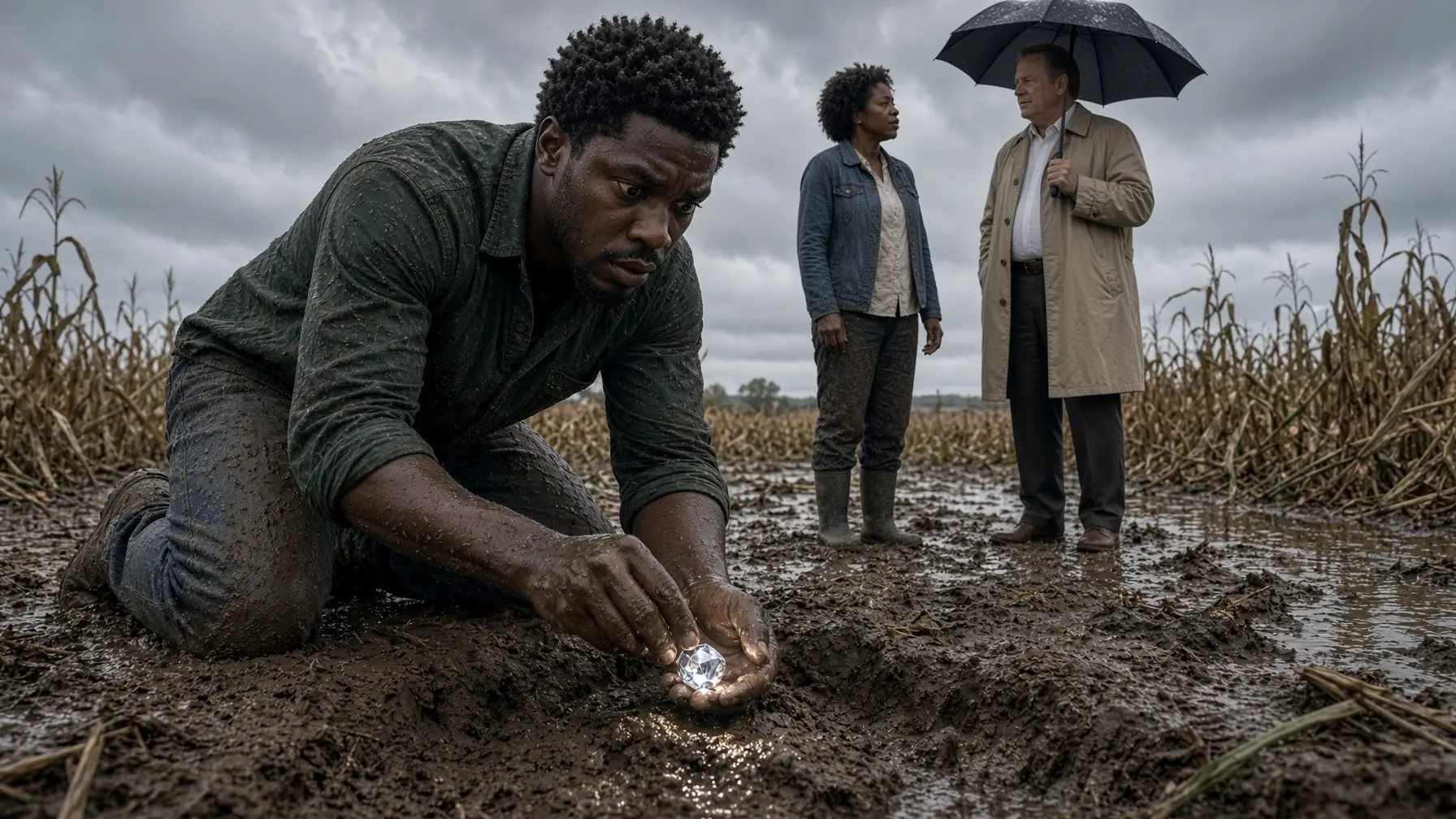
Clayton Mercer said it from the edge of Elijah Whitfield’s cornfield while brown water climbed over the rows in the gray light before dawn.
Rain came down in hard sheets around both men.
The field was disappearing.
Not slowly.
Not in a way that gave anyone time to save machinery, open drainage channels, or drag sandbags into place.
The water had arrived like something released.
Elijah stood forty feet away in soaked work clothes, mud sucking at his boots, and watched twelve years of his father’s labor vanish beneath a rising brown current.
Clayton Mercer did not lower his voice.
There was no one else out there at five-thirty in the morning.
No one to hear what he said next.
“Now the water’s going to finish what your daddy’s bad luck started.”
Elijah turned.
Mercer stood near a white pickup with the Stonebridge Bank logo printed on the door.
Fifty-three years old.
Expensive rain jacket.
Clean boots that had not touched the field.
Hands resting comfortably in his pockets.
His face did not look worried.
That was the part Elijah remembered later.
Not the words.
The expression.
Mercer looked satisfied.
“Twenty-four years old,” he called over the rain. “And you’re about to lose everything your family ever had.”
Elijah said nothing.
Mercer looked toward the flooded field.
“Standing right here watching it happen.”
Then he looked back at Elijah.
“Same as he did.”
That sentence landed harder than the rain.
Elijah’s father, Raymond Whitfield, had died two years earlier at fifty-six.
Stroke.
Sudden.
A man who had spent his entire adult life keeping 110 acres of riverbottom farmland alive through drought, low commodity prices, equipment failures, and loans that never seemed to get smaller no matter how many payments he made.
Raymond had worried about money.
Elijah knew that.
But his father had never surrendered the farm.
Never sold.
Never stopped believing the Whitfields’ land was worth protecting.
And now Clayton Mercer was standing on the edge of it as if Raymond’s death had been a failure.
As if Elijah were next.
Elijah turned back toward the field.
Water had already swallowed the first six rows of corn.
Then ten.
Then twenty.
The current tore stalks sideways.
Debris moved through it.
Fence posts.
Branches.
A feed barrel.
Something metallic slammed against the irrigation pump housing downstream.
Elijah wanted to run into the field.
There was nothing to run toward.
By sunrise, four feet of water covered parts of the property.
By midmorning, the season was gone.
And somewhere fourteen miles upstream, the Pinecrest Reservoir continued releasing water through a spillway system that had never opened like that in the seven years since it was built.
Elijah did not know that yet.
All he knew was that his farm was drowning.
And Clayton Mercer had arrived before sunrise to watch.
The Whitfield farm sat outside Asheford Mills in riverbottom country where the soil had been famous for generations.
Dark.
Deep.
Rich enough that Elijah’s great-grandfather, Isaiah Whitfield, had saved for nearly twenty years before finally buying the first eighty acres in 1961.
Before that, Isaiah had farmed other men’s land.
Sharecropped.
Leased.
Worked fields he improved and then left because the owner raised rent.
The Whitfield farm was different.
It was the first ground anyone in Elijah’s family could call theirs.
Raymond later bought another thirty acres.
One hundred ten total.
Not enormous.
But enough.
Corn.
Soybeans.
Some hay.
Occasional winter wheat.
The farm never made the family wealthy.
It made them independent.
That mattered more.
Elijah understood that from childhood.
Land was not simply acreage.
It was proof that something had survived.
By the time Elijah inherited the farm at twenty-two, survival had become expensive.
Raymond had taken out a mortgage nine years earlier to modernize irrigation and replace aging equipment.
The loan came from Stonebridge Bank.
Stonebridge had been financing farms around Asheford Mills for three generations.
Clayton Mercer had run it for fourteen years.
His father before him.
His grandfather before that.
The Mercer family and the Whitfield family both inherited something.
But Elijah had learned quickly that one inheritance came with leverage over the other.