The black card hit the marble counter with a sound so small it should not have stopped an entire bank.
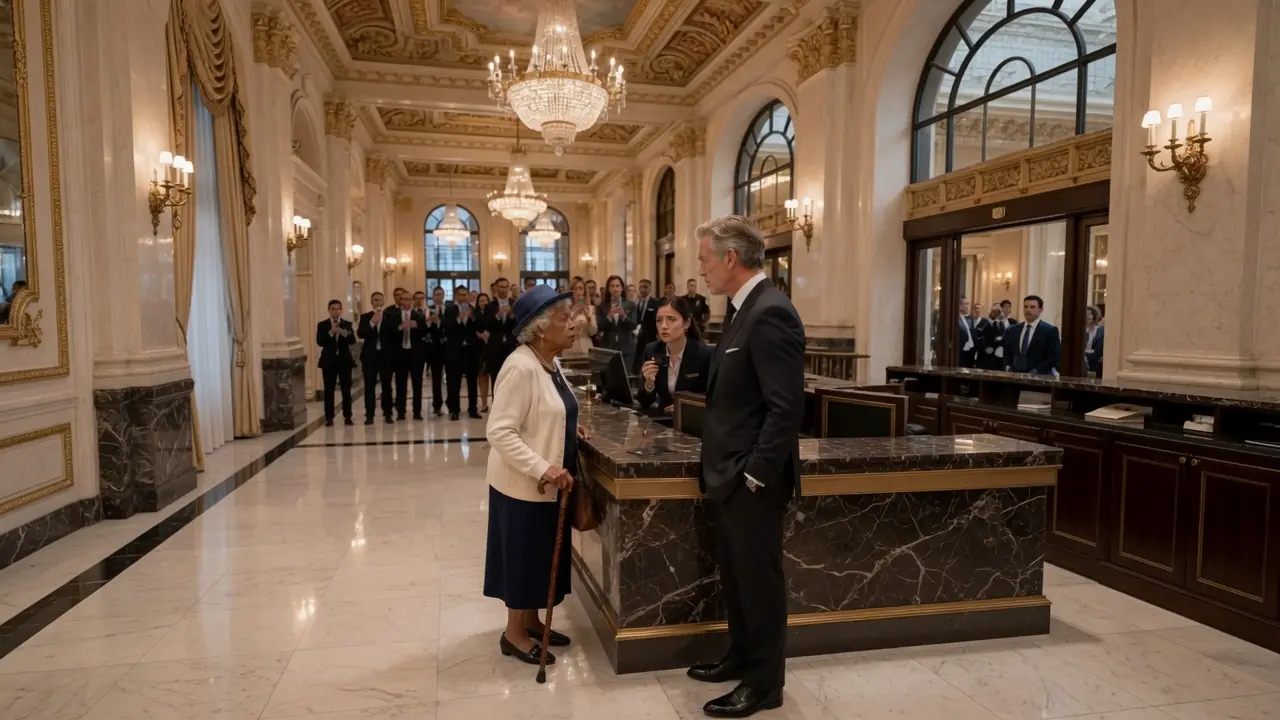
But inside Hayes National Trust, where chandeliers glowed above imported stone floors and polished shoes moved quietly through private wealth, that tiny click felt like a warning. Margaret Ellison stood at the teller window with one hand wrapped around a carved wooden cane, her blue hat tilted neatly above her gray curls. She was eighty-two years old, dressed in a cream cardigan and sensible shoes, carrying a worn leather purse that had seen more life than most people in that lobby had courage.
To the clients waiting in velvet chairs, she looked like a fragile old woman who had wandered into the wrong place.
To Charles Hayes, president of Hayes National Trust, she looked like an inconvenience that needed to be removed before lunch.
Janet Morales, the youngest teller in the branch, picked up Margaret’s card and froze. It was matte black, heavy, and almost plain, with no ordinary bank logo, no silver numbers, and no bright design meant to impress regular customers. Only Margaret Ellison’s name appeared on the front, pressed in clean white letters beside a thin silver emblem Janet had never seen before. When she inserted it into the terminal, the screen blinked once, then locked.
A red message appeared.
Executive authorization required.
Janet’s fingers stiffened over the keyboard. She tried again, thinking she had made a mistake, but the system refused her a second time. Her eyes moved from the card to Margaret’s face, then back to the screen. “One moment, Mrs. Ellison,” she whispered.
Margaret sighed softly. “Child, I have had more than one moment taken from me in this life.”
Janet swallowed, unsure whether to smile or apologize. The message on the screen would not disappear. It did not say declined. It did not say invalid. It only demanded authorization from someone far above her teller level.
Across the lobby, Charles Hayes was greeting a real estate developer with the polished warmth he reserved for men wearing watches worth more than Janet’s yearly salary. Charles was tall, silver-haired, and dressed in a charcoal suit that looked tailored to intimidate. The Hayes name was engraved in brass above the entrance, carved into the marble wall, printed on every statement, and repeated in every boardroom speech about legacy. Charles wore that name like a crown.
When Janet called him, he turned with visible annoyance.
“Mr. Hayes,” she said quietly, “this card requires executive clearance.”
Charles walked over slowly, his smile still arranged for the room. He looked at the card first, then at Margaret’s worn purse, her cane, her old hands, and the careful way she stood to keep pressure off her left knee. His expression changed, but only for a second. Disgust learned to dress itself as professionalism in places like Hayes National Trust.
He picked up the card between two fingers. “This card is probably damaged,” he said.
Margaret lifted her chin. “It is not damaged.”
Charles looked at the name. “Mrs. Ellison, is it?”
“Margaret Ellison.”
“Mrs. Ellison,” he said loudly enough for nearby clients to hear, “this is a private banking institution. We do not process every unusual card someone brings to the counter.”
A few people turned. A woman near the waiting area lowered her magazine. A man in a navy suit glanced up from his phone and watched with the half-interested expression of someone hoping for entertainment before his appointment.
Margaret did not move. “I asked her to check my balance.”
Charles smiled wider. “And I am explaining that you may be in the wrong bank.”
The words drifted through the lobby, soft and cruel. Janet’s face flushed. Margaret’s fingers tightened around the cane, but her eyes stayed steady on Charles.
“No,” she said. “You are the wrong man.”
The smile on Charles’s face thinned. Behind him, the real estate developer shifted uncomfortably. A security guard near the entrance straightened, sensing trouble but not yet knowing whose trouble it was.
Charles leaned one elbow against the counter. “Let me guess. Someone told you there was money here. Maybe a grandson? Maybe a church friend? These cards get passed around sometimes by people who do not understand what they’re holding.”
Margaret’s jaw tightened. “Young man, I opened my first account before you learned to spell interest.”
Janet inhaled sharply.
Charles’s eyes flicked toward her, warning her to stay silent. Then he turned back to Margaret with a colder expression. “You need to lower your voice.”
Margaret looked around the lobby. She saw the watching faces, the half-raised phones, the chandelier light glittering over people who suddenly found her humiliation interesting. She had lived eighty-two years. She had buried a husband, raised two children, survived hospitals, landlords, bosses, and men who mistook her patience for permission.
Charles slid the card back toward her without checking anything.
Margaret’s cane struck the marble floor once.
“I said check my balance!”
The entire lobby froze.
The sound echoed beneath the chandeliers. Heads turned from every corner of the bank. Janet stopped breathing, her hand hovering above the keyboard. Charles slowly turned back toward Margaret, his smile gone now, replaced by the insulted stare of a man who could not believe an elderly Black woman had raised her voice inside his kingdom.
“You are making a scene,” he said.
Margaret stepped closer to the counter, her cane steady beneath her palm. “No, Mr. Hayes. I am ending one.”
His nostrils flared. “Fine.”
He snatched the black card from the counter and moved toward the executive terminal behind Janet’s station. His fingers flew over the keys with sharp irritation. He wanted the room watching now. He wanted to expose her quickly, return the card, and have security escort her out while everyone understood that he had protected the dignity of the institution.
The screen blinked.
Charles smirked.
Then the account loaded.
His fingers stopped.
At first, he stared as if the numbers had arranged themselves incorrectly. He typed another command. Then another. The screen refreshed, and the same information appeared again, clearer, heavier, impossible to dismiss.
Janet leaned closer, and her eyes widened until fear replaced confusion.
Charles stepped back.
All the color drained from his face.
Margaret approached the counter with slow, patient steps. Her cane tapped against the marble like a quiet judgment. Tap. Tap. Tap. Every person in the lobby seemed to lean toward the screen.
“Well?” she asked softly.
Charles swallowed.
His voice cracked. “This account…”
The lobby held its breath.
Janet whispered, “Mr. Hayes…”
Charles turned his head slowly toward Margaret, as if the woman before him had changed shape in the last ten seconds. “This account controls our holding company.”
A murmur rolled through the room.
The real estate developer lowered his phone. The woman with the magazine stood up without meaning to. The security guard’s hand dropped away from his radio. Janet covered her mouth, not because she was shocked that the card worked, but because she understood exactly what Charles had done.
Margaret smiled faintly.
“Now read my balance out loud,” she said, “so everyone can hear who you tried to throw away.”
Charles stared at her, trapped between arrogance and terror. “Mrs. Ellison, perhaps we should continue this privately.”
“You made the insult public,” Margaret said. “The truth can stand in the same room.”
Janet’s eyes moved to Charles, then back to the screen. Her voice trembled. “Mr. Hayes, the account is tied to Ellison Legacy Holdings.”
The name hit the lobby like thunder.
Several older clients recognized it immediately. Ellison Legacy Holdings was not a regular investor. It was the quiet private trust behind hundreds of commercial properties, agricultural land holdings, energy leases, municipal bonds, and, according to financial rumors, a controlling stake in the parent company that owned Hayes National Trust.
Charles gripped the counter. “That is not possible.”
Margaret’s eyes sharpened. “You keep saying that about things you never bothered to know.”
He looked at the screen again, desperate for a flaw. “This must be an administrative structure. A shared trust. A foundation account.”
“It is mine.”
The words were simple, but they took the breath from the room.
Charles looked at her cane, her cardigan, her blue hat, and the worn purse resting against her arm. He had judged every visible thing about her and found no room for power. Now power stood in front of him, old, Black, calm, and impossible to remove.
Janet stepped back from the terminal. “Mrs. Ellison, I am so sorry.”
Margaret turned to her, and her expression softened. “You were afraid, child. Fear is different from cruelty.”
Janet’s eyes filled with tears.
Charles cleared his throat, trying to gather pieces of authority from the floor. “Mrs. Ellison, I apologize if my handling of this situation seemed abrupt.”
Margaret looked at him for a long time.
“If?” she asked.
The single word made him flinch.
Margaret placed both hands on her cane. “I did not come here because I needed you to believe I had money. I came here because I needed to know if this bank still deserved mine.”
The silence deepened.
Charles opened his mouth, but no defense came. Around him, phones were still recording. His family name remained on the wall above the entrance, but suddenly it looked less like ownership and more like borrowed decoration.
Margaret turned toward Janet. “Call the board liaison.”
Charles stiffened. “That will not be necessary.”
Margaret’s cane tapped once. “It became necessary when you called my card fake.”
Janet hesitated, glancing at Charles.
Margaret’s voice softened but stayed firm. “Do not look at him for permission to do the right thing.”
Janet reached for the phone.
Charles stepped toward her. “Janet.”
Margaret turned sharply. “Do not threaten that girl with your eyes. She did more honest banking in five minutes than you did in twenty years.”
The lobby murmured again.
Charles’s jaw clenched, but he stepped back.
Within minutes, the private elevator opened. Three board members entered the lobby with the strained faces of people who had been pulled from a meeting by a call they did not understand. First came Arthur Bell, the board chair, an elderly man with white hair and cautious eyes. Behind him walked Linda Park, head of audit, and Mason Greer, legal counsel for the holding company.
Arthur looked from Charles to Margaret, then to the black card on the counter. His face changed immediately.
“Mrs. Ellison,” he said, voice low with respect. “We were not aware you were visiting today.”
Margaret gave him a small nod. “That was the point.”
Arthur glanced at Charles. “What happened?”
Before Charles could speak, Margaret raised one hand. “Let the room answer.”
No one moved at first.
Then the man in the navy suit near the waiting area lifted his phone. “I recorded most of it.”
Charles turned on him. “You had no right—”
Margaret’s voice cut through the lobby. “He had the courage you lacked.”
The man stepped forward and handed his phone to Mason Greer. The video showed everything clearly: Charles holding the card like trash, suggesting Margaret was confused, refusing to check the account, trying to slide it back, then reacting only after she demanded the balance aloud.
Arthur watched in silence.
Linda Park’s face tightened with each second.
When the video ended, Arthur looked at Charles with disappointment so cold it barely needed words. “Is this accurate?”
Charles’s throat moved. “The situation was unusual.”
Margaret laughed once, softly. “A Black woman with money is not unusual, Mr. Hayes. It is only unusual to men who think wealth must look like them.”
Arthur closed his eyes briefly.
Linda stepped closer to Margaret. “Mrs. Ellison, on behalf of the board, I apologize.”
Margaret turned to her. “I appreciate the words. I came for the truth.”
Linda nodded. “Then we will give it to you.”
Charles tried one last time. “The teller system required executive clearance. I acted in accordance with policy.”
Margaret looked at him. “Policy did not tell you to mock my purse.”
He froze.
“Policy did not tell you to call my card fake.”
His face reddened.
“Policy did not tell you to assume a grandson or church friend had sent me here.”
The lobby went painfully quiet.
Margaret stepped closer, her cane steady on the floor. “Policy did not make you cruel, Charles. It only gave your cruelty a desk.”
Janet lowered her eyes, tears sliding down her cheeks.
Arthur turned to Mason. “Secure all video footage from the lobby and teller system. Preserve the terminal logs. Notify compliance and outside counsel.”
Charles stared at him. “Arthur, this is absurd.”
Arthur’s voice hardened. “No, Charles. What is absurd is the president of this institution humiliating the controlling owner in front of clients because he was too arrogant to check a card.”
The words struck like a verdict.
Charles looked at Margaret, and for the first time, fear replaced pride. “Mrs. Ellison, please. I have served this bank for decades.”
Margaret tilted her head. “Served it?”
He swallowed. “Yes.”
“No, Mr. Hayes. You guarded a door you thought belonged to your family. You forgot who built the house behind it.”
His eyes flicked toward the brass name above the entrance.
Margaret followed his gaze. “Your grandfather founded Hayes National Trust with money from people he would not have invited to dinner. Farmers. Teachers. Railway workers. Widows. Black families who saved nickels when banks across town turned them away.”
Arthur looked down.
“My husband, Samuel Ellison, was one of those people,” Margaret continued. “He brought deposits here when your grandfather needed capital, and your grandfather smiled because Samuel’s money spent just fine, even if he would not let him enter through the front door in 1958.”
The room seemed to shrink around Charles.
Margaret’s voice remained steady, but grief moved beneath it now. “Samuel bought shares quietly. Then more. Then land. Then bonds. Then companies. He believed ownership was the one language men like your family could not pretend not to understand.”
Charles said nothing.
“He died before he could walk through this lobby and be treated with the respect his money had already earned,” Margaret said. “So I came today for him.”
Janet covered her mouth.
Margaret looked at the chandeliers, the marble, the brass counters, the wealthy clients watching with ashamed faces. “I wanted to see whether the old arrogance had finally died in this building.”
Her eyes returned to Charles.
“It had not.”
Arthur exhaled slowly. “Mrs. Ellison, what would you like done?”
Charles looked at Arthur in panic. “You cannot possibly let her decide my position in the lobby.”
Margaret smiled sadly. “You decided mine here.”
Arthur did not protect him.
Margaret turned to Linda. “I want a full review of every discrimination complaint, every denied private banking appointment, every closed account appeal, every unusual security escort from the last ten years.”
Linda nodded quickly. “You will have it.”
“I want Janet protected from retaliation.”
Janet looked up, startled.
Arthur said, “Done.”
“I want Charles Hayes removed from customer-facing authority immediately while the board reviews his conduct.”
Charles went pale. “Margaret—”
She raised a hand. “You may call me Mrs. Ellison.”
The correction silenced him.
Arthur turned to Charles. “Effective immediately, you are placed on administrative leave pending investigation.”
Charles stared at the board chair as if the words had been spoken in a foreign language. Administrative leave was something he had approved for others. It was not something that happened to Hayes men inside Hayes National Trust.
His voice dropped. “My family name is on this building.”
Margaret leaned on her cane. “And my family money keeps the lights on.”
No one spoke after that.
Charles looked around the lobby, searching for allies among the same people who had watched his cruelty with interest minutes earlier. The developer avoided his eyes. The clients looked away. Even the security guard stared at the floor.
The kingdom had no soldiers left.
Charles turned and walked toward the elevator, his shoulders stiff, his face gray.
As he passed Margaret, she spoke softly.
“Mr. Hayes.”
He stopped.
“When you go home tonight, do not ask why you lost your chair. Ask why an old woman had to shout before you checked her name.”
Charles did not answer.
The elevator doors opened and swallowed him.
For several seconds, the lobby remained frozen in the aftermath. Then Janet stepped from behind the counter, picked up the black card with both hands, and returned it properly to Margaret.
“I am sorry, Mrs. Ellison,” she said again.
Margaret took the card and placed it inside her purse. “You listened when the truth arrived. That matters.”
Janet wiped her cheek. “I should have spoken sooner.”
Margaret’s expression softened. “Then speak sooner next time.”
The words were gentle, but they carried weight.
Two weeks later, Hayes National Trust announced that Charles Hayes had resigned from his role as president. The official statement spoke of leadership transition, accountability, and renewed values. It did not describe the sound of Margaret’s cane striking marble. It did not mention the way Charles’s face changed when the screen loaded. It did not admit that the bank’s polished culture had cracked because one elderly woman refused to be embarrassed into silence.
But everyone in Mason Greer’s legal office knew.
Everyone in the lobby knew.
And soon, through whispers, recordings, and carefully worded news articles, the city knew too.
Margaret returned to the bank one month later.
This time, the doors opened before she reached them. Janet, now promoted to client relationship associate, greeted her at the entrance with quiet pride. The lobby looked the same, but it felt different. Not perfect. Margaret was too old to believe one disgrace could cleanse generations of arrogance. But different mattered.
Arthur Bell met her near the private consultation room. “Mrs. Ellison,” he said, “the review has already uncovered several troubling patterns.”
Margaret nodded. “Patterns do not trouble me. People ignoring them does.”
Arthur accepted the rebuke. “We are correcting them.”
“You are beginning to correct them,” she said.
“Yes,” he admitted. “Beginning.”
Margaret sat in the consultation room beneath a framed photograph of the bank’s founding. Charles’s grandfather stood in the center of the image, smiling beside white businessmen in dark suits. Margaret looked at the picture for a long time, then pulled a small black-and-white photograph from her purse.
It showed Samuel Ellison as a young man, standing outside a small grocery store he once owned. His tie was crooked, his shoes were dusty, and his smile was proud enough to warm the whole room.
Margaret placed the photograph on the table.
“This should hang somewhere people can see it,” she said.
Arthur looked at it. “Of course.”
“No,” Margaret corrected. “Not as decoration. As memory.”
He nodded. “As memory.”
Three months later, a new display appeared in the lobby of Hayes National Trust. It told the story of early community investors whose deposits and quiet ownership helped build the institution. Samuel Ellison’s photograph stood near the center. Beneath it, a plaque read:
Samuel and Margaret Ellison: Investors, landowners, builders of generational wealth, and controlling legacy partners in Hayes National Trust.
People stopped to read it.
Some looked surprised.
Margaret always smiled when she saw that.
Not because surprise pleased her, but because surprise proved the lesson still needed teaching.
On the anniversary of Samuel’s death, Margaret visited the bank once more. She wore the same blue hat, the same cream cardigan, and carried the same carved cane. Janet walked beside her through the lobby, now confident in a way Margaret liked to see.
Near the counter, a young Black man in work boots approached nervously with a folder of savings bonds and a question about opening an investment account. The receptionist smiled at him and said, “We can help you with that, sir.”
Margaret paused.
The young man did not notice her watching.
But Janet did.
Margaret’s eyes softened. “That is a start.”
Janet nodded. “Yes, Mrs. Ellison.”
Margaret looked toward the brass Hayes name above the door, then toward Samuel’s photograph on the wall. For years, men like Charles had believed buildings remembered only the names carved into them. But buildings remembered footsteps too. Deposits. Denials. Quiet patience. Cane strikes on marble.
They remembered who was told they did not belong.
And they remembered who stayed anyway.
Margaret walked to the counter and placed her black card down again.
This time, Janet picked it up with respect.
“Good morning, Mrs. Ellison,” she said. “How may we serve you today?”
Margaret smiled.
Not because the card worked.
Not because the balance was large.
But because, at last, the room had learned to check the person before judging the package she came in.
And somewhere beyond the chandeliers, beyond the marble, beyond the brass name on the wall, Margaret imagined Samuel smiling too.