The stagecoach lurched to a halt in front of the weathered hotel in Hays City, Kansas, and Natalie Green stepped down into the dusty street with her heart hammering against her ribs, knowing that in less than an hour she would meet the man she was supposed to marry.
It was June of 1876, and the afternoon sun beat down mercilessly on the small frontier town that had sprung up along the Kansas Pacific Railway.
Natalie smoothed her travel-worn dress and tried to calm the nervous flutter in her stomach as she watched the driver haul her two modest trunks from the back of the coach.
Inside one of those trunks, carefully wrapped in oilcloth and hidden beneath her few belongings, lay the tools of a talent she had never shared with anyone, a secret she had guarded since she was barely old enough to hold the implements steady in her small hands.
She had answered an advertisement placed by a rancher named Harold Graves, who was looking for a wife, someone practical and hardworking who could help manage a home on the expanding frontier.
In her letters, Natalie had been honest about most things.
She could cook and sew, keep accounts, and manage a household.
She was 22 years old, neither a great beauty nor plain, with dark hair that she wore in a simple bun and hazel eyes that her mother had once said looked like sunlight through honey.
What she had not mentioned was the unusual skill that had occupied her spare moments since childhood, the talent that her father had taught her before he died when she was 12.
The hotel clerk directed her to a small room on the second floor where she could wash and change before meeting her intended.
As she climbed the narrow stairs, Natalie wondered what Harold Graves would be like.
His letters had been brief but kind, describing his ranch ten miles outside of town, his herd of cattle, and his simple life.
He was 27, he had written, and had been working his land for five years.
He wanted a partner, not just someone to cook his meals, but someone who would share the challenges and rewards of building something lasting.
Natalie washed the dust from her face and hands in the basin of cool water and changed into her best dress, a simple blue cotton with white lace at the collar that her mother had helped her sew before Natalie left St. Louis.
Looking at herself in the small mirror, she thought about the journey that had brought her here.
Her mother had remarried after her father’s death, and while her stepfather was not cruel, the small house had become crowded with his own children.
At 22, Natalie knew she was past the age when most women married, and opportunities in St. Louis had been scarce.
When she saw Harold’s advertisement in the newspaper, something inside her had stirred with hope.
A knock at her door made her jump.
The hotel clerk called through the wood that Mr. Graves was waiting in the lobby.
Taking a deep breath, Natalie straightened her shoulders and walked downstairs to meet her future.
Harold Graves stood near the front window, his hat in his hands, turning it nervously as he watched the street outside.
When he heard her footsteps, he turned, and Natalie got her first real look at the man she had agreed to marry.
He was tall, well over six feet, with broad shoulders that spoke of years of hard physical work.
His face was sun-weathered and honest, with brown eyes that crinkled at the corners when he smiled tentatively at her.
His dark hair was neatly combed, and he wore clean clothes that looked recently pressed, clearly his best outfit saved for this important meeting.
“Miss Green.”
His voice was deeper than she expected, with a warmth that immediately put her somewhat at ease.
“Yes, Mr. Graves.”
She extended her hand, and he took it gently, his palm calloused but his grip careful.
“I am glad you made it safely. The journey from St. Louis can be rough.”
He seemed almost as nervous as she felt, which somehow made her feel better.
“It was long, but the coach was sturdy enough.”
She studied his face, trying to read the character there.
She saw kindness in his eyes and honesty in the straightforward way he met her gaze.
“I thought we might have supper at the restaurant down the street if you are not too tired. Give us a chance to talk some before we make any final decisions.”
His thoughtfulness touched her.
Many men in his situation would have simply expected her to go through with the marriage immediately, treating it as a business transaction already concluded.
“That sounds very nice. Thank you.”
They walked the short distance to the small restaurant, and Harold held the door for her as they entered.
The interior was simple but clean, with checked cloths on the tables and the smell of beef stew and fresh bread in the air.
They settled at a corner table, and for a moment there was an awkward silence as they both searched for words.
“Your letters mentioned you grew up in St. Louis,” Harold began, his fingers fidgeting with the napkin in front of him. “That must be quite different from Hays City.”
“It is,” Natalie admitted. “But I am ready for something different. My father used to tell me stories about the frontier, about building something with your own hands. I think he always wanted to come west himself, but circumstances never allowed it.”
“What did your father do?” Harold asked, genuine interest in his voice.
“He was a watchmaker,” Natalie said, the familiar pang of loss touching her heart even after all these years. “He had a small shop. He taught me a great deal before he passed.”
“I am sorry for your loss,” Harold said quietly. “My own parents died of fever when I was 19. It is part of why I came out here to build something new.”
They talked through the meal, carefully exploring each other’s histories and hopes.
Natalie learned that Harold had worked as a ranch hand for three years before saving enough to buy his own land.
He had 160 acres with good grass and a reliable creek running through it.
His herd was small but growing, about 50 head of cattle.
He had built a modest house, just four rooms, but solid and well constructed.
He did most of the work himself, but during roundup and branding, he hired a few hands to help.
“I will not lie to you, Miss Green,” he said as they finished their meal. “It is a hard life. The work is constant, and there are no guarantees. A bad winter or a dry summer can set you back years, but it is honest work and the land is beautiful. If we work together, I believe we can build something good.”
“Why did you decide to look for a wife through an advertisement?” Natalie asked, curious about this detail.
Harold looked down at his plate, a faint color rising in his cheeks.
“There are not many women out here, and the ones who are already settled, well, they have their pick of suitors. I am not much for fancy words or courting rituals. I figured it was best to be straightforward about what I could offer and what I needed. When I got your letter, your honesty appealed to me. You did not paint yourself as something you are not, and you asked sensible questions about the life here.”
Natalie felt a growing respect for this quiet, earnest man.
“I appreciate your honesty as well. I will be equally honest with you. I came west because my opportunities in St. Louis were limited. But I am not running from anything, and I am not looking for an easy life. I know how to work hard, and I am willing to do whatever it takes to help build a good home.”
Harold met her eyes, and she saw approval there.
The sincerity in his voice moved her.
“Then I will do my best to be a good wife.”
They were married the next morning in the small church at the edge of town, with the preacher’s wife and the hotel clerk as witnesses.
Natalie wore the same blue dress, and Harold wore his Sunday clothes, and they spoke their vows in the quiet sanctuary with sunlight streaming through the plain windows.
When Harold kissed her, it was brief and respectful, the kiss of a man who understood that true intimacy would take time to build.
After the ceremony, they loaded Natalie’s trunks into Harold’s wagon, and he helped her up onto the seat beside him.
The ranch was ten miles northwest of town.
And as they rode through the Kansas prairie, Natalie got her first real sense of the land that would be her new home.
The grass stretched endlessly in all directions, rippling in the wind like a golden sea.
The sky was enormous, bigger than any sky she had ever seen in the city, and the air smelled of earth and wild sage.
“It is beautiful,” she said softly, and Harold glanced at her with pleased surprise.
“I think so, too. Some people find it too empty, too lonely, but I have always loved the space here.”
They passed scattered herds of cattle grazing in the distance, and once Harold pointed out a group of antelope bounding away at their approach.
The wagon road was rough, barely more than wheel ruts through the grass, but Harold handled the team with easy confidence.
The house came into view as they crested a low rise, and Natalie felt a flutter of nervousness mixed with anticipation.
It was a simple structure made of sawn lumber, with a covered porch across the front and a stone chimney rising from the center.
Behind the house stood a barn, a chicken coop, and several smaller outbuildings.
The creek Harold had mentioned ran about 50 yards from the house, lined with cottonwood trees that provided the only significant shade in the landscape.
Harold brought the wagon to a stop in front of the house and jumped down, then came around to help Natalie descend.
“It is not much, but it is solid. I built it myself over two summers.”
“It looks like a good house,” Natalie said, and she meant it.
The structure was simple but well made, with straight walls and a roof that looked sound.
He carried her trunks inside, and Natalie followed him into her new home.
The interior was as plain as the exterior, but clean and well organized.
The main room served as both kitchen and living area, with an iron stove in one corner and a simple table with four chairs.
A rocking chair sat near the fireplace.
Two doorways led to the other rooms.
One to a small bedroom with a simple bed and wardrobe, the other to what looked like a storage room with shelves and supplies.
“I sleep in the bedroom,” Harold said, then quickly added, “but I can move my things to the storage room. I want you to be comfortable. We can take our time with everything else.”
Natalie felt a rush of gratitude for his consideration.
“Thank you. I think that would be best, at least for now.”
Harold nodded and immediately began moving his few personal belongings to the other room, giving her space to settle in.
When he finished, he showed her where everything was in the kitchen, the root cellar behind the house where he stored potatoes and other vegetables, the chicken coop where she could gather eggs, and the well with its hand pump that provided their water.
“I usually ride out to check the herd every morning,” he explained. “Sometimes I am gone most of the day, depending on where they have wandered, but I will always be back by evening. If you need anything while I am gone, there is a bell on the porch. Ring it three times fast, and I will come back.”
“What about dangerous animals?” Natalie asked, trying to keep the nervousness from her voice.
“We get coyotes and the occasional wolf, but they rarely come this close to the buildings. I have never seen a mountain lion this far east, though they are around. The biggest danger is probably rattlesnakes in the summer, so watch where you step, especially in the tall grass. There is a shotgun on the wall there, loaded and ready if you need it.”
That first week passed in a blur of adjustment and learning.
Natalie threw herself into establishing routines, learning the rhythms of the ranch.
She discovered that Harold was an early riser, up before dawn to tend to the horses and check on things before riding out.
She began waking early as well, preparing breakfast for him before he left.
The work was constant but satisfying in a way her life in St. Louis had never been.
Every task had a clear purpose, from gathering eggs to tending the small vegetable garden Harold had started behind the house.
Harold was patient and kind, showing her how things worked and never criticizing when she made mistakes.
He was a quiet man, not given to unnecessary conversation, but she began to appreciate the comfortable silences between them and the small moments of connection when they worked together on tasks around the homestead.
It was on the eighth day of her marriage that Harold discovered her secret.
She thought he had ridden out to check the north pasture and would be gone until late afternoon.
Feeling safe in her solitude, Natalie had retrieved the carefully wrapped bundle from her trunk and carried it out to the covered porch where the light was good.
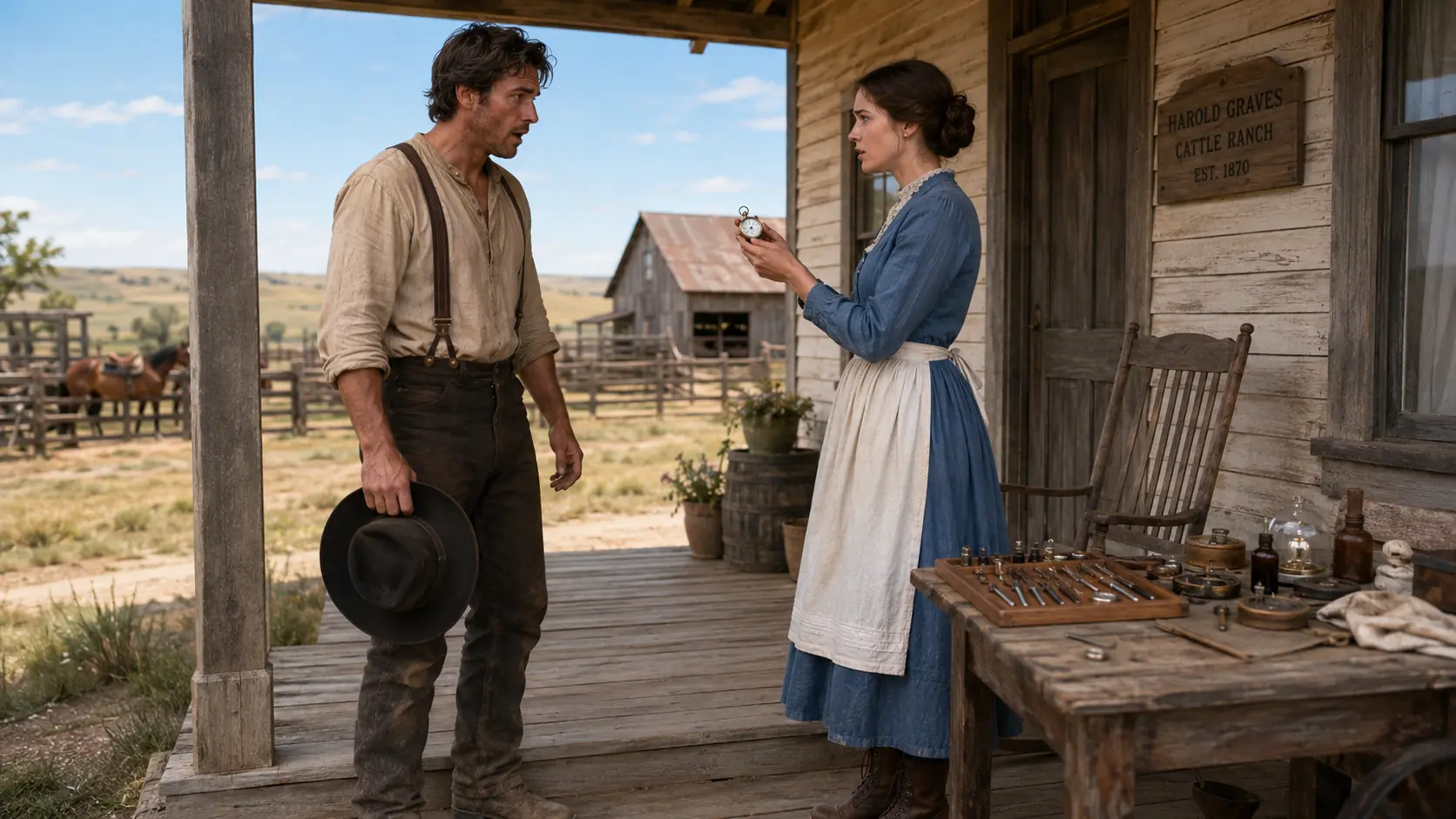
She unwrapped the oilcloth to reveal her tools, delicate screwdrivers, tiny pliers, magnifying lenses, and a small collection of watch parts and mechanisms she had brought with her on the wagon ride to the ranch.
She had noticed that Harold wore a pocket watch on a chain, and she had seen him check it several times.
The previous evening, she had noticed him shake it and frown, then hold it to his ear with a concerned expression.
When he thought she was not looking, he had opened the case and peered inside with obvious frustration.
While he was out, Natalie had quietly retrieved the watch from where he had left it on the small table beside his bed.
Now sitting in the rocking chair on the porch with her tools spread on a small board across her lap, she carefully opened the case and examined the mechanism inside.
She was so absorbed in her work that she did not hear Harold return.
He had come back earlier than expected because one of his best mares showed signs of lameness, and he wanted to check her more carefully in the barn.
He was walking toward the house when he saw Natalie on the porch, bent over something in her lap with intense concentration, her fingers moving with practiced precision.
“What are you doing?” he asked, climbing the porch steps.
Natalie jumped, nearly dropping the watch, her heart leaping into her throat.
She looked up at him with wide eyes, caught in the act of touching his personal property without permission, doing something she had never told him she could do.
Harold’s gaze moved from her face to the watch in her hands to the tools spread across her lap and back to her face.
His expression was unreadable.
“I am sorry,” Natalie said quickly, her words tumbling over each other. “I should have asked. I noticed you having trouble with your watch, and I thought I could fix it. My father taught me. It is what he did, and I learned from him. I have been repairing watches since I was 12 years old. I should have told you, but I did not know how you would feel about it, and I did not want you to think I was strange or inappropriate for a woman. And I am so sorry I touched your watch without asking.”
Harold stepped closer, his eyes on the watch in her hands.
“You know how to repair watches?”
“Yes.”
Her voice was small, uncertain of his reaction.
“Can you fix it? It stopped keeping proper time about two weeks ago.”
She nodded, relief flooding through her at his calm tone.
“I think so. The mainspring has lost tension, and one of the gears is slightly out of alignment. I can adjust it.”
Harold pulled over the other chair from near the door and sat down beside her, watching with fascination as she bent back over the delicate mechanism.
Her fingers moved with absolute confidence now, making minute adjustments with her tools.
She explained what she was doing as she worked, pointing out the different components and how they worked together.
“My father always said that a good watch is like a tiny universe,” she said softly, her attention focused on the intricate gears. “Everything has to work in perfect harmony, each piece depending on all the others. He said it taught you about patience and precision.”
“Why did you not mention this in your letters?” Harold asked, genuinely curious rather than accusatory.
Natalie paused in her work, meeting his eyes.
“I was afraid you would think it was peculiar. Most men do not want a wife who spends her time on such things. My stepfather thought it was inappropriate, said I should focus on more womanly pursuits. I did not want you to refuse me before you even met me.”
Harold was quiet for a moment, watching as she made a final adjustment and then carefully closed the watch case.
She wound it gently and held it to her ear, listening to the steady tick, then handed it back to him.
“Try it now. It should keep accurate time.”
Harold opened the case and watched the second hand move smoothly around the dial.
He held it to his own ear, listening to the precise rhythm, then looked at Natalie with an expression that made her breath catch.
“That is remarkable,” he said quietly. “You have a real skill, a valuable one. Why would I think less of you for that?”
“Many men would.”
“Then many men are fools.”
He closed the watch and slipped it back into his pocket, then reached out and gently took one of her hands, examining her fingers with new appreciation.
“These are the hands of a craftsman. My father was a carpenter back in Ohio before he died, and he always said you could tell a person’s worth by the work of their hands. You have the hands of someone who creates and repairs, who makes things better. That is nothing to be ashamed of.”
Tears prickled at Natalie’s eyes, emotion welling up unexpectedly at his acceptance.
“You truly do not mind?”
“Mind? Natalie, this is wonderful. Do you know how valuable this skill could be out here? People are always needing their timepieces repaired, and the nearest watchmaker is probably in Kansas City. You could help people and earn money doing it.”
“I brought some supplies with me, parts and tools. Not much, but enough to do basic repairs.”
Harold smiled, a genuine expression of delight that transformed his usually serious face.
“You are full of beautiful surprises, Natalie Graves.”
The use of her married name, combined with the warmth in his voice, made her heart flutter in a way she had not expected.
She found herself smiling back at him, feeling truly seen and accepted, perhaps for the first time since her father had died.
“There is something else I want to show you,” Harold said, standing up. “If you are sharing secrets today, I have one, too.”
Intrigued, Natalie carefully wrapped her tools back in their cloth and followed Harold out to the barn.
He led her to the tack room in the back and moved aside a wooden crate, revealing a dusty leather case.
He opened it to show her a violin, the wood still gleaming despite the dust.
“It was my mother’s,” he said quietly. “I have not played it in years. I taught myself when I was young, and my mother encouraged it, but after they died, it seemed frivolous. There is always so much work to do, and I told myself I did not have time for such things.”
“Will you play something?” Natalie asked.
Harold looked uncertain, but he lifted the violin from its case and checked the tuning, making small adjustments to the strings.
Then he tucked it under his chin, raised the bow, and began to play.
The music that filled the barn was hesitant at first, rusty from lack of practice, but it quickly grew more confident.
He played a simple folk melody, sweet and melancholy, and Natalie watched his fingers move across the strings with surprising grace.
This strong, quiet man who spent his days working with cattle and horses had this hidden wellspring of beauty inside him.
When he finished, he lowered the violin and looked at her almost shyly.
“I am out of practice.”
“It was beautiful,” she said honestly. “You should play more often.”
“Maybe I will, if you will work on your watches. We can both make time for the things we love, not just the things we must do.”
It was a small moment, but it felt significant, a turning point in their relationship.
They were not just two strangers bound by a practical arrangement anymore.
They were beginning to see each other as whole people with depths and talents and dreams beyond the daily necessities of frontier life.
That evening, after supper, they sat together on the porch and watched the sun set over the prairie.
Harold played his violin, rusty but heartfelt, and Natalie worked on a watch that had been giving her trouble for months, a piece she had brought from St. Louis, intending to puzzle out its mysteries.
The sounds of the violin mingled with the song of crickets and the whisper of wind through the grass, and Natalie felt something settling inside her, a sense of rightness she had not expected to find so quickly.
Over the following weeks, word spread through the community about Natalie’s skill.
Harold mentioned it to a few people when he went to town for supplies, and soon neighbors began stopping by with timepieces that needed repair.
An old rancher brought a pocket watch that had belonged to his father.
A young cowboy brought a small clock his mother had given him.
A widow from a neighboring homestead brought a delicate lady’s watch that had stopped working after her husband’s death.
Natalie worked on each piece with careful attention, charging modest fees that Harold insisted she keep for herself.
The work gave her a sense of purpose beyond her household duties, and she loved the challenge of diagnosing each problem and finding the solution.
She set up a small workbench in the corner of the main room near the window where the light was best.
As autumn arrived and the heat of summer faded into crisp, clear days, Natalie and Harold’s relationship deepened.
They were learning each other’s rhythms and habits, finding companionship in their shared work and quiet evenings.
Harold began playing his violin more regularly, and sometimes Natalie would stop her work to listen, watching his profile in the lamplight as his bow moved across the strings.
One evening in late September, after they had been married for three months, Harold came in from checking on a sick calf to find Natalie preparing supper.
She had made a stew from venison that a neighbor had shared, and the smell filled the warm kitchen.
As he washed his hands at the basin, he watched her moving efficiently around the space that had become her domain.
“The calf is going to be fine,” he said. “I think it just ate something that disagreed with it.”
“That is good news.”
Natalie ladled stew into bowls and brought them to the table.
They ate in comfortable silence for a while, but Natalie could sense that Harold had something on his mind.
Finally, he set down his spoon and looked at her directly.
“I have been thinking,” he began, then paused as if unsure how to continue. “When we married, I told you we could take our time with everything. I meant that. But I want you to know that my feelings have changed since you arrived. You are not just a practical arrangement anymore, Natalie. You have become important to me. I care about you.”
Natalie’s heart began beating faster.
She had been feeling the same shift inside herself.
The way her pulse quickened when Harold smiled at her.
The way she found herself watching for his return each evening.
The warmth that spread through her chest when he said something kind or played a particularly beautiful piece of music.
“I feel the same way,” she admitted softly. “You have been so kind to me, so accepting. I did not expect to feel this way so quickly.”
Harold reached across the table and took her hand.
“I do not want to rush you into anything, but I want you to know that when you are ready, I would like for us to be truly married in every way.”
Natalie felt her cheeks warm, but she met his gaze steadily.
“I think I am ready now, if you are.”
That night they came together with tenderness and care, learning each other in this new way, as they had been learning each other in all the others.
Harold was gentle and patient, and Natalie felt the last walls between them crumble as they became husband and wife in full truth.
The next morning, lying in bed with early sunlight streaming through the window and Harold’s arm around her, Natalie felt a contentment she had never known.
This life she had stepped into so nervously just three months ago had become home in every sense.
As autumn progressed into winter, their ranch hummed with steady activity.
Harold spent his days managing the herd, preparing for the hard months ahead by stockpiling hay and making sure the barn was secure against coming storms.
Natalie continued her watch repair work, which had grown into a steady side business, and she also began helping more with the outdoor work.
She learned to ride Harold’s gentlest mare, a sweet-tempered bay named Clover, so she could check on the closer pastures and help move cattle when needed.
Winter arrived with a vengeance in late November, bringing snow and bitter cold that turned the prairie white and made every outdoor task an ordeal.
But the house Harold had built was tight and warm, and they had prepared well.
On the long winter evenings, they entertained each other with Harold’s music and Natalie’s stories, and they grew closer with each passing day.
It was during one of the worst storms in January that a crisis tested them.
Harold went out to check on the cattle in the barn and did not return when expected.
After an hour passed with no sign of him, Natalie bundled herself in every warm garment she could find and fought her way through the blinding snow to the barn.
She found him there unconscious on the floor with blood on his forehead.
One of the horses had spooked at a crack of thunder and kicked out, catching Harold above his left eye.
Natalie’s heart seized with terror, but she forced herself to stay calm.
She could not drag him back to the house in these conditions.
So instead, she made him as comfortable as possible in the barn, packing snow against his wound to stop the bleeding and covering him with every blanket she could find.
For two days, the storm raged while Natalie nursed Harold in the barn.
She kept him warm, tended his wound, and tried to get him to drink water during his few lucid moments.
She prayed harder than she had ever prayed in her life, terrified of losing this man who had become so precious to her.
When Harold finally opened his eyes fully on the third morning, the storm had passed, and weak sunlight filtered through the cracks in the barn walls.
His head ached terribly, but when he saw Natalie’s exhausted face bent over him, her eyes red from crying and lack of sleep, his first thought was concern for her.
“You should not have stayed out here,” he said weakly. “You could have frozen.”
“I could not leave you,” Natalie said, tears streaming down her face now that he was awake. “I could not lose you, Harold. I love you.”
It was the first time either of them had spoken those words.
And despite his pain and weakness, Harold reached up to touch her face.
“I love you, too. I think I have loved you since you told me about your father and the watches. But I know for certain I loved you when I saw you caring for that neighbor’s broken clock like it was the most important thing in the world.”
They stayed in the barn for another hour until Harold felt strong enough to walk, leaning heavily on Natalie back to the house.
She settled him in bed and fussed over him for the next week, barely letting him lift a finger until she was satisfied he had fully recovered.
The wound left a small scar above his eyebrow, but it healed cleanly.
That crisis seemed to cement something between them, burning away any last traces of hesitation or formality.
They were fully partners now, in love and committed to facing whatever challenges the frontier threw at them.
Spring arrived with a rush of green grass and wildflowers, and with it came good news.
Natalie discovered she was pregnant.
She told Harold one evening in early April as they sat on the porch watching the sunset, the same place where he had first discovered her secret talent.
“I am going to have a baby,” she said simply, watching his face.
Harold’s expression transformed from surprise to joy so quickly it made her laugh.
He pulled her into his arms and held her carefully, as if she had suddenly become fragile.
“When?”
“The doctor in town thinks it will be around November.”
“A baby,” Harold repeated, wonder in his voice. “Our baby.”
They spent that spring and summer preparing, with Harold building a cradle in the evenings while Natalie sewed tiny clothes and blankets.
The ranch work continued, but Harold insisted on taking over more of the heavy tasks, not wanting Natalie to overexert herself.
She continued her watch repairs, working until her growing belly made it difficult to sit comfortably at her workbench.
Their neighbors rallied around them as well.
The community in this part of Kansas was small but tight-knit, and people helped each other through the challenges of frontier life.
The women brought gifts for the baby and shared advice with Natalie.
The men helped Harold with the summer roundup and branding, knowing he would want to stay close to home once the baby arrived.
On a cold evening in mid-November, with the first snow of the season falling softly outside, Natalie went into labor.
Harold rode to fetch the nearest neighbor woman who had experience with birthing, a tough 60-year-old named Martha, who had delivered half the babies in the county.
She arrived quickly and took charge with calm efficiency.
The labor was long and difficult, lasting through the night and into the next day.
Harold paced the main room, feeling helpless and terrified every time he heard Natalie cry out.
But finally, just as the sun was setting on the second day, he heard the strong wail of a newborn baby.
Martha emerged from the bedroom with a tired smile.
“You have a son, Mr. Graves, a healthy boy with good lungs. Your wife did well, but she needs rest.”
Harold rushed into the bedroom to find Natalie exhausted but glowing, holding a tiny bundle wrapped in the blue blanket she had sewn.
He sat carefully on the edge of the bed and looked down at his son’s red, wrinkled face with absolute awe.
“He is perfect,” Harold whispered. “What should we name him?”
Natalie asked softly.
They had discussed names but had not decided.
Now, looking at their son, Harold thought of his father and how much he wished the older man could have met his grandson.
“What about Daniel? It was my father’s name.”
“Daniel Graves,” Natalie said, testing the name. “I like it. Daniel Henry Graves.”
“Henry?”
Harold looked at her questioningly.
“For my father, Henry Martin. So he carries both our fathers’ names with him.”
Harold felt his throat tighten with emotion.
“That is perfect.”
They settled into the exhausting but joyful rhythms of new parenthood.
Daniel was a good baby, healthy and strong, though he kept them up many nights with his crying.
Harold proved to be a devoted father, taking his son in his arms whenever he could and singing to him in a soft voice while Natalie rested.
Sometimes he would play gentle melodies on his violin, and they both marveled at how the music seemed to soothe the baby.
As Daniel grew from an infant to a toddler, the ranch continued to prosper.
Harold’s herd had grown to over a hundred head of cattle, and he had hired a young cowhand named Peter to help with the daily work.
Natalie’s watch repair business had become well known throughout the county, and she received timepieces in the mail from as far away as Denver, sent by customers who had heard of her skill.
When Daniel was two years old, Natalie became pregnant again.
This time, the pregnancy was easier, and in the spring of 1880, she gave birth to a daughter they named Grace Helen, after Harold’s mother.
Little Grace was a peaceful baby with her mother’s hazel eyes and her father’s dark hair, and Daniel was immediately fascinated by his new sister, wanting to hold her and help with everything.
The house that had seemed spacious when Natalie first arrived now felt crowded with four people, and Harold began planning an addition.
With the help of neighbors, he built two more rooms onto the back of the house, giving the children their own bedroom and creating a separate space for Natalie’s workshop, where she could work without worry of tiny hands grabbing her delicate tools.
Life settled into a rhythm of work and family, challenges and joys.
There were hard times, certainly.
A drought one summer killed off a significant portion of their herd and nearly broke them financially.
A prairie fire another year came within a mile of their house before a sudden rainstorm stopped its advance.
Daniel fell seriously ill with a fever when he was four, and they spent a terrifying week not knowing if he would survive.
But he recovered, and each challenge they faced seemed to strengthen rather than weaken their bond.
On their fifth wedding anniversary, Harold surprised Natalie by taking her to dinner at the restaurant in Hays City where they had shared their first meal together.
Her mother came out from St. Louis to watch the children for the evening, and for a few hours, Natalie and Harold were just a couple again.
Not parents or ranchers or craftspeople.
Just two people who had found each other and built a life together.
“You ever regret answering my advertisement?” Harold asked as they finished their meal.
Natalie reached across the table and took his hand.
“Not for a single moment. This life has been harder than I imagined, but it has also been richer. I would not trade it for anything.”
“You took a leap of faith coming out here to marry a stranger.”
“So did you, accepting a bride you had only known through letters. We were both taking a chance.”
Harold smiled.
“I am glad we did. You have given me everything I did not know I was missing. A home, not just a house, children, love. You showed me that life could be more than just work and survival.”
“You showed me the same thing,” Natalie said softly. “You accepted me, all of me, including the parts I was afraid to show anyone. You made me feel valued for who I really am.”
They returned home that night to find the children asleep and Natalie’s mother reading by the fire.
After she retired to the spare room, Harold took out his violin and played for Natalie, the same folk melody he had played for her that first time in the barn.
But now it was polished and practiced, filled with all the emotion of the years they had shared.
When Daniel was six and Grace was four, Natalie discovered she was pregnant again.
This pregnancy was unplanned, as the others had been, but no less welcome.
In the winter of 1882, she gave birth to twin boys.
The labor was difficult, and there were moments when the midwife looked worried, but both babies arrived healthy and howling.
They named them Thomas and William, and their arrival transformed the household into cheerful chaos.
Between the ranch work, Natalie’s watch repair business, and four children under the age of seven, there was never a moment of rest.
But Harold and Natalie worked together with practiced efficiency, each supporting the other through the exhausting days.
Daniel grew into a serious, thoughtful boy who loved following his father around the ranch and learning about the cattle.
Grace showed early signs of musical talent and would beg her father to let her try his violin.
The twins were identical and mischievous, always getting into trouble together, but so charming that it was hard to stay angry with them.
As the years passed, the ranch continued to grow.
Harold’s reputation as an honest rancher and a fair employer spread, and he was able to hire more help and expand his herd.
Natalie’s watch repair business became legendary in the region.
She had developed several innovative techniques for difficult repairs, and she began teaching some of her skills to Grace, who showed an interest in the delicate work.
The children grew, and the frontier around them changed.
Hays City expanded, getting a proper school and a telegraph office.
The railroad brought more settlers, and the wild prairie became increasingly dotted with homesteads and farms.
The era of the open range was ending, and ranchers like Harold had to adapt to a more settled, civilized West.
When Daniel was 15, he asked his father to teach him about managing the ranch business.
Harold, proud of his son’s interest, began showing him the books and explaining the decisions that went into running a successful operation.
Grace, now 13, had become skilled enough at watch repair that she helped her mother with simpler jobs.
The twins, at 11, were a whirlwind of energy, equally comfortable helping with ranch work or getting into mischief in town.
One evening in the summer of 1891, the family gathered on the expanded porch for supper.
It was something they did often in good weather, all sitting around a long table Harold had built, sharing food and conversation.
As Natalie looked around at her family, she felt a wave of gratitude so powerful it brought tears to her eyes.
Harold noticed and reached over to squeeze her hand.
“What is it?”
“I am just happy,” she said simply. “Look at what we have built.”
Harold followed her gaze, seeing their children laughing together, the ranch spread out before them, prosperous and thriving, the life they had created through years of hard work and dedication and love.
“We did well, did we not?”
“We did very well.”
That night, after the children were in bed, Harold and Natalie sat together on the porch swing Harold had installed a few years earlier.
The stars blazed overhead in the clear Kansas sky, and the familiar sounds of the prairie night surrounded them.
“You remember the day you arrived?” Harold asked, his arm around Natalie’s shoulders.
“I was so nervous. I had no idea what I was walking into.”
“I was terrified,” Harold admitted. “I had no idea how to court a woman, much less convince one to marry me sight unseen. I thought you would take one look at this rough ranch and me and get right back on that stage.”
Natalie laughed softly.
“I almost did. But then I saw how kind your eyes were, and I thought maybe it would be all right.”
“And then I discovered you fixing my watch.”
“I was so afraid you would be angry.”
Harold turned to look at her, his weathered face gentle in the starlight.
“That was the moment I started falling in love with you. Not just because of your skill, though that impressed me. It was because I saw that you had this whole part of yourself you had been hiding, afraid someone would not accept it. And I realized I wanted to be the person who accepted all of you.”
“You have been that person every day for 16 years,” Natalie said, reaching up to touch his face. “You showed me what real partnership looks like. We built this together, Harold. Every piece of it.”
They sat in comfortable silence for a while, swinging gently, listening to the night sounds.
Then Harold spoke again, his voice thoughtful.
“I have been thinking about the future. Daniel is getting old enough to take on more responsibility. In a few years, he could run this place if he wanted to. The girls and the twins will need their own opportunities. Maybe it is time to think about expanding or maybe even starting something new.”
“What did you have in mind?” Natalie asked, curious.
“There is land available to the west near the Colorado border. Good grazing land, and the railroad is pushing through there. Daniel and I could establish a second ranch, keep the family business growing. Or if that does not appeal to you, we could stay here and just help the children establish their own futures.”
“Let’s talk to them,” Natalie suggested. “See what they want. We raised them to think for themselves. Let’s see what they dream about.”
Over the following months, they had many family discussions about the future.
Daniel did want to stay in ranching, but he was interested in trying new breeding techniques he had read about.
Grace wanted to expand her mother’s watch repair business, maybe even opening a proper shop in town.
The twins, still young, were not sure yet what they wanted, but were excited about any adventure.
Harold and Natalie decided to help each child pursue their dreams while keeping the original ranch as the family home base.
Harold worked with Daniel to improve their breeding program, bringing in better stock and building the herd’s reputation.
Natalie helped Grace establish a workshop in Hays City, teaching her everything she knew about the craft.
When the twins were old enough, they would have the same support for whatever path they chose.
The years continued to roll by, bringing changes and challenges, but also stability and joy.
Hays City grew from a rough frontier town into a proper community with schools, churches, and businesses.
The ranch that Harold had started with 50 head of cattle now supported over 500, with Daniel managing most of the daily operations.
Grace’s watch and clock repair shop in town was thriving with customers from across the state.
The twins, now teenagers, were still figuring out their paths, but showed promise in everything they tried.
Through it all, Harold and Natalie remained each other’s anchor and support.
They still shared quiet evenings on the porch, still found time for Harold to play his violin while Natalie worked on a particularly challenging watch repair.
The physical demands of ranch life had weathered them both, adding lines to their faces and gray to their hair, but their love had only deepened with time.
On their 20th wedding anniversary in 1896, their children surprised them with a celebration.
The whole family gathered at the ranch, along with neighbors and friends from town.
Someone had commissioned a sign for the ranch entrance that read, Graves Family Ranch, Est. 1876, and it was unveiled with great ceremony.
There were speeches and toasts, and Harold played his violin while couples danced in the barn.
At one point in the evening, Natalie found herself standing slightly apart from the crowd, watching the celebration.
Harold found her there and slipped his arm around her waist.
“You look thoughtful,” he said.
“I am just remembering,” Natalie replied. “Twenty years ago, I stepped off that stage in Hays City, not knowing what my life would become. I was so uncertain, so afraid I was making a terrible mistake. And now, now I know it was the best decision I ever made. Every hard day, every challenge, every moment of doubt was worth it to build this life with you.”
Harold pulled her close and kissed her temple.
“I am the one who got lucky. You brought so much more to my life than I ever imagined. Not just your skills or your hard work, though those have been invaluable. You brought beauty and depth and love. You showed me that life could be about more than just survival. You are full of beautiful surprises, Natalie Graves, and you have been surprising me for 20 years.”
Natalie turned in his arms and kissed him properly, not caring who might see.
When they broke apart, she rested her forehead against his.
“Here is to 20 more years of surprises.”
“At least 20 more,” Harold agreed.
As they stood there holding each other, their children’s laughter and their guests’ conversation filling the warm summer air, Natalie reflected on the journey that had brought them to this moment.
She thought about the frightened young woman who had answered a newspaper advertisement and the lonely rancher who had taken a chance on finding a partner through letters.
She thought about the secret she had been afraid to share and the acceptance she had found.
She thought about the home they had built together.
Not just the physical structure, but the family and the life and the love.
The prairie wind blew gently across the land that had become her home, carrying the scent of grass and earth and possibility.
In the distance, the cattle grazed peacefully, and closer at hand, the house that Harold had built 20 years ago stood solid and welcoming, expanded now to hold their growing family, but still fundamentally the same structure where they had begun their married life.
“Dance with me,” Harold said suddenly, pulling her toward the barn where others were dancing to the music of fiddles and guitars.
“You are supposed to be playing,” Natalie protested, laughing.
“Let someone else play for a while. I want to dance with my wife.”
They joined the other couples, and Harold swept her into a simple waltz.
He was not an elegant dancer, but he was sure and steady, and Natalie followed his lead easily.
They had learned each other’s rhythms long ago, in countless small ways, and dancing was just one more way they moved together in harmony.
Daniel danced past with a young woman from a neighboring ranch, and Harold raised his eyebrows at Natalie.
“Did you know about that?”
“I have my suspicions,” Natalie admitted. “She has been finding reasons to visit the ranch quite often lately.”
“You think he is serious about her?”
“I think it is possible. She seems like a good young woman, practical and hardworking.”
Harold chuckled.
“That sounds familiar.”
“It does, does it not? I hope he is as fortunate in his choice as his father was.”
They danced until the musicians took a break, then found seats at one of the long tables that had been set up outside.
Friends and neighbors came by to congratulate them and share stories.
Old Martha, now in her 80s but still sharp as ever, regaled them with the story of delivering Daniel, embellishing it with details that made Natalie blush and Harold laugh.
As the evening wore on and the celebration gradually wound down, the family helped clean up.
The twins, now 16 and strapping young men, carried tables and chairs with easy strength.
Grace directed operations with the same precision she brought to her watch repair work.
Daniel worked alongside his father, the two of them moving in the easy synchronization of people who worked together daily.
When the last guest had departed and the children had all retired to their rooms, Harold and Natalie found themselves alone on the porch once more, the place where so many important moments of their life together had unfolded.
“Twenty years,” Harold said softly, almost to himself. “Sometimes it feels like yesterday that you stepped off that stage, and sometimes it feels like you have always been here.”
“I know what you mean. This life we have built feels both miraculous and inevitable.”
Natalie leaned her head on his shoulder, comfortable and content.
“What do you think the next 20 years will bring?” Harold asked.
“Grandchildren, I imagine. More changes. The world keeps moving forward even out here.”
Natalie paused, then added, “But whatever comes, we will face it together. That is what we have always done.”
“That is what we will always do,” Harold agreed.
They sat together in the darkness, listening to the familiar sounds of the ranch settling for the night.
The horses shuffled in their stalls in the barn.
A coyote called in the distance, its lonely cry answered by another far away across the prairie.
The stars wheeled slowly overhead in their ancient patterns, and a gentle breeze carried the scent of summer grass.
Inside the house, their children slept safely, surrounded by the life their parents had built through determination and hard work and love.
The ranch spread out around them, a testament to what could be accomplished when two people committed fully to each other and to a shared vision of the future.
Natalie thought about her father, who had taught her the craft that had become such an important part of her life.
She wished he could have known Harold, could have seen the life she had made and the family she had raised.
She thought about how that small talent, that secret she had been afraid to share, had become a bridge to real intimacy with her husband.
If she had not taken the risk of revealing that hidden part of herself, would they have found the same deep connection?
She could not know, but she was grateful that she had been brave enough to be fully herself with this good man who had accepted her completely.
Harold thought about the advertisement he had placed in that St. Louis newspaper, how desperate and foolish it had seemed at the time.
He had been so lonely on his ranch, working hard but building something that felt empty without someone to share it with.
He had hoped for someone practical and capable, and he had gotten that.
But he had also gotten so much more.
A true partner, a passionate love, a companion who challenged and surprised and delighted him.
The life he had imagined when he placed that advertisement had been pale and simple compared to the rich, complex, beautiful life they had actually created together.
“I love you,” Natalie said softly into the darkness.
She said it often, but it never lost its power, never became routine.
Every time she spoke those words, she meant them with her whole heart.
“I love you too,” Harold replied, pulling her closer. “Always have, always will.”
The seasons continued their eternal cycle, and the years rolled on.
Daniel did marry the young woman from the neighboring ranch, a practical and kind girl named Sarah, and they established their own homestead on land adjacent to the family ranch.
They gave Harold and Natalie their first grandchildren, a pair of boys who reminded everyone of the twins when they were young.
Grace married a banker from Hays City, a quiet man who appreciated her talent and supported her business.
They built a house in town and continued to expand the watch and clock repair shop, eventually selling timepieces as well as repairing them.
She gave birth to a daughter who showed early signs of inheriting the family’s mechanical aptitude.
The twins eventually found their separate paths despite their close bond.
Thomas decided to study law and moved to Topeka, though he visited frequently.
William stayed on the ranch, working alongside his father and older brother, and married a schoolteacher who started the first proper school in their area.
Through all these changes, Harold and Natalie remained at the center of their growing family, the foundation upon which everything else was built.
The original ranch house underwent several more expansions and renovations, but they never considered leaving it.
This was where they had started, where they had learned to love each other, where they had raised their children.
It was home in the deepest sense of the word.
As Harold moved into his 50s and then his 60s, the physical demands of ranch work began to take their toll.
His joints ached on cold mornings, and he tired more easily than he once had.
But he adapted, taking on more of the management and planning, while Daniel and William handled the hardest physical labor.
He spent more time with his grandchildren, teaching them the things his own father had never lived to teach him.
Natalie’s eyesight, stressed by years of close work on tiny watch mechanisms, began to decline.
She had to get spectacles, and eventually she took on fewer repairs, focusing on the most challenging and interesting pieces while teaching her skills to Grace and to interested grandchildren.
But her hands remained steady, and her mind remained sharp, and she continued to find joy in the precise, meditative work of repairing the tiny universes inside pocket watches and clocks.
On a summer evening in 1906, as they celebrated their 30th wedding anniversary, surrounded by children and grandchildren, Harold stood up to make a toast.
He was 64 years old now, his dark hair completely gray, his face deeply lined by decades of sun and wind, but his eyes were still bright and clear.
And when he looked at Natalie, the love there was unmistakable.
“Thirty years ago,” he began, and the gathered family quieted to listen, “I was a lonely man with a struggling ranch and a dream of building something lasting. I placed an advertisement in a St. Louis newspaper, hoping to find a practical woman who could help me survive the challenges of this life.”
He paused, and a slight smile touched his lips.
“What I got was so much more than I asked for.”
Harold looked at Natalie, who sat watching him with tears already gathering in her eyes.
“Natalie brought practicality, yes, and capability and hard work. But she also brought talent and passion and a capacity for love that transformed my life. She brought music and laughter and surprise. She taught me that life is not just about surviving, but about truly living. She showed me that the most important things are often the ones we are afraid to share, the hidden parts of ourselves that we fear others will reject.”
He raised his glass.
“To my wife, my partner, my love. You arrived with secret talents, but the greatest surprise was not your skill with watches, remarkable as that is. The greatest surprise was discovering that I was capable of loving and being loved so deeply. You have filled my life with beautiful surprises, Natalie Graves, and I am grateful for every single day we have shared.”
The family raised their glasses and drank to the toast, and then there were calls for Natalie to respond.
She stood, a little embarrassed by the attention, but also moved by her husband’s words.
“I did not prepare anything,” she began, her voice soft but clear. “But I will say this. Thirty years ago, I was terrified. I was traveling across half a continent to marry a man I had never met, hoping that I had made the right choice, but not really knowing. I carried secrets with me, afraid to be fully known, because I had learned that people often could not accept a woman who did not fit their expectations.”
She looked at Harold with such love that several of the grandchildren whispered to each other about how sweet their grandparents were.
“Harold accepted me completely from the very first. He never asked me to be less than I was, to hide my talents or dim my light. Instead, he encouraged me to shine, to pursue the work I loved, to be fully myself. That is the greatest gift anyone can give to another person, the freedom to be authentic.”
Natalie’s gaze swept across her family.
“Everything you see here, all of you, this ranch, this life we have built, it all comes from that foundation of acceptance and love. Your grandfather and I have weathered many storms together, faced many challenges, but we have always faced them as true partners, each valuing what the other brings. I hope all of you will be as fortunate in your own lives.”
More toasts followed, and then the grandchildren demanded that Harold play his violin.
He complied, playing the folk melody that had become almost a family anthem, the one he had played for Natalie that first time in the barn.
As he played, several of the grandchildren danced, and the summer evening filled with music and laughter and love.
Later, when everyone had gone home or retired to their rooms, Harold and Natalie took their customary walk around the property.
It was something they had done for years, a way to check on things and also to steal a few moments alone together.
Their steps were slower now than they had been 30 years ago, but they still moved in easy harmony, comfortable with the silence between them.
They stopped at the creek where the cottonwood trees they had planted when Daniel was born had grown tall and strong.
The water murmured over the rocks, and somewhere nearby, a night bird called.
“You ever think about that day I found you fixing my watch?” Harold asked. “How nervous you were?”
“I think about it often,” Natalie admitted. “It was such a small thing in some ways, but it changed everything. If I had not taken the risk, if I had kept hiding that part of myself, I wonder if we would have truly connected.”
“I think we would have,” Harold said thoughtfully. “Eventually. But perhaps it would have taken longer. That moment accelerated something, broke down a wall between us. It showed me that you were a person of depth and talent, and it showed you that I could accept you as you really were.”
“I have tried to remember that lesson with our children,” Natalie said, “to let them be who they really are, to support their true talents and interests rather than forcing them into predetermined roles.”
“You have done that beautifully. Look at how they have all flourished, each in their own way.”
They stood together in the darkness, listening to the creek and the night sounds of the prairie.
After all these years, this land still had the power to move Natalie with its austere beauty.
The endless sky, the sweep of grass, the sense of space and possibility had never lost their appeal.
“I am glad I came here,” she said softly. “I am glad I took the chance.”
“I am glad you did too,” Harold replied, putting his arm around her shoulders. “This life we have built, it is more than I ever dreamed possible when I was a young man working alone on this land. You made it all real, Natalie. You made it all meaningful.”
They turned and walked slowly back toward the house, where lamplight glowed warmly in the windows.
Behind them, the prairie stretched away into darkness.
The same endless grassland that had witnessed their arrival 30 years ago, their struggles and triumphs, their love and their life.
Tomorrow would bring new challenges and new joys.
But tonight, they were content together in the home they had made, surrounded by the family they had raised, secure in a love that had only grown stronger with time.
Inside the house, they prepared for bed with the easy familiarity of three decades together.
Harold checked the locks while Natalie banked the fire in the stove.
They moved through the nighttime routine without needing to speak, each knowing what the other would do.
In their bedroom, the same room where Natalie had first slept 30 years ago, they lay down together in the comfortable bed Harold had bought to replace the simple frame he had used as a bachelor.
Through the window, stars blazed in the clear Kansas sky, the same stars that had watched over them all these years.
“Good night, my love,” Harold murmured, pulling Natalie close.
“Good night,” she replied, nestling into his embrace.
They fell asleep as they had for 30 years, wrapped in each other’s arms, and their dreams were peaceful and content.
The years that followed brought the inevitable changes of aging.
Harold’s health began to decline more noticeably in his late 60s, though he remained active and engaged with the ranch and family.
Natalie developed arthritis in her hands, which made detailed watch work difficult, though she continued to take on special projects that interested her.
But they faced these challenges as they had faced everything else, with patience and mutual support and a determination to make the most of the time they had together.
Their grandchildren grew, and some of them started having children of their own, making Harold and Natalie great-grandparents.
The ranch passed primarily into Daniel’s hands, with William as his right hand, and it continued to prosper.
Grace’s shop in Hays City had become an institution known throughout the state.
Thomas’s law practice in Topeka was successful, and he often helped with legal matters for the family business.
Through all the changes, the original ranch house remained the center of the family, the place where everyone gathered for holidays and celebrations.
Harold and Natalie aged gracefully, their love remaining a steady foundation that supported not just them, but the entire extended family.
On a fall evening in 1916, Harold sat on the porch in his rocking chair, wrapped in a blanket against the chill.
He was 74 now and increasingly frail, though his mind remained sharp.
Natalie sat beside him in her own chair, her hand clasped in his, both of them watching the sun set over the prairie they had loved for so long.
“It is beautiful, is it not?” Harold said softly. “I never get tired of these sunsets.”
“Neither do I,” Natalie agreed.
At 70 years old, she had slowed considerably, but she was still active and engaged, still taking joy in her work and her family.
“I have been thinking,” Harold said, his voice thoughtful, “about everything we have done, everything we have built. And I want you to know that I have no regrets, Natalie. Not a single one. Every moment with you has been a gift.”
Natalie felt tears prick her eyes.
Harold had been having more of these reflective conversations lately, as if he was taking stock, preparing for an inevitable end.
“Do not talk like that,” she said, though her voice was gentle. “You are going to be here for many more years yet.”
“Perhaps,” Harold said. “But whenever my time comes, I want you to know that I am at peace. I have lived a good life, a full life, and it is all because of you. You made everything worthwhile.”
“We made it together,” Natalie corrected. “We were partners in everything.”
Harold squeezed her hand.
“Yes, we were. The best partners, the best life. I am so grateful I placed that advertisement and so grateful you answered it.”
They sat together in comfortable silence as the sun dipped below the horizon, painting the sky in shades of orange and pink and purple.
Around them, the ranch hummed with the quiet activity of evening.
Daniel checking on the livestock.
Grandchildren playing near the barn.
The familiar sounds of home and family.
Harold died peacefully in his sleep three months later on a cold January night with snow falling softly outside.
Natalie woke in the morning to find him lying beside her, looking peaceful and at rest, finally free from the pain and limitations that had increasingly troubled him in his final months.
The grief was profound, even though she had known it was coming.
They had been together for 40 years, partners in every sense of the word.
And his loss left a hole in her life that nothing could fill.
But even in her grief, Natalie found comfort in the family they had built together, the legacy they had created.
The house filled with children and grandchildren and great-grandchildren, all of them mourning Harold, but also celebrating the remarkable life he had lived.
They buried him on a small hill overlooking the ranch, in a spot he had once told Daniel he thought was the most beautiful view on the property.
The entire community turned out for the funeral, testifying to the respect and affection Harold had earned over his 40 years in Kansas.
Story after story was told of his kindness, his fairness, his quiet strength.
In the months after Harold’s death, Natalie had to relearn how to live.
After 40 years of partnership, of sharing every decision and every moment, she was alone in a way she had not been since she stepped off that stagecoach in Hays City as a frightened 22-year-old bride.
But she was not the same woman she had been then.
Harold had helped her become strong and confident and capable, and that strength sustained her now.
She continued living in the ranch house, surrounded by family.
Daniel and Sarah moved into the main house with her so she would not be alone, and the great-grandchildren brought noise and laughter and life into the rooms that might otherwise have felt too empty.
Natalie continued her watch repair work, focusing on teaching her craft to the younger generations who showed interest.
She spent time with each of her children and grandchildren, sharing stories of Harold and the life they had built together.
On what would have been their 41st wedding anniversary, Natalie walked out to Harold’s grave on the hill.
She brought wildflowers, the kind that grew on the prairie they had both loved.
As she stood there looking out over the ranch, she thought about the journey they had traveled together.
“I miss you,” she said aloud, though no one was there to hear. “Every day I miss you. But I am grateful for every moment we had. You showed me what love really means, Harold. You accepted me completely and encouraged me to be fully myself. That is the gift you gave me, and I’ve tried to pass it on to our children and grandchildren.”
A gentle breeze stirred the grass, and Natalie chose to believe it was Harold’s way of responding.
She stood there for a while longer, remembering, then turned and walked back down to the house where her family waited.
Natalie lived for six more years after Harold’s death, remaining active and engaged until the very end.
She died peacefully in the summer of 1922 at the age of 76, surrounded by her children and grandchildren.
Her last words were soft and content.
“I am coming, Harold. Wait for me.”
They buried her beside Harold on the hill under a simple marker that read, Natalie Green Graves, 1854–1922. Beloved wife, mother, and craftsman.
The entire family gathered once more, celebrating a life well lived and a love that had lasted beyond death.
The ranch continued under Daniel’s management and then passed to his sons.
The watch repair business that Natalie had started continued through Grace and her descendants.
The family grew and spread, but they never forgot the foundation that Harold and Natalie had laid, the example they had set of true partnership and enduring love.
Years later, when Daniel was an old man himself, he sat on the porch of the ranch house with his own grandchildren, telling them stories of their great-grandparents.
He told them about the day his mother had arrived in Hays City to marry a man she had never met, about the secret talent she had brought with her, and how his father had discovered it and encouraged it.
He told them about the watch repairs and the violin music, about the hard times and the good times, about the love that had sustained them through everything.
“The most important thing they taught me,” Daniel said to his attentive audience, “was that real love means accepting someone completely, encouraging them to be fully themselves. My father could have been threatened by my mother’s talent, could have demanded she give it up to focus only on traditional women’s work, but instead he celebrated it, encouraged it, helped her build a business around it. And my mother did the same for him, encouraging him to make time for his music even when there was so much work to do.”
One of the great-great-grandchildren, a young girl of about ten, raised her hand.
“Is it true that Great-Great-Grandpa called Great-Great-Grandma full of beautiful surprises?”
Daniel smiled.
“He did. He said it the day he discovered her fixing his watch, and he said it many times after that because she kept surprising him for their entire lives together. They surprised each other, actually. They started as strangers brought together by circumstance, and they built something remarkable.”
He paused, looking out over the land his parents had tamed, the ranch they had built from almost nothing.
The sun was setting, painting the sky in glorious colors.
And in that moment, it was easy to feel the presence of Harold and Natalie, their legacy living on in the land and the family they had created.
“That is what real love is,” Daniel continued. “Not just romance and passion, though they had that too. But true love is building something together day by day, year by year. It is accepting each other’s quirks and talents and flaws. It is working side by side toward common goals. It is being surprised and delighted by each other even after decades together. My parents showed me all of that, and I’ve tried to build my own marriage on the same foundation.”
The children nodded solemnly, understanding in their own way the importance of what they were being told.
This story of their great-great-grandparents would be passed down through generations, a reminder of what was possible when two people committed fully to each other and to building a life together.
As the sun finally set and the stars began to emerge in the darkening sky, Daniel thought about his parents and the incredible journey they had traveled together.
From that first nervous meeting in Hays City to the final peaceful years of their life together, they had built something lasting and beautiful.
Their love story was not one of grand gestures or dramatic moments, but rather of quiet devotion and daily choices to honor and support each other.
That, Daniel thought, was what made it so powerful.
It was a love story anyone could aspire to, built on respect and partnership and genuine affection.
Harold and Natalie Graves had shown their family and their community what was possible when two people truly committed to each other.
And that legacy would endure long after both of them were gone.
The prairie wind whispered through the grass, carrying the scent of earth and growing things.
And somewhere in the distance, a coyote called to its mate.
Life continued on the ranch Harold had built and Natalie had helped make into a home, and their love continued to echo through the generations, a lasting gift to all who came after them.
The house they had shared still stood strong, expanded and modernized, but fundamentally the same structure where they had learned to love each other and built their life together.
And on the hill overlooking it all, two simple markers stood side by side, testifying to a love that had transcended time and circumstance, a partnership that had lasted a lifetime and beyond.