Sophia Sterling arrived at Hawthorne Executive Airfield outside Atlanta at eight forty-seven on a clear Monday morning. She carried one slim leather case, wore a cream suit without visible designer labels, and had dismissed her driver at the security gate. There was no assistant walking beside her, no bodyguard clearing a path, and no group of executives announcing her importance. She preferred arriving quietly when she needed to understand how people behaved without being watched.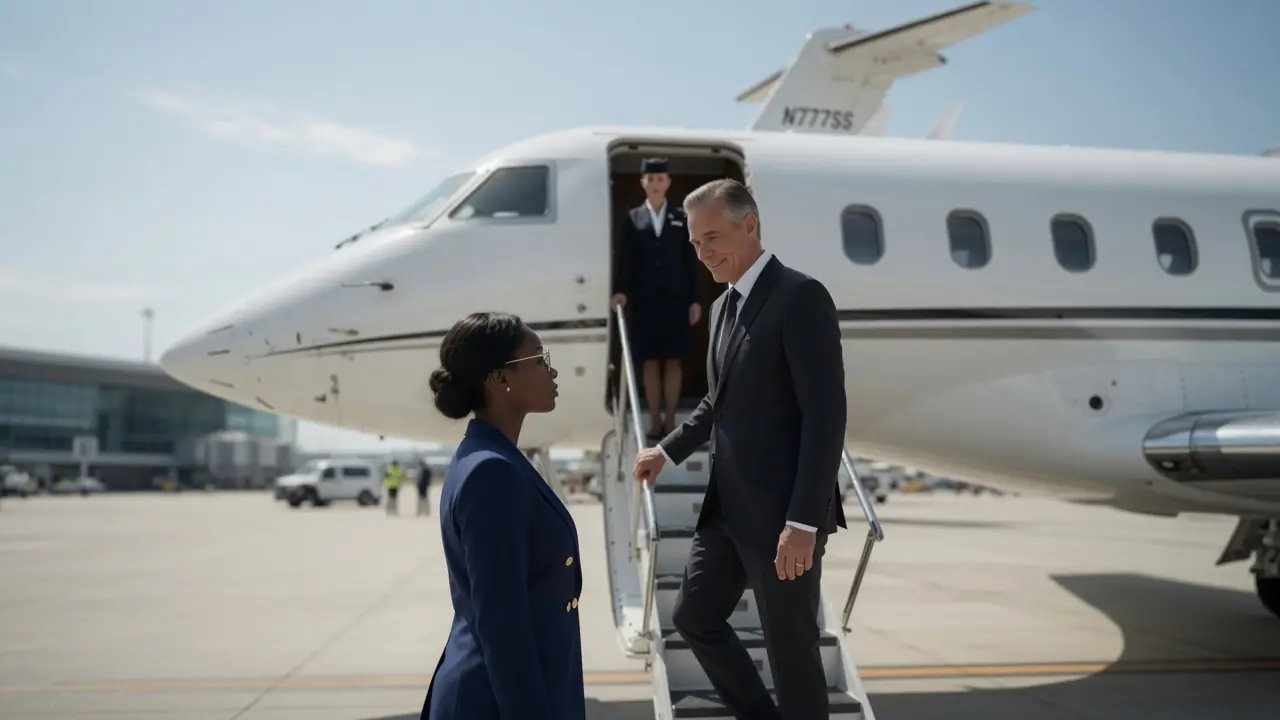
The white Sterling Global jet waited near Hangar Four with its stairs lowered and engines silent. The company’s silver compass emblem appeared near the door, while the registration number was painted beneath the tail. Sophia had approved the aircraft’s purchase three years earlier after determining that commercial travel was costing senior teams too much time. She had personally selected the interior because she wanted working tables instead of decorative bars and oversized televisions.
That morning, the jet was scheduled to carry Sophia and three senior officers to a medical-device plant in Nashville. A production failure had delayed equipment needed by several hospital networks, and Sophia planned to meet factory workers before speaking with investors. She had ordered the flight kept small because she wanted direct answers rather than rehearsed presentations. The passenger list had been confirmed twice by her executive assistant.
Yet someone else was standing at the bottom of the stairs.
Adrian Voss wore a black suit, polished shoes, and the expression of a man accustomed to being recognized before introducing himself. At fifty-six, he served as chairman of Sterling Global’s board and had spent twenty years collecting power through alliances, committees, and carefully managed favors. He had not founded the company, built its products, or managed its employees. Still, he spoke about Sterling Global as though the corporation existed because he permitted it.
A flight attendant named Claire Simmons stood inside the open cabin doorway. She looked uncertain, glancing between Adrian and a tablet in her hands. Captain Robert Hale remained near the cockpit, speaking quietly with a ground technician. Neither appeared to understand why the chairman had arrived for a flight on which he was not listed.
Sophia walked toward the aircraft.
Adrian noticed her when she was twenty feet away. His eyes moved across her suit, shoes, leather case, and empty surroundings. He did not recognize her immediately because they had met only through video conferences during the previous eight months. Sophia had recently cut her hair, and Adrian had spent most virtual meetings looking at his own image or reviewing messages while she spoke.
He stepped directly into her path.
“This area is restricted,” he said.
Sophia stopped. “I’m aware.”
“Then you should return to the terminal.”
“I’m boarding this aircraft.”
Adrian looked toward the jet and then back at her. “No, you are not.”
Sophia studied him for a moment. She knew his face, voice, and board record perfectly. What surprised her was how easily he displayed contempt when he believed the person before him carried no authority. During official meetings, Adrian wrapped every insult in professional language. On the runway, he did not bother.
“My name should be on the passenger list,” Sophia said.
Adrian gave a short laugh. “People say that whenever they wander into private aviation.”
Claire descended one step. “Mr. Voss, I can verify her identification.”
“There is nothing to verify,” Adrian replied. “This jet is reserved for senior Sterling Global leadership.”
Sophia remained calm. “And who are you?”
His expression changed as though the question itself were offensive. “Adrian Voss.”
She waited.
He added, “Chairman of Sterling Global.”
Sophia nodded. “Thank you.”
Adrian looked irritated by her lack of reaction. “Now give security your name and explain how you entered this section.”
“Sophia Sterling.”
The name should have ended the confrontation.
Instead, Adrian smiled.
“You expect me to believe you are related to the company because you borrowed its founder’s surname?”
Claire checked the tablet again. Her face changed when she saw the passenger manifest, but Adrian raised one hand before she could speak.
“This jet is reserved for powerful executives,” he said, turning back toward Sophia. “It is not available to women pretending they belong beside them.”
The ground technician stopped working.
Captain Hale looked toward the stairs.
Sophia felt anger, but she did not show it. Anger often gave arrogant people an excuse to shift attention from their behavior to the reaction it caused. She had learned to let people finish revealing themselves before introducing consequences. Adrian had already said enough to damage his position, but he did not yet understand that.
“Give me your full name and official board position,” Sophia said.
His smile widened. “I already told you.”
“I want you to say it clearly.”
“Adrian Charles Voss, chairman of Sterling Global’s board.”
Sophia removed her phone.
“One call from me can have you removed from this runway,” Adrian continued. “I suggest you leave before this becomes more embarrassing.”
Sophia unlocked the screen. “Good. Corporate now has everything needed to remove you instead.”
He stared at her.
She placed a call to Margaret Sloan, Sterling Global’s general counsel. Margaret answered immediately because Sophia had sent a brief message while walking through the gate. The call connected through the speaker.
“Good morning, Sophia,” Margaret said. “Are you at the aircraft?”
Adrian’s face shifted.
“I am,” Sophia answered. “I’m standing with Adrian Charles Voss, who has blocked me from boarding and identified himself as corporate chairman.”
Silence followed.
Then Margaret spoke carefully. “Mr. Voss is not authorized for today’s flight.”
Adrian stepped closer to the phone. “Margaret, there is a misunderstanding.”
Sophia looked directly at him. “Explain it.”
He lowered his voice. “I did not recognize you.”
“That is obvious.”
“The passenger manifest did not include a photograph.”
“It included my name.”
“I thought she was claiming a connection to you,” Adrian said toward the phone. “She arrived without an escort and refused to follow security procedures.”
Sophia glanced around the open runway. “Which security procedure did I refuse?”
Adrian hesitated.
She continued. “You did not request identification. You did not ask Claire to verify the list. You looked at me and decided I could not belong here.”
“That is not what happened.”
Captain Hale stepped closer. “It is what I witnessed.”
Claire came down another step. “It is also what I witnessed.”
Adrian turned sharply toward them. “Both of you should be careful about involving yourselves in a board matter.”
Sophia heard the threat.
So did Margaret.
“Mr. Voss,” the general counsel said through the phone, “do not intimidate employees who are cooperating with the chief executive.”
Adrian looked around as though searching for someone who might still support him. The technician avoided his eyes. The crew remained near Sophia. For the first time, the chairman understood that authority had shifted without anyone raising a voice.
He reached for control through a different strategy.
“Sophia, I came because the Nashville situation requires board oversight,” he said. “I intended to join the flight and discuss the company’s response privately.”
“You were told yesterday that the flight was restricted to the operational team.”
“As chairman, I do not require permission.”
“You require authorization to board a company aircraft.”
“I represent the board.”
“You represent the board only within the authority granted by its bylaws.”
His jaw tightened.
Sophia had expected Adrian to challenge her leadership eventually. He had opposed her appointment as chief executive, describing her at the time as too young, too operational, and insufficiently respectful of established governance. She was forty-one, had spent sixteen years inside Sterling Global, and had restored two failing divisions before leading the entire company. Adrian’s real objection was simpler.
He could not control her.
For months, Sophia had noticed unexplained delays in board approvals and unusual expenses connected to Adrian’s travel committee. He authorized private flights without clear business purposes, used company properties for personal events, and arranged consulting contracts involving former associates. None of the transactions alone proved serious misconduct. Together, they suggested someone had begun treating corporate resources as personal property.
Margaret’s legal team had been investigating quietly.
The Nashville production crisis had accelerated matters.
Three days earlier, Sophia learned that a supplier called Voss Meridian Components had delivered defective electrical assemblies to the medical-device plant. The company was registered through several holding entities, but investigators traced its beneficial ownership to Adrian’s brother, Jonathan Voss. Adrian had advocated for the supplier without disclosing the family connection.
Now he was attempting to board the jet taking Sophia to the damaged facility.
“You are not traveling to Nashville,” she said.
Adrian’s face hardened. “You do not have the authority to exclude the board chairman from a company investigation.”
“I have the authority to control operational access, corporate transportation, and employee safety.”
“This is about your embarrassment on the runway.”
“No. The runway revealed your judgment. The investigation concerns your conduct.”
Adrian looked toward Margaret’s voice coming from the phone. “What has she told you?”
Margaret answered. “Enough that you should stop speaking without counsel.”
The color left his face.
Sophia closed the distance between them slightly. “Why did you come here, Adrian?”
“To provide oversight.”
“Why is your briefcase packed for three days?”
He looked down instinctively.
The leather case beside the stairs was larger than the documents required for a same-day plant visit. A garment bag also rested near the aircraft door. Adrian had planned a longer trip.
Sophia continued. “The flight plan filed this morning includes an unscheduled continuation from Nashville to Grand Cayman.”
Captain Hale’s expression changed. “That route was added through the chairman’s office.”
Adrian turned toward him. “It was a contingency.”
“For what?” Sophia asked.
“A possible investor meeting.”
“There is no investor meeting.”
Adrian remained silent.
Margaret spoke through the phone. “Sophia, airport security has been notified. They are approaching Hangar Four.”
Adrian’s control finally cracked.
“You called security on the chairman of your own board?”
“I called security because an unauthorized passenger attempted to alter a corporate flight plan during an active financial investigation.”
“You are turning a misunderstanding into a public spectacle.”
“You created the spectacle when you blocked the stairs.”
A black airport vehicle appeared near the hangars.
Adrian looked toward it, then back at Sophia. “Think carefully about what you’re doing. I can call an emergency board session before this plane leaves the ground.”
“I already did.”
He stared at her.
At seven thirty that morning, before leaving home, Sophia had convened the independent directors through a confidential video meeting. Margaret presented preliminary evidence connecting Adrian to the supplier, undisclosed travel, and manipulated committee records. The board voted to suspend his chairman privileges pending a formal hearing if he attempted to interfere with the plant investigation.
The vote had been six to one.
The single opposing vote belonged to Adrian’s closest ally.
“You held a board meeting without me?” he demanded.
“The bylaws permit independent directors to meet when the chairman is the subject of investigation.”
“This is a coup.”
“No. It is governance.”
Two airport security officers arrived with a Sterling Global compliance director named Daniel Price. Daniel carried a sealed folder and walked directly toward Sophia. He acknowledged Adrian with a brief nod but did not shake his hand.
“Ms. Sterling,” Daniel said, “the suspension order has been executed.”
Adrian looked between them. “Suspension?”
Daniel opened the folder and handed him a letter. “Effective immediately, your board travel privileges, executive access, spending authority, and use of company property are suspended.”
“You cannot suspend my board seat on a runway.”
“The independent directors suspended your privileges,” Sophia said. “A formal vote on removal is scheduled for this afternoon.”
Adrian read the document rapidly. “This says nothing about removing me from the board.”
“Not yet.”
He lifted his head. “Then I remain chairman.”
“Temporarily in title, without authority.”
“You planned this humiliation.”
Sophia looked toward the flight attendant, captain, technician, and security officers who had watched him insult her. “I planned an investigation. You supplied the humiliation yourself.”
Adrian tore the suspension letter in half.
Daniel did not react. “That was a courtesy copy.”
The chairman threw the pieces onto the concrete.
One security officer stepped forward. “Sir, we need your airport credential.”
Adrian laughed in disbelief. “You expect me to surrender access to a company facility I oversee?”
“Yes,” the officer said.
Adrian removed the badge from his jacket and placed it inside the officer’s hand with unnecessary force. He then reached for his briefcase near the stairs. Daniel stopped him.
“The bag must be inspected before leaving the restricted area.”
“That is my personal property.”
“It was placed aboard a corporate aircraft during an active evidence-preservation order.”
Adrian gripped the handle. “You have no right.”
Margaret’s voice remained on Sophia’s phone. “Mr. Voss, if you remove the case before inspection, we will seek an immediate court order.”
His eyes moved toward Sophia.
For the first time, fear replaced arrogance.
He released the handle.
Daniel opened the case in Adrian’s presence. Inside were clothing, two phones, several envelopes of foreign currency, and a portable drive labeled with the name of the Nashville supplier. Beneath the drive were signed consulting agreements involving companies unknown to Sterling Global’s legal department.
Captain Hale looked away.
Claire covered her mouth.
Daniel photographed the contents before placing the case inside an evidence bag. “This will remain with outside counsel.”
Adrian’s voice became quieter. “Those files have legitimate explanations.”
“You will have an opportunity to provide them,” Sophia said.
“You believe the board will choose you over me?”
“This is not a contest between us.”
“It always has been.”
The answer revealed more than he intended.
Sophia understood then that Adrian had viewed every operational decision, promotion, and success as a battle for personal dominance. Employees were pieces, budgets were weapons, and company property represented status. He could not imagine leadership existing without an opponent because he had never understood service.
The jet stood behind him, gleaming in the sunlight.
He had blocked Sophia from boarding because he believed the stairs represented access to power. Now he was learning that the aircraft was only transportation. Authority came from responsibility, evidence, and the trust of people willing to follow when no one forced them.
Sophia turned toward Claire. “Is the cabin ready?”
“Yes, Ms. Sterling.”
“Captain?”
“We can depart in twelve minutes.”
Sophia nodded. “Remove Mr. Voss’s luggage and restore the original Nashville flight plan.”
Adrian stepped toward her. “You are leaving while the chairman is under accusation?”
“I am visiting the plant your supplier damaged.”
“You cannot discuss this with employees.”
“I can discuss any fact necessary to protect them.”
“You will destroy confidence in the company.”
Sophia’s expression remained steady. “Confidence is not protected by hiding who caused the failure.”
Adrian lowered his voice so only she could hear. “You think those workers care about you? They care about their paychecks. The moment the numbers fall, they will abandon you.”
Sophia looked at him.
“Maybe,” she said. “But they deserve a leader who arrives before asking whether loyalty is guaranteed.”
She stepped onto the first stair.
Adrian spoke again.
“You would not be doing this if you understood how many people I know.”
Sophia paused and looked back.
“You blocked a woman from her own aircraft because you thought she knew no one. That is exactly why you are losing your seat.”
She climbed into the jet.
Claire followed, while Captain Hale returned to the cockpit. Daniel and airport security remained with Adrian on the runway. The cabin door began closing as he stood beneath the stairs without his credential, luggage, authority, or audience.
Sophia took the seat nearest the working table.
It was the chair Adrian normally claimed during board travel because it faced the cabin and allowed everyone to see him. She had never cared about the position before. That morning, she placed her case there and opened the Nashville production report.
The jet began moving.
Through the window, she saw Adrian standing beside the security vehicle while Daniel spoke on the phone. He appeared smaller as the aircraft turned toward the runway. Moments later, the engines rose, and the ground began falling away.
The formal board meeting took place six hours later.
Sophia attended from a conference room inside the Nashville plant. Behind the glass wall, engineers and assembly workers continued examining the defective components. She had spent the afternoon listening to technicians, reviewing inspection records, and promising employees that no one would lose work because executives had hidden the truth.
Adrian joined the meeting with two attorneys.
He denied personal ownership of Voss Meridian Components and claimed his brother’s involvement had been unknown to him. Outside counsel presented bank records showing that Adrian received payments through a consulting entity linked to the supplier. The portable drive from his briefcase contained draft contracts, internal pricing discussions, and instructions to suppress quality concerns.
The evidence was overwhelming.
The board voted nine to one to remove Adrian as chairman.
His closest ally abstained.
A week later, Adrian resigned from the board entirely after federal investigators opened an inquiry into undisclosed related-party transactions, wire transfers, and attempted destruction of corporate records. Sterling Global canceled every contract connected to Voss Meridian Components and filed suit to recover losses. Adrian’s name disappeared from the company website before the month ended.
Sophia did not celebrate publicly.
The production failure had delayed essential medical equipment and damaged trust with hospitals. Removing one dishonest executive did not repair the systems that allowed him to operate without challenge. She appointed an independent ethics committee, created direct reporting channels for plant employees, and required board members to disclose family business relationships annually.
She also changed the private-flight policy.
Passenger manifests now required verification by crew members rather than permission from the highest-ranking person near the aircraft. No executive, including Sophia, could override safety or identification procedures through title alone. Crew members who raised concerns received formal protection against retaliation.
Claire Simmons became training director for executive aviation.
Captain Hale joined a compliance panel focused on unauthorized route changes.
The ground technician received a written commendation for preserving operational records after noticing Adrian’s unusual instructions.
Sophia understood that people often saw corruption before leaders did. What they lacked was confidence that speaking would not cost them their livelihood. A company that punished inconvenient truth would eventually be governed by comfortable lies.
Three months later, Sophia returned to Hawthorne Executive Airfield.
She arrived without an entourage again.
A newly hired security officer stopped her politely before she reached the aircraft. He requested identification, compared it with the passenger list, and contacted the crew when the digital record briefly failed to load.
Sophia waited.
The young officer appeared nervous when the system finally displayed her title.
“I apologize, Ms. Sterling.”
“For what?”
“For delaying you.”
“You followed procedure.”
He looked relieved.
Sophia continued toward the aircraft, then stopped. “What would you have done if I demanded you let me through?”
“I would have called my supervisor.”
“Good.”
She boarded only after Claire confirmed the manifest.
Inside the cabin, Adrian’s former seat remained beside the working table. Sophia sat across from it and reviewed the company’s recovery report. Nashville production had returned to schedule, hospital orders were shipping, and employees had received bonuses from money recovered through canceled supplier payments.
The empty chair carried no emotional power.
It did not represent revenge or victory.
It represented a lesson.
Adrian believed a seat belonged to whoever looked important enough to claim it. He judged Sophia before asking her name, threatened employees before hearing them, and treated corporate resources as evidence of personal superiority.
Sophia believed a seat belonged to whoever accepted the responsibility attached to it.
The difference ended his career.
Months later, a business magazine requested an interview about the runway confrontation. The reporter wanted a dramatic account of Adrian’s expression when he learned Sophia owned the jet. She declined to describe the moment as a personal triumph.
“The important question is not whether he recognized me,” she said. “It is how he treated someone he believed had no power.”
The quote became the most widely shared statement from the interview.
Employees printed it inside offices.
Universities included it in leadership discussions.
Claire placed a small copy near the crew entrance of the Sterling Global jet.
Sophia saw it during a later flight and smiled.
She had boarded her own aircraft that morning, but ownership had never been the real issue. Adrian would have been equally wrong if she had been a cleaner, assistant, supplier, or passenger who entered the wrong area and needed directions.
Respect should not depend on discovering that the person being humiliated can punish you.
The corporate chairman learned that lesson too late.
He blocked Sophia Sterling from her own jet because she did not look powerful enough to belong there.
Before the wheels left the runway, she removed every privilege he had mistaken for power and left him standing beneath an empty staircase.
The jet carried Sophia toward the employees who needed her.
Adrian remained behind with the title he had abused already disappearing from the company he thought he controlled.