The laughter began before the first fish ever touched the water.
Margaret Hale remembered the exact afternoon it started. Rain tapped against the windows of the county cooperative conference room while farmers filled every folding chair, balancing paper cups of coffee on their knees. Fertilizer prices covered one wall, commodity charts covered another, and every conversation returned to the same problem: the soil was tired. Fields that had once produced generously now demanded more chemicals, more irrigation, and more money just to deliver the same harvest.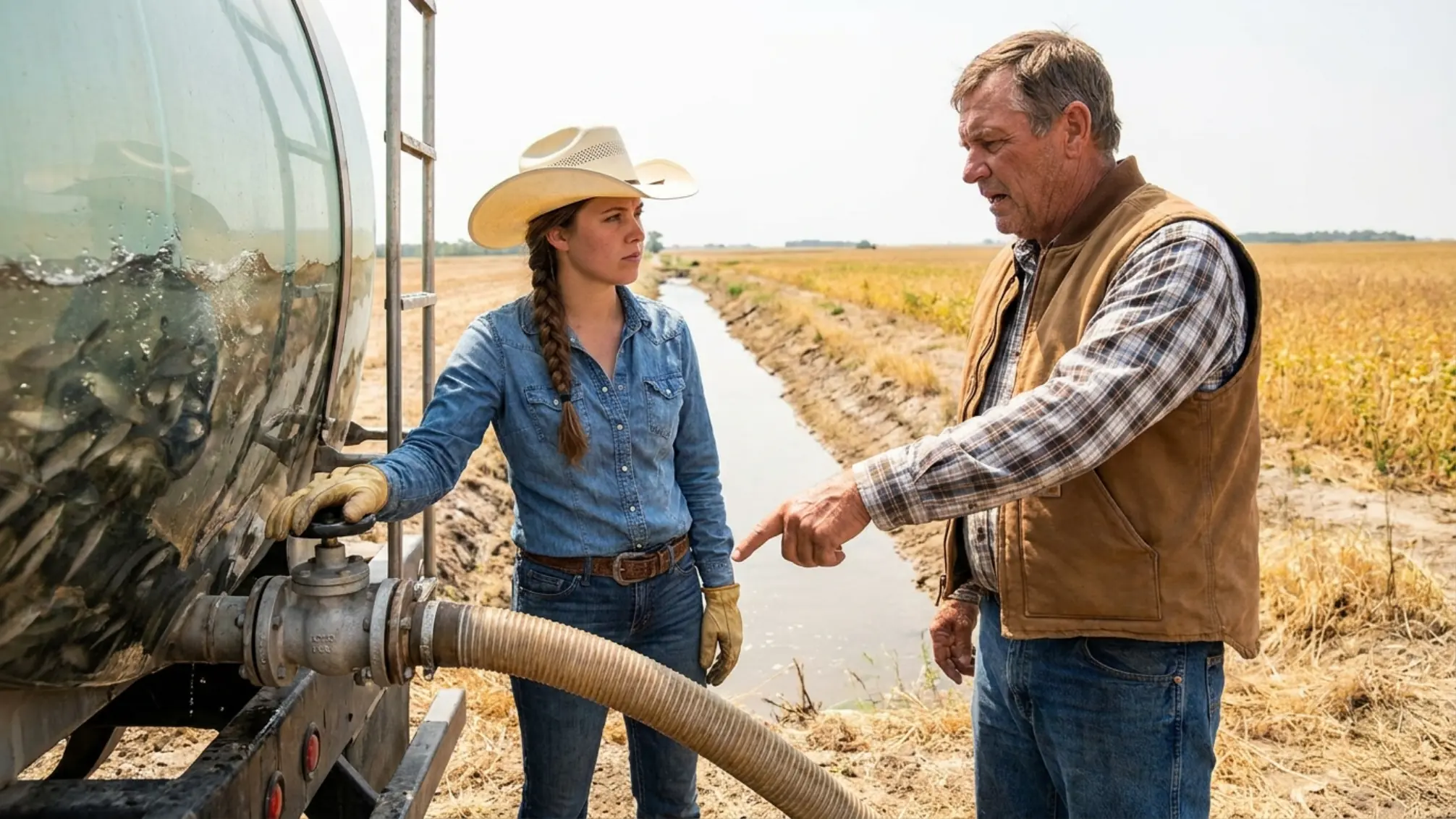
Margaret sat near the back in a fitted blue denim shirt, dark jeans, and mud-stained boots. Her long dark hair was braided beneath a cream cowboy hat, and the expression in her green eyes immediately made Dale Harper suspicious.
He leaned back and pointed his coffee cup at her.
“Oh, no.”
Margaret looked over. “What?”
“That look.”
“What look?”
“The idea look.”
The room laughed because everyone recognized it. Margaret rarely attended a meeting unless she wanted answers or believed she had found one, and neither situation usually ended quietly.
The cooperative manager sighed. “What are you thinking, Margaret?”
She stood, walked to the whiteboard, and drew a long irrigation ditch. Then she added several smaller channels branching toward fields. Finally, she drew a row of fish in the water.
Silence settled over the room.
Dale stared at the board. “No.”
Margaret turned. “No what?”
“The fish.”
“Yes.”
“Why are there fish in the irrigation ditch?”
“That is the idea.”
The silence broke into laughter.
Margaret waited until it faded. “We move irrigation water through miles of channels every year. The water carries sediment, grows algae, and reaches soil that is steadily losing organic matter. Fish produce nutrients, disturb settled material, consume algae, and contribute biological waste.”
Dale rubbed his forehead. “You want to put fish in drainage mud.”
“I want to put tilapia in controlled irrigation channels.”
“On a soybean farm.”
“Yes.”
“You are opening a seafood restaurant now?”
The room laughed again, louder this time.
Margaret returned to her chair without arguing. She knew the difference between skepticism and amusement. Skepticism asked for evidence. Amusement dismissed an idea before anyone bothered to understand it.
For weeks afterward, the jokes followed her everywhere. At the diner, men asked whether she planned to serve grilled tilapia beside the tractor shed. At church, someone wanted to know whether the baptismal pool needed stocking. Dale announced that Hale Farm would soon be offering fishing licenses with every seed order.
Margaret ignored most of it.
Privately, however, she kept studying.
The Hale farm stretched across nearly six hundred acres of Missouri bottomland. Her grandfather Samuel had described its soil as black cake batter—dark, soft, and alive. By the time Margaret inherited the operation, the ground was still productive, but it behaved differently. Water disappeared too quickly after rain, organic matter had declined, and each season demanded larger fertilizer purchases.
Samuel had noticed the change years earlier.
When Margaret was fourteen, she followed him into a soybean field after a hard summer storm. The surface looked wet, but when he dug several inches down, the soil crumbled dry between his fingers.
“Feel that,” he said.
Margaret took a handful. “It just rained.”
“I know.”
“What is wrong with it?”
Samuel tossed the dirt aside. “Nothing yet.”
The answer stayed with her because she eventually understood what he meant. The land had not failed, but it was moving in that direction. Healthy soil held water, supported organisms, and recovered from heat. Tired soil depended on constant rescue.
After Samuel died, Margaret inherited hundreds of his notebooks. He recorded rainfall, earthworm counts, planting dates, crop failures, and ideas that had seemed strange during his lifetime. Several volumes focused almost entirely on biology—microbes, insects, organic matter, and natural nutrient cycles.
One winter evening, while reading agricultural research from other parts of the world, Margaret discovered integrated fish-and-crop systems. Farmers used water, fish waste, sediment, and plant production as parts of the same cycle.
She did not believe Missouri irrigation ditches could simply copy a rice field in Asia. The climate, crops, and management were different. But the principle remained fascinating.
Biology could support more biology.
The following spring, Margaret ordered several thousand juvenile tilapia for a limited experiment. They would occupy only selected lined ditches with controlled water flow, screens at the outlets, oxygen monitoring, and emergency holding tanks. She filed permits, consulted a water specialist, and prepared records for every variable she could measure.
The delivery truck attracted half the county.
Dale arrived first.
He climbed out of his pickup, stared at the specialized tanks, then looked at Margaret standing beside the release hose.
“No.”
She smiled. “Morning.”
He pointed dramatically at the truck. “You actually did it.”
“I said I would.”
“This is a farm.”
“I noticed.”
“Fish belong in ponds.”
“Today they belong in my ditch.”
Dale stepped in front of the valve. His faded plaid shirt was damp with sweat, and his weathered face carried the confidence of a man who expected Margaret to surrender once ridicule became confrontation.
“Dump those fish in that channel, and I will have the county shut this circus down before sunset.”
Margaret moved closer until only the hose separated them.
“Try it, Dale. My permits are legal, the outlets are screened, and every test the county requested is complete.”
“That paper will not save you when they rot and poison the water.”
“You should read the monitoring plan before pretending you understand it.”
His eyes hardened. “When this fails, I will buy the farm after the bank takes it.”
Margaret reached around him and wrapped one gloved hand around the valve.
“Then watch closely. When the harvest numbers arrive, you will be the first man forced to explain why the fish worked.”
She opened the line.
Water surged through the hose, carrying hundreds of fingerlings into the irrigation channel. Silver bodies flashed beneath the surface before disappearing downstream. Children cheered, workers adjusted the screens, and neighboring farmers laughed as though they were witnessing the beginning of a public disaster.
The first weeks were not impressive.
Some fish died from handling stress, and Margaret recorded every loss. Water temperatures shifted more sharply than expected during cold nights, forcing her to deepen two channel sections and install shaded refuge pools. A clogged outlet raised the water level one afternoon, and Nathan Hale spent three hours clearing leaves before the bank overflowed.
Dale visited often enough to appear interested in her failure.
He would stand beside the ditch with his arms folded and ask whether dinner was ready.
Margaret continued measuring oxygen, turbidity, algae, fish growth, sediment depth, and nutrient content. She documented every mistake instead of hiding it. If the experiment failed, she wanted to know why rather than protect her pride.
By midsummer, something unexpected became visible.
The fish were surviving.
Not all of them, but enough to establish a stable population within the managed channels. They fed on algae and organic material, reducing the thick green mats that usually clogged gates during hot weather. Their movement stirred fine sediment, preventing the heavy accumulation Margaret had battled each irrigation season.
The water looked cleaner.
Dale claimed that clean-looking water proved nothing.
Margaret agreed.
She wanted measurements, not appearances.
Her younger sister Emily joined her one evening beside the widest ditch. Hundreds of tilapia moved beneath the sunset, disturbing the reflected clouds.
“Still think this works?” Emily asked.
Margaret watched the current. “Maybe.”
“That sounds optimistic.”
“No. Optimistic is buying fish. This is observation.”
Summer became autumn without disaster.
The tilapia grew more quickly than Margaret expected. The channels continued carrying irrigation water normally, and algae remained noticeably lower. Most neighbors lost interest because slow success was less entertaining than sudden failure.
Margaret, however, noticed subtle differences in the nearby fields.
Soybeans growing closest to the stocked irrigation network had darker leaves. The soil beneath them remained damp longer after watering, and earthworms appeared in places where she had rarely found them during previous seasons.
The changes were too small to prove anything, but they were consistent enough to investigate.
She invited crop consultant Daniel Foster to walk the fields.
Daniel knelt near the ditch, dug into the soil, and squeezed a dark handful between his fingers.
“Have you changed your fertilizer program here?”
“No.”
“Added compost?”
“Not in this section.”
He broke apart the soil and studied the roots. “There is more biological activity.”
Margaret felt her pulse quicken. “How much more?”
“I cannot tell without testing.”
He looked toward the ditch.
“What is in that water?”
Margaret smiled. “You already know.”
Daniel stared at the fish.
“That cannot be the explanation.”
“Then we should test until we find another one.”
The laboratory results showed higher microbial respiration near several stocked channels. Organic nitrogen levels had risen slightly, and water infiltration improved in the closest soil zones. None of the numbers was dramatic enough to support a grand claim.
But they were not random.
Margaret expanded the experiment the following year.
She stocked more tilapia, divided the farm into comparison zones, and installed monitoring equipment along both fish-managed and conventional irrigation channels. She measured soil carbon, moisture retention, sediment, algae, nutrient concentration, earthworm populations, and crop performance.
“If people are going to laugh,” she told Emily, “I want enough evidence to make them work for it.”
The second season tested her confidence more severely than the first.
A spring storm washed debris into one channel and killed nearly two hundred fish before oxygen could recover. A pump failure stranded another section in shallow water. Margaret spent an entire night moving tilapia by hand into emergency tanks while cold rain soaked through her jacket.
At dawn, Dale found her kneeling beside the ditch.
He examined the dead fish floating near the bank.
“Looks like I was right.”
Margaret rose slowly. Mud covered her jeans, and exhaustion darkened the skin beneath her eyes.
“About what?”
“They cannot survive here.”
“A pump failed.”
“Fish died.”
“Then I will build a backup system.”
“You never know when to stop.”
She stepped toward him. “And you never know the difference between a failed idea and a correctable problem.”
Dale pointed at the water. “That is money floating belly-up.”
“It is data.”
“It is stupidity.”
Margaret’s expression turned cold. “Call me stupid again on my land, and you will leave without the truck you arrived in.”
Dale’s confidence flickered.
Nathan appeared behind her carrying a wrench, and Dale wisely backed away.
“You are going to ruin yourself proving a point,” he said.
Margaret looked at the failed pump. “I am trying to improve soil. You are the one desperate to make it personal.”
She installed redundant pumps, emergency overflow channels, and temperature alarms. Fish survival improved during the rest of the season, while the stocked ditches stayed cleaner than the control sections.
Then the harvest numbers arrived.
Margaret initially assumed the yield monitor was wrong.
Color-coded maps showed stronger production in field sections nearest the fish-managed irrigation channels. The pattern followed the water network so closely that it looked as though someone had traced the ditches across the screen.
She recalibrated the system.
The pattern remained.
She compared moisture maps, soil tests, and planting records. Seed population, fertilizer rates, and pest pressure had been nearly identical across the test zones.
Yet the ditch-adjacent fields produced enough additional grain to matter financially.
Emily found Margaret sitting before the computer late one evening.
“You have been staring at that map for an hour.”
“Yes.”
“Good staring or bad staring?”
Margaret pointed at the screen.
“The highest-performing zones follow the fish channels.”
Emily leaned closer. “All of them?”
“Almost perfectly.”
For the first time since the experiment began, Margaret allowed herself to smile without caution.
The official harvest report spread through the county within days.
Dale entered the diner carrying a printed copy, sat heavily at the central table, and slapped the pages beside his coffee.
“No.”
Rick Mason looked up. “What happened?”
Dale pointed at the yield map.
“Fish.”
The table became silent.
The third year brought more visitors.
Consultants wanted water samples. Agricultural students requested soil data. Conservation officers inspected the outlet screens and confirmed that the tilapia remained inside the managed system.
Some experts remained skeptical, as Margaret expected. The improved yields might result from several interacting factors: reduced algae, nutrient cycling, better sediment distribution, higher microbial activity, or differences in water quality.
Margaret did not claim the fish alone had transformed the farm.
She said only what the data supported.
The integrated channels appeared to improve the irrigation environment, and the nearby soil was responding.
One consultant stood beside the water for nearly an hour before admitting, “What bothers me is that I cannot explain which part matters most.”
Margaret watched the tilapia circle beneath the surface. “Maybe biology likes biology.”
“That is not a scientific answer.”
“No, but it may be where the scientific answer starts.”
Then the drought came.
Rain disappeared in early May and did not return in meaningful amounts for weeks. Temperatures climbed, pastures browned, and corn leaves curled across the county. Farmers ran pumps longer while wells dropped and irrigation expenses rose.
The Hale fields suffered too, but not equally.
Crops nearest the fish-managed channels remained greener. Soil there retained moisture longer and accepted irrigation water more effectively instead of allowing it to rush away across hardened surfaces.
The fields were not immune to drought.
They were simply more resilient.
Dale drove to the farm one evening and found Margaret standing beside the original ditch. The setting sun turned the water copper while tilapia moved through the shadows.
He climbed out without greeting her.
For several seconds, he stared at the field beyond the channel. Crops on his side of the county road had already begun yellowing. Margaret’s were stressed but still upright.
“No,” he said.
She laughed. “Good evening.”
“This should not work.”
“Apparently, it does something.”
“For three years, I have been waiting for it to fail.”
“I know.”
“It is becoming irritating.”
Margaret laughed harder than she expected.
Dale kicked at the soil near the ditch. It broke apart dark and soft beneath his boot.
“What did you add here?”
“Less than before.”
“That does not make sense.”
“The fish contribute nutrients. Cleaner channels improve flow. Biological material moves into the soil. Better soil holds water. There may be other factors.”
“You sound uncertain.”
“I am uncertain.”
He looked surprised.
Margaret folded her arms. “Uncertainty is why I keep collecting evidence. Confidence without evidence is what you brought to the first stocking day.”
Dale stared at the water.
“Can I see your numbers?”
“You made fun of them before they existed.”
“I am asking now.”
Margaret handed him the printed summary from her truck.
That evening marked the beginning of the county’s slow change in attitude. People had first mocked the experiment, then ignored it, then questioned it. Now they began visiting.
University researchers installed sensors along the ditches. Soil scientists measured microbial communities. Water specialists studied sediment movement, algae reduction, and nutrient distribution.
One professor spent three afternoons collecting samples before telling Margaret, “You may have stumbled onto something important.”
“Accidentally?”
“Most discoveries begin when someone notices what everyone else dismissed.”
By the fourth year, several farms quietly copied parts of the system.
Nobody announced it publicly.
Margaret discovered Dale’s attempt by accident.
She was driving past his south field when she noticed a new screen across an irrigation outlet. She stopped, climbed from the truck, and walked toward the ditch.
Juvenile tilapia scattered beneath the water.
Dale emerged from behind a pump housing.
For a long moment, neither spoke.
Margaret pointed downward. “Fish.”
“Leave.”
“You bought fish.”
“Get off my property.”
“You spent three years calling me insane.”
“Margaret.”
“You threatened to buy my farm after they poisoned the mud.”
Dale pointed toward her truck. “Go.”
She laughed all the way back to the road.
The fifth season brought the clearest results yet.
Organic matter had increased gradually in several test zones. Earthworm counts rose, soil structure improved, and irrigation efficiency strengthened. Fertilizer costs stabilized because Margaret could reduce some inputs without sacrificing production.
The farm looked healthier.
Not transformed into some impossible paradise, but more balanced and more capable of recovering from stress.
The county cooperative invited Margaret to speak in the same conference room where the laughter had begun.
Every seat was filled again.
Dale sat in the front row with his arms folded. This time, he did not interrupt when Margaret drew irrigation channels on the whiteboard.
She presented five years of data, including failures, fish losses, pump problems, costs, yield comparisons, water-quality records, and soil results. She explained that the system required careful screening, monitoring, climate control, and legal compliance. It was not a trick that could be copied carelessly.
A farmer near the back raised his hand.
“So the fish saved your farm?”
Margaret shook her head. “No.”
The room waited.
“The fish became one part of a larger biological system. They helped us manage algae, cycle nutrients, disturb sediment, and increase organic inputs. But cover crops, reduced tillage, better irrigation timing, and careful monitoring mattered too.”
Dale lifted his hand.
Margaret looked at him cautiously. “Yes?”
“What would you tell someone who laughed before seeing the numbers?”
Several farmers smiled.
Margaret held his gaze.
“I would tell him to bring his soil tests and stop pretending pride is evidence.”
The room erupted, though this time Dale laughed with everyone else.
Years after the first stocking, people still remembered the fish more than anything else. Visitors came expecting to see thousands of tilapia swimming through irrigation ditches, and children leaned over the banks to watch them move beneath the surface.
Margaret appreciated the attention, but she always redirected it toward the soil.
One evening, she stood beside the original channel as sunlight spread across the fields. Emily joined her and looked down at the water.
“You know what I find funny?”
“What?”
“Everyone remembers the fish.”
Margaret smiled.
“They should remember the soil.”
The experiment had never truly been about proving that fish belonged on a farm. It had been about questioning why the land required more help every year while producing less resilience.
The tilapia did not perform a miracle.
They simply became part of a cycle modern farming had nearly forgotten—the idea that water, animals, plants, microbes, and soil were not separate machines operating beside one another. They were parts of the same living system.
The county had laughed because Margaret drew fish inside a ditch.
Five years later, several of those same farmers stood beside their own irrigation channels, watching silver bodies move through the water while healthier soil darkened beneath their boots.
And Dale Harper never made another seafood joke without first checking whether Margaret was close enough to hear it.