The old leather book fell from beneath the loose floorboard just before sunset.
Clara Whitmore had entered the north barn looking for a missing foaling record, not a secret capable of dividing her life into everything she believed before that evening and everything she would be forced to understand afterward. She had moved a cracked grain chest away from the wall when one of its iron feet caught beneath a warped plank. The board lifted, revealing a narrow space filled with dust, mouse nests, and a package wrapped in oilcloth.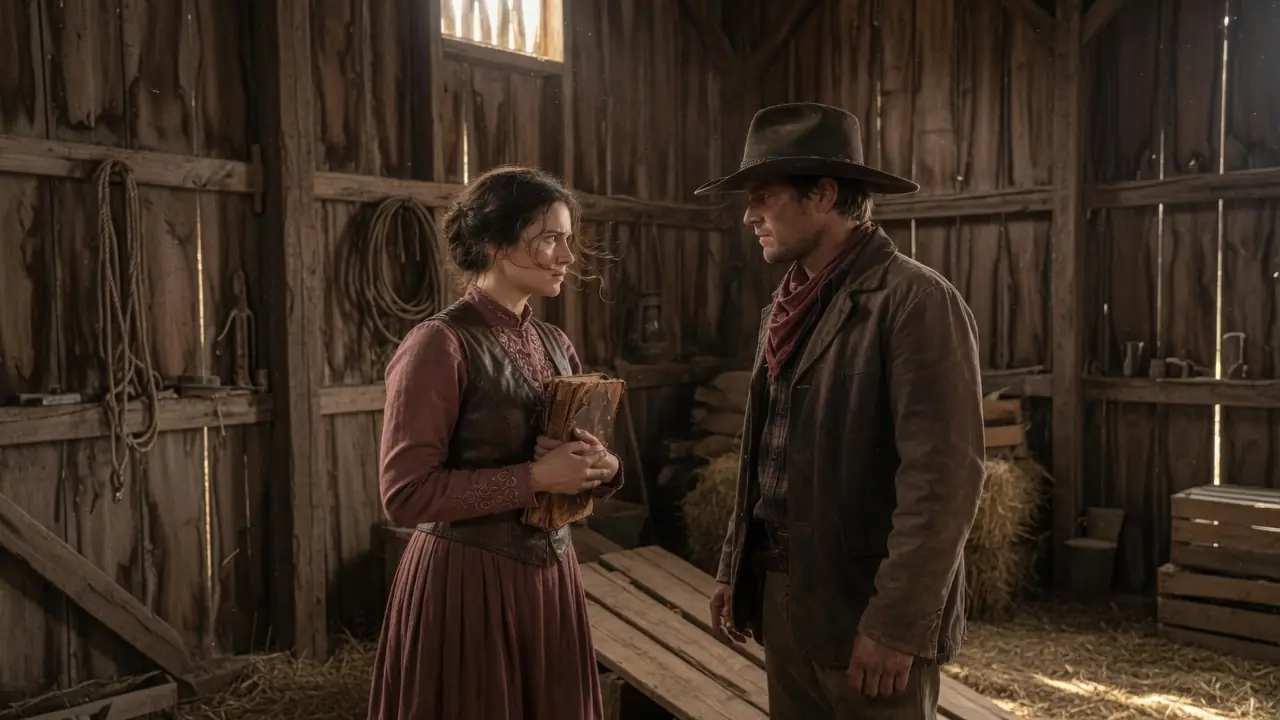
Inside the package was a ledger.
Its brown leather cover had hardened with age, and several pages had been stained by water. The first half contained ordinary ranch accounts written in her grandfather’s careful hand: cattle purchases, fencing costs, wages, and winter feed. The entries changed near the middle, where several pages had been cut away with a knife.
Clara sat on the barn floor and continued reading.
A folded survey map had been pressed between two pages dated eighteen years earlier. The map showed the original Whitmore boundary ending at Cottonwood Creek. Beyond the creek lay four hundred and eighty acres marked DAWSON PROPERTY in dark blue ink.
On the official county maps, that land belonged to the Whitmores.
Clara knew every acre of it. She had ridden across Dawson Ridge since childhood, gathered wildflowers near its eastern slope, and watched her father graze cattle there during dry seasons. He had always claimed the Dawson family abandoned the land after debts destroyed them.
The ledger told another story.
A payment of six hundred dollars had been made to Deputy Recorder Silas Crane three days before a new boundary deed appeared at the county office. Another entry listed “legal correction expenses” beside the name of Clara’s father, Horace Whitmore. Beneath it was a copy of the altered deed carrying the signature of Caleb Dawson’s father.
Clara had seen Jacob Dawson’s handwriting before.
The signature was false.
She stared at the page until the words began losing their shape. The dusty barn, the horses shifting behind the stall doors, and the evening light pouring through the roof seemed to move farther away. Her father had not purchased the Dawson land.
He had stolen it.
A floorboard creaked behind her.
Clara turned quickly.
Caleb Dawson stood in the open barn doorway with one hand resting against the frame. He was thirty-four, tall and broad-shouldered, with a weathered face shaped by years beneath the Wyoming sun. Dust covered his boots, and his brown work shirt clung to his back after a long day repairing the western fence.
His eyes moved from Clara to the ledger.
The color left his face.
“Where did you find that?” he asked.
“Under the floor.”
Caleb remained in the doorway.
Clara rose slowly, holding the ledger against her chest. She had known Caleb most of her life, though their closeness had grown only during the previous two years. He had worked for the Whitmore ranch since he was eighteen, first breaking horses and later managing the cattle drives.
He knew the land better than anyone.
He also avoided Dawson Ridge whenever possible.
Clara had once assumed the place carried painful memories because his parents had failed there. She now understood that he had been forced to work beside land taken from his own family. Every fence he repaired and every animal he moved across the ridge had reminded him of what the Whitmores possessed because his father had been cheated.
“You knew,” Clara said.
Caleb did not deny it.
“How long?”
“Since my father died.”
“That was twelve years ago.”
“Yes.”
Clara opened the ledger to the forged deed.
“Why did you hide the truth after my father stole your family’s land?”
Caleb looked toward the horses rather than at her.
“Because I’m too big, too rough, and too ruined for a woman like you.”
The answer struck her as strangely cruel.
“Do not turn this into something about your boots and your shirt.”
“It has everything to do with who we are.”
“My father forged a deed.”
“And you are his daughter.”
Clara stepped closer.
“You believe blood makes me part of his crime?”
“No.” Caleb’s voice broke slightly. “I believed the truth would break something inside you, and then you would look at me and wonder whether every kind word I ever gave you was meant to get the land back.”
Clara stopped.
During the past two years, Caleb had taught her to repair a saddle strap, carried her home after a horse threw her, and sat beside her through the night when her mother died from pneumonia. He had never asked for money, property, or recognition. He had kept his feelings guarded, but Clara had seen them in the way he always noticed when she was tired and in how he moved between her and danger without making her feel weak.
Now she understood what he had hidden beneath that loyalty.
“You stayed silent to protect me while my own family buried yours,” she said.
Caleb finally met her eyes.
“And now that you know, Clara, I may lose the only thing I never wanted to take from them—you.”
The words left the barn quiet.
Clara wanted to step toward him. She also wanted to run into the house, place the ledger in front of her father, and demand that he explain every stolen acre. Anger, grief, and love pressed against one another until she could not separate them.
“Did my father know you knew?” she asked.
“No.”
“How did you find out?”
“My father kept a copy of the original survey inside his Bible. Before he died, he told me Horace offered him fifty dollars to leave the county and never challenge the deed.”
“And your father accepted?”
“He spat blood on the floor and told him no.”
Jacob Dawson had been ill by then, weakened by years in the mines before he returned to ranching. He tried to challenge the deed, but Silas Crane claimed the original survey had been lost in a courthouse fire. Horace controlled the local bank, the cattle association, and nearly every man willing to testify.
Jacob had no money for attorneys.
Caleb was twenty-two when his father died inside a rented cabin two miles from the land he once owned. His mother had already passed, and his younger brother had gone east to work for the railroad. Caleb remained because leaving felt like allowing the theft to become permanent.
“Then you came to work for us,” Clara said.
“I needed food.”
“That was the only reason?”
“At first.”
“And later?”
Caleb’s jaw tightened.
“Later, leaving meant leaving you.”
Clara closed her eyes.
She remembered the afternoon three months earlier when they had sheltered beneath a cottonwood during a storm. Caleb had almost kissed her, then stepped away and said she deserved someone from her own world. She had believed pride or fear kept him distant.
Now she knew shame had been doing the work.
“You should have told me,” she said.
“What would you have done at nineteen?”
“I don’t know.”
“Neither did I.”
“I am not nineteen anymore.”
“No.”
“Then why keep hiding it?”
Caleb looked at the ledger.
“Because every year made the truth harder. Your mother became ill. Your father gave me more responsibility. You trusted me. Then you began looking at me like I might be more than a hired hand.”
“And you thought silence was kinder?”
“I thought losing the land was easier than watching you hate me.”
Clara’s anger rose.
“You decided for me.”
“Yes.”
“You allowed me to love a version of my father that was not real.”
Caleb flinched.
“I know.”
“You allowed me to believe your family failed because they were careless.”
“I know.”
“And every time I spoke proudly about what the Whitmores built, you stood there and said nothing.”
“What did you want me to say?”
“The truth.”
Caleb stepped closer.
“The truth is your father stole everything my parents worked for. The truth is I spent half my life angry enough to burn his house down. The truth is that when I met you, I hated you before you ever spoke because you carried his name.”
Clara’s face went pale.
Caleb continued before courage failed him.
“Then you brought food to my father when he was sick. You sat outside his cabin because he was too proud to let you clean it. You cried when he died, though he had barely spoken kindly to you.”
Clara remembered Jacob Dawson as a hard, bitter man who refused help but accepted her mother’s soup. She had never understood why he stared at her with such sorrow. Perhaps he had seen a child growing inside the comfort purchased by his ruin.
“I stopped hating you,” Caleb said. “That made everything worse.”
Clara looked down at the ledger.
“Does anyone else know?”
“Amos Reed knew part of it. He was there when the old fence was moved.”
“The blacksmith?”
Caleb nodded.
“He signed a statement for my father, but Horace threatened to call in the mortgage on his shop. Amos burned his copy.”
“Is he still alive?”
“He lives outside Cheyenne.”
Clara closed the book.
“I am taking this to my father.”
Caleb caught her wrist, then immediately released it when she looked down at his hand.
“Do not confront him alone.”
“Why?”
“Because men who hide crimes for eighteen years do not become harmless when someone finds the papers.”
“My father would never hurt me.”
Caleb’s expression did not change.
“You believed he would never steal land either.”
The sentence followed Clara into the house.
Horace Whitmore sat in the study reading a cattle report beside the fireplace. He was sixty-three, silver-haired, and still physically powerful despite the stiffness developing in his left leg. His portrait hung behind the desk beneath those of his father and grandfather.
He looked up when Clara entered.
“You found the foaling records?”
She placed the ledger on his desk.
Horace stared at it for several seconds.
Then he closed the study door.
“Where was this?”
“Under the north barn floor.”
His hands remained flat on the desk.
“Who else has seen it?”
“Caleb.”
Something cold entered his face.
“So Dawson finally showed you.”
“I found it myself.”
“He has been waiting for this opportunity.”
Clara felt the first piece of Caleb’s fear become real.
“You think he planted the ledger?”
“I think a bitter man can wait a long time for revenge.”
“The entries are in Grandfather’s handwriting.”
“Some of them.”
“The deed contains Jacob Dawson’s forged signature.”
Horace leaned back.
“You do not understand what happened.”
“Then explain it.”
He walked toward the window and looked across the property. From there, Dawson Ridge rose beyond the pasture, dark against the evening sky.
“Jacob Dawson owed money to everyone in the county,” Horace said. “He could not manage the land.”
“That does not give you permission to steal it.”
“I saved it from collapse.”
“For yourself.”
“For this family.”
Clara opened the ledger again.
“You paid Silas Crane six hundred dollars.”
“To correct an inaccurate boundary.”
“The original map shows the creek as the boundary.”
“The map was wrong.”
“Then why forge Jacob’s signature?”
Horace turned sharply.
“Be careful what you accuse me of.”
“Did you sign his name?”
Silence answered.
Clara felt her last hope disappear.
Her father moved closer.
“The Dawsons would have lost the property within a year. Jacob was sick, the taxes were unpaid, and Caleb was a wild boy incapable of keeping cattle alive. I consolidated the land before outsiders bought it.”
“You could have purchased it honestly.”
“Jacob refused every offer.”
“So you decided his refusal did not matter.”
Horace struck the desk with his palm.
“I did what was necessary.”
The old phrase sounded different now.
Clara had heard him use it when dismissing workers, negotiating prices, and refusing her mother’s requests to help struggling families. She had always thought necessity meant strength.
Now it meant permission.
“Return the land,” she said.
Horace laughed once.
“You have no idea what you are asking.”
“I am asking you to return what you stole.”
“The north herd grazes there. The spring water rights run through that acreage. Without it, the Whitmore ranch loses nearly half its value.”
“Then half our value was never ours.”
Horace stared at her.
“This is Caleb’s work.”
“He tried to stop me from confronting you alone.”
“Because he wants you afraid.”
“He has known for twelve years and asked for nothing.”
Horace’s mouth tightened.
“That man has been looking at you as though he owns the future.”
“He has never treated me like property.”
The words struck deeper than Clara intended.
Her father’s expression hardened.
“You will stay away from him.”
“I am thirty years old.”
“You are my daughter.”
“That does not make me yours to command.”
Horace moved around the desk.
“Caleb Dawson wants the land, the ranch, and you.”
“He could have exposed you years ago.”
“He waited until you trusted him.”
“No.” Clara held up the ledger. “He waited because he knew the truth would destroy my faith in you.”
Horace’s face changed.
For one brief second, guilt appeared.
Then pride covered it.
“You will give me that book.”
Clara stepped back.
“No.”
“That ledger belongs to the Whitmore estate.”
“It proves a crime.”
“It proves nothing without the missing county records.”
“Amos Reed may testify.”
Fear flashed in Horace’s eyes.
Clara saw it.
Her father reached for the book.
The study door opened.
Caleb stood in the doorway with two ranch hands behind him. He had followed Clara to the house after all, not because he doubted her strength but because he knew Horace’s desperation better than she did.
Horace’s voice became dangerous.
“You are dismissed.”
Caleb remained still.
“I expected that.”
“You will leave this ranch tonight.”
Clara moved beside him.
“He stays.”
Horace stared at his daughter.
“You would choose a hired hand over your own blood?”
“I am choosing the truth over a thief.”
The words struck the room like a gunshot.
Horace stepped back.
Caleb looked at Clara, pain and love crossing his face at once. He had spent years fearing this moment, believing she would hate him for revealing what her father had done. Instead, she stood beside him.
That did not make the choice easy.
It made it honest.
They left the ranch before midnight.
Clara packed one suitcase, her mother’s jewelry, and the ledger. Horace ordered every employee to remain loyal, but Amos Bell, the ranch cook, and three younger hands refused to stop Caleb from saddling horses.
Clara and Caleb rode to Cheyenne the following morning.
Amos Reed lived in a narrow house behind his old blacksmith shop. He was seventy-eight, with clouded eyes and hands bent by arthritis. When Clara placed the ledger before him, he began crying.
“I should have spoken,” he said.
“You were threatened,” Clara replied.
“So was Jacob.”
Amos had not burned everything.
He removed a metal box from beneath the shop floor. Inside lay a notarized statement describing the night Horace, Silas Crane, and two hired men moved the boundary markers. There was also a copy of a bank record showing the six-hundred-dollar payment.
The evidence was enough to reopen the land claim.
Clara hired attorney Margaret Sloan using money inherited from her mother. Caleb objected, insisting he could not allow her to spend her future repairing her father’s crime. Clara reminded him that the Whitmore fortune had benefited from the land for eighteen years.
“This is not charity,” she said. “It is restitution.”
Horace fought the claim.
He told neighbors Caleb had seduced Clara to seize the ranch. He claimed Clara was unstable from grief and being manipulated by a resentful employee. Several powerful cattlemen supported him because admitting Horace’s fraud raised questions about deals they had made with him.
Clara testified publicly.
She described finding the ledger, confronting her father, and hearing him admit that Jacob refused to sell. When opposing counsel asked whether love had influenced her, Clara did not deny it.
“Yes,” she said. “I love Caleb Dawson. But love did not write my grandfather’s entries, forge Jacob’s signature, or pay the recorder.”
Caleb testified next.
He admitted hating the Whitmores as a young man. He also admitted he had stayed silent out of fear, shame, and love for Clara. The honesty weakened Horace’s attempt to portray him as a calculating schemer.
Silas Crane had died five years earlier, but his widow produced letters showing he had regretted helping Horace. One letter stated plainly that the boundary change had been fraudulent.
The court restored the four hundred and eighty acres to Caleb Dawson.
Horace was ordered to repay years of grazing income and surrender the associated water rights. Criminal prosecution was limited by missing witnesses and the passage of time, but the judgment destroyed the respected reputation he had protected more fiercely than his relationship with his daughter.
The Whitmore ranch survived.
It became smaller, but not ruined.
Clara refused Horace’s request to return home unless she abandoned Caleb and publicly called the lawsuit a misunderstanding. She moved into the small Dawson cabin instead, helping Caleb repair the roof, clear the neglected well, and rebuild the fences his father once placed.
For weeks, Caleb kept expecting her to regret the choice.
One evening, he found Clara sitting in the barn reading the restored ledger. The court had returned it as part of the Dawson records. She looked up when he entered.
“You should keep that locked away,” he said.
“I wanted to understand every page.”
“Some things do not improve with rereading.”
“Some things become harder to hide.”
Caleb sat beside a hay bale.
Clara closed the ledger.
“Do you still believe you are too big and rough for me?”
Caleb almost smiled.
“I’m bigger than you.”
“That is not what you meant.”
He looked toward the open doors.
“I have no fine house, no education, and no name that opens doors.”
“My name closes more doors now than yours.”
“You lost your family.”
“I lost a lie.”
“He is still your father.”
“Yes.”
The answer carried grief rather than denial.
Clara would never stop remembering Horace teaching her to ride, sitting beside her through childhood fevers, and carrying her on his shoulders through spring mud. A man could love his child and still commit a terrible wrong. Accepting one truth did not erase the other.
It simply made forgiveness more complicated.
“I did not choose you because you were innocent of every mistake,” Clara said. “You hid the truth from me for years.”
Caleb lowered his eyes.
“I know.”
“I am still angry.”
“You should be.”
“But you did not steal from my family.”
“No.”
“You did not come near me for revenge.”
“No.”
“You protected my heart badly,” she said. “But you protected it at the cost of your own future.”
Caleb looked at her.
“And now?”
“Now we stop hiding.”
They married in early autumn beside Cottonwood Creek.
There were no wealthy guests, no musicians, and no Whitmore banners. Amos Reed attended in a borrowed coat. Several ranch hands came despite Horace’s order that anyone supporting Clara would never work for him again.
Most came anyway.
Horace did not attend.
He sent no blessing, only a letter stating that Clara would understand him when she was older. She placed it inside the stove without answering.
Caleb built their home on a rise overlooking the restored acreage. Clara managed the accounts, negotiated water access, and established written contracts with every ranch hand. No boundary was moved without signatures from both owners and an independent surveyor.
They named the property Dawson Creek Ranch.
Years later, Horace became ill.
Clara visited him despite Caleb’s concern, not to surrender the land or pretend the past had changed, but because refusing his wrong did not require erasing every bond between them. Horace asked whether she had come to forgive him.
“I came because you are my father,” she said. “That is not the same thing.”
He looked older than she remembered.
“Did he make you happy?”
“Caleb never made happiness a bargain.”
Horace turned toward the window.
“I built everything for you.”
“You built it by taking from someone else.”
“I thought power would keep the family safe.”
“It only taught you to fear losing what was never yours.”
Horace never fully apologized.
Some people reached the edge of truth and still chose pride. Clara accepted that she could not force repentance any more than Caleb could force her love. She left before dark and returned to the ranch she had chosen.
At home, Caleb sat inside the barn repairing a saddle.
The old ledger rested on a shelf above him, not hidden beneath the floor but visible in plain sight. Clara had preserved it so their children would know that family history should never be protected by silence.
Caleb looked up.
“How was he?”
“Still my father.”
“That bad?”
She smiled sadly.
“That complicated.”
He opened one arm.
Clara sat beside him.
Years earlier, Caleb had believed he was too rough, too damaged, and too poor to stand beside a Whitmore. Clara once believed blood loyalty required defending her family even when the truth became uncomfortable.
Both had been wrong.
Love did not demand blindness.
It demanded enough courage to look directly at what had been done, return what was stolen, and choose one another without pretending the past had never existed.
Clara rested her head against Caleb’s shoulder while evening settled across Dawson Ridge.
The land had never needed their family names.
It had needed the truth.
And at last, it belonged to the people who were willing to live honestly upon it.