Laurel Bennett heard the dealership pickup before she saw it.
She stood beside the combine’s ladder, one hand holding a worn spiral notebook against her hip, the other resting on the faded green panel. Beyond the harvested stubble, uncut wheat moved in the evening wind.
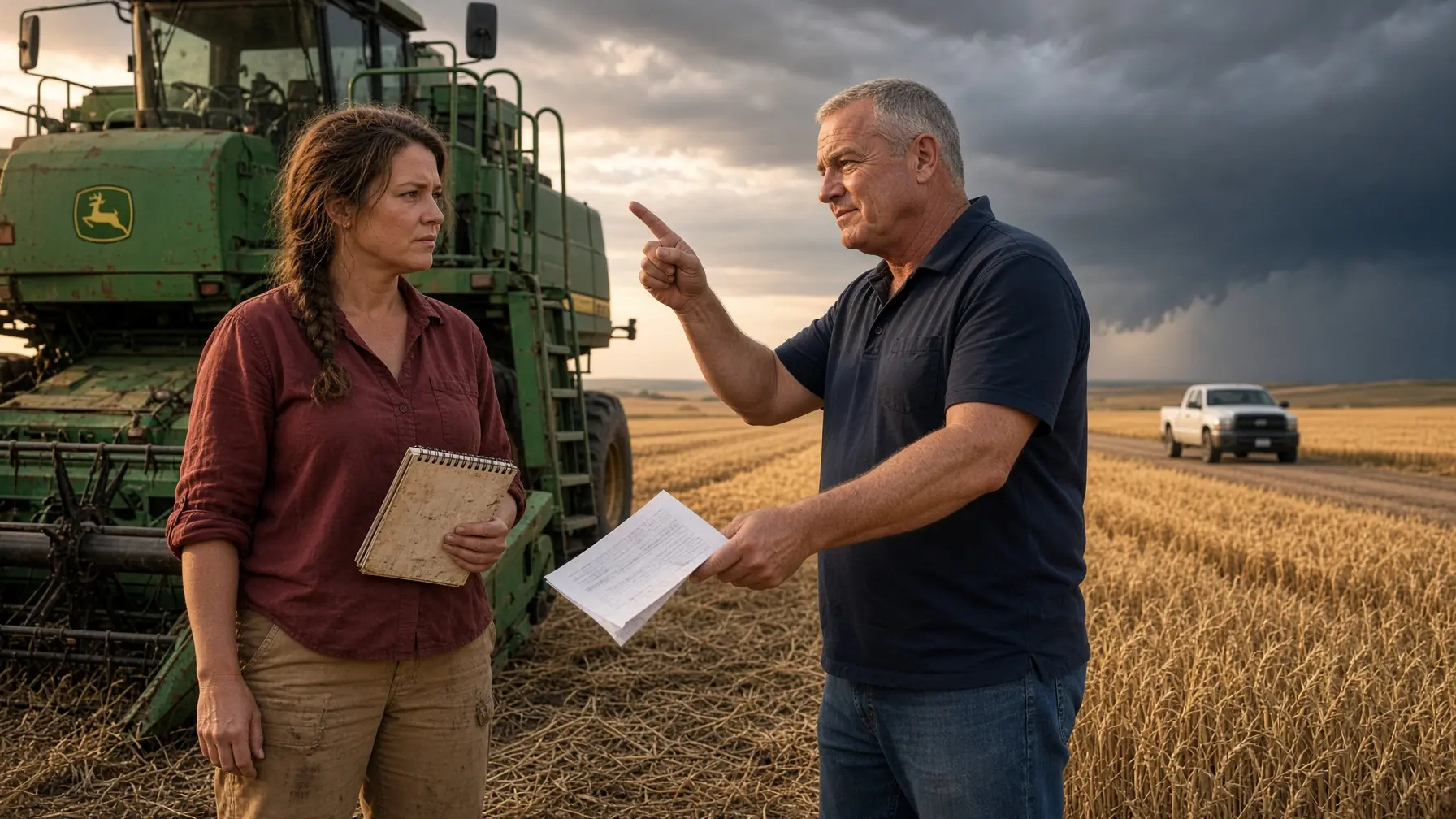
The truck slowed on the access road.
Laurel recognized it and felt the small reserve of patience she had left begin to drain.
She knew why Grant Voss had come.
He had already called.
Twice.
Both conversations ended with him asking whether she understood what was approaching from the west, as though the dark clouds were something only he had noticed.
Now he was bringing the same argument into the field.
The pickup stopped, clean white paint catching the last warm light. Grant got out with a folded paper in his hand and stood for a moment looking at the combine.
Laurel could almost hear his conclusion forming.
The old John Deere 9660 STS stood on cut stubble with its header lowered safely to the ground. Its green paint was chipped, its panels carried years of wear, and dust had collected in places no amount of washing ever seemed to reach.
It did not look impressive.
Laurel had never needed it to.
What she needed was much more specific.
The western sky answered with a distant flash beneath the clouds.
She looked toward it, then back at Grant.
He was smiling.
At five that morning, the field had looked almost gentle.
Laurel walked along its edge while the air was still cool, brushing a few heads of wheat with her hand. She did not need to be there to know the crop was ready.
She went because looking from the kitchen window was not enough.
A field became different when she stood beside it. From a distance, it was color and acreage and something to fit into a schedule.
Up close, it was the result of decisions she remembered making.
Days she waited.
Days she went ahead.
Money spent when spending it felt difficult.
Work repeated after the first attempt did not hold.
She had carried those decisions through the season. Now the crop stood ready, and the sky had begun making its own plans.
Laurel checked the horizon.
Clear then.
Almost insultingly clear.
She knew how quickly that could change.
The forecast had occupied too much of the previous evening, and she finally turned the screen facedown because reading it again would not create more hours.
She had written a short list on a separate piece of paper.
Things to do.
Things to check.
People to contact.
The list was not in the maintenance notebook.
That notebook had another purpose, and she kept it close enough that the edges had softened from use.
At thirty-five, Laurel had learned that memory became unreliable when she was tired. It remembered the general shape of a problem and forgot the detail she needed when the problem returned.
The notebook kept her from pretending certainty.
She did not show it around.
Not because it held a secret that would impress anyone.
Because it was part of how she worked, and she disliked watching people turn useful habits into something to joke about.
Grant had done that once.
He saw it tucked beneath her arm during a visit and asked whether she was writing a book about keeping old machines alive.
Laurel answered that she was keeping records.
He told her newer equipment would give her less to write down.
At the time, she smiled.
She did not want every conversation to become a disagreement.
Now she remembered the remark whenever he spoke about the combine.
He had never opened a notebook.
He had opened a brochure.
Both men and women could mistake owning a confident voice for possessing useful knowledge. Grant happened to sell that confidence with equipment.
Laurel had bought from him before.
Small things.
Ordinary things.
She knew he could be helpful when there was a straightforward sale to make. He answered the phone, found what she needed, and told her when something would arrive.
She did not believe everything about him was false.
That was what made his pressure difficult.
He mixed information she needed with conclusions that served him. By the time she separated one from the other, he was usually asking why she was making the decision harder than it needed to be.
The combine was the clearest example.
Every time he looked at it, he began with its age.
Laurel began with its condition.
Those were related.
They were not identical.
She knew the machine could fail.
It had given her enough trouble to remove any romantic attachment to its faded paint. She did not stand beside it and imagine that being old made it noble.
She wanted it to do work.
She also wanted people to stop treating an old machine as though the work already done by it counted for nothing.