The first thing Carl Eberhart said when I answered the phone was:
“They won't send another machine.”
It was a little after seven in the morning.
Cold enough that frost still silvered the grass beneath my kitchen window.
I held the phone against my ear and looked at the steam rising from my coffee.
“What happened?”
“Second header jammed.”
He paused.
“The dealership says they're done trying.”
I knew what that meant.
Carl had fourteen acres of corn still standing in the east bottom.
Under normal conditions, fourteen acres was nothing.
An afternoon.
Maybe less with the right equipment.
But these were not normal conditions.
A hard frost had hit early.
Then a partial thaw.
Then another freeze.
The stalks had gone rigid.
The ears hung at strange angles.
The kernels were dry enough to crack if you looked at them wrong.
Every modern machine Carl had tried either jammed at the header or threshed the corn too aggressively and shattered more grain than it saved.
And Carl did not have another week.
First National in Atlantic had given him until the end of the month to make a loan payment.
That field was supposed to make the difference.
I asked:
“What did Denton say?”
Denton ran service at Knapp’s Farm Equipment.
Young man.
Competent.
Patient.
The kind of person who knew everything the manual expected him to know.
Carl gave a bitter laugh.
“Said their system won't run slow enough.”
I knew that too.
The newer machine they had tried was excellent equipment.
Far better than anything sitting on my property.
Under normal conditions.
But its rotor-management system compensated automatically.
Drop the speed too low and the computer brought it back up.
Useful with ordinary grain.
Terrible with corn brittle enough that too much mechanical force turned kernels into meal before they reached the tank.
Carl was quiet.
Then:
“Bank man comes Friday.”
I looked toward the east side of my property.
From my kitchen I could not see the shed.
But I knew exactly what was inside it.
I had known for years.
I said:
“Give me an hour.”
The shed stood a quarter mile from the house.
My father built it in 1952 from salvaged railroad ties, rough lumber, and roofing tin purchased from three different places because he refused to pay new-material prices if old material would still keep water out.
His name was Harlan Hope.
He was a farmer first.
Mechanic because farming demanded it.
Inventor only when existing equipment irritated him enough.
In the spring of 1952, he bought the remains of a fire-damaged John Deere Model 55 combine.
Frame.
Partial drivetrain.
Bent header components.
A collection of parts most sensible farmers would have hauled directly to scrap.
He paid $180.
The dealer told him:
“You're buying yourself a summer of frustration.”
My father answered:
“Cheap summer.”
That was Harlan.
Over the next fourteen months, he rebuilt the machine.
Not restored.
Rebuilt.
If something was unavailable, he made it.
If factory hardware seemed unnecessarily complicated, he simplified it.
He welded joints Deere had bolted.
Machined two pulley wheels on a borrowed lathe.
Reworked the separator drive.
Changed the threshing arrangement after reading a 1938 Iowa State extension bulletin about cold-weather grain.
Somewhere during that year, the machine stopped being a John Deere assembled according to factory specification.
It became my father's combine wearing John Deere paint.
The neighbors came when he finished.
Not to admire it.
To watch.
People love being present when confidence turns into embarrassment.
My father knew that.
He climbed into the seat anyway.
The combine started.
Then worked.
Year after year.
Wet seasons.
Dry seasons.
Late harvests.
Poor crops.
Heavy crops.
It worked our ground until my father's hands became too stiff for long days on machinery.
After he died in 1981, I kept the combine in the shed.
People assumed sentimentality.
Maybe there was some.
But that was not the real reason.
I kept it because I understood what was inside it.
And because I never believed a working thing became useless simply because newer things existed.
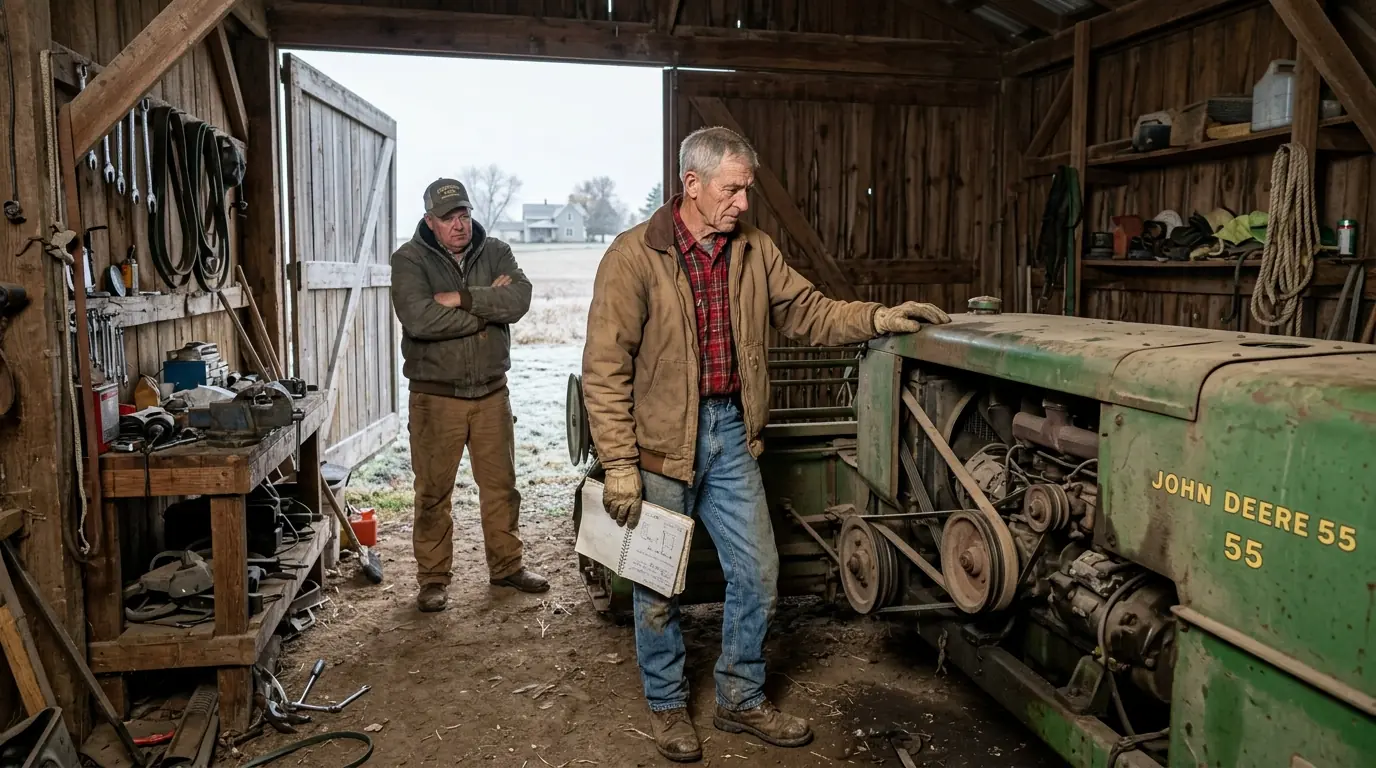
That morning, I lifted the wooden shed door.
Cold air moved behind me.
The old Model 55 sat in half-darkness.
Dusty green.
Faded decals.
Rust at the edges.
A machine from another era.
The cylinder housing still carried the seam weld my father had made from boiler plate.
One canvas elevator belt he had installed decades earlier had stiffened badly but had not rotted.
Four reel fingers were still bent.
They had been bent since the late 1970s.
I once tried straightening them.
My father watched.
Then said:
“They'll bend again.”
“Why?”
“Reel's slightly out of balance.”
“Shouldn't we fix that?”