The back forty had been dead longer than Eli Merritt had been alive.
It stretched beyond the northern windbreak in a flat, colorless sheet of cracked earth, bordered by sagging fence wire and posts bleached almost white by the Kansas sun. Nothing useful had grown there in eleven years. Even weeds seemed to avoid it.
Eli’s father, Nathan Merritt, called the field a lesson in knowing when to quit.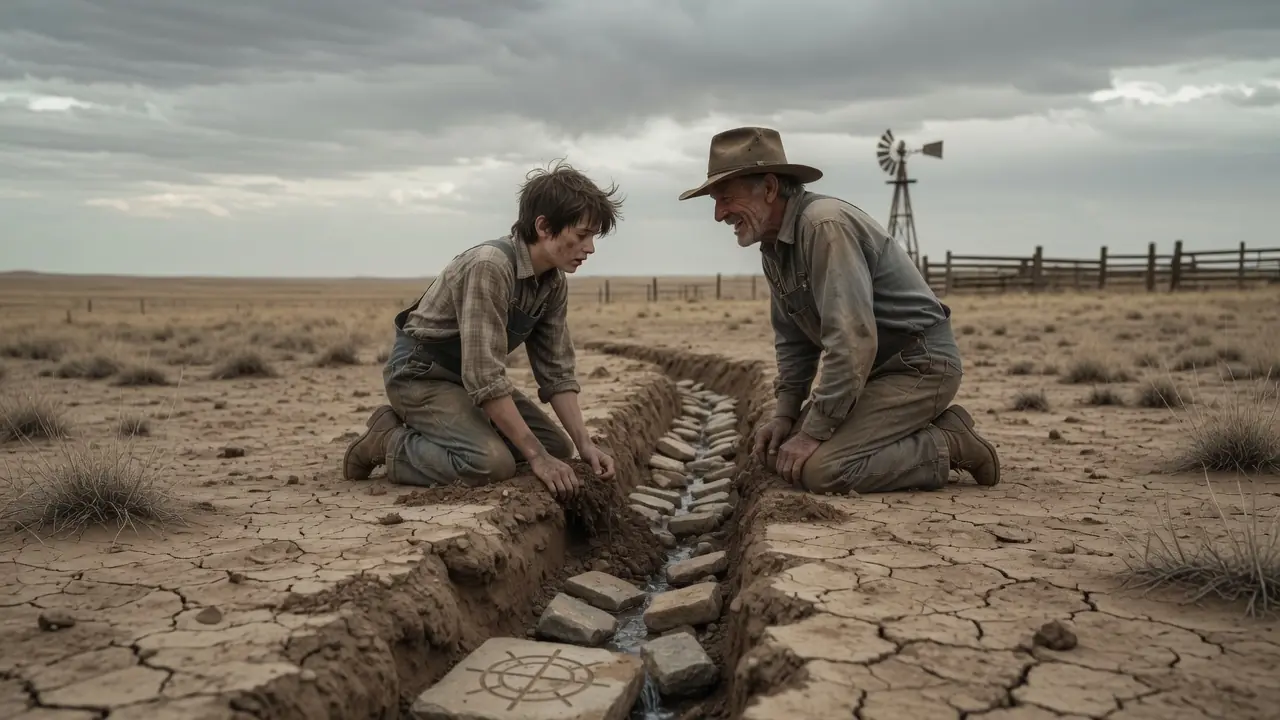
His grandfather called it cursed ground.
The neighbors simply called it worthless.
Every spring, when the rest of the Merritt farm showed narrow green rows of wheat, the back forty remained brown. Rain rolled across the hardened clay without soaking in, collecting briefly in shallow depressions before vanishing under the heat. Two wells had failed there, one before Eli was born and another when he was six.
Nathan had spent thousands of dollars drilling the second well.
The crew reached dry limestone.
After that, he locked the gate and stopped talking about the field.
Eli had never been good at leaving questions alone.
He noticed things other people dismissed because they seemed too small to matter. He knew which fence post leaned farther after a strong north wind, which hen laid eggs beneath the old mower, and which section of barn roof leaked only when rain came from the west. His teachers called him observant.
Walter Briggs called him strange.
Walter owned eight hundred acres west of the Merritt place and carried himself like a man personally responsible for every harvest in the county. He wore a broad hat, drove a red pickup polished more often than his tractor, and laughed whenever Eli asked questions adults could not answer. Walter believed a boy should learn farming by listening, not by thinking too loudly.
Eli’s curiosity about the back forty began during the worst week of July.
The temperature had remained above one hundred degrees for six straight days. Corn curled inward across the county, cattle crowded beneath thin strips of shade, and the irrigation ponds dropped lower each afternoon. Nathan began waking before sunrise to move water between tanks.
One evening, Eli crossed the abandoned field while searching for a missing calf.
The ground burned through the soles of his boots.
Near the northeastern corner, however, the temperature changed.
It was not cool in the ordinary sense. Nothing in western Kansas felt cool that summer. Yet a patch of earth beside a cluster of dead cottonwood roots felt noticeably less hot beneath Eli’s palm.
He knelt and pressed both hands against the soil.
The surface was cracked like everything around it, but the dirt beneath the first inch was darker. When he lifted a handful, it held together briefly before crumbling. The rest of the field turned to powder immediately.
Eli marked the place with three stones.
The calf had returned to the barn by the time he reached home.
At supper, Nathan barely looked up from the bank statements spread beside his plate. Eli’s mother, Sarah, served beans and cornbread while trying not to ask how much money remained in the farm account. Eli waited until his father had eaten before mentioning the soil.
“The northeast corner of the back forty is cooler,” he said.
Nathan continued reading.
“Shade from the cottonwoods.”
“They’re dead, and the sun was still on it.”
“Then you imagined it.”
“The dirt underneath was darker.”
Nathan folded the statement and set it aside.
“Eli, I know you want to help, but that field has beaten men with more experience than both of us combined.”
“Maybe they were looking in the wrong place.”
Sarah looked at her son with concern.
Nathan rubbed one hand across his tired face.
“Leave the field alone.”
Eli nodded.
He did not agree.
The next morning, he returned before sunrise with a garden trowel, a thermometer borrowed from the kitchen, and a notebook. He measured six places across the back forty. The soil in the marked corner was eight degrees cooler than the soil near the center.
He repeated the test at noon.
The difference became eleven degrees.
Eli dug a narrow hole two feet deep. The first layer was hard clay, but beneath it he found coarse sand mixed with small rounded stones. That kind of material did not belong in the middle of the field.
It looked carried.
Or placed.
He filled the hole before anyone saw it.
That evening, while searching the machine shed for an old survey map, Eli found a wooden trunk belonging to his great-grandfather, Samuel Merritt. The trunk had been shoved beneath horse blankets, broken harness, and a rusted cream separator. Its brass latch opened only after Eli worked oil into it.
Inside were three shirts, a compass, several faded photographs, and six journals wrapped in cloth.
Samuel Merritt had settled the land in 1908.
Eli knew the basic family story. Samuel arrived with two horses, a pregnant wife, and less than two hundred dollars. He survived dust storms, grasshopper swarms, and years when wheat sold for almost nothing.
Nobody had mentioned the journals.
The first contained ordinary accounts of planting dates, animal births, and expenses. The second described fence construction and arguments with a railroad company. The third included repeated references to something Samuel called the lower gallery.
Eli read by flashlight after everyone went to sleep.
April 14, 1911. Began stone lining at the east fall. Water moves slow but steady beneath the red clay.
April 29, 1911. Completed thirty-two rods with help from Thomas and Hiram. Covered before summer heat. Must keep northern mouth clear.
June 3, 1912. Gallery feeds cottonwoods and lower cistern. Even in dry weather, the ground above stays cool.
Eli sat upright in bed.
The dead cottonwoods stood exactly where the cooler soil began.
The later entries became harder to understand. Samuel used measurements from landmarks that no longer existed: the smokehouse corner, the black oak, the windmill shadow at noon. One page contained a hand-drawn diagram showing a narrow underground passage lined with stones.
It resembled an irrigation channel.
But instead of carrying surface water, it collected water moving slowly through a buried layer of sand and gravel.
Eli had read about such systems in a library book. People in dry regions built underground galleries to capture groundwater before it sank too deep. The channels required no pump. Gravity carried the water toward a storage basin or outlet.
Nobody in the county had ever mentioned Samuel building one.
Perhaps nobody remembered.
The final entry about the gallery was dated 1934.
Dust covered everything. Closed lower mouth with capstone to protect it from collapse. Told Robert where it lies. If the field dies, open what we buried.
Robert had been Eli’s grandfather.
He was eighty-two and lived in a care home in Hays.
On Saturday, Sarah drove Eli to visit him.
Robert Merritt’s memory moved unpredictably. Some days he remembered the names of horses dead for sixty years but forgot whether he had eaten breakfast. Other days he mistook Sarah for his sister.
Eli brought the journal.
When he opened it to the diagram, Robert’s cloudy eyes became focused.
“Where did you find that?”
“In Great-Grandpa Samuel’s trunk.”
Robert touched the page carefully.
“Your father know?”
“No.”
“Good.”
Sarah raised an eyebrow.
Robert gave a faint smile.
“Nathan never had patience for old stories.”
Eli leaned closer.
“Was the lower gallery real?”
Robert looked toward the window.
“My father showed me once. Stone tunnel under the field. Cold water ran through it when every pond dried.”
“What happened?”
“The flood of ’51 changed the creek. Silt buried the inlet. Later, your grandfather plowed over the markers.”
“You were my grandfather.”
Robert frowned, then laughed softly.
“That’s right.”
He explained that the underground channel began near a gravel seam along the northern rise. Water traveled through hand-cut stone toward a cistern near the old cottonwoods. Samuel sealed the outlet during the Dust Bowl to protect it from collapse and contamination.
Robert had intended to reopen it.
Then tractors replaced horses, deep wells became common, and everyone believed old systems no longer mattered. The exact location faded from memory.
“Can it still work?” Eli asked.
Robert looked at the journal again.
“Stone lasts longer than pride.”
Sarah drove home silently.
Near the farm, she finally spoke.
“You know your father told you to stay away from that field.”
“I know.”
“Are you planning to obey him?”
Eli looked down at the journal.
“No.”
Sarah sighed.
“I expected a less honest answer.”
She did not tell Nathan.
The next morning, Eli carried a shovel, measuring tape, compass, and water jug into the back forty. He began at the dead cottonwoods and followed Samuel’s directions backward. Thirty-two rods north by northeast brought him near the cooler patch.
Several landmarks were gone, but the land itself had not changed completely.
A shallow depression curved toward the northern rise.
The stones beneath the soil became smoother and more frequent.
Eli began digging.
By noon, he had opened a trench four feet long and less than two feet deep. Sweat soaked his shirt, blisters formed along his palms, and the hard clay resisted every shovel strike. He found nothing beyond sand and scattered rock.
A pickup approached along the fence.
Walter Briggs leaned against the open window.
“What are you burying?”
“Nothing.”
“Then why are you digging?”
“I think there’s a water channel under here.”
Walter stared at him.
Then he laughed.
The sound carried across the empty field.
“You drilling a well with a garden shovel?”
“It isn’t a well.”
“What is it?”
“An underground gallery my great-grandfather built.”
Walter turned toward the passenger seat, where his brother-in-law, Dale, sat eating sunflower seeds.
“You hear that? Samuel Merritt built a secret river under the dead field.”
Dale laughed with him.
Eli kept digging.
Walter climbed from the pickup.
“Why are you wasting your time digging a field everyone knows is dead?”
“Because this corner stayed cool during the drought, and my great-grandfather wrote that water still runs beneath it.”
Walter pushed his hat back.
“A boy with an old notebook won’t bring this land back.”
Eli drove the shovel into the clay again.
“Then you have nothing to worry about.”
Walter watched for another minute before leaving.
By supper, half the county seemed to know.
Nathan entered the house angry enough to slam the screen door.
“You went digging after I told you not to.”
Eli sat at the table with both hands wrapped in cloth.
“I found sand beneath the clay.”
“You found dirt.”
“Grandpa Robert remembered the gallery.”
Nathan looked toward Sarah.
“You took him to ask Dad?”
“He deserved to hear it,” she replied.
Nathan turned back to Eli.
“That field has already cost this family more money than we could afford. I will not watch you build hopes around some century-old tunnel.”
“It doesn’t cost anything to dig.”
“It costs time.”
“My chores are done.”
“It costs disappointment.”
Eli looked directly at his father.
“Maybe I can handle disappointment.”
Nathan flinched.
The farm had been under pressure for three years. Fertilizer prices rose, wheat yields fell, and the failed irrigation pump required another loan. Nathan carried every problem as if protecting his family meant never admitting fear.
Eli understood that his father was not angry about the shovel.
He was afraid of believing again.
Nathan took the journals and locked them inside his desk.
“The digging stops.”
For two days, Eli obeyed.
On the third morning, he discovered the desk key beneath a jar in the workshop. He copied every measurement onto paper, returned the journal, and left before sunrise.
He did not dig in the same spot.
After reviewing Samuel’s diagram, Eli realized the channel might lie deeper near the outlet than at the collection point. He moved twelve yards uphill and began another trench.
The clay changed after three feet.
His shovel struck something solid.
The sound was not the dull impact of limestone.
It rang.
Eli dropped to his knees and cleared the soil with his hands. Beneath the clay lay a flat stone shaped too evenly to be natural. Its surface carried three chiseled lines forming an arrow.
His pulse quickened.
He cleared the edges and found a second stone beside it.
Then a third.
The stones formed the top of something buried.
Walter Briggs returned that afternoon with two other farmers.
They parked beside the fence as though arriving for entertainment. Walter brought a folding chair and a bottle of soda. One farmer asked whether Eli had found gold.
“Better,” Eli said.
Walter laughed.
“Show us your underground river.”
Eli ignored them and continued removing soil.
The sun dropped lower.
His shoulders burned, and each breath tasted like dust. The top stones formed a line running east to west, exactly as Samuel’s diagram predicted.
Eli wedged the shovel beneath one.
It did not move.
Walter stood from the chair.
“You’ve had your fun. Fill the hole before a cow breaks a leg.”
Eli found a long iron bar near the fence and pushed it beneath the edge of the stone.
The capstone shifted.
A breath of cold air rose from beneath it.
Eli froze.
The farmers stopped laughing.
He pushed again.
The stone lifted enough for dark soil to appear beneath it. Not dry powder.
Mud.
Eli reached into the gap.
His fingers came back wet.
Walter stepped closer.
“That could be trapped rain.”
“It hasn’t rained in thirty-four days.”
Eli cleared more soil and levered the stone aside.
Below it was a narrow channel lined with hand-cut rock. The stones curved inward, forming a tunnel barely large enough for a man’s shoulders. Packed silt filled most of the opening.
A faint trickle moved through the bottom.
Eli stared.
Cold water touched his fingertips.
Walter crouched beside the trench.
“How deep does it go?”
“Thirty-two rods, maybe more.”
The other farmers gathered closer.
Eli used a small hand shovel to remove silt from the outlet. The trickle strengthened slightly, carrying brown water into the trench. He cleared another foot.
The mud suddenly shifted.
A heavy rush of cold water burst between the stones.
Eli fell backward.
Water filled the bottom of the trench, spread across the cracked earth, and darkened the clay in a widening circle. It was not a violent spring, but it flowed steadily and clearly after the first wave of dirt passed.
Nobody spoke.
Walter removed his hat.
Nathan’s pickup appeared at the far gate.
He drove across the field faster than the ruts allowed, stopped beside the trench, and jumped out. Anger covered his face until he saw the water.
Then everything inside him seemed to go still.
Eli stood with mud covering his knees.
“I found it.”
Nathan walked to the edge of the trench.
Water continued flowing beneath the opened capstone.
He crouched and placed one hand into it.
“It’s cold.”
“Fifty-eight degrees,” Eli said. “I checked.”
Nathan looked toward the dead cottonwoods.
“My grandfather used to talk about water under this field.”
“You thought it was a story.”
“I thought most things he said near the end were stories.”
Walter Briggs cleared his throat.
“The boy may have found an old seep.”
Eli looked at him.
“You said there was nothing.”
Walter did not answer.
Nathan stood.
“This does not mean the field is saved.”
“I know.”
“The gallery could be collapsed.”
“I know.”
“The water may not be enough.”
“I know.”
Nathan looked at his son’s blistered hands, muddy clothes, and exhausted face.
Then he looked at the flowing channel.
“What do you need?”
Eli smiled for the first time that day.
“More shovels.”
Work began the following morning.
Nathan called a county extension engineer named Dr. Melissa Grant, who arrived with groundwater maps, testing equipment, and a skeptical expression. She examined the stonework and confirmed that the system resembled a horizontal infiltration gallery.
Samuel Merritt had built it along a shallow perched aquifer.
Water moving through the gravel layer collected behind the northern rise. The gallery intercepted that movement and carried it downhill through gravity. Because it remained underground, little water was lost to evaporation.
“It’s remarkably sophisticated,” Melissa said.
Nathan looked at the hand-cut stones.
“My great-grandfather had six years of schooling.”
“Education and intelligence are not the same thing.”
Testing showed the water was clean enough for irrigation after the channel was flushed. Its flow rate was modest but steady, producing almost twelve gallons per minute. That would not support forty acres of water-intensive crops.
It might support careful restoration.
Eli returned to the journals.
Samuel had never flooded the entire field. He directed water into a stone cistern, then released it through shallow furrows only during the coolest hours. He planted sorghum, beans, and drought-resistant wheat rather than crops demanding constant irrigation.
He also covered the soil.
Repeated entries mentioned straw, manure, and clover.
The field had not survived because Samuel discovered endless water.
It survived because he wasted none.
Nathan organized crews to clear the gallery in sections. Walter Briggs offered a backhoe, though he described the gesture as protecting the boy from hurting himself. Eli understood it was the closest Walter could come to apologizing.
They used machinery only for the upper soil.
Every stone near the tunnel was uncovered by hand.
The gallery extended farther than expected. Several sections had collapsed, but the original builders placed access shafts every fifty yards. Once the shafts were opened, airflow improved and water moved more freely.
At the lowest point, they found the cistern.
It was a circular stone basin buried beneath eight feet of soil and covered by timber that had rotted almost completely. Inside were fragments of an old wooden gate used to regulate flow.
Nathan held the broken gate in both hands.
“My grandfather knew this was here.”
Eli nodded.
“And I drove tractors across it for twenty years.”
“You didn’t know.”
Nathan looked at him.
“Neither did you. You looked.”
That autumn, they did not plant the full field.
Eli selected five acres near the channel outlet. They spread compost, drilled holes through the compacted layer, and planted a cover crop of rye, clover, and radish. Water from the gallery was released into narrow furrows twice each week.
At first, almost nothing happened.
Walter drove past several times and said nothing.
Then thin green lines appeared across the brown ground.
By October, roots had begun breaking the clay.
The county newspaper published a photograph of Eli kneeling beside the opened capstone. The headline called him the Boy Who Found Water. Eli disliked it.
He had not found water.
Samuel had found it.
Eli had listened.
During winter, Nathan and Eli read every journal together. They discovered notes about windbreak spacing, crop rotation, and soil moisture written decades before those practices became fashionable. Samuel recorded failures as carefully as successes.
One entry became Nathan’s favorite.
A farmer’s pride dries faster than his land. Watch the soil, not the neighbors.
Walter did not appreciate that line.
The next spring, the Merritts planted twelve acres of drought-resistant wheat and six acres of grain sorghum. They kept the rest under cover crop. Nathan resisted the temptation to expand faster.
Eli monitored water flow every morning before school.
The channel remained steady.
By June, the revived section of the back forty stood green while neighboring fields began showing drought stress. The wheat was not the tallest in the county, but its roots reached deeply into improved soil.
People started visiting.
Some came because they were curious.
Others came because their wells were failing.
Walter Briggs arrived alone one evening.
Eli found him standing beside the cistern.
“My grandfather mentioned stone drains once,” Walter said.
“Did he build any?”
“I don’t know.”
“You could check.”
Walter looked across the field.
“I laughed at you.”
“Yes.”
“I was wrong.”
Eli waited.
Walter removed his hat.
“I’m sorry.”
It was not a graceful apology.
It was enough.
The first harvest from the restored acreage produced less grain than Nathan once expected from good land. Yet it exceeded every prediction for the dead field. More importantly, soil tests showed increased organic matter and improved water retention.
The field was becoming alive again.
Nathan placed the first sack of wheat beside Samuel’s journals in the farmhouse.
Robert Merritt died that winter.
At his funeral, Nathan spoke about the gallery and admitted that his father had tried to tell him. Eli stood beside the grave holding the compass from Samuel’s trunk.
Afterward, Nathan handed him the journals.
“They belong to you.”
“They belong to the family.”
“You’re the one who made us listen.”
Five years later, the back forty no longer looked abandoned.
Cottonwoods grew again near the restored cistern. Native grasses protected the field edges, while carefully selected crops occupied rotating sections. The Merritts never tried to force all forty acres into production.
They treated water as a limit rather than a promise.
Eli studied agricultural engineering after high school but returned every summer. He mapped old water systems across western Kansas, helping families search journals, survey lines, and oral histories before drilling expensive wells.
Not every search succeeded.
Some forgotten channels had collapsed permanently.
Some stories were only stories.
But enough proved real to change how people thought about the past.
The stone gallery never became a famous treasure. It produced no gold, oil, or sudden fortune. Its water did not turn desert into paradise overnight.
It offered something more durable.
A steady flow.
A restored field.
And proof that knowledge buried by pride could still rise when someone young enough to ask questions refused to stop digging.
Years after Walter Briggs laughed beside the trench, he stood with Eli beneath the new cottonwoods. Children from the county school gathered nearby while Eli explained how the underground channel worked.
One child asked whether he had known water would appear.
Eli smiled.
“No.”
“Then why did you keep digging?”
He looked toward the dark green field where cracked clay once stretched beneath the sun.
“Because the ground was telling us something,” he said. “Everyone else had simply decided it had nothing left to say.”