The laughter did not begin in a ballroom.
It began in a snowstorm, with Elizabeth Drummond on her knees in the white silence, one glove lost, her breath breaking, and the medicine she had meant to fetch still miles away.
Then a shadow emerged through the forest.
A tall man in a dark Highland cloak bent over her without a word, lifted her as if she weighed nothing, and carried her into the storm.
Elizabeth tried to ask his name.
Darkness took her first.
When she opened her eyes again, she was lying before a fire in a stranger’s mountain cabin, half alive, half fever, and entirely at the mercy of a man whose face looked carved from winter itself.
The room swam in heat and shadow.
For one confused instant, Elizabeth thought she had died and been delivered into some stern Highland purgatory where the fire burned low and a silent judge sat watching from across the room.
Then the judge moved.
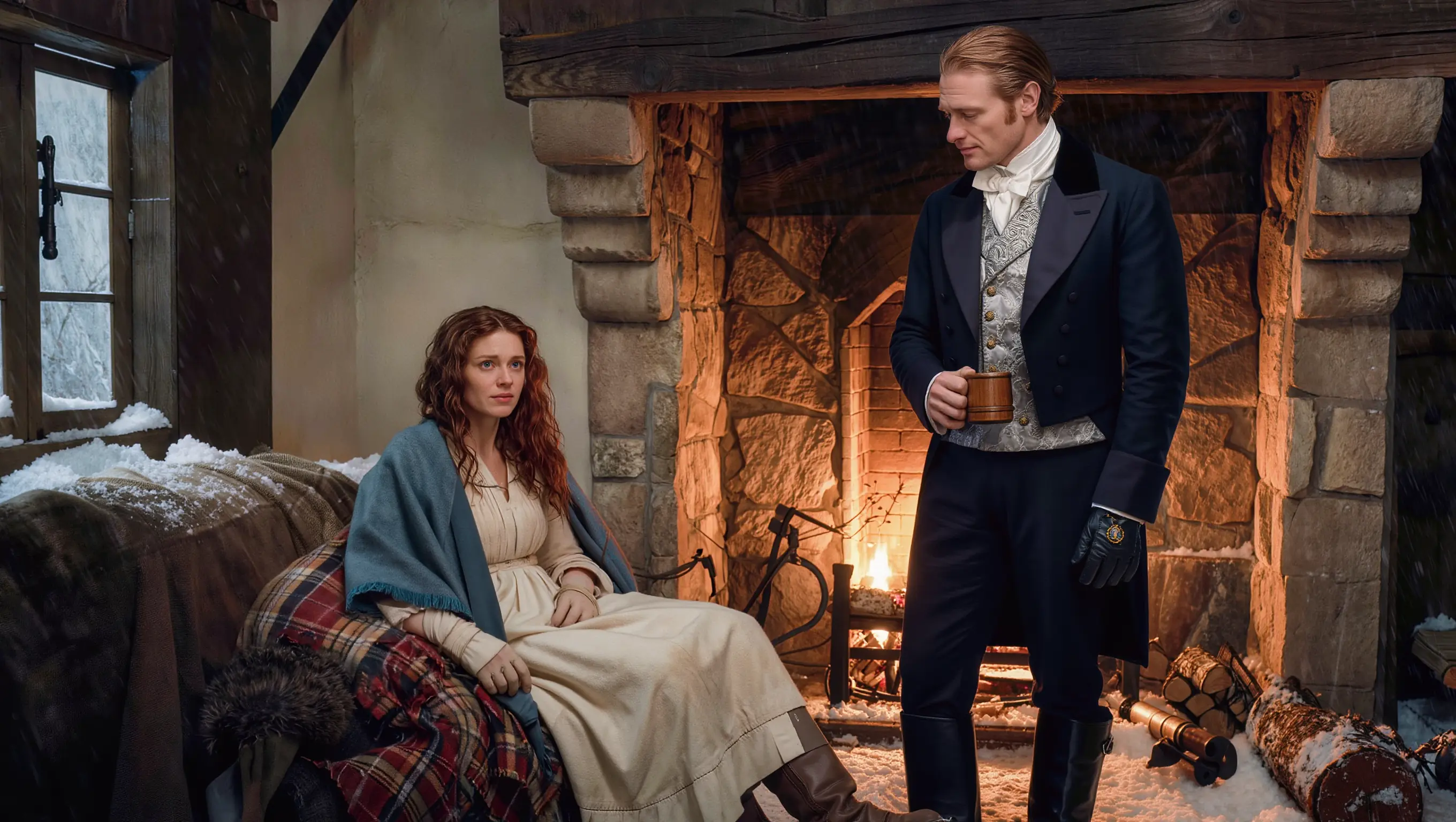
He rose from the chair near the hearth and came toward her with a wooden cup in one hand.
“Drink,” he said.
His voice was deep, unadorned, and used to obedience.
Elizabeth tried to push herself up.
Pain flashed through her hands and feet so sharply that a cry escaped before she could stop it.
The man set the cup aside and pressed one broad hand against her shoulder, firm enough to still her, careful enough not to hurt.
“You nearly froze to death,” he said. “Lie still.”
She obeyed because she had not the strength to do otherwise.
He lifted the cup again and held it to her lips.
Bitter herb tea touched her mouth.
She swallowed on instinct and nearly choked.
The heat went through her like a blade.
“My family,” she whispered.
His expression did not change.
He had a hard-striking face with dark hair drawn back from his brow, a close-trimmed beard, and pale eyes that looked less like a gentleman’s than a soldier’s or a laird’s.
There was a scar through one eyebrow, thin and old, as though even his skin had learned not to speak of pain.
“The storm has closed the paths,” he said. “No one can go down the mountain tonight.”
Panic came to her all at once.
“Mother.”
Her voice cracked.
“My mother is ill. I was going for medicine. My sisters will think…”
“They will think you were caught in the storm,” he said.
“You do not know my sisters.”
“No,” he replied, and there was something cool in the word. “I do not.”
He stepped back then, as if even that much closeness displeased him.
Elizabeth lay breathing too fast beneath rough Highland blankets and forced herself to look around.
The cabin was plain, but well kept.
A hunting rifle stood above the mantel.
There were books stacked on a side table, boots drying near the fire, and a tartan thrown over the back of a chair.
Not a crofter’s shelter, then.
Not quite.
Yet neither was it the polished comfort of a southern gentleman’s lodge.
The place felt older than fashion, more private, more dangerous.
She studied the man again.
He wore no title upon his person, yet authority sat on him as naturally as height.
“Did you carry me here?” she asked.
“Yes.”
“Why?”
At that, something unreadable passed over his face.
“Because you were dying.”
The simplicity of it silenced her.
Elizabeth turned her eyes to the fire.
Shame rose hot beneath her fever.
Once, three years ago, she would never have been found alone in a forest, half frozen, with her skirts soaked through and her family depending on her return.
Three years ago, there had been servants, carriages, physicians who answered within the hour, and a house in Edinburgh bright enough to make one believe fortune itself had taken up residence.
Then her father died with a pistol beside his hand.
Then came the letter no one would show them.
Then came the whispers.
By the time society had finished with the name Drummond, there was almost nothing left of it but debt, scandal, and the stubborn pride of four women trying not to sink.
Her rescuer had returned to his chair.
He sat with one ankle over the other and watched the fire, not her, yet she felt the force of his attention all the same.
“You have not told me your name,” she said at last.
A pause.
Then, “It is not necessary tonight.”
Elizabeth frowned faintly.
“You save dying women and refuse your own name?”
His mouth shifted, not into a smile, but into something that knew how one worked and had no use for it.
“You are alive,” he said. “That is the important matter.”
She ought to have resented his coldness.
She closed her eyes, meaning only to rest them for a moment.
The fire crackled.
Wind struck the shutters.
Somewhere in the cabin, floorboards answered the weather with old, tired groans.
Just before sleep took her, she heard him rise.
Then, in a voice so low she might have imagined it, he said, “You should never have been alone in that forest, whoever you are.”
Elizabeth wanted to answer that ruined daughters did not always have the luxury of safety, but the darkness came too swiftly.
And across the room, the stranger kept watch while the storm buried the mountain deeper still.
The storm had worsened.
Snow pressed thick against the windows, and the world beyond the cabin had vanished so completely that Elizabeth could almost believe the rest of Scotland had ceased to exist.
She woke with fever still clinging to her, though the terrible cold had at last loosened its grip.
The stranger was already awake.
He stood near the hearth, splitting kindling with swift, controlled movements.
His shirt sleeves rolled back, the fire painting bronze light over his hands.
They were not a nobleman’s hands.
They were scarred, calloused, and steady.
“You should be in bed,” he said without looking at her.
“And yet I am on your sofa,” Elizabeth murmured, her throat raw.
That earned her the briefest glance.
His eyes were startlingly pale in the morning light.
“The bed would have been improper.”
Despite her weakness, a flicker of amusement touched her.
“How reassuring to know your principles survived the snow.”
His jaw tightened as though he regretted rescuing a woman capable of answering him.
He crossed the room, poured tea, and handed it to her.
This time, their fingers brushed.
The contact was brief, accidental, and inexplicably unsettling.
“What am I to call you?” Elizabeth asked. “If not my savior?”
A beat of silence.
Then, as if the name were something dragged from him rather than offered, he said, “Euan.”
“No title, no surname, only Euan.”
She repeated it softly, and for reasons she could not explain, the room altered around the sound.
“I am Elizabeth,” she said.
He inclined his head once.
Still no warmth, still no questions.
Yet throughout that long gray day, she began to notice the shape of his care in the very things he refused to name.
The fresh blanket placed over her feet before dawn.
The broth seasoned more gently when he realized strong herbs made her cough.
The way he kept feeding the fire whenever her hands trembled.
Kindness hidden inside severity.
Toward evening, the fever took hold again.
Elizabeth drifted in and out of uneasy dreams until one name escaped her lips before she could stop it.
“Mother.”
She felt a hand close around hers, not tenderly.
Not at first.
Then, after a pause, more gently than she would have believed possible from him.
When she forced her eyes open, Euan was beside her, his face shadowed, his expression unreadable.
“You are safe,” he said.
Elizabeth looked at him through the haze of fever and thought, with a confusion more dangerous than weakness, that safety had never before sounded like a man trying so hard not to care.
The fever broke on the fifth day, not all at once, but in quiet surrender.
Elizabeth woke to a different kind of warmth, one that did not burn, but settled gently into her bones.
The storm had softened outside.
Light filtered through the frost-laced window, pale and silver, no longer hostile.
She sat up slowly.
This time, the world did not spin.
Across the room, Euan stood by the table, sharpening a knife with slow, precise strokes.
The sound carried through the cabin like a steady heartbeat.
“You’re stronger,” he said without turning.
“Yes.”
A pause.
“Then you will live.”
It was not meant as kindness, and yet something in the way he said it made her chest tighten.
Elizabeth pushed the blanket aside and stood, testing her weight.
Her legs trembled, but they held.
It felt like reclaiming something she had nearly lost forever.
“I must go home,” she said.
Euan’s hand stilled.
“No.”
The word came sharp, immediate.
She turned toward him, startled by the force of it.
“You don’t understand.”
“I understand the mountain,” he cut in. “And the mountain says no.”
His eyes lifted to hers then, cold, certain, unyielding.
“You leave now, you die.”
Silence settled between them.
Elizabeth swallowed the protest rising in her throat.
He was not wrong.
She knew it.
But knowledge did nothing to ease the weight pressing against her ribs.
“My mother is ill,” she said, quieter now. “My sisters are alone.”
Something flickered in his gaze.
It was gone before she could name it.
“The storm will pass,” he said, “and when it does, you will go.”
You will go, not we.
The distinction did not escape her.
Elizabeth nodded once, though the acceptance felt like surrender.
She turned away, walking carefully across the room.
Her fingers brushed the back of his chair, the table, the edge of the hearth, small anchors in a place that was not hers.
“Thank you,” she said at last, “for saving my life.”
Euan did not answer.
For a moment, she thought he would ignore it entirely.
Then quietly, almost reluctantly, he said, “Anyone would have done the same.”
Elizabeth let out a faint breath that might have been a laugh.
“No,” she replied, “they wouldn’t.”
That made him look at her again.
Truly look this time, not as a burden, not as a problem to be endured until the snow melted, but as something else.
His gaze lingered longer than before, searching her face as if trying to reconcile what he saw with something he had long believed.
“What were you doing in the forest?” he asked.
The question was simple.
The answer was not.
Elizabeth hesitated, then said, “I was going for medicine.”
“For your mother?”
“Yes.”
“And you went alone?”
“There was no one else to send.”
Her voice remained steady, but something beneath it, fatigue, pride, grief, shifted in a way she could not fully conceal.
Euan watched her in silence, then he set the knife aside.
“You are not what I expected,” he said.
Elizabeth tilted her head slightly.
“You did not expect me at all.”
“No,” he admitted, “I didn’t.”
Another pause.
Then, almost against his will, he added, “Most would have stayed, waited, accepted the risk.”
“And let her die?” Elizabeth asked.
Their eyes met.
Something passed between them then.
Not agreement, not understanding, but recognition.
Euan looked away first.
Later that night, the wind eased further.
The cabin felt smaller somehow, quieter, as if the storm had been holding something in place that now threatened to move.
Elizabeth lay awake on the sofa, staring into the dying fire.
“You’re not asleep,” she said softly.
“I rarely am.”
His voice came from the darkness.
She turned her head slightly.
He sat in his chair again, half-shadowed, watching the flames.
“You saved me,” she said after a moment. “But you keep your distance as though I’m something dangerous.”
Euan did not answer immediately.
When he did, his voice was lower than before.
“Some things are.”
Elizabeth frowned faintly.
“And I am one of them?”
A long silence.
Then, “I don’t know yet.”
The honesty of it startled her more than any lie could have.
Elizabeth studied him in the firelight, the hard lines of his face, the tension that never fully left his shoulders.
“You speak as though you are deciding what I am,” she said.
“I am.”
“And what happens when you decide?”
His gaze lifted to hers.
For a heartbeat, something sharp, something almost like conflict, broke through the calm surface.
Then it vanished.
“You leave,” he said.
Elizabeth turned back to the fire, though her thoughts no longer followed its glow.
Outside, the storm had begun to loosen its grip.
Inside, something far more dangerous had just begun.
On the seventh day, everything changed with a single word.
“Drummond.”
Elizabeth had not meant to say it aloud.
The name slipped from her as she stood near the hearth, steady enough now to move without thought, strong enough to forget caution for one fatal moment.
“I am Elizabeth Drummond,” she said, as though it were merely a fact.
Silence followed.
Not the quiet they had grown used to.
Something heavier.
Euan did not move.
For a heartbeat, she thought he had not heard.
Then slowly, too slowly, he turned.
Elizabeth had seen his coldness before.
His distance.
His restraint.
She had never seen this.
The fire in his eyes was no longer hidden.
It burned.
“Say that again,” he said.
The words were calm.
His voice was not.
Elizabeth’s breath caught, but she did not retreat.
She had spent three years refusing to shrink from her own name.
“Drummond,” she repeated. “Daughter of the Viscount of Ardmore.”
The moment the words settled, something in the room shifted.
It was no longer a refuge.
It was a battlefield.
Euan stepped forward once, only once, but the force of it was enough to make her pulse stumble.
“I should have known,” he said, more to himself than to her.
Elizabeth frowned.
“Known what?”
His laugh came low and sharp, not amused, not even bitter.
Recognition.
“Of all the cursed chances,” he murmured. “Of all the names the storm could have brought to my door.”
A chill crept through her, slow and certain.
“You know my family,” she said.
Euan’s gaze snapped back to hers.
“I know enough.”
“Then you know the truth is not what they…”
“Truth?”
The word cut through her like steel.
For the first time, his control slipped.
“Do you know what your father did?”
Elizabeth straightened.
“Yes,” she said. “I know what they said he did.”
“Not what they said.”
His voice dropped, quieter now and far more dangerous.
“What he did.”
The air between them tightened.
Elizabeth felt it then.
Not confusion, not distance, hatred.
Real, old, lived-in.
And suddenly, she understood.
“You believe it,” she whispered.
Euan’s jaw clenched.
“I don’t believe,” he said. “I remember.”
Her heart began to pound.
“Remember what?”
For a moment, he did not answer.
When he did, each word felt dragged from somewhere buried and unwilling to stay buried any longer.
“My father died,” he said, “because of yours.”
The world seemed to tilt.
Elizabeth shook her head once, instinctively.
“No.”
“Yes.”
“It was an accident.”
“That is what everyone said.”
“And it’s true.”
Euan stepped closer, close enough now that she could see the strain in his face, the control cracking beneath something far more dangerous.
“My father lived a year after the shot,” he said. “A year.”
“Long enough to know exactly who pulled the trigger.”
Elizabeth’s breath caught.
“And long enough,” Euan continued, his voice almost quiet now, “to tell me it was no accident.”
Silence fell, heavy, crushing.
Elizabeth stared at him, searching for doubt.
There was none, only certainty sharpened by years.
“You’re wrong,” she said, though her voice had softened. “You must be.”
His expression hardened further.
“And you are loyal,” he replied, “as daughters tend to be.”
The words struck deeper than anger would have.
Elizabeth took a step back.
“You saved me,” she said. “You cared for me, and all this time…”
“I didn’t know.”
That stopped her.
He ran a hand through his hair, turning away for a moment as though even looking at her had become difficult.
“I didn’t know,” he repeated quieter, “not until now.”
Elizabeth’s thoughts raced.
Every moment in the cabin, the care, the silence, the strange restraint, reshaped itself in her mind.
Not kindness, not indifference.
Conflict.
“And now?” she asked.
Euan did not answer immediately.
When he finally turned back, his face had gone still again, too still.
“Now,” he said, “I decide what to do with you.”
The words should have frightened her.
They did, but something else rose beside the fear.
Defiance.
Elizabeth lifted her chin.
“I am not something to be dealt with,” she said. “I am not my father.”
“No,” Euan replied.
His eyes held hers.
“And that is the problem.”
She stilled.
“What does that mean?”
For a brief moment, only a moment, something uncertain flickered through him.
Gone almost before it appeared.
“It means,” he said slowly, “that I should hate you.”
Silence.
The fire cracked behind them.
The wind pressed faintly against the glass.
“And you don’t?” Elizabeth asked.
Euan didn’t answer.
That was answer enough.
The silence did not break that night.
It stretched between them like a line neither dared cross.
Elizabeth sat near the hearth long after the fire had burned low, her hands folded tightly in her lap as though stillness alone could hold her together.
Across the room, Euan remained by the window, his back turned, his presence distant in a way it had never been before.
Not because he was indifferent, because he was choosing distance, and somehow that hurt more.
“You should rest,” he said at last.
The words were familiar.
The tone was not.
Elizabeth rose slowly.
“And you?”
“I will remain here.”
Of course he would.
She nodded once, then turned away.
But halfway to the sofa, she stopped.
“You had the right to know who I was,” she said quietly. “I should have told you sooner.”
Euan did not turn.
“And I should have told you who I was,” he replied.
Her breath caught.
“What do you mean?”
A pause.
Then, “Euan MacIntosh.”
The name settled into the room with a weight that made her chest tighten.
MacIntosh.
She knew that name.
Everyone in the Highlands did.
Elizabeth turned slowly, disbelief rising too fast to be contained.
“The Duke of Strathmore,” she whispered.
He faced her then, not denying it, not softening it.
“Yes.”
The truth struck like ice through her veins.
The son.
The man whose father…
No.
Elizabeth stepped back.
Every memory reshaped itself again.
His command, his isolation, the quiet authority she had sensed but not understood, and the hatred.
“You knew,” she said.
“Not at first.”
“But long enough.”
His silence answered.
Elizabeth let out a breath that trembled despite her efforts.
“You let me thank you,” she said. “You let me trust you.”
“I saved your life.”
“And then what?” she demanded, something breaking through her composure. “Stayed to see whether I deserved to live?”
The words landed harder than she intended.
Euan flinched, only slightly, but she saw it.
“No,” he said low. “I stayed because the…”
“Storm made leaving impossible.”
“And nothing else?” she pressed.
His jaw tightened.
Elizabeth searched his face, desperate now for something that would make sense of everything.
“You cared for me,” she said. “You held my hand. You…”
“I did what was necessary.”
The words cut clean, too clean.
Elizabeth stepped back as though struck.
For a moment, neither of them spoke.
Then, more quietly, she said, “You are lying.”
Euan’s eyes flickered.
“I don’t lie.”
“You do,” she said, “just not well.”
That stopped him.
Elizabeth swallowed, forcing the truth past the ache rising in her chest.
“You could have left me,” she continued. “You could have treated me like a burden, and you didn’t.”
“That doesn’t change who you are.”
“No,” she said softly. “But it changes who you are.”
The words lingered, dangerous.
Euan turned away again, running a hand over the back of his neck as though trying to shake something loose.
“You think kindness erases blood?” he asked.
“I think kindness reveals it.”
Silence, heavy, uncertain.
Elizabeth felt it then.
The shift neither of them could stop, not toward forgiveness, not yet, but away from something colder.
“My father was not a murderer,” she said quietly.
Euan closed his eyes briefly.
“My father said otherwise.”
“He was dying.”
“Yes.”
“And you never questioned it?”
That struck deeper.
Euan’s voice hardened.
“I lived it.”
Elizabeth took a step closer.
“And I lived the aftermath,” she replied.
“The ruin.”
“The silence. The way the world decided what was true without ever asking us.”
Their eyes met.
For the first time since the truth had been spoken, there was no accusation in hers, only something far more dangerous, understanding.
Euan felt it, and it unsettled him more than hatred ever had.
“You should hate me,” she said.
“I told you,” he replied, “I should.”
And yet he did not answer because he could not.
Elizabeth let out a slow breath, steadying herself.
“Then perhaps,” she said softly, “neither of us knows the truth as well as we believe.”
The fire cracked behind them.
Outside, the wind had almost died.
Inside, something far more fragile had taken its place.
Not peace, not trust, but the quiet, terrifying possibility that everything they had been certain of might be wrong.
On the twentieth morning, the world returned, not gently, with the sharp, unmistakable sound of hooves breaking through snow.
Euan was awake before the second strike.
He reached for the pistol by instinct, already moving toward the door before thought could catch him.
“Stay inside,” he said.
Elizabeth was on her feet despite herself.
“Who is it?”
“Inside,” he repeated.
This time, she obeyed.
He stepped out into the cold.
The storm had weakened, but winter still held the mountain in its grip.
Snow lay thick across the clearing, though the sky had begun to break in pale streaks of gray.
A rider waited near the cabin.
Fergus, old, broad-shouldered, wrapped in furs, his horse lathered from the climb.
“Your Grace,” he said, dismounting.
Euan stilled.
That title did not belong here.
“What are you doing on this mountain?” he asked low.
“Bringing news you did not answer letters to receive.”
Euan’s jaw tightened.
“Speak.”
Fergus hesitated.
That was enough to set something cold moving through him.
“It’s about Glencairn,” the man said at last.
Euan felt it before he heard it.
“A young woman went missing during the storm. They searched, but…”
Fergus shook his head.
“Nobody was found.”
Euan said nothing.
“Her family has been near broken,” Fergus continued more quietly. “The mother is ill. The sisters doing what they can. The village…”
He stopped again.
“Say it.”
“They say she is either dead,” Fergus said, “or worse.”
Silence.
Euan’s hands curled slowly at his sides.
“Worse how?”
Fergus looked away.
“That she was taken,” he said. “Or ran off, or…”
He swallowed.
“That no woman disappears that long without losing what cannot be returned.”
Euan closed his eyes for a moment.
Of course, the world had already decided her fate.
“And when she returns?” he asked.
Fergus met his gaze then.
“They will not welcome her kindly.”
The truth settled heavy.
Unavoidable.
Unforgiving.
Euan dismissed him with a short command, sending him to the stable behind the cabin.
He stood alone in the cold long after the man had gone, staring at nothing.
Then he turned back toward the door.
Inside, Elizabeth stood exactly where he had left her, waiting.
Her face told him she already knew.
“My family,” she said.
Euan stepped inside and shut the door against the cold.
“They live,” he said.
Her breath broke.
Relief came first, then the rest.
“And the village?” she asked, already bracing.
Euan did not soften it.
“They believe you dead,” he said, “or ruined.”
The word landed like a blade.
Elizabeth closed her eyes.
For a moment, she did not move.
Then she laughed, a small sound empty of humor.
“Of course they do.”
She turned away, pressing her hand to the table as if the ground beneath her had shifted.
“I was gone for weeks,” she said, “alone with a man.”
Her voice remained controlled, too controlled.
“They do not need truth,” she continued. “They never did.”
Euan watched her carefully.
For the first time since she had spoken her name, she looked fragile.
Not weak, but exposed.
“My sisters,” she whispered. “They will carry this with me.”
“Yes.”
“And my mother?”
“She lives,” he said again, more firmly.
Elizabeth nodded, though the reassurance did little to steady her.
“They will look at me differently,” she said. “They will look at them differently.”
She turned then, her green eyes sharp despite the tears gathering there.
“And you know it.”
Euan did.
God, he did.
He had seen it before, the way society decided a woman’s worth in silence, the way rumor became truth faster than fact ever could.
“There may be a way,” he said.
The words came before he fully chose them.
Elizabeth stilled.
“A way?” she repeated.
Euan took a step forward.
Everything in him resisted what he was about to say.
Everything he had built for six years stood against it, but none of it mattered now.
“Marriage.”
The word hung between them.
Elizabeth stared at him.
“You cannot be serious.”
“It would end the talk,” he said. “Or at least silence it.”
“You think a marriage solves this?”
“I think my name protects what yours cannot.”
The words were blunt, brutal, true.
Elizabeth’s expression shifted.
Shock, disbelief, something like anger.
“You would marry me,” she said slowly, “to repair my reputation.”
“I would marry you,” he corrected, “to prevent your destruction.”
“And yours?” she asked sharply. “Do you think there is no cost to you?”
Euan’s jaw tightened.
“There is always a cost.”
Silence followed, heavy, uncertain.
Elizabeth looked at him as though trying to understand the man standing before her.
“You hate my family,” she said.
“I did.”
“Did?”
The single word struck harder than it should have.
Euan exhaled slowly.
“I don’t know what I feel anymore,” he admitted.
The honesty of it unsettled them both.
“You ask me to marry you,” Elizabeth said, her voice quieter now, “when you are not even certain you do not hate me.”
“I ask you to survive,” he replied.
Their eyes held.
The fire crackled behind them.
Outside, the storm was finally breaking.
Inside, something far more dangerous had just begun.
Elizabeth stepped back.
“I need time,” she said.
Euan nodded once.
“You have it.”
But they both knew time was no longer something they truly possessed.
The thaw began the next morning.
Elizabeth woke to the sound of water dripping from the eaves.
A soft, steady rhythm that felt almost foreign after weeks of silence and storm.
When she stepped to the window, the world had changed.
The white had begun to break.
Dark earth showed through in uneven patches.
Pine branches lifted, shedding their burden.
And above it all, the sky, no longer iron gray, held the faintest promise of blue.
They could leave.
She should have felt relief.
Instead, her chest tightened.
Behind her, Euan moved quietly, already dressed, already prepared for departure.
He did not speak of the night before, of the proposal, of the choice now standing between them like a door neither dared open.
“In two days,” he said as though discussing weather alone, “the path will be passable.”
Elizabeth nodded.
Two days.
Two days before everything ended or began.
They did not speak of marriage again, not directly.
Yet it lived in every glance, every silence that lingered too long, every moment where their hands almost brushed and did not.
Elizabeth found herself watching him more than she should.
The way he moved through the cabin with quiet certainty.
The way he always checked the fire before she woke.
The way he never once crossed the invisible boundary she had set, never assumed, never demanded.
Not even now.
Especially not now.
And that frightened her more than his anger ever had.
On the final night, she could not sleep.
The fire had burned low.
The cabin lay in shadow.
She rose and found him already awake.
Of course.
Euan sat in his chair as he had every night, as though sleep were a luxury he no longer allowed himself.
“You knew I would come,” she said softly.
“I didn’t sleep,” he replied.
She crossed the room and sat opposite him.
For a long moment, neither spoke.
Then, “If I return,” Elizabeth said, “everything changes.”
“Yes.”
“My family, their future, their name.”
“Yes.”
“And if I accept what you offered…”
She hesitated.
“That changes everything, too.”
Euan’s gaze did not waver.
“Yes.”
She studied him carefully.
“You would marry me knowing what I am,” she said.
“I know what you are,” he replied.
“Do you?”
There was no challenge in the question, only truth.
Euan leaned forward slightly, his voice quieter now.
“You are not your father,” he said, “and I am not mine.”
The words settled between them.
Elizabeth felt something shift, not resolve, not certainty, but something closer.
“And if we are both wrong?” she asked.
“Then we will be wrong together.”
It was not romantic.
It was not soft.
It was something far more dangerous.
Honest.
Elizabeth exhaled slowly.
“You are asking me to tie my life to yours,” she said, “when we barely understand each other.”
“I am asking you to choose,” he replied, “whether you face what comes alone or not.”
Silence followed.
Then, “Why did you really save me?”
The question lingered in the air.
Euan did not answer at once.
When he did, his voice was rougher than she had ever heard it.
“Because I couldn’t leave you there.”
“That is not the same thing.”
“No,” he said quietly, “it isn’t.”
Their eyes met.
For a moment, everything else, the past, the names, the hatred, fell away.
There was only the space between them and what neither of them yet understood.
Euan stood slowly.
He stepped closer, then stopped as though even now he refused to take what was not freely given.
Elizabeth’s breath caught.
He lifted his hand, hesitated, then very gently touched her cheek.
The contact was brief, careful, as if he expected her to pull away.
She didn’t.
The world seemed to narrow to that single point of warmth.
Then he stepped back.
“You should sleep,” he said, his voice controlled once more.
“Tomorrow.”
Everything waited in that word.
They rode down the mountain at first light.
The path was treacherous, but clear enough to follow.
Snow broke beneath the horse’s hooves, melting into slush as the sun climbed higher.
Elizabeth did not look back at the cabin.
She knew if she did, she might not leave.
Beside her, Euan rode in silence.
The distance between them felt wider now.
Not because they were strangers again, because they were not.
Glencairn came into view by midday, and with it the stares, the whispers, the judgment already written in every face.
Elizabeth felt it before they even reached the square.
The shift in air, the quiet that fell too quickly, the way people turned to look and did not look away.
“She’s alive.”
“And with him.”
“A month?”
The words didn’t need to be finished.
They reached her anyway.
Elizabeth’s spine straightened.
Her hands tightened on the reins.
She would not break, not here, not in front of them.
But beside her, something in Euan changed.
She felt it without looking.
The stillness, the decision, and then he spoke, loud enough for the square.
“For anyone who has something to say,” Euan said, his voice cutting clean through the murmurs, “say it now.”
Silence.
No one moved.
No one answered.
Because they knew who he was, because his name carried weight hers no longer did.
Euan turned slightly in the saddle.
His gaze swept the gathered faces.
“Miss Drummond,” he said, formal now, deliberate, “is under my protection.”
A murmur rippled through the crowd.
“And will soon be my wife.”
The world stopped.
Elizabeth’s breath caught.
She turned toward him.
He did not look at her, not yet.
He looked at them, at the people who had already decided her fate.
“No one here will speak her name with disrespect again,” he said.
It was not a request.
It was a decree.
Only then did he turn to her, and for the first time since the mountain, there was no distance in his gaze, only truth.
Elizabeth felt the weight of it, the choice, the risk, the unknown future waiting on the other side.
Slowly, she lifted her chin and did not pull away.