“I drove across your ranch because that ugly fence and mud pit are ruining this neighborhood.”
HOA president Patricia Langford stood in the driveway of the Holt family’s Texas ranch, waving a thick violation folder inches from Daniel Holt’s chest. Her tailored pale-pink pantsuit looked absurdly clean beside the dust-covered fence posts, muddy tire tracks, and old white Mustang parked near the barn. Behind Daniel, his fifteen-year-old son, Caleb, watched silently with both hands buried inside the pockets of his gray hoodie.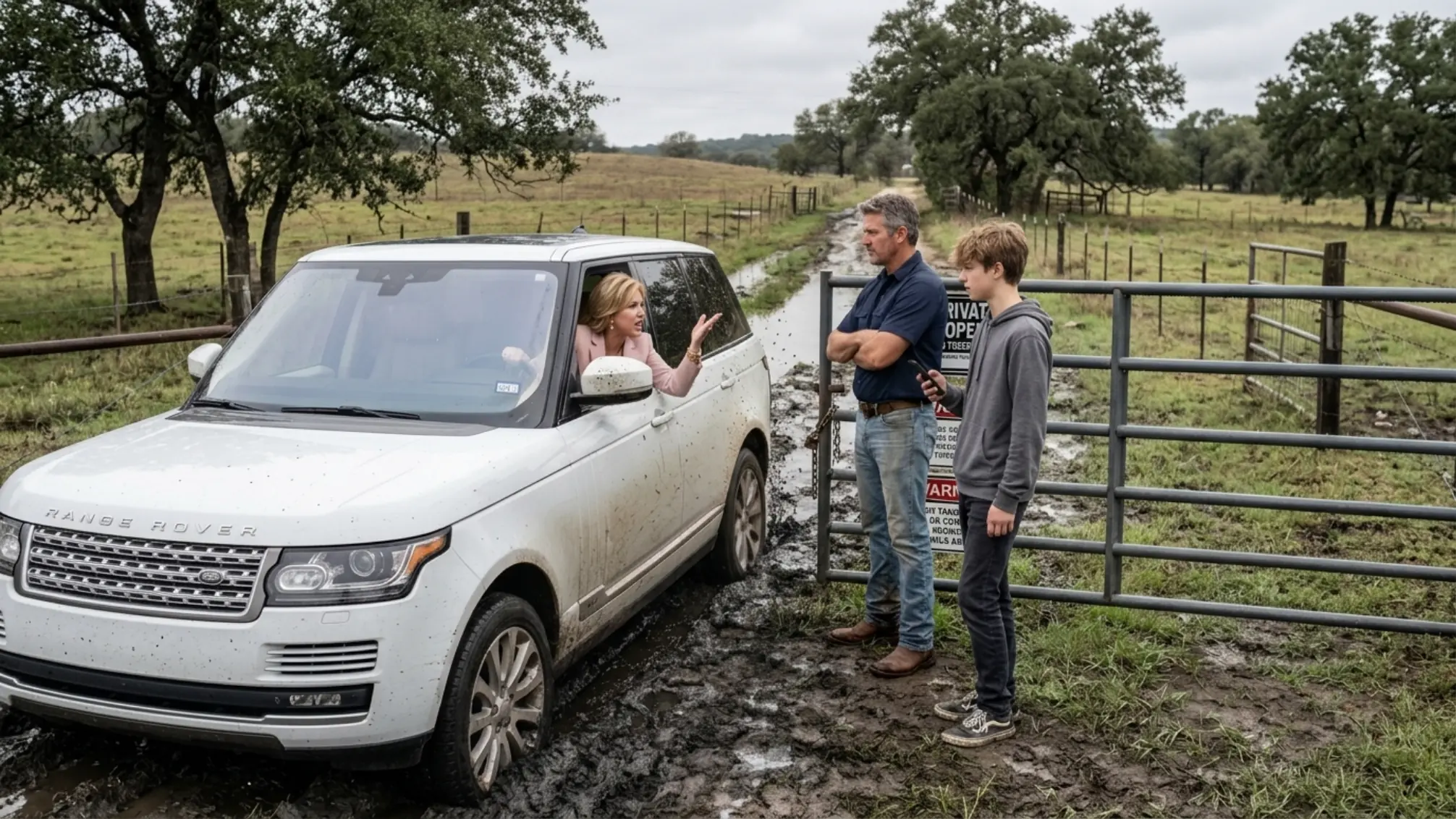
Daniel did not step backward. At forty-seven, the widowed single father had weathered droughts, cattle illnesses, collapsing prices, and the death of the woman who had helped him build the ranch. One entitled neighbor holding a stack of invented violations was not enough to frighten him.
“I warned you twice,” he said calmly. “That ground is soft enough to swallow your SUV.”
Patricia pointed one manicured finger at his chest. “You’ll repair the road, remove the mud, replace that fence, and stop behaving as though owning a few acres gives you authority over everyone.”
Caleb looked past her toward the ranch access lane. “You should turn around now, ma’am. Your luxury SUV is already sinking.”
Patricia’s mouth remained open for a second.
Then she spun around.
Her pearl-white Range Rover sat halfway across the lower pasture, where rainwater had collected beneath a deceptively firm layer of grass. The front tires had disappeared almost to the rims, while the rear of the vehicle tilted sharply toward the drainage ditch. Mud bubbled around the wheels as the weight continued pressing downward.
“That is impossible,” Patricia whispered.
The Range Rover sank another inch.
Daniel folded his arms. “No, ma’am. That is exactly what I told you would happen.”
The trouble had begun eighteen months earlier, when a development company purchased the former Collins orchard beside Daniel’s ranch. The orchard was divided into forty-seven luxury homes marketed as Stonebrook Estates, a private community offering “country serenity without country inconvenience.” Promotional photographs showed manicured lawns, decorative ponds, and distant cattle grazing beyond white fences.
The advertisements never mentioned that the cattle belonged to someone else.
Daniel’s family had owned Holt Ridge Ranch for seventy-two years. His grandfather purchased the first hundred acres after returning from Korea, and Daniel’s father added another sixty when neighboring farmland came up for sale. Daniel and his late wife, Rebecca, raised Caleb there among horses, cattle, thunderstorms, and responsibilities that did not disappear simply because a child wanted to sleep late.
Stonebrook’s first residents arrived expecting a controlled version of rural life. They liked sunsets, horses in the distance, and photographs beside hay bales. They disliked manure smells, tractor noise before breakfast, insects around porch lights, and roads that became muddy after rain.
Patricia Langford disliked Daniel personally.
She moved into the largest house near the ranch boundary and was elected HOA president three months later. At fifty-one, she treated every conversation like a board meeting and every board meeting like a coronation. She had spent years managing upscale residential properties in Dallas and believed rules were most effective when delivered with a smile sharp enough to feel like a threat.
Her first letter arrived in a cream envelope.
It accused Daniel of maintaining an “unsightly agricultural barrier” visible from Stonebrook’s eastern entrance. The barrier was a barbed-wire fence installed by his grandfather decades before the development existed. Patricia demanded it be replaced with decorative white vinyl fencing at Daniel’s expense.
He returned the letter with a copy of the county property map.
The fence stood entirely on his land.
Her second complaint concerned tractor noise. Daniel had started the machine at 6:15 one morning to move hay before temperatures became dangerous. Patricia cited Stonebrook’s quiet-hours policy, ignoring that Daniel neither lived in the HOA nor belonged to it.
He sent back one sentence.
Your rules stop at my property line.
Patricia interpreted boundaries as personal insults.
Soon, Stonebrook residents began receiving emails claiming Holt Ridge Ranch damaged neighborhood property values. Patricia photographed Daniel’s muddy cattle trailer, his weathered barn, and the livestock pond visible from the main road. She described ordinary ranch infrastructure as abandoned equipment, unsafe water, and visual neglect.
Some residents believed her.
Others simply wanted peace and remained silent.
Patricia’s most serious conflict involved the old service lane crossing the lower pasture. Decades earlier, the Collins family received temporary permission to use it during harvest season. The agreement ended when the orchard was sold, and the lane remained part of Daniel’s deeded property.
Stonebrook’s developers built their official entrance on the northern road.
Patricia preferred Daniel’s lane because it shortened her drive to the country club by seven minutes.
The first time Daniel found her Range Rover crossing the pasture, he stood beside the gate and waited for her to return. Patricia stopped only because his truck blocked the exit.
“This is private land,” he told her.
“It connects to our neighborhood.”
“It connects because you opened my gate.”
“The developer told us residents once used this route.”
“The orchard owner did, with permission.”
Patricia adjusted her sunglasses. “Then I’m sure you can extend the same courtesy.”
“No.”
She looked surprised, as though Daniel had misunderstood the natural order of things.
“Your road is poorly maintained,” she said.
“It isn’t a public road.”
“You cannot block established access.”
“There is no established access.”
Daniel handed her a printed copy of the survey and photographed her vehicle before moving his truck. Patricia drove away without apologizing. Two days later, Daniel installed a chain and a red PRIVATE PROPERTY—NO THROUGH TRAFFIC sign across the gate.
The chain disappeared the following week.
Caleb found it lying in the ditch with fresh bolt-cutter marks through one link. Tire tracks crossed the pasture and continued toward Stonebrook. Daniel reported the damage, replaced the chain with a heavier one, and installed a motion camera on the fence post.
The next recording showed Patricia leaving her vehicle after midnight.
She cut the new padlock, moved the chain, and drove through.
Daniel took the footage to the county sheriff’s office. A deputy spoke with Patricia and warned her that entering again could result in a trespassing charge. She claimed there had been confusion over easement rights and promised to use Stonebrook’s official entrance.
For nearly a month, she did.
Then heavy spring rains washed out part of the northern county road. Repairs created delays each morning, and Patricia decided inconvenience outweighed the law. She began crossing Daniel’s land again, sometimes followed by delivery drivers or Stonebrook residents who assumed the route was permitted.
Daniel blocked the lane with two round hay bales.
Patricia hired a landscaping contractor to move them.
She later sent Daniel an invoice for “emergency access restoration.”
Caleb found the invoice at breakfast and laughed until milk came through his nose. Daniel did not laugh. Rebecca had been alive when the development was approved, and she had warned him that people who wanted the appearance of country living would eventually demand the countryside behave like a subdivision.
After her death from ovarian cancer, Daniel became more protective of the ranch. It was the last place where every fence, tree, and worn floorboard still carried something of her. Patricia’s repeated intrusions felt less like a traffic dispute and more like someone walking through his family’s home without permission.
Caleb understood that.
He had been twelve when his mother died and rarely spoke about grief directly. Instead, he repaired the Mustang they had planned to restore together, cared for her mare, and became angry whenever Patricia treated the ranch as unused space.
“She thinks nobody owns land unless it has matching mailboxes,” he said one evening.
Daniel tightened a bolt beneath the Mustang’s hood. “She thinks rules matter only when she writes them.”
“Why don’t you have her arrested?”
“Because once would make her a martyr. I want enough proof that she cannot call it a misunderstanding.”
They collected it.
Camera recordings showed Patricia crossing eleven times over three months. On two occasions, she led contractors through the ranch. Another video captured her removing a temporary drainage marker Daniel placed after discovering unstable soil near the lower lane.
That ground had always been dangerous after prolonged rain.
Beneath the grass lay black clay over an old spring-fed basin. During dry weather, the lane seemed solid. After storms, water became trapped below the surface, creating a soft layer capable of swallowing heavy machinery. Daniel’s father once lost half a tractor there and spent two days pulling it out with chains.
Daniel placed warning flags on both sides.
Patricia removed those too.
Her emails became more aggressive as Stonebrook’s annual meeting approached. She proposed that the HOA claim permanent access through Daniel’s ranch under a theory of historic use. The association’s attorney refused, explaining there was no recorded easement and no legal basis for taking private property.
Patricia did not share that opinion with residents.
Instead, she announced that Daniel was “obstructing a traditional community road” and creating emergency-response risks. She circulated a petition demanding the county compel him to reopen the lane.
Daniel attended the HOA meeting carrying the deed, surveys, photographs, and sheriff’s warning. He sat quietly in the back while Patricia described him as hostile, unreasonable, and resistant to neighborhood safety.
When he stood, several residents seemed surprised he was there.
“The lane is private,” Daniel said. “Your lawyer already told the board that.”
Patricia’s expression tightened. “This meeting is for homeowners.”
“You invited discussion about my land.”
“You are interrupting official business.”
Daniel placed copies of the attorney’s written opinion on the front table. “Then conduct it honestly.”
Residents began reading.
A man near the aisle asked Patricia why she had claimed the easement was under legal review when counsel had concluded none existed. Another homeowner wanted to know whether HOA money had been used to move Daniel’s hay bales.
Patricia ended the meeting early.
The following morning, she arrived at the ranch carrying a violation folder.
Daniel and Caleb had been preparing the Mustang for a test drive when her Range Rover crossed the lower pasture. She ignored the main ranch entrance, drove around the locked gate through a shallow section of fence, and parked near the house.
Her tires tore through newly planted grass.
Patricia climbed out in heels and began accusing Daniel of damaging Stonebrook’s image, blocking emergency access, and embarrassing her at the meeting. She waved notices threatening fines of $500 per day if he failed to comply with HOA landscaping standards.
Daniel glanced through the papers.
“You know I am not a member.”
“You benefit from our community’s property values.”
“My ranch existed before your community.”
“Then perhaps it is time the ranch adapted.”
Caleb stood beside the Mustang, listening.
Patricia demanded decorative fencing, removal of visible farm equipment, restrictions on livestock near the neighborhood boundary, and permanent access through the lower pasture. She claimed the board had approved every requirement.
Daniel knew the board had not.
“You drove across marked unstable ground to hand me fake violations,” he said.
“They are official HOA documents.”
“They apply to people inside your HOA.”
“You are surrounded by us now.”
“That doesn’t make you my government.”
Patricia’s face sharpened. “Men like you use tradition as an excuse for neglect.”
Daniel looked at the folder in her hand, then toward the muddy tracks running across land his grandfather had worked. “Women like you use paperwork as an excuse for theft.”
Her cheeks reddened.
That was when she declared his fence ugly and his mud pit harmful to the neighborhood. Daniel warned her again that the Range Rover could sink. She dismissed him, threatened legal action, and demanded obedience.
Then Caleb told her to turn around.
Patricia ran toward the vehicle.
Her heels sank immediately.
She stumbled, recovered, and continued across the pasture while shouting for Daniel to bring a tractor. The Range Rover’s wheels spun when she started the engine, throwing black mud across the pearl-white doors.
“Stop accelerating!” Daniel called.
She pressed harder.
The rear tires dug downward until the frame rested against the ground. Mud surged around the exhaust, and one front wheel disappeared almost completely.
Patricia climbed out screaming.
“You did this!”
Daniel remained beside the driveway. “I did not drive your SUV onto marked private land.”
“You trapped the road.”
“There is no road.”
“You knew it would sink.”
“That is why I warned you.”
Patricia crossed the pasture carefully, holding her trousers above the mud. By the time she reached solid ground, both shoes were gone. Her pale-pink pants were stained to the knees, and fury had destroyed every trace of her polished authority.
“You will pull it out immediately.”
“No.”
Her eyes widened. “Excuse me?”
“The soil is unstable. Taking my tractor in now could sink it too.”
“Then use another vehicle.”
“No towing company will enter without a recovery plan.”
“I have an important meeting this afternoon.”
Daniel looked toward her buried Range Rover. “Then you should call a rideshare.”
Caleb turned away to hide a smile.
Patricia dialed emergency services and claimed Daniel had deliberately blocked her vehicle on an access road. A deputy arrived twenty minutes later—the same deputy who had previously warned her about trespassing.
He studied the Range Rover, warning flags, damaged fence, and tire tracks.
“Ms. Langford,” he said, “why were you on this property?”
“This is a neighborhood access route.”
“No, ma’am. We already discussed that.”
“He created hazardous conditions.”
Daniel handed the deputy photographs showing the warning signs and markers before Patricia removed them. Caleb opened the camera footage on his phone. It showed her driving around the locked gate and crossing beneath the NO TRESPASSING sign.
The deputy watched silently.
Patricia pointed at Daniel. “He refused to rescue my vehicle.”
“He is not required to risk his equipment because you ignored warnings.”
“I could have been killed.”
“You could have used the public road.”
Her voice dropped. “Do you understand who I am?”
“Yes, ma’am. You are the person I warned in writing not to trespass here again.”
The deputy issued a citation.
Patricia stared at it as though the paper itself had betrayed her. Several Stonebrook residents had begun gathering along the fence, alerted by messages that their HOA president’s vehicle was disappearing into Daniel’s pasture.
Some recorded video.
The Range Rover continued sinking.
By sunset, only the upper halves of the wheels remained visible. A professional recovery company arrived with a tracked vehicle, ground mats, winches, and three workers. The supervisor examined the site and quoted Patricia $8,700 because the operation required stabilizing the ground before extracting the SUV without breaking its frame.
She demanded Daniel pay.
The supervisor laughed, assuming she was joking.
Daniel required the company to sign a damage agreement before entering his ranch. Patricia accused him of delaying the recovery, but the deputy supported his right to protect the property.
Work began the following morning.
The scene attracted more spectators than any HOA event Patricia had organized. Workers placed wide mats across the pasture, attached two winch cables, and slowly lifted the Range Rover from the mud. Black clay poured from the wheel wells, doors, and undercarriage.
The engine was destroyed.
The electrical system had flooded.
The insurer later declared the vehicle a total loss.
Worse for Patricia, the removal revealed that repeated traffic had damaged an underground drainage channel. The HOA’s unauthorized use of the lane had compacted soil and redirected runoff toward Daniel’s hayfield, causing nearly $23,000 in erosion and crop loss.
Daniel filed suit.
He included trespassing footage, fence repairs, destroyed warning markers, drainage damage, and the contractor invoice Patricia sent after moving his hay bales. Stonebrook’s insurance company refused to defend her personal actions because the board had never authorized access through the ranch.
Residents demanded an emergency meeting.
Patricia arrived carrying another folder, but nobody allowed her to control the discussion. The association’s attorney confirmed she had ignored legal advice, misrepresented easement rights, spent HOA funds without approval, and exposed the community to liability.
Evan Ramirez, a homeowner who had remained quiet for months, introduced a motion to remove her.
The vote was overwhelming.
Patricia lost the presidency, her vice-chair position, access to association accounts, and the authority she had used as a weapon. The new board issued Daniel a written apology and agreed to pay for fence restoration, drainage repair, and damage caused by unauthorized contractors.
Daniel did not request decorative fencing.
He rebuilt the original barbed-wire line with cedar posts resembling those his grandfather installed. Beside the gate, Caleb mounted a larger sign.
PRIVATE RANCH. NO HOA ACCESS. SOFT GROUND DOES NOT CARE HOW EXPENSIVE YOUR SUV IS.
Daniel read it twice.
“The final sentence may be unnecessary.”
“It is educational,” Caleb replied.
Daniel left it.
Months later, Patricia’s lawsuit against the recovery company was dismissed. Her insurer increased her rates, and Stonebrook residents stopped treating her complaints as commands. She eventually sold her house, though nobody knew whether humiliation or financial pressure made the decision.
The public road was repaired.
Without traffic crossing Daniel’s land, the lower pasture recovered. He restored the drainage channel, replanted grass, and installed a wetland fence around the unstable basin. Native plants returned, and water stopped cutting through the hayfield.
On the first anniversary of the sinking, Daniel and Caleb finished restoring Rebecca’s Mustang.
They rolled the white car from the barn beneath a clear Texas sky. Caleb sat behind the wheel while Daniel rested one hand on the roof.
“Mom would have loved this,” the boy said.
“She would have complained about the engine noise.”
“She would have smiled while doing it.”
Daniel nodded.
They drove toward the ranch gate and turned onto the county road—the legal road, as Caleb called it. Near the former Stonebrook entrance, a new sign directed all residents north, away from Holt Ridge.
The mud basin remained visible beyond Daniel’s fence.
Nothing about it looked threatening. Grass covered the surface, wildflowers grew along the edge, and afternoon light reflected in shallow water. Yet beneath that ordinary beauty lay clay powerful enough to stop a vehicle worth more than many homes.
Patricia believed wealth, titles, and paperwork could make the land obey her.
The land had never heard of the HOA.
It did not care about designer suits, board votes, property values, or the price of a Range Rover. It responded only to weight, water, clay, and the stubborn laws of nature Daniel had spent his life respecting.
She had driven across his ranch because she believed warnings were challenges and boundaries existed for people without influence.
Her SUV sank for a simpler reason.
Daniel had told her the truth.
And no amount of authority could keep her expensive vehicle from disappearing into the mud she was too arrogant to avoid.