The fluorescent lights inside Henderson’s John Deere dealership hummed above a showroom filled with polished green tractors, yellow seats, sales banners, and customers who had stopped pretending not to listen. Earl Maddox stood on the customer side of the counter with mud dried across his canvas overalls and a brown paper bag resting between his calloused hands. Across from him, dealership owner Warren Henderson stared at the document Earl had pushed over the counter.
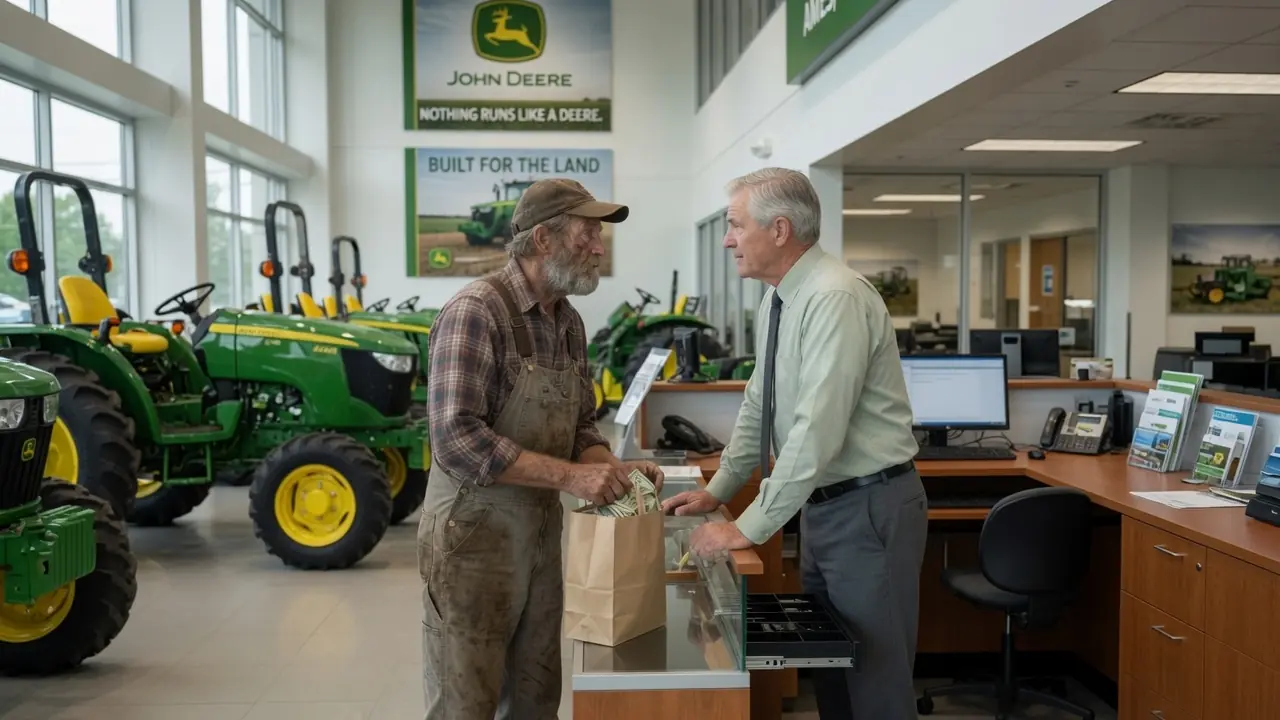
Warren’s face changed as soon as he read the first line.
The paper was not a tractor invoice, bank statement, or loan application. It was a certified foreclosure assignment transferring full control of the dealership property, service bays, inventory liens, and operating note to Maddox Agricultural Holdings. Beneath the company name appeared one signature.
Earl Maddox, Managing Owner.
Warren read it again, slower this time. The sleeves he had started rolling up remained bunched beneath his elbows, and the threat to break Earl’s jaw still seemed to hang in the air between them. Around the showroom, two salesmen stepped away from the counter while the receptionist quietly removed her hand from the security button.
“This is fake,” Warren said.
Earl opened the brown paper bag. Inside were bundled stacks of cash, a cashier’s check, and the keys provided by First Prairie Bank that morning. The money represented the final amount required to satisfy the dealership’s delinquent property taxes and prevent a third-party liquidation company from seizing the entire operation.
“The bank accepted the transfer at eight fifteen,” Earl said. “County clerk recorded it at nine.”
“You don’t have the money.”
“I didn’t ten years ago.”
Warren looked toward the office behind the showroom. His attorney had warned him the bank might sell the distressed note, but Warren had assumed it would go to a regional dealership chain. No bank officer had mentioned that the buyer was the same farmer he had humiliated in front of half the county.
Ten years earlier, Earl had walked into Henderson’s wearing the same brown cap and nearly the same pair of overalls. His old Farmall M had developed a cracked rear wheel center, and he came hoping to trade it toward a used John Deere 4020. The Farmall had belonged to his father and had worked the Maddox farm since before Earl was tall enough to reach the clutch.
Warren examined the tractor for less than a minute.
He laughed at the faded red paint, the welded seat bracket, and the toolbox Earl’s father had fashioned from an ammunition box. Then he offered Earl two hundred dollars and announced loudly that any farmer still relying on such a machine deserved to lose his land.
Earl had not answered.
He left the dealership, loaded the wheel center into his pickup, and drove thirty miles to a salvage yard. He found another Farmall with a burned engine, purchased its rear assembly for seventy-five dollars, and spent the night installing it inside his barn. The next morning, the old tractor started on the second turn.
Warren told the story differently.
At restaurants, grain elevators, and equipment auctions, he described Earl as a stubborn relic too proud to accept modern farming. He said the Maddox place would be auctioned within three years and joked that he might buy the Farmall afterward for scrap.
For a while, many people believed him.
Henderson’s dealership was expanding rapidly. Warren sold larger tractors, wider planters, computerized sprayers, and combines that could harvest more acres in one day than Earl’s father once harvested in a week. His advertisements promised farmers that modern equipment would turn family operations into profitable businesses.
The machines worked.
The financing often did not.
Warren offered low introductory payments that rose sharply after two years. He encouraged farmers to use land as collateral, telling them one strong harvest would cover the difference. When crops failed or commodity prices fell, Henderson’s repossessed the equipment, sold it again, and left the bank to collect against the farm.
Earl watched neighbors replace reliable machinery with equipment they could not repair themselves. He watched men who owned their land borrow against it to purchase machines sized for farms twice as large. Most believed production would solve every problem.
Then three wet springs arrived in five years.
Seed went into the ground late, harvests came in light, and interest continued accumulating. Farms that had survived droughts, wars, and two generations of family arguments disappeared beneath loan balances printed in clean black numbers.
Earl survived because he owed little.
He kept the Farmall, repaired his own equipment, and purchased parts from auctions rather than showrooms. When he needed more horsepower, he bought a damaged tractor from a bankrupt estate and rebuilt the engine with his daughter, Rebecca, who had grown up handing him wrenches in the barn.
Rebecca possessed her father’s patience but not his willingness to remain silent. She earned a degree in agricultural finance and returned home after discovering that many rural banks understood equipment values better than they understood farming. She began helping local families examine loan contracts before signing them.
The first agreement she studied came from Henderson’s.
The contract contained an insurance fee charged twice, a service package the farmer never requested, and a clause allowing the dealership to raise the interest rate whenever equipment resale values declined. The farmer believed he was borrowing eighty thousand dollars.
He actually owed nearly one hundred and six thousand.
Rebecca brought the paperwork to Earl.
“This isn’t selling tractors,” she said. “It’s harvesting farms.”
Earl warned the farmer before he signed. Warren heard about the interference and confronted Earl at the grain elevator.
“You couldn’t afford my equipment, so now you’re telling other men not to buy it?”
“I’m telling them to read what you put beneath the price.”
“Your daughter came home with a college degree and thinks she understands business.”
“She understands numbers.”
Warren stepped closer. “And you understand rust.”
Earl looked toward the men listening nearby. Ten years earlier, he might have lowered his head and walked away. This time, he answered.
“Rust shows itself. Debt waits beneath the paint.”
Warren laughed, but fewer people joined him.
Over the next two years, Rebecca reviewed dozens of equipment contracts. She did not tell farmers never to modernize. She helped them calculate realistic yields, repair costs, fuel consumption, insurance, depreciation, and interest after promotional periods ended.
Some purchased smaller machines.
Others repaired what they already owned.
Several walked away from Henderson’s entirely.
Warren responded by spreading rumors that Rebecca was trying to destroy the county’s only authorized John Deere dealership. He refused to sell parts to farmers who consulted her and instructed his service department to delay their repairs during planting season.
That decision created the first opportunity Earl never expected.
Farmers began bringing broken equipment to the Maddox barn.
Earl repaired what he could. Rebecca ordered parts from independent suppliers, and Earl’s son-in-law organized a mobile service truck. They charged fair labor rates and explained every repair before beginning work.
The barn became too small within six months.
Earl converted an abandoned feed warehouse near the highway into Maddox Agricultural Repair. They serviced John Deere, International Harvester, Case, Ford, and any machine a farmer needed to keep moving. Earl hired older mechanics Warren had dismissed for being too slow and young apprentices nobody else wanted to train.
Every apprentice began with the Farmall.
Earl taught them how fuel moved, how compression failed, how timing changed, and how to listen before replacing parts. He believed a mechanic who understood a simple machine could diagnose a complicated one without depending entirely on a computer screen.
Warren mocked the repair shop publicly.
Privately, he feared it.
Henderson’s service income declined first. Then used-equipment sales weakened because Maddox Agricultural Repair helped farmers keep older machines running. Warren attempted to protect his profits by borrowing money to expand into two neighboring counties.
He built a larger showroom, purchased excess inventory, and refinanced the original dealership property. The expansion looked impressive from the highway, but almost every tractor on the lot belonged partly to the bank.
When interest rates increased, Warren’s payments rose.
He sold more aggressively.
Salesmen were instructed to approve buyers who would not have qualified five years earlier. Trade-in values were inflated on paper, then hidden inside larger financing balances. The dealership appeared profitable only because Warren counted future payments as current income.
Rebecca saw the collapse coming before the bank did.
One winter morning, a former Henderson’s bookkeeper named Marlene Shaw arrived at the Maddox repair shop carrying three boxes of copied records. Warren had fired her after she refused to alter dates on repossession notices.
The documents showed that Henderson’s had taken machines from several farms before the contractual cure periods expired. In two cases, the dealership resold tractors while the original owners were still negotiating with the bank.
One file contained the name of Earl’s closest friend, Samuel Cole.
Samuel lost his farm after his combine was repossessed during harvest. Warren claimed Samuel had missed three payments, but Marlene’s records showed one payment had been intentionally posted to the wrong account.
Samuel died eighteen months later.
His widow still lived in a rented house outside town.
Earl sat alone in the repair shop after everyone left and read the file twice. He remembered Samuel arriving at his farm the morning after the repossession, ashamed to ask whether Earl could finish harvesting the remaining wheat.
Earl used the Farmall and an old pull-type combine to save what they could.
It had not been enough.
Rebecca placed the other files beside Samuel’s. “We can give these to the state.”
“We will.”
“But the dealership’s already failing.”
Earl looked up.
Through her work in agricultural finance, Rebecca knew First Prairie Bank was preparing to call Warren’s commercial note. Henderson’s owed more than the property and inventory were currently worth. If the bank foreclosed, an outside chain would probably purchase the dealership, dismiss the workers, and move the service center to the city.
Black Ridge County would lose another local business.
Earl did not care about saving Warren.
He cared about the mechanics, receptionists, parts clerks, and farmers who still depended on the dealership. He also cared about the seven families whose equipment had been unlawfully taken.
Rebecca proposed forming an investment group.
Earl contributed savings from the repair business and used a portion of his paid-off land as security. Several farmers added smaller amounts, including men who once laughed when Warren called Earl a fool. Samuel’s widow invested the settlement money she received after the state reviewed her husband’s case.
Together, they made an offer for the dealership’s distressed loan.
The bank rejected it initially.
Rebecca returned with repair-shop financial statements, service contracts, property evaluations, and a plan to keep every employee who had not participated in fraud. Earl included one additional promise.
Farmers whose machinery had been wrongfully repossessed would receive compensation before any investor collected profit.
First Prairie Bank accepted.
Warren learned about the potential transfer only after missing his final opportunity to cure the loan. He spent the next week searching for emergency financing, but no lender wanted a dealership under investigation.
On Friday morning, the bank recorded the foreclosure assignment.
Earl drove his Farmall into town.
The old tractor’s red paint had faded again since its last restoration, but the engine ran steadily. He parked it beside the newest John Deere in the dealership lot and walked inside carrying the cash required to settle the unpaid taxes.
Warren saw him and immediately assumed he had come to create trouble.
That was when the shouting began.
Now, with the deed resting beneath his hands, Warren looked through the glass doors toward the Farmall outside. Customers had begun gathering near the windows.
“You planned this,” he said.
“I prepared for it.”
“You stole my bank.”
“A bank can’t be stolen.”
“You turned my customers against me.”
“You did that every time you treated one like prey.”
Warren shoved the deed back across the counter. “I built this business.”
“You borrowed this business.”
For one second, Warren looked as though he might actually climb over the counter. Earl did not step back. At fifty-eight, he no longer had the speed he possessed as a younger man, but decades of lifting engines, wrestling tires, and working cattle had left strength in his shoulders.
The dealership’s service manager, Paul Reddick, entered the showroom.
“Warren,” he said carefully, “the state investigators are here.”
Two officials stood behind him with Rebecca and a county deputy. Rebecca carried copies of Marlene’s records and the repossession files.
Warren’s anger turned to fear.
He pointed at Earl. “This man threatened me.”
Every person in the showroom had heard the exchange.
The receptionist spoke first. “You threatened to break his jaw.”
One salesman nodded. “And throw him outside.”
Warren looked around the room, expecting loyalty from employees he had underpaid, blamed, and frightened for years. Nobody defended him.
Rebecca placed a document beside the deed. “You are being removed from management under the terms of the foreclosure transfer. The investigators need access to your financial records.”
“You can’t remove me from my own building.”
Earl picked up the keys from the paper bag.
“It isn’t yours anymore.”
Warren left through the front doors under the supervision of the deputy. Outside, he stopped beside the Farmall and stared at it as though the machine itself had returned to witness his humiliation.
He placed one hand on its faded hood.
“You destroyed everything over this piece of junk,” he said.
Earl followed him outside.
“No. I built something because of it.”
Warren looked back toward the showroom. “You think farmers will respect you because your name is on a deed?”
“No.”
“Then what was all this for?”
Earl considered the question.
“It was for Samuel Cole driving home without his combine. It was for every family who believed your contract because they trusted the man selling it. And it was for every employee inside that building who deserves to work without helping you take another farm.”
Warren laughed bitterly. “You’ll fail within a year.”
“Maybe.”
“You don’t know how to run a dealership.”
“I know how to run something without bleeding it dry.”
The investigation lasted six months. Warren was charged with falsifying financial records, unlawful repossession, and fraud connected to eleven equipment contracts. Several bank employees were also dismissed for ignoring irregularities in exchange for sales commissions.
The court ordered restitution.
Samuel’s widow received enough to purchase a small home. Two farming families recovered machinery that had not yet been resold. Others received payments from the dealership’s remaining assets and Warren’s seized accounts.
Earl renamed the business Black Ridge Farm Equipment Cooperative.
He kept the John Deere franchise after negotiating new terms with the manufacturer, but the dealership also stocked parts for older brands and offered independent repair services. Every financing agreement included a one-page summary showing the full cost, interest changes, collateral risk, and realistic monthly payment.
Rebecca led the finance office.
No salesman was paid more for placing a customer into a larger loan.
Paul managed the service department, and Marlene returned as controller. The mechanics kept their jobs, the apprentices from Earl’s repair shop gained access to professional equipment, and local high-school students could attend evening repair classes without paying tuition.
Earl placed the old Farmall in the center of the showroom.
Not behind glass.
Every few weeks, he started it, drove it outside, and used it around the property. Children climbed onto the seat during open-house days, and older farmers stood nearby telling stories about the machines that taught them to work.
A small sign beside it read:
PAID FOR. REPAIRABLE. STILL WORKING.
One year after the foreclosure, Warren returned.
He looked older and thinner, wearing an inexpensive jacket instead of a pressed shirt and tie. Most of the criminal charges had ended in a plea agreement requiring restitution, probation, and the permanent loss of his dealer license.
Earl found him standing beside the Farmall.
“I remember offering you two hundred dollars,” Warren said.
“So do I.”
“You must enjoy seeing me like this.”
“I don’t.”
Warren looked skeptical. “You took my building.”
“The bank took it. We bought what remained.”
“You made me a joke.”
Earl rested one hand on the tractor’s hood. “I didn’t tell you to threaten an old man in front of your employees.”
Warren lowered his eyes. “I thought you came in to mock me.”
“I came to pay the taxes and keep the doors open.”
“Why?”
“Because a dealership is more than the man who owns it.”
Warren looked through the showroom toward the parts counter, where farmers spoke with employees instead of waiting nervously for salesmen. A young apprentice was explaining a repair estimate to an elderly rancher line by line.
“I could have done things differently,” Warren said.
Earl did not offer easy forgiveness.
“Yes.”
Warren remained there another minute, then walked toward the exit.
Before he reached the door, Earl called after him.
“The Farmall needs washing Saturday.”
Warren turned.
“It doesn’t need a licensed dealer,” Earl said. “Just a man willing to work.”
Warren stared at him, uncertain whether the offer was charity, punishment, or something more difficult.
“What time?”
“Seven.”
He arrived at six fifty.
The work did not erase what he had done. It did not restore lost farms, return Samuel Cole, or transform Warren into a good man overnight. But it forced him to stand beside people he once dismissed and learn that respect could not be financed, demanded, or displayed beneath showroom lights.
Years later, visitors still asked Earl why he bought a John Deere dealership after spending so long defending an old Farmall.
He always gave the same answer.
“The color of a tractor never ruined a farmer,” he said. “Pride, bad debt, and men who profit from both—that’s what you have to watch.”
Then he would climb onto the faded red machine, pull the starter, and let its steady engine answer the rest.