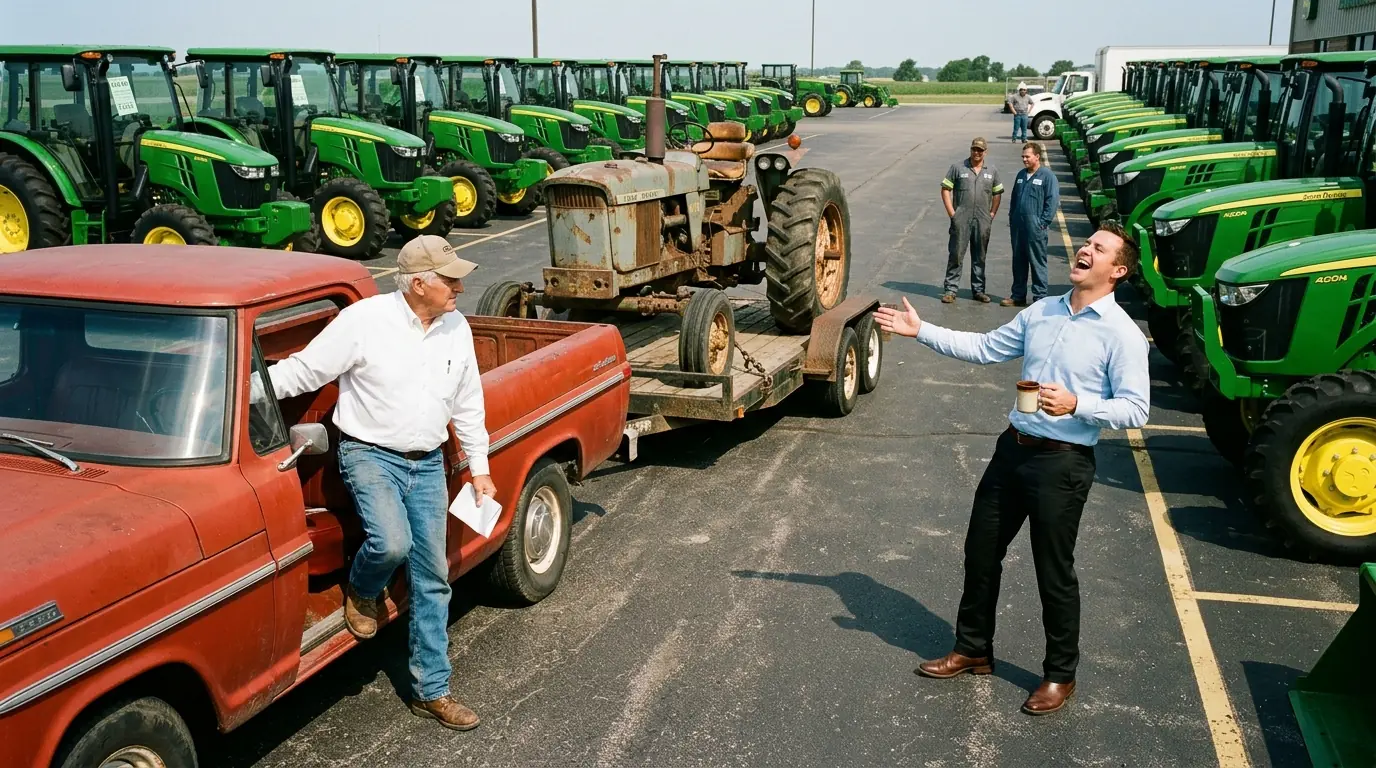
The morning sun came down hard on the asphalt of the John Deere dealership in Cedar County. New tractors lined the front lot like soldiers at parade. Green paint shining, yellow wheels spotless, price tags swinging in the breeze. Then came the sound. A low, uneven rumble. Old metal coughing through old air. Heads turned. An old red pickup pulled in, towing a flatbed trailer. And on that trailer sat a tractor that looked like it belonged in a scrap yard. Rust on the hood, a dent on the side, paint faded to a strange shade between green and gray. The tires were cracked. The seat was patched with leather that had seen forty winters.
Behind the wheel of the truck sat an old man, seventy-two years old, wearing worn jeans, a clean white shirt, and a cap pulled low over silver hair. His name was Walter Hensley. He climbed out slowly. No hurry. No nerves. The dealership manager stepped out of the showroom holding a coffee. His name was Marcus Cole, thirty-four years old, wearing a tailored shirt and polished boots that had never seen mud, the kind of man who measured success by the badge on his belt buckle. Marcus took one look at the tractor and laughed—loud, open, the kind of laugh designed for an audience. Two mechanics by the service bay turned to watch. A young couple shopping for a riding mower stopped mid-conversation. A delivery driver leaned against his truck and smiled.
"Sir," Marcus said, voice carrying across the lot, "I hope you're here to drop that off at the recycling yard. Took a wrong turn, huh?" A few chuckles from the bystanders. Walter said nothing. He pulled a folded paper from his back pocket. "You're a few miles short of the junkyard," Marcus continued, walking closer. "But hey, I'll give you fifty bucks for the scrap metal. Save you the trip." More laughter. Walter looked up at him, slow, calm. His eyes were a pale, steady gray. "Son," he said quietly, "before this day is done, you're going to wish you'd shown that tractor a little more respect." The laughter died. Marcus blinked. Walter walked past him toward the service bay.
Now, here's the thing about that tractor. It was a 1962 John Deere 4010. Walter had owned it since he was twenty-two years old. His father bought it new and handed him the keys the day he came back from the service. For over sixty years, that tractor had worked his land. But here's what nobody at the dealership knew: Walter had been driving past this dealership for thirty-eight years. Every spring. Every fall. Same route. Same time. Same tractor on the back of his trailer. He had never once stopped in—until today. Three days earlier, the local paper had run a feature on Marcus Cole, a glossy photo with a bold headline calling him the future of Cedar County agriculture. The article quoted Marcus dismissing what he called sentimental farmers who clung to obsolete equipment from another century. Walter had read it twice. Then he folded the paper, set it on his kitchen table, and walked out to the barn. He had been waiting decades for the right moment. This was it.
Why keep a rusted tractor when you own 400 acres of prime farmland? Why drive sixty miles to a dealership you'd never visited? And why, on this exact morning, did Walter Hensley walk into Marcus Cole's lot, knowing exactly what was about to happen? The answer was sitting under the hood. And it had been sitting there, untouched by any other hand, since 1962.
To understand Walter, you have to understand the land. His farm sat on the western edge of Cedar County: 420 acres of rolling fields, a creek that ran through the back forty, and a barn his grandfather built in 1919. Walter wasn't loud. He wasn't the kind of man who told stories at the diner. He'd come in on Saturday mornings, order black coffee and two eggs, nod to the regulars, and leave a tip that was always exactly twenty percent. People in Cedar County respected him, but they underestimated him too. They saw the patched overalls, the old boots, the modest farmhouse. They didn't see the three universities he'd quietly funded scholarships for. They didn't see the bank statements.
Every February, Walter did the same thing. He pulled the 4010 into his workshop. He drained the oil, cleaned the filters, checked the lines, tightened what needed tightening. He never let another mechanic touch it. He never had to. His son, Tom, forty-eight, a mechanical engineer in Denver, used to tease him about it. "Dad, that tractor's older than I am. Why don't you just buy a new one?" Walter would smile and say the same thing every time: "Some things were built right the first time, son. You don't fix what isn't broken." But there was more to it than that. There was a reason Walter never let anyone else open that engine. A reason he kept the original maintenance log in a fireproof box in his office. A reason he'd kept every receipt, every record, every signed delivery slip from 1962. Walter was waiting. He just hadn't told anyone what he was waiting for.
Marcus Cole had managed the Cedar County John Deere dealership for six years. Before that, he'd worked at a luxury car dealership in Kansas City. He had an MBA. He drove a new pickup that he washed twice a week. To Marcus, farming was a brand. It was a story you sold to people. The new line of John Deere tractors had touchscreens, GPS systems, and climate-controlled cabs. That was the future. Anything older than 1990 was a museum piece. Anything older than 1980 was scrap. He followed Walter into the service bay, the smile creeping back onto his face. "Look, sir," he said, raising his voice so the mechanics could hear, "I respect the sentiment. Old tractor, family heirloom, I get it. But this thing isn't worth the trailer it's sitting on. Trade it in toward something modern. I'll cut you a deal." Walter set his folded paper on the workbench. "I'd like an inspection," he said. "Full inspection. Engine block opened. Witness." Marcus laughed again, this time softer, almost pitying. "Sir, an inspection on a unit like this runs four hundred dollars. There's nothing to find." "I'll pay it," Walter said. "It's a waste of your money." "It's my money." The mechanics looked at each other. One of them, a heavy-set man named Earl, who'd been turning wrenches his whole working life, straightened up slowly. He'd been watching Walter the whole time. And something in the old man's face was making him pay closer attention. Marcus shrugged dramatically. "All right. Your funeral. Earl, get the lift. Let's give the gentleman a show."
A small crowd was gathering now. Two customers from the showroom, another mechanic, the delivery driver. Marcus caught their eyes and grinned, ready for the punchline. Walter said nothing. He walked to his truck and came back carrying a leather tool roll, old, worn smooth at the edges—the kind of roll a man carries for forty years. He set it on the workbench and untied it slowly. "I'll open it myself," he said. Marcus laughed. "Sir, that's not really—" "I'll open it myself," Walter repeated. Same tone. Same calm. Earl looked at Marcus. Marcus waved a hand. "Fine. Whatever. Let the man play mechanic." Earl drove the 4010 onto the lift. The engine sputtered, then settled into a low, even rhythm, smoother than anyone in that bay expected. Earl raised an eyebrow. The tractor went up. Marcus pulled out his phone and started filming. "For the dealership social media," he announced, "the internet's going to love this." Walter's expression didn't change. He selected a wrench from his roll. Old steel, polished by decades of use. He stepped up to the engine and placed his hand flat on the cover for a moment, the way a man might rest his hand on the shoulder of an old friend. Then he began to work, slow, methodical. He knew every bolt. He knew the order. He didn't need to look. The bay went quiet. One bolt, two, three. Each one set down carefully on the bench in the same order he'd removed them. Marcus tapped his foot. Earl had stopped moving entirely. He was watching Walter's hands, the way a man watches another man who knows something he doesn't. The cover came loose. Walter lifted it free with both hands and set it down gently on a clean rag he'd already laid out. Then he stepped back. "Take a look," he said.
 Marcus stepped forward, peering in. He looked. He frowned. He looked again. He laughed. "That's it? That's the big secret?" He turned to the crowd. "Folks, it's an engine, old, worn, same as every other 4010 from sixty years ago. Sir, I'm sorry to disappoint you, but there's nothing special in there." A few people in the crowd shifted, embarrassed for Walter. Marcus turned back to him, the smile fully returned. "Look, I tried to tell you. This is just an old tractor. Now, if you want to talk about a trade-in—"
Walter picked up a flashlight from his tool roll. He stepped to the engine. He shined the light onto the casting near the fuel injection mount. He brushed away decades of fine dust with a careful hand. "Earl," he said quietly, "come read this." Earl walked over slowly. He bent down. He squinted. His face changed. He stood up. He took off his cap. He looked at Walter, then at Marcus, then back at the engine. "Marcus," Earl said, "you need to come look at this." Marcus walked over, still smirking. He bent down. He looked. The smirk slipped. The casting number stamped on the block wasn't a standard production number. It was an experimental prototype designation, a series that John Deere had only produced fourteen of in late 1961 as part of a closed engineering program testing an experimental turbocharger configuration, a design that was shelved the following year due to manufacturing cost. Of the fourteen prototype engines made, twelve were destroyed during testing. One was preserved in the John Deere archive in Moline, Illinois. The fourteenth had vanished from the records in early 1962. It had been installed by mistake in a standard production 4010 that shipped to a small dealership in Cedar County. A young man named Walter Hensley had bought that tractor. His father had signed the papers. They had no idea what they had until twenty years later when Walter, now in his forties, had the engine inspected by a retired Deere engineer who happened to be a family friend. The engineer had told him the truth. He had told him what the engine was. He had told him what it was worth. And he had told him one more thing: "Walter, this engine is the only example of this prototype outside of the company archive. It's a piece of agricultural history. Don't ever let anyone tell you it's just an old tractor." Walter had thanked him. He had kept the records. He had put the original purchase invoice, the engineer's signed letter, and the John Deere archive's written response from his inquiry in 1985 all in his fireproof box. And he had waited. He had waited a lifetime because Walter knew that one day the right person would dismiss the tractor publicly. And on that day, the truth would be worth far more than it had ever been on a quiet day at home.
Walter walked over to the workbench. He unfolded his paper. It was a single sheet, slightly yellowed at the edges. "That's a letter," he said calmly, "from the John Deere archives in Moline, dated 1985, confirming the casting number on this engine, confirming its origin, and confirming that this is the only known surviving prototype of its kind in private hands anywhere in the world." He placed the letter on the bench. "I have the original 1962 invoice in my truck. I have the engineer's inspection report. I have a chain of documentation going back six decades." Marcus had gone very still. The phone hung at his side. He was no longer filming. The crowd had stopped moving.
"Now, son," Walter said, his voice low and even, "I drove past this dealership for thirty-eight years, every spring, every fall. I never came in. You know why?" Marcus didn't answer. "Because I was waiting for the right moment," Walter said. "I read your interview in the paper this week, the one about sentimental farmers and obsolete equipment." He picked up his letter and folded it. "I think we just found the moment." The video Marcus had filmed never made it to dealership social media, but Earl had seen enough. That afternoon, he made a quiet call to a friend who worked at the regional Deere office. He described what he had seen on the casting. He described the documentation. He described the man who carried it. Within a week, the story moved on its own. The friend told a collector. The collector called Moline. Within ten days, two representatives from John Deere's heritage division were standing in Walter's barn photographing the engine with white gloves and museum-grade lighting. They confirmed everything. A formal offer was made, high six figures, to acquire the tractor for the corporate heritage collection. Walter declined. He accepted a different arrangement instead with a regional agricultural museum in Iowa on one condition: the tractor would be displayed publicly with his father's name listed as the original purchaser. The plaque would read, "Hensley family, Cedar County, stewards of an unrecognized piece of history for sixty-three years."
The story made the regional papers. Then a national farm publication. Then a feature segment on a network morning show. The newspaper feature on Marcus, the one calling him the future of Cedar County agriculture, was quietly pulled from the paper's online archive. Too late. It had already traveled the way these things travel, passed from one phone to another, one feed to another, until it reached every corner of the country that had ever felt overlooked. The dealership chain office in Des Moines reviewed everything. Marcus was reassigned to a smaller branch in another state. The official statement called it a personnel realignment. Everyone knew what it was. The new manager at Cedar County was Earl, promoted at sixty-one years old after a lifetime in the trade. He took the job on one condition. A small sign was hung above the service bay entrance, hand-painted, simple letters. It read, "Respect every machine that comes through this door. You don't always know what you're looking at."
A year later, on a quiet Sunday morning, Walter sat on the porch of his farmhouse with a cup of coffee. The fields were empty. The sun was just coming over the eastern ridge. His son, Tom, had flown in from Denver for the weekend. He was sitting in the chair beside him. The tractor was gone now. The museum had picked it up in March. In its place in the barn sat a small framed photograph: Walter's father, 1962, standing beside the tractor on the day they brought it home. A boy in the background, Walter at twenty-two, smiling under a blue sky.
"Dad," Tom said, "why'd you wait so long? You could have sold that tractor decades ago, lived easier, traveled." Walter took a slow sip of his coffee. "Your grandfather told me something the day he gave me that tractor," he said. "He said most people spend their whole life trying to be seen. And the ones who learn to wait, really wait, end up being remembered." He looked out at the fields. "I didn't keep the tractor for the money. I kept it because it was his. And because somewhere along the way I figured out that the world has a habit of laughing at things it doesn't understand." He set his coffee down. "All I ever did was make sure I was still standing the day it stopped laughing."
The wind moved through the corn. Somewhere behind the barn, a meadowlark called. Tom didn't say anything for a long time. He just sat with his father on a quiet porch on a quiet morning and watched the sun come the rest of the way up. Walter Hensley passed away two years later at seventy-five in the same farmhouse his grandfather built. The plaque at the museum still bears his father's name. The tractor still runs. Some men chase respect. Some men earn it slowly over a lifetime and let it find them when the time is right.