The crowd began gathering inside Torrence Farm Equipment before nine on Saturday morning. Farmers from across southeastern Missouri had driven into Dexter for the dealership’s annual spring demonstration, filling the parking lot with muddy pickups, flatbed trailers, and men wearing faded caps from brands they defended almost as fiercely as family names. Green banners hung from the steel rafters, polished John Deere tractors stood beneath bright showroom lights, and a long table near the service counter offered coffee, biscuits, and brochures promising more horsepower, better traction, and smarter farming. At the center of it all stood Rick Torrence with a microphone in his hand and the confident grin of a man who believed every person in the building had come to hear him speak.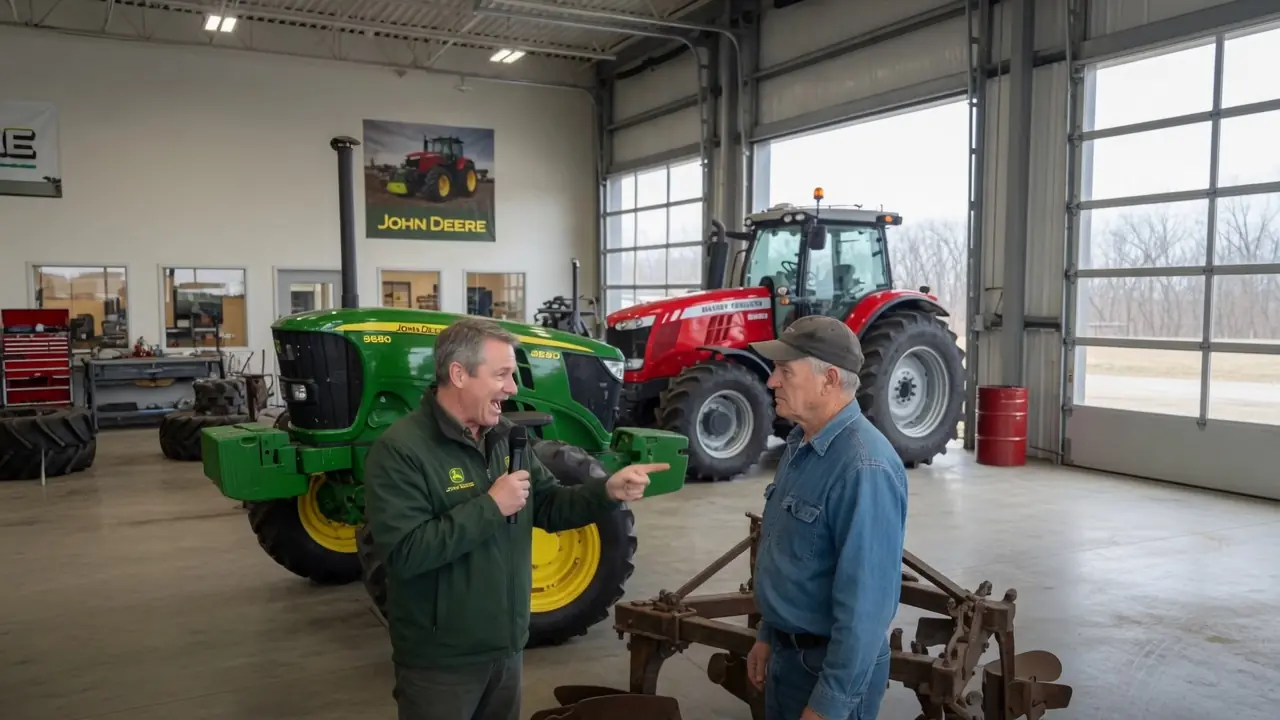
Rick was forty-eight, clean-shaven, broad through the shoulders, and always dressed as though a photographer might appear without warning. His dark-green dealership jacket carried an embroidered John Deere logo over the chest, and his boots were clean enough to prove he spent more time selling equipment than using it. His father had opened the dealership thirty years earlier, but Rick had transformed it into the largest agricultural equipment business in the county. He was successful, persuasive, and completely certain that any farmer who bought a different brand had simply failed to understand his explanation.
Near the rear service bay stood an old twelve-bottom moldboard plow that Rick had brought in for the demonstration. The plow was heavy, rusted along the frame, and built to turn deep strips of stubborn ground rather than pose beneath showroom lights. Rick had arranged for a green John Deere 9680 to pull it through a nearby test field after lunch. According to the posters taped to the walls, the event would prove why “serious Missouri farms trusted green power.”
Vernon Gast arrived without a trailer, a salesman, or an audience. He parked his faded white pickup beside the loading dock and entered wearing a blue denim work shirt, dark jeans, worn boots, and the black cap he had owned long enough for the logo to disappear. At sixty-seven, Vernon moved more slowly than he once had, but nothing about him appeared weak. His weathered face carried the calm expression of a man who had survived droughts, floods, collapsed grain prices, broken machinery, and promises made by people wearing cleaner boots.
Vernon had farmed heavy clay ground outside Bloomfield for nearly forty years. His father had taught him to judge moisture by squeezing soil in one hand and to listen to an engine before believing any gauge on its dashboard. Vernon did not care much about brand loyalty. He cared whether a machine started in January, finished before rain, and returned enough value to justify the debt attached to it.
Three months earlier, Vernon had purchased a used red Massey Ferguson 8680 from an estate sale in northern Arkansas. The tractor had nearly four thousand hours on it, faded paint around the steps, and a cab seat repaired with black tape. Several neighbors told him he had paid too much for another man’s trouble. Vernon replaced two hydraulic hoses, serviced the transmission, changed every filter, and used it through the final weeks of winter without a single major failure.
He had not brought the tractor to Torrence Farm Equipment to prove anything. It was parked several miles away on his nephew’s trailer because Vernon planned to collect a replacement bearing from a machinery shop after attending the demonstration. He would have listened quietly, drunk one cup of coffee, and gone home if Rick had not noticed the small Massey Ferguson patch sewn onto his cap.
Rick pointed toward him from the center of the showroom. “Vernon Gast, I heard you finally traded common sense for red paint.”
Several farmers laughed. Vernon stopped beside the coffee table and looked toward the microphone.
“I bought a tractor,” he said.
“You bought an old Massey,” Rick corrected. “That is not always the same thing.”
More laughter moved through the room. Vernon lifted the lid from the coffee urn and filled a paper cup without reacting. Rick had spent years turning public teasing into a sales technique. He made farmers laugh at someone else’s equipment until buying green felt like joining the winning side.
Rick walked toward the twelve-bottom plow. “We’re pulling this through the west field today. Full depth. Heavy clay. No shallow passes and no excuses.”
A younger farmer near the front asked whether the Massey Ferguson 8680 had enough power to handle the same load. Rick laughed so loudly that he lowered the microphone and looked around as though the question itself had been part of the entertainment.
“That red Massey is overpriced scrap,” he said. “It will die the second this plow bites into Missouri clay.”
The crowd reacted immediately. Some laughed, while others turned toward Vernon to see whether he would defend himself. Vernon took one slow drink of coffee before placing the cup on the table.
“Hook it up,” he said.
Rick’s smile widened. “What?”
“Your mouth has done enough work for one day. Hook the plow to my tractor.”
A murmur spread through the showroom. Several farmers moved closer. Rick looked toward the service manager, then back at Vernon, trying to decide whether the older man understood what he had challenged.
“That plow needs power,” Rick said. “Not nostalgia.”
“My Massey is parked on my nephew’s trailer near County Road 412.”
Rick pointed toward the crowd. “When it stalls, you’ll apologize to every farmer here and admit you brought a toy into a real dealership.”
Vernon walked to the plow, lifted the heavy hitch chain from the frame, and threw it toward Rick. The salesman caught it awkwardly against his chest.
“Follow me outside,” Vernon said. “Keep that microphone ready for your own humiliation.”
The room erupted with laughter, but this time none of it was aimed at Vernon. Rick’s face tightened for half a second before his practiced smile returned. He raised the microphone and announced that the demonstration had just become more interesting.
Within twenty minutes, more than forty trucks were moving toward the test field west of the dealership. Word traveled quickly through phone calls and text messages. Farmers who had planned to arrive after lunch abandoned their morning work and drove toward Dexter. By the time Vernon’s nephew brought the red Massey Ferguson 8680 from the trailer, nearly a hundred people lined the edge of the field.
The test ground had been selected because it was difficult. Two days of light rain had softened the surface, but the clay beneath remained dense and sticky. The field had not been worked since the previous season, and several low areas held enough moisture to pull hard against tires. A tractor might cross the ground easily without a load, yet a twelve-bottom plow running at full depth would test engine power, traction, transmission response, and the operator’s judgment.
Rick climbed onto the frame of the plow and addressed the crowd through a portable speaker. He explained that a fair test required the bottoms to run at least eight inches deep. He described the weight, width, and expected draft load in detail, emphasizing each number as though he hoped the mathematics would frighten Vernon into withdrawing.
Vernon stood beside the Massey Ferguson with one hand on the red hood. The 8680 was not beautiful. Dried mud marked the tires, the paint had faded around the fuel tank, and the black exhaust stack carried a thin ring of soot. Compared with the polished green tractor waiting nearby, it looked like a machine that had already spent its morning working.
Rick walked closer and inspected it with exaggerated concern. “You sure this old thing still has all its gears?”
“It has more gears than you have useful questions,” Vernon replied.
Several farmers laughed again. Rick crouched near the rear tire and pointed toward the tread. “These tires are worn.”
“They are worn from moving through fields.”
The service manager hid a smile behind his hand.
Vernon’s nephew, Caleb, backed the tractor toward the plow. Vernon guided him slowly until the drawbar aligned with the hitch. They connected the pin, attached the hydraulic lines, checked the safety chain, and adjusted the plow’s depth controls. Vernon performed every step without rushing, ignoring Rick’s commentary and the phones recording from the crowd.
An older farmer named Lester Boone walked over to inspect the connection. Lester had farmed clay soil longer than Rick had been alive and had no loyalty to any paint color. He checked the bottoms, measured the adjustment, and confirmed that the plow would run at full depth.
“No trick here,” Lester announced. “If he pulls it, he pulls it honestly.”
Rick lifted the microphone. “And if he doesn’t?”
“Then the ground wins,” Lester replied. “It has beaten better men than you.”
Vernon climbed into the cab. The engine started immediately and settled into a deep, steady idle. He adjusted the mirrors, checked the hydraulic pressure, and moved the tractor toward the starting line at the northern edge of the field.
Rick approached the cab steps. “Last chance to save yourself.”
Vernon opened the side window. “Are you afraid the farmers might learn something?”
“I’m afraid we’ll waste an hour dragging your tractor out.”
“Bring a chain if it comforts you.”
Rick stepped back as the Massey rolled into position. The crowd moved along the field boundary, forming a long line behind the safety markers. Several John Deere salesmen stood together near the polished 9680, while local farmers gathered around Lester and debated whether the red tractor had enough weight to maintain traction.
The Massey Ferguson 8680 produced strong rated horsepower, but numbers alone did not settle the argument. Missouri clay did not care what a brochure promised. If the tires slipped, the engine lugged too deeply, or Vernon entered the wet section too aggressively, the plow could stop him before he reached halfway.
Vernon lowered the plow gradually as he moved forward. The steel bottoms entered the soil one after another, cutting beneath the surface and rolling thick dark strips to the side. The engine note deepened, and black exhaust briefly rose from the stack as the load came on.
The tractor did not stop.
Vernon maintained a steady speed while the plow settled to full depth. The rear tires pressed into the clay, leaving heavy tracks but little wasted spin. The 8680 moved across the first hundred yards with the engine working hard yet controlled.
Rick spoke into the microphone. “Easy ground at the beginning. Wait until he reaches the low section.”
The low section lay near the center of the field, where moisture collected beneath the surface. Several farmers turned toward it. The clay there had stopped smaller tractors in previous demonstrations, and even Rick’s service manager admitted quietly that the ground would decide the test.
Vernon kept the tractor straight. He did not accelerate for momentum or lift the plow to reduce resistance. As the front tires entered the darker soil, the engine loaded more heavily and the rear tires sank another inch.
The crowd became silent.
The Massey continued pulling.
Its engine tone dropped slightly, but Vernon did not touch the gear selector. The tractor held the same gear and kept moving through the wet clay. Thick ribbons of soil rolled cleanly behind the plow, proving that every bottom remained deep in the ground.
Caleb watched the tires. “He’s barely slipping.”
Lester nodded. “He weighted it properly.”
Rick’s smile disappeared. “He’ll have to downshift before the rise.”
The final third of the field climbed gently toward a dry ridge. The slope was not steep, but after the resistance of the low ground, it would keep the tractor under full load. Vernon rested one hand lightly on the steering wheel and watched the engine information display.
The 8680 began the climb.
It did not downshift.
The engine held, the tires continued gripping, and the plow turned twelve deep furrows all the way to the boundary. When Vernon finally raised the implement, the steel bottoms emerged coated in heavy clay. He turned at the end of the field while the crowd exploded into cheers.
Some farmers lifted their caps. Others laughed and pointed toward Rick. Nearly every phone remained aimed at the red tractor.
Vernon brought the Massey to a stop near the crowd and climbed down. He did not raise his arms, celebrate, or speak immediately. He walked to the plow and checked every bottom with Lester to confirm that none had lifted during the run.
Lester measured the furrow. “Eight and a half inches in the low section. Nine near the ridge.”
Rick stepped forward with the microphone. “One pass does not prove durability.”
“No,” Vernon said. “It proves your impossible claim was wrong.”
“You had favorable tire pressure.”
“That is called setting up a tractor correctly.”
“You knew this field.”
“I had never driven it before today.”
Rick looked toward his green John Deere 9680. “The Deere will pull it faster.”
Vernon nodded. “Then hook it up.”
The crowd shifted with renewed excitement. Rick had not expected the challenge to continue. His demonstration plan involved a carefully adjusted plow, a selected path, and a dealership operator who had tested the field earlier in the week.
Now the farmers wanted the same conditions.
Lester insisted that the John Deere use the same plow without changing its depth. He also marked the starting point and requested a parallel pass close enough for everyone to compare the furrows. Rick agreed because refusing would look worse than losing.
The service manager disconnected the Massey and attached the plow to the dealership’s green 9680. The John Deere was newer, cleaner, and more powerful on paper. Rick climbed into the cab himself, determined to regain control of the event.
Vernon stood with the farmers at the edge of the field. He had no interest in seeing the John Deere fail. A good tractor was a good tractor, regardless of paint. His argument was never that Massey Ferguson was superior in every situation. His argument was that Rick had lied when he called it incapable.
Rick lowered the plow and began the pass. The Deere pulled strongly across the first section, moving slightly faster than Vernon had. Its larger tires maintained traction, and the engine sounded smooth beneath the load.
Several salesmen began smiling again.
Then Rick entered the wet clay.
The tractor’s automatic system detected the increased resistance and shifted down. The change was not a failure. It was exactly what the transmission had been designed to do, protecting the engine while maintaining movement.
However, Rick had promised that Vernon’s Massey would stall or downshift under the same load.
The Deere continued through the section successfully, but every farmer had heard and felt the automatic gear change. Rick reached the ridge, completed the pass, and returned to the crowd.
“It pulled faster,” he announced.
Lester crossed his arms. “It also shifted.”
“That is intelligent power management.”
Vernon nodded. “Then perhaps downshifting was not the disgrace you made it sound like ten minutes ago.”
The crowd laughed louder than before. Rick handed the microphone to his service manager and walked toward the dealership truck. His sales presentation had collapsed because he had built it on ridicule rather than fact.
A young farmer named Mason Reed approached Vernon. Mason had been considering a large equipment purchase for his family’s expanding operation. Rick had spent weeks convincing him that any tractor without green paint would cost him time and respect.
“What year is your Massey?” Mason asked.
“Older than Rick’s argument.”
“How many hours?”
“Three thousand nine hundred and twelve when I checked this morning.”
“What repairs have you done?”
Vernon described the hoses, service work, filters, and tire adjustments honestly. He did not pretend the tractor was perfect. He explained that parts availability mattered, dealer support mattered, and maintenance history mattered more than the color of the hood.
Other farmers gathered around him. Some owned John Deere equipment and intended to keep it. Others ran Case IH, New Holland, Kubota, or mixed fleets. The demonstration had not converted everyone to Massey Ferguson, but it had reminded them that machines should be judged by work rather than salesroom theater.
Rick returned after several minutes without the microphone. “You embarrassed me in front of my customers.”
Vernon looked across the field at the two parallel furrows. “You invited them to laugh at me.”
“That was salesmanship.”
“That was arrogance.”
“I was making a point.”
“So was the tractor.”
Rick lowered his voice. “You think one field pass changes anything?”
“It changed what those men saw.”
Rick glanced toward the farmers surrounding the Massey. Several were photographing its model plate and asking Caleb where Vernon bought it. Two younger farmers compared financing information on their phones.
The red tractor had not destroyed John Deere’s reputation. It had done something more dangerous to Rick personally: it had made his certainty look dishonest.
“You planned this,” Rick said.
“I came for coffee.”
“That tractor happened to be nearby?”
“I was collecting a bearing.”
“You expect me to believe that?”
Vernon studied him for a moment. “You believe only stories that make you look important.”
Rick stepped closer. “My family built this dealership.”
“My family built farms that keep dealerships alive.”
The words carried farther than either man intended. The farmers nearby became quiet.
Vernon continued, his voice calm. “You sell tools. Useful tools, expensive tools, sometimes excellent tools. But the men standing here decide whether those tools earn their place. You do not get to insult their judgment simply because they bought from someone else.”
Rick looked around and realized every customer was listening.
Lester stepped forward. “He is right.”
A farmer in a John Deere cap nodded. “I run green equipment, Rick, but I’m tired of being told another machine cannot work because you do not sell it.”
Another man added, “You could have praised your tractor without calling his scrap.”
Rick’s service manager lowered his eyes. The lesson had become larger than the field test.
The following Monday, a video of the demonstration began spreading through local farming groups. Someone had recorded Rick’s original challenge, Vernon throwing him the hitch chain, the red tractor pulling the plow at full depth, and the John Deere automatically shifting in the wet clay. Within three days, the video had been shared across several states.
The caption read: Salesman said the Massey would choke. The Missouri clay answered for him.
Vernon disliked the attention. Reporters from two agricultural websites called his home, and a tractor enthusiast drove four hours to photograph the 8680. Vernon answered technical questions but refused to insult the John Deere.
“The green tractor completed the work,” he told every caller. “The salesman was wrong, not the machine.”
That distinction earned him more respect than boasting would have. Farmers understood that Vernon had not staged the test to promote a brand. He had defended the value of evidence against the volume of a microphone.
Rick faced consequences inside the dealership. Several customers delayed purchases and demanded independent comparisons before signing contracts. One farmer canceled a large order, explaining that he no longer trusted Rick’s claims about competing machines.
Rick’s father, Harold Torrence, returned from semi-retirement after watching the video. At seventy-four, Harold still visited the dealership each Wednesday and knew many customers by their first names. He called Rick into the office and closed the door.
“You did not lose because the Massey pulled the plow,” Harold said.
Rick sat across from him. “The video made us look foolish.”
“You made us look foolish.”
“I was selling our equipment.”
“You were selling your pride.”
Harold reminded him that the dealership had survived because farmers trusted its service department when machines broke during planting and harvest. Trust could not survive if customers believed every recommendation came with contempt for anything the dealership did not sell.
“A man who farms six hundred acres may know more about what works on his ground than you do,” Harold said. “Your job is to help him, not perform above him.”
Rick resisted the lesson at first. He blamed Vernon, the crowd, social media, and the weather. Yet every explanation returned him to the same truth: he had publicly promised the tractor would fail, and the tractor had simply continued moving.
Two weeks later, Vernon entered Torrence Farm Equipment to collect hydraulic fittings. The showroom was quieter than it had been during the demonstration. Rick stood behind the service counter without a microphone.
“I owe you an apology,” he said.
Vernon stopped.
“I mocked your tractor, and I mocked you because I thought it would make my product look stronger.”
“It made you look weaker.”
“I know.”
Rick glanced toward two farmers waiting near the parts desk. “I also told customers things I could not prove. That ends now.”
Vernon placed the fittings on the counter. “Apologies are easy inside a quiet room.”
Rick nodded. “Then come outside.”
Near the dealership entrance, Rick had installed a new sign advertising monthly field comparisons. Farmers could bring different tractors, use identical implements, record fuel consumption, measure depth, and review the results without sales commentary.
The first event would compare five tractors from different manufacturers on the same ground. Rick had invited independent mechanics and agricultural extension specialists to verify the conditions.
“No microphone?” Vernon asked.
“One microphone,” Rick said. “For announcing numbers, not insulting people.”
Vernon studied the sign. “That might teach you something.”
“It already has.”
Several months later, Torrence Farm Equipment hosted the first open comparison. More than two hundred farmers attended. John Deere equipment performed well, as Rick expected, but machines from other brands also produced strong results.
Rick presented every number honestly. When a Case IH used less fuel in one test, he said so. When the John Deere completed another task faster, he explained the advantage without declaring every competing tractor worthless.
Vernon brought the Massey Ferguson 8680 again. The old red tractor did not win every category, but it remained steady, efficient, and reliable. When it finished pulling a heavy cultivator across another patch of clay, the crowd applauded.
Rick approached Vernon after the event. “Still overpriced scrap?”
Vernon looked at the red tractor. “The price seems better every time you talk about it.”
Rick laughed. It was the first time Vernon had heard him laugh without using someone else as the joke.
The story of the twelve-bottom plow remained popular across the county. Farmers repeated it at auctions, cafés, and parts counters, often exaggerating the depth, the slope, and the size of the crowd. Some versions claimed the Massey pulled thirteen bottoms. Others said Rick hid behind the dealership when it reached the ridge.
Vernon corrected none of them unless the tractor’s work was misrepresented. He knew how quickly truth could become legend once farmers had time, coffee, and an interested audience.
The real lesson was simpler.
A polished showroom could display horsepower, but it could not decide what a machine was capable of doing. A microphone could make one man louder, but it could not change the resistance of Missouri clay. Rick’s sales pitch had been designed to humiliate an old farmer and prove that green paint owned the field before the engines ever started.
Instead, Vernon hitched the same plow to his faded red Massey Ferguson and let the work speak.
The tractor entered the heavy clay at full depth, held its gear, climbed the final rise, and finished the pass without downshifting. It did not argue, boast, or demand applause.
It simply proved him wrong in front of every farmer watching.