The stagecoach left Clara Whitlock beside a crooked signpost three miles outside Laramie, Wyoming, with one carpetbag, a faded brown coat, and a letter promising that a man named Gideon Ross would be waiting. Snow clung to the distant ridges, though the October road was still mostly mud, and the wind moved across the open country without finding anything tall enough to stop it. Clara stood with her sleeves pulled over her wrists and repeated the smile she had practiced during the journey west. It was gentle, grateful, and carefully empty.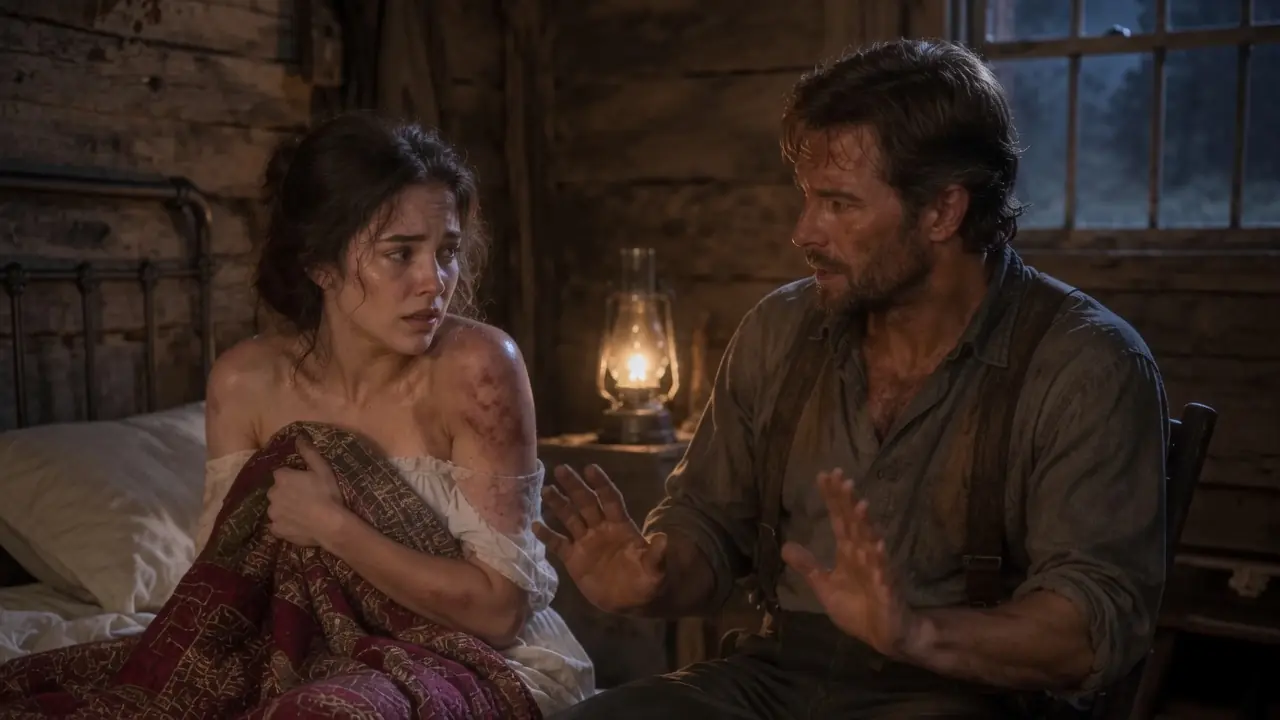
A wagon appeared beyond the cottonwoods half an hour later. The driver was a broad-shouldered man in his mid-thirties with dark hair, a short beard, and a charcoal work shirt beneath a worn canvas coat. He climbed down before the horses had fully stopped, removed his hat, and looked at Clara as though he were trying to decide whether speaking first might frighten her. His eyes were steady and gray-green, nothing like the eyes she remembered from home.
“Miss Whitlock?”
“Yes.”
“I’m Gideon Ross.”
Clara offered the rehearsed smile. “I hope I have not disappointed you.”
His brow tightened slightly. “You’ve only said five words to me.”
She looked down, realizing she had already made a mistake. Gideon took her carpetbag but did not reach for her arm, even when her boot slipped near the wagon wheel. Instead, he held out his open palm and waited until she chose whether to take it.
Clara placed only her fingertips against his hand. Gideon helped her onto the wagon without closing his fingers around hers. It was such a small restraint that she nearly cried.
The ranch stood in a shallow valley surrounded by pine-covered hills and miles of empty grass. There was a weathered cabin, a barn reinforced with fresh timber, two corrals, and a narrow creek running behind the chicken coop. Gideon apologized for the size of the place before Clara had even stepped down.
“It isn’t much yet,” he said. “But the roof holds, the well is clean, and the bedroom door has a lock from the inside.”
Clara turned toward him sharply.
Gideon seemed to realize how strange that sounded. “I thought you might want privacy until we know each other better.”
“You are my husband now.”
“Not until Reverend Hale arrives tomorrow.”
“And after that?”
“After that, you still get privacy whenever you ask for it.”
No man had ever spoken to Clara as if her asking mattered. Her stepfather, Silas Whitlock, had treated every locked door as a challenge and every refusal as disrespect. Even her mother had eventually stopped saying no because it only made him angrier.
Inside the cabin, Gideon showed Clara a small bedroom with clean sheets, a blue quilt, and wildflowers in a chipped ceramic cup. A second room near the kitchen held a narrow cot and his clothes. He explained that he would sleep there until she invited him elsewhere.
Clara stared at the flowers. “Did you pick these?”
“My neighbor’s daughter did. I chose the cup.”
“It has a crack.”
“I chose poorly.”
A quiet laugh escaped Clara before she could stop it. Gideon smiled, but he did not look triumphant, as Silas always had when he forced any sign of happiness from someone. He simply carried her bag into the room and left the door open behind him.
They were married the following afternoon beneath a stand of yellow cottonwoods. Reverend Hale read the vows while Gideon’s nearest neighbors, Thomas and Ruth Bell, stood as witnesses. Clara’s hands trembled when Gideon placed a plain silver band on her finger, but he did not squeeze them or pull her closer for the expected kiss.
“May I?” he asked quietly.
Every person present heard him. Clara saw surprise pass across Ruth’s face, but not mockery.
Clara nodded. Gideon touched his lips briefly to her forehead.
That night, he cooked rabbit stew while Clara unpacked the contents of her carpetbag. She owned two dresses, one comb, a sewing kit, a small Bible that had belonged to her mother, and a bundle of documents wrapped in oilcloth. She pushed the documents beneath the mattress when she heard Gideon’s boots near the doorway.
He knocked despite the open door. “Supper’s ready.”
“I’ll come.”
“You don’t have to hurry.”
Clara joined him at the table wearing her high-collared nightdress beneath a wool robe. The sleeves were pulled to her fingertips despite the warmth from the stove. Gideon noticed, but he said nothing.
They ate in a quiet that was not yet comfortable but did not feel dangerous. Gideon told her about the ranch, the winter feed he still needed to cut, and a stubborn mare named June who refused to accept that fences applied to her. Clara described the journey west but avoided every question about the home she had left.
When the dishes were washed, Gideon rose from the table. “I’ll be in the other room.”
Clara’s heart began beating too fast. “You do not have to.”
He waited.
She had prepared herself for this moment throughout the journey. She had told herself that marriage meant enduring what followed, that Gideon had paid for the advertisement, the stagecoach fare, and the license. A decent wife could not refuse after taking so much from a man.
“I know what is expected,” she whispered.
Gideon’s expression changed. “Nothing is expected tonight.”
“But we are married.”
“That makes me responsible for your safety. It does not make your fear something I am allowed to ignore.”
Clara looked at him, uncertain whether his kindness was real or merely patience before anger. Men could pretend for a long time when they wanted something. Silas had been charming for nearly three months after marrying her mother.
Gideon moved toward the cot. Clara suddenly reached for his sleeve.
“Stay,” she said.
He turned but did not come closer. “Are you certain?”
She nodded even as terror climbed into her throat.
Gideon sat on the wooden chair beside the bed while Clara remained beneath the quilt. He asked about the journey, then about the wildflowers, then about nothing at all. Slowly, the silence softened.
When he eventually moved his hand toward hers, Clara flinched violently. Her shoulder struck the wall, and the sleeve of her nightdress pulled above her elbow.
Gideon saw the scars.
Some were thin and pale. Others were raised, dark, and uneven across the inside of her forearm. A newer bruise curved around her upper arm like the print of a hand.
Clara yanked the fabric down. “It hurts… this is my first time.”
Gideon immediately raised both hands and pushed the chair farther from the bed. “Then nothing happens until you feel safe with me.”
Tears filled Clara’s eyes. “You did not bring me here to sleep alone.”
“I brought you here because your letters sounded lonely, and mine probably sounded worse.”
“You will regret choosing me.”
“Because you have scars?”
“Because I am afraid of everything.”
Gideon looked toward the oil lamp rather than forcing her to meet his eyes. “Fear kept you alive long enough to reach this ranch. I won’t shame you for it.”
Clara’s breath broke into a sob. She had expected disgust, questions, perhaps anger that another man had already marked what Gideon considered his. Instead, he offered her the quilt where it had slipped from her shoulder.
“He taught me that every touch ends in pain,” she whispered.
Gideon slowly extended one hand, leaving several feet between them. “Then let mine be the first that asks—and never forces.”
Clara stared at his open palm. After a long moment, she placed her hand in it.
He held her as gently as if she were carrying a wound he could not see. Nothing else happened that night. Gideon remained in the chair until she fell asleep, then returned to the cot before dawn.
Over the following weeks, Clara learned the rhythm of the ranch. Gideon rose before sunrise, fed the horses, repaired fences, and returned for breakfast with cold reddening his cheeks. Clara baked bread, tended the chickens, and discovered she had a talent for calming June, the mare Gideon claimed had been created entirely from bad decisions.
They spoke more each day. Gideon told Clara that his parents had died during a fever outbreak when he was nineteen, leaving him the ranch and more debt than cattle. He admitted that he had placed the marriage advertisement because the silence in the cabin had become heavier every winter.
Clara still slept alone, though some nights she asked him to sit beside the bed. Gideon never tried to touch her unless she reached first. When nightmares woke her, he stayed on the other side of the locked door and spoke until she recognized where she was.
One evening, Clara rolled up her sleeves while kneading dough. She did not realize what she had done until Gideon entered carrying firewood. He saw the scars again but looked only at her face.
“Do you want help with supper?” he asked.
Her eyes burned. “You can peel the potatoes.”
He did not mention the scars. That silence gave her more courage than sympathy might have.
Three days later, Clara removed the oilcloth bundle from beneath the mattress. She placed it on the table while Gideon repaired a harness near the stove.
“The man who hurt me is Silas Whitlock,” she said. “He married my mother when I was eleven.”
Gideon set down the leather strap. “Your father?”
“My stepfather.”
Clara explained that Silas had controlled a lumber company in Missouri through violence, forged debts, and stolen land. Her mother inherited a small mill and two hundred acres from Clara’s grandfather, but Silas forced her to sign documents until he controlled nearly everything. When she resisted, he beat her.
After Clara’s mother died, Silas claimed the property had been transferred entirely to him. Clara discovered the truth inside a locked desk: the original deed, a ledger recording bribes, and letters proving that Silas had forged her mother’s signature after her death. She stole the papers and fled before he could destroy them.
“He needs these documents,” Clara said. “Without them, he cannot sell the mill to the railroad.”
“Does he know where you came?”
“I used my real name in the advertisement. I believed he would never look west.”
Gideon examined the bundle but did not open it. “These belong to you.”
“You should read them.”
“Only if you ask me.”
Clara slowly untied the string. Together they reviewed the deed, the ledger, and a signed statement from a former clerk who had witnessed Silas alter several documents. Gideon’s expression grew colder with every page.
“We need to take these to a judge,” he said.
“I tried before I left. Silas owns the sheriff and half the county officials.”
“He does not own Wyoming.”
“He will come.”
“Then we prepare before he arrives.”
Gideon took Clara to Laramie the following morning. Judge Edwin Mercer examined the papers privately and agreed they appeared genuine, but jurisdiction remained in Missouri. He advised sending certified copies to a federal land office and contacting an attorney willing to challenge Silas across state lines.
Gideon paid the copying and postage fees despite Clara’s objections. He also arranged for the originals to be stored inside the bank’s safe rather than returning them to the ranch. Clara carried only several convincing duplicates inside the oilcloth bundle.
“You think he will search the cabin,” she said.
“I think a man who left scars like yours will believe he can take whatever he wants.”
They returned to the ranch before sunset. Clara noticed that Gideon now kept his rifle near the door, but he did not speak about danger unless she asked. He continued repairing fences, teasing June, and waiting for permission before touching his wife.
Gradually, Clara’s fear loosened. She began sitting beside him on the porch after supper, their shoulders almost touching. One evening she rested her head against him without planning to.
Gideon became completely still. “Is this all right?”
“It was until you asked.”
“I promised to ask.”
“Then yes. It is all right.”
Their first real kiss came beneath the cottonwoods after the first snow. Clara initiated it, pressing her lips uncertainly against his. Gideon did not pull her closer until she wrapped her arms around him.
For the first time, touch did not feel like surrender. It felt like a door Clara had chosen to open.
Silas arrived twelve days later.
Clara heard the hoofbeats shortly after midnight. Gideon was sitting beside her bed because a storm had rattled the shutters and made sleep difficult. Both of them went still as three riders entered the yard.
A fist struck the front door.
“Clara!” Silas shouted. “I know you’re inside.”
Her body reacted before her mind did. She folded beneath the quilt, unable to breathe, every scar suddenly burning as if it were fresh.
Gideon knelt several feet from the bed. “Look at me.”
“He found me.”
“Yes.”
“He will kill you.”
“He may try.”
Gideon opened his hands. “Do you want me to face him, or do you want us to leave through the back?”
Clara stared at him. Even now, he offered a choice.
“I am tired of running.”
Gideon nodded. “Then stay behind me until you decide otherwise.”
He took his rifle and approached the door. Clara followed wearing her coat over her nightdress, the duplicate documents pressed against her chest. Gideon lifted the wooden bar but kept the door mostly closed.
Silas stood outside with two hired men. He was nearly sixty, heavy through the shoulders, with iron-gray hair and a face that once appeared handsome until anger twisted it. Snow collected across his black coat.
“You stole from me,” Silas said.
Clara’s legs trembled, but she stepped where he could see her. “The deed belonged to my mother.”
“You belong to me until every debt is paid.”
Gideon’s voice became quiet. “She belongs to no one.”
Silas looked him over with contempt. “So this is the fool who bought himself a damaged bride.”
Gideon shifted the rifle slightly. “Say another word about my wife, and this conversation ends.”
Clara touched his arm. “No. Let him speak.”
Silas smiled. “You still think papers can save you? The sheriff back home already signed a warrant calling you a thief.”
“You forged that too,” Clara said.
His expression hardened. “Give me the documents.”
“They are already with a federal judge.”
For the first time, uncertainty crossed Silas’s face. Then he lunged toward the doorway.
Gideon struck him with the rifle stock and forced him back into the snow. One of the hired men reached for a revolver, but lanterns suddenly appeared along the road. Thomas Bell arrived first with Reverend Hale, two ranchers, and Deputy Marshal Samuel Cole from Laramie.
Gideon had sent Thomas a warning before nightfall after noticing unfamiliar tracks near the south fence. He had suspected Silas was already close.
The marshal dismounted. “Silas Whitlock?”
Silas straightened his coat. “This woman stole legal property from Missouri.”
Deputy Cole produced a folded telegram. “Judge Mercer received a response from the federal land office this evening. They want you questioned about forged deeds, illegal timber sales, and the disappearance of a county clerk.”
Silas looked toward Clara with murder in his eyes. “You ungrateful little liar.”
Clara’s fear nearly pulled her backward. Then she remembered Gideon sitting in the chair, moving farther away when she flinched. She remembered his hand waiting open between them.
She stepped in front of her husband.
“You killed my mother slowly,” Clara said. “You stole her land, her money, and every year she should have lived without fear. You will not take another thing from me.”
Silas rushed toward her.
Gideon caught him before he reached the porch, but Clara did not hide. She watched as Deputy Cole and Thomas forced Silas’s hands behind his back. The hired men surrendered without resistance after learning federal authorities were involved.
Silas continued shouting as the marshal placed him on a horse. He promised Clara that no judge would believe a frightened woman over a respected businessman.
Clara held up her scarred arms beneath the lantern light. “Then they can begin by believing what you left on me.”
The yard became silent.
Silas was taken to Laramie and later transported east to face charges. The documents Clara stole led investigators to hidden accounts, forged property transfers, and testimony from workers Silas had threatened for years. Her mother’s land was restored to Clara’s name, and the planned railroad sale was stopped before completion.
Months passed before the case ended. Silas was convicted of fraud, assault, and conspiracy, while two officials who protected him lost their positions. Clara sold the Missouri mill to the workers who had kept it operating and used part of the money to clear Gideon’s ranch debt.
He argued with her for three days.
“You did not marry me to pay for this ranch,” he said.
“No. I married you because your letters sounded lonely.”
“They were terrible letters.”
“They were honest.”
Clara invested the remaining money in cattle, fencing, and a small schoolhouse near the valley. She kept her mother’s original deed inside a cedar chest Gideon built, not as proof of wealth but as proof that Silas had failed to erase them.
On the first anniversary of Clara’s arrival, she stood before the bedroom mirror and rolled her sleeves above her elbows. The scars remained. Some would never fade, but they no longer felt like Silas’s ownership marks.
Gideon appeared at the doorway and knocked on the frame. “May I come in?”
Clara smiled. “You live here.”
“That is not what I asked.”
“Yes, Gideon. Come in.”
He crossed the room and stopped before her. Clara placed his hand against one of the scars on her forearm.
“It does not hurt now,” she said.
His thumb remained still against her skin. “Are you certain?”
“It reminds me that I survived.”
Gideon kissed the inside of her wrist, softly enough that she could have withdrawn at any moment. Clara did not.
She rested her forehead against his chest. “I thought marriage meant giving a man the right to take whatever he wanted.”
“And now?”
“Now I think it means choosing each other again every day.”
Gideon wrapped his arms around her only after she drew them closer. Outside, snow began falling across the corrals, covering the ground where Silas had once stood and believed fear would bring Clara back under his control.
He had followed her west for stolen documents.
Instead, he found a woman who had recovered her voice, a husband who understood that protection did not mean possession, and a truth too large to bury beneath threats.
Clara had arrived at the ranch carrying one carpetbag, a rehearsed smile, and scars she believed made her impossible to love. Gideon never tried to repair her as though she were broken. He simply gave her enough safety to discover that the strongest part of her had survived intact.
The scars remained beneath her sleeves whenever she chose to cover them.
But they were no longer secrets.
And they were no longer chains.