“It’s hurt… this is my first time.”
Eleanor’s whisper was so faint that Samuel Hale almost mistook it for the prairie wind pressing against the cabin walls. She sat on the edge of the wedding bed with both hands twisted tightly into the white sheet, her knuckles pale and her shoulders rigid beneath her thin nightdress. The oil lamp beside the window trembled whenever the wind slipped through the gaps in the timber, causing restless light to move across her frightened face. She did not look like a shy bride waiting for tenderness; she looked like a prisoner waiting for punishment.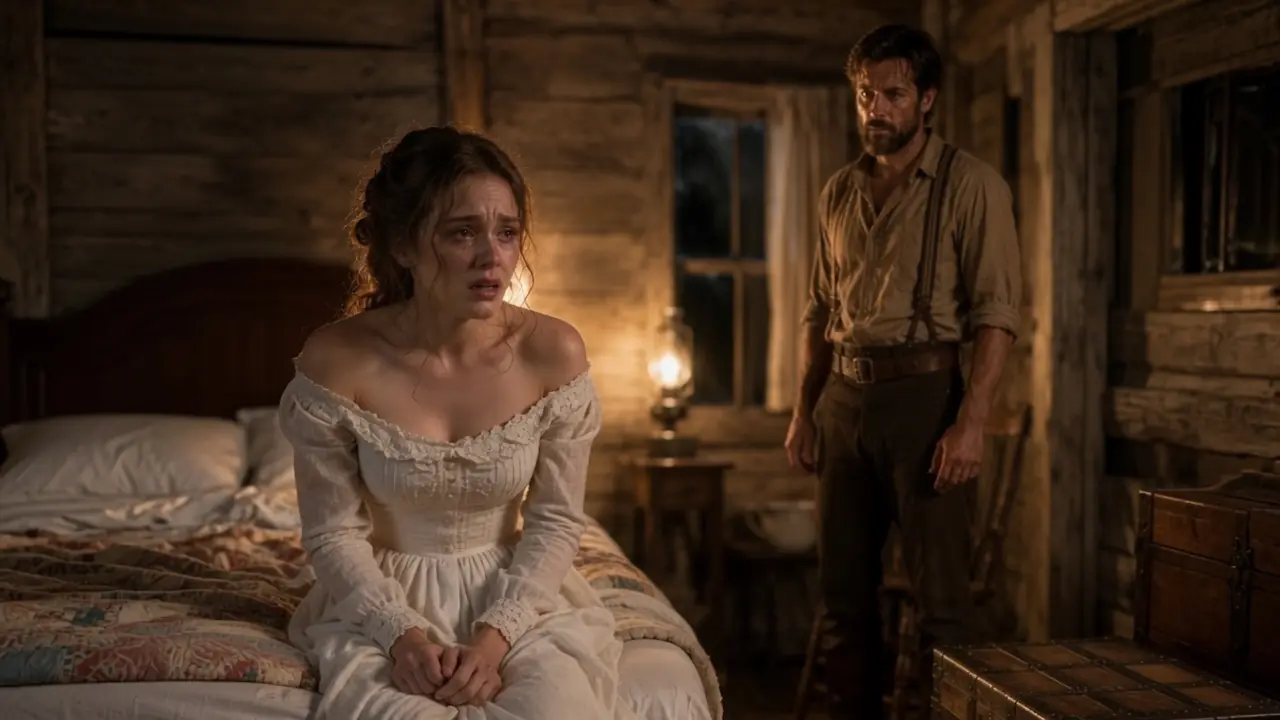
Samuel stood several feet away, unsure what she believed would happen next.
He was thirty-six years old, broad through the shoulders, with a weather-darkened face and hands hardened by ranch work. Ten years had passed since fever took his first wife, Clara, and in all that time he had learned how to live with silence. He ate alone, worked alone, and slept beneath the same roof where Clara’s laughter had once filled every corner. The advertisement for a mail-order bride had not come from romance but from loneliness he had finally grown too tired to deny.
Eleanor had answered with a short, careful letter.
She wrote that she could cook, mend clothes, keep accounts, and endure hard work without complaint. She asked only whether Samuel drank heavily, whether he had children, and whether the bedroom door inside his cabin possessed a lock. The questions had seemed unusual, but life on the frontier made strangers cautious, and Samuel respected caution more than false sweetness.
When Eleanor arrived in Abilene three days earlier, she carried one battered wooden trunk and wore a faded gray traveling dress too light for the evening chill. She was younger than Samuel expected, with chestnut hair pinned at the nape of her neck and eyes that inspected every doorway before she crossed it. When the stationmaster lifted her trunk suddenly, Eleanor flinched hard enough to nearly stumble off the platform. Samuel noticed, but she dismissed it as exhaustion from the journey.
Their wedding was small.
A preacher spoke the vows inside a whitewashed church while Samuel’s neighboring ranchers stood as witnesses. Eleanor’s voice barely rose above a whisper when she said yes. She smiled when expected, accepted congratulations politely, and kept watching the church doors as though someone might enter before the ceremony ended.
Now, alone inside the cabin, Samuel finally understood that her unease was not ordinary nervousness.
“It will be over quickly,” he said, trying to reassure her.
The moment the words left his mouth, shame struck him.
Eleanor’s breathing stopped.
Her eyes widened, and she pressed herself farther back on the mattress until the wooden headboard prevented her from retreating. Samuel saw terror cross her face so quickly and completely that it seemed to erase the young woman beneath it. She raised one hand defensively, and the sleeve of her nightdress slid toward her elbow.
Bruises covered her arm.
Some were dark purple, others yellow and green with age. Beneath them lay narrow white scars and the faint round marks of old burns. They were not injuries from one accident or one cruel evening.
They were a history.
Samuel stepped backward immediately.
He raised both hands where Eleanor could see them.
“Why are you trembling like I’m about to punish you?” he asked softly. “Who did this?”
Eleanor pulled the sleeve down and hugged her arm against her chest.
“No one.”
“That is not true.”
“I fell.”
“Not that many times.”
She looked toward the locked trunk near the wall.
Samuel followed her gaze but did not approach it. He could see the way her attention moved from the trunk to the window and then toward the rifle resting beside the door. Whatever secret she carried had crossed hundreds of miles with her.
He reached for the quilt folded at the foot of the bed.
Eleanor recoiled.
Samuel stopped before touching her. Instead, he placed the quilt beside her and moved back toward the fireplace. She stared at it for several seconds before pulling it around her own shoulders.
“I am not going to hurt you,” Samuel said.
Disbelief filled her eyes.
“The man who raised me said every husband takes what he paid for.”
Samuel’s face hardened.
“No one paid for you.”
“You sent money for the journey.”
“I purchased a train ticket.”
“He said that made me yours.”
“It made the ticket yours.”
Eleanor looked down at the quilt.
Samuel took a chair from beside the washstand and placed it near the opposite wall. He sat far enough away that she would not feel cornered. The cabin remained silent except for rain tapping against the window.
“You may sleep in that bed alone,” he said. “I will sleep near the fire.”
“You are my husband.”
“That does not make me your jailer.”
“I made vows.”
“So did I.”
Samuel leaned forward, resting his forearms on his knees.
“I vowed to protect you. Protection does not begin by frightening you.”
The first tear slipped down Eleanor’s cheek.
She wiped it away quickly, as though crying might anger him. Samuel looked toward the fire and gave her the privacy of not being watched. After several minutes, he heard the bed creak as she shifted beneath the quilt.
“My uncle’s name is Silas Crowe,” she said.
Samuel remained still.
“He was my mother’s older brother.”
“What happened to your parents?”
“My father died in a factory accident when I was nine. My mother became ill three years later.”
Silas had appeared after the funeral carrying legal documents that declared him Eleanor’s guardian. At first, he seemed generous. He paid the burial expenses, moved Eleanor into his house outside St. Louis, and promised that she would never be alone.
The generosity ended within weeks.
Silas owned a laundry employing widows, immigrants, and orphaned girls. Eleanor worked from before sunrise until late at night, washing sheets in boiling water and carrying baskets heavier than she was. Silas kept every dollar she earned and told neighbors that he had rescued an ungrateful child.
When she resisted, he beat her.
When she attempted to leave at sixteen, he found her at the railway station and locked her inside a storage room for three days. Afterward, Eleanor stopped running openly. She learned to obey while quietly collecting evidence of what happened inside the laundry.
“He kept a ledger,” she said. “Payments, bribes, wages he stole, names of girls who disappeared.”
Samuel looked toward the trunk.
“You have it?”
“I copied part of it.”
“Is that why he followed you?”
“I don’t know if he did.”
Her voice broke.
“I don’t know whether he even knows where I went.”
“How did you escape?”
A traveling schoolteacher named Mrs. Ames began bringing books to the laundry workers. She noticed Eleanor’s injuries and helped her answer Samuel’s advertisement under another surname. When Samuel sent money for the journey, Mrs. Ames purchased the ticket and hid Eleanor in a supply wagon until the train left St. Louis.
Before leaving, Eleanor entered Silas’s office.
She took letters connecting him to a city official who had ignored complaints about the laundry. She also took copies of falsified debt agreements that Silas used to claim his workers owed him money. Every document lay inside the trunk.
“I thought marriage was the only place he couldn’t legally take me from,” Eleanor whispered.
Samuel felt anger settle inside him, cold and controlled.
“Did you marry me because you wanted a husband or because you needed a hiding place?”
Eleanor’s face crumpled.
“I am sorry.”
“That was not an accusation.”
“You should send me away.”
“Why?”
“Because I deceived you.”
“You told me you needed a home.”
“I did not tell you why.”
Samuel looked toward the rain-dark window.
“You came here believing a stranger might be safer than the man who raised you.”
She lowered her head.
“Yes.”
“Then whatever you escaped must have been worse than anything I imagined.”
Samuel stood slowly.
Eleanor stiffened, but he moved only toward the fireplace. He gathered another blanket, removed his boots, and settled onto the floor beside the hearth.
“You should lock the bedroom door,” he said.
She stared at him.
“The lock works from inside.”
“What if you need something?”
“I can knock.”
Samuel turned his back so she could prepare for sleep without feeling watched. Several minutes later, the bedroom door closed. The lock clicked.
He remained awake until sunrise.
The next morning, Eleanor emerged wearing the same guarded expression, but the bruises were hidden beneath a long-sleeved dress. Samuel had prepared coffee and biscuits, though the biscuits were hard enough to threaten a man’s teeth. He placed the plate on the table and stepped away.
“You cooked?” she asked.
“I attempted something similar.”
She picked up one biscuit and tapped it against the plate.
Samuel sighed.
“The chickens rejected them too.”
A faint smile touched her mouth.
It disappeared quickly, but Samuel saw it.
He showed her the cabin in daylight: the pantry, the well, the barn, and the small room once used for storage. He offered to move a bed into it so she could have a private room indefinitely. Eleanor looked confused by the suggestion.
“People will talk.”
“People always talk.”
“They will think I am a bad wife.”
“They already think I am a stubborn old fool. Their opinions appear unreliable.”
Samuel established three rules.
She could lock any door she wished.
He would never enter her room without permission.
And no part of the marriage would continue unless she chose it freely.
Eleanor listened in silence.
“What do you expect from me?” she asked.
“Honesty when you can manage it.”
“And the ranch?”
“If you wish to help, I will teach you. If you do not, we will find something else.”
“What if I never become the wife you expected?”
Samuel thought of Clara, whose memory had become so polished over ten years that he sometimes forgot they had argued about money, weather, and his habit of leaving muddy boots near the stove. Eleanor was not Clara, and he had no right to force one woman into the shape of another.
“Then I will stop expecting you to be someone you are not.”
Trust came slowly.
For the first week, Eleanor slept with a chair beneath the door handle despite the lock. She startled whenever Samuel entered the cabin too quickly and avoided standing between him and an exit. When he raised an axe in the yard to split wood, she dropped a basket and covered her head.
Samuel set the axe down immediately.
He waited until she lowered her arms.
“I should have warned you.”
“You were cutting wood.”
“That does not make your fear foolish.”
He began announcing himself before entering rooms. He placed tools down before approaching her and never stood between her and the door. These habits felt unnatural at first, but Samuel soon understood they were not burdens.
They were promises made through movement.
Eleanor began helping with the ranch accounts. She possessed an extraordinary mind for numbers and discovered within two afternoons that a cattle buyer had underpaid Samuel three times during the previous year. Samuel rode into town with her calculations and returned with forty-three dollars.
“You saved the ranch more money than I made this week,” he said.
Eleanor looked worried.
“You are not angry?”
“Why would I be angry?”
“Silas hated when I corrected his figures.”
“Silas sounds like a man who preferred theft to arithmetic.”
That evening, Eleanor laughed for the first time.
It was a small sound, startled out of her before she could prevent it. Samuel looked toward her, and the laughter vanished.
“I am sorry.”
“Do not apologize for that.”
“For what?”
“Making the cabin sound less empty.”
Her eyes softened.
Three weeks after the wedding, a stranger arrived at the ranch.
Samuel saw the rider approaching from the eastern ridge shortly before noon. The man wore a black coat despite the heat and rode a bay horse lathered with sweat. Eleanor was hanging sheets behind the cabin when she looked up.
The clothespins fell from her hand.
Every trace of color left her face.
“Samuel.”
He followed her gaze.
“Is that him?”
Eleanor could not answer.
She backed toward the cabin, but her legs seemed unable to carry her. Samuel stepped between her and the approaching rider without touching her. Silas Crowe dismounted beside the fence.
He was in his late forties, narrow-faced and clean-shaven, with a smile that never reached his eyes. Dust covered his boots, but his coat was expensive. He looked at Samuel first, then past him toward Eleanor.
“There you are,” Silas said.
Eleanor began trembling.
Samuel did not move.
“You are on private land.”
“I have come for my niece.”
“She is my wife.”
Silas smiled.
“That marriage is invalid.”
He removed several folded documents from his coat. One declared Eleanor legally incompetent due to nervous illness. Another identified Silas as her permanent guardian with authority over her residence, wages, and marriage.
Eleanor stared at the papers.
“He said he would do this.”
Samuel took them but did not hand them to her.
“Who signed these?”
“A judge in Missouri.”
“Then a Kansas marshal can examine them.”
Silas’s smile faded.
“There is no need to involve officials.”
“There is every need.”
“She stole from me.”
Eleanor looked toward Samuel.
“The ledger.”
Silas stepped closer.
“She took business documents and money.”
“I took twelve dollars that belonged to me.”
“You owned nothing.”
Samuel’s voice became cold.
“She belongs to no man.”
Silas looked him over.
“You paid for a bride. Do not pretend this is about freedom.”
“I paid for her journey.”
“You received damaged goods.”
Samuel struck him before thinking.
The punch knocked Silas against the fence. Blood appeared at the corner of his mouth, but Samuel did not continue. He stepped back, furious with himself for acting before Eleanor could see that violence would stop.
Silas smiled through the blood.
“There he is.”
Samuel’s fists remained closed at his sides.
“Leave.”
“I will return with the law.”
“Bring all of it.”
Silas mounted his horse.
Before riding away, he looked at Eleanor.
“You know what happens to girls who shame me.”
Eleanor flinched.
Samuel took one step forward.
Silas turned the horse and rode east.
That night, Eleanor packed her trunk.
Samuel found her near the door wearing her traveling dress.
“Where are you going?”
“If I leave, he will stop.”
“No.”
“He will destroy your ranch.”
“Then we will build another.”
“He has papers.”
“We have evidence.”
“He knows officials.”
“Then we find honest ones.”
Eleanor gripped the trunk handle.
“You do not understand him.”
Samuel approached slowly and stopped several feet away.
“You are right. I do not understand how he thinks.”
His voice softened.
“But I understand what fear has made you believe. It has convinced you that everyone near you will be safer if you disappear.”
Tears filled her eyes.
“Wouldn’t you be?”
“No.”
“Why?”
“Because I would know I allowed you to face him alone.”
Eleanor looked down.
“I don’t want you killed.”
“I do not intend to be.”
“You struck him.”
“I should not have.”
“He deserved it.”
“That is not the same as it being wise.”
Samuel looked toward the locked trunk.
“The documents inside may be stronger than my fists.”
The following morning, they rode into Abilene.
Marshal Thomas Reed examined Silas’s guardianship papers and immediately questioned the seal. The document claimed Eleanor had been declared incompetent in a county where no judge by the listed name had served. The marshal sent telegrams to Missouri and asked Eleanor to provide a formal statement.
She struggled to speak.
Samuel sat beside her but did not answer for her. Whenever she stopped, he waited. The marshal did the same.
By evening, Eleanor had told the entire story.
The copied ledger revealed unpaid wages, false debts, bribes, and names of officials who protected Silas’s laundry. One letter described arrangements to send two orphaned workers west under false contracts. Another suggested Silas intended to sell Eleanor’s labor to a wealthy household after she became “too troublesome.”
The marshal sent the evidence to St. Louis.
For six days, nothing happened.
Then Silas returned with two hired men.
They arrived after midnight, cut the eastern fence, and entered through the barn. Samuel woke to a horse screaming and reached for his rifle. Eleanor stood in the hallway holding the lamp, terror frozen across her face.
“Stay inside,” Samuel said.
Silas shouted from the yard.
“You cannot hide forever, Nell.”
Samuel opened the door but remained behind the frame.
“The marshal knows you are here.”
“He will arrive too late.”
Silas’s men moved toward the cabin.
Then Eleanor stepped beside Samuel.
He looked at her.
“You do not have to come out.”
“I am tired of hiding.”
She carried no weapon.
Only the original ledger copy and one of Silas’s letters. Her hands shook, but she walked onto the porch. Silas stared at her as though obedience should have returned the moment he appeared.
“You forged the guardianship papers,” Eleanor said.
“Go inside the wagon.”
“No.”
His face changed.
Samuel had seen that expression before in frightened horses—the instant before panic turned into violence. Silas reached beneath his coat.
A rifle cracked from the darkness.
The shot struck the dirt near his boot.
Marshal Reed emerged beside the barn with three deputies. Samuel had sent a ranch hand into town after Silas’s first visit, asking the marshal to watch the eastern road. The deputies surrounded the men before anyone could draw.
Silas pointed toward Eleanor.
“She stole from me.”
Marshal Reed held up a telegram.
“Missouri authorities want to discuss that.”
The telegram confirmed the judge’s name was false. It also reported that Mrs. Ames had testified about abuse inside the laundry and provided the names of three missing workers. Silas was wanted for fraud, unlawful confinement, assault, and suspected trafficking.
The hired men surrendered immediately.
Silas did not.
He lunged toward Eleanor.
Samuel moved, but she was faster.
She stepped aside.
Silas stumbled past her and fell against the porch rail. The deputies restrained him before he could rise.
He looked up at Eleanor with hatred.
“You are nothing without me.”
She stood above him, shaking but upright.
“I was nothing because you needed me to believe it.”
The deputies took him away before dawn.
For weeks afterward, Eleanor expected him to return. Every hoofbeat in the distance sent her toward the window. Every knock tightened her chest.
Samuel never told her the fear should have ended.
He understood that prison bars around Silas would not immediately remove the ones he had built inside her. Instead, Samuel continued announcing himself before entering rooms. He continued sleeping near the fire until Eleanor stopped locking the bedroom door.
One evening in early autumn, she found him carrying blankets toward the hearth.
“You can sleep in the bed,” she said.
Samuel stopped.
“Are you certain?”
“No.”
He waited.
Eleanor took a slow breath.
“But I want to try.”
He placed the blankets down.
“You may change your mind at any moment.”
“I know.”
That knowledge mattered more than courage.
They lay on opposite sides of the bed with nearly two feet between them. Samuel kept both hands visible above the quilt. Eleanor remained awake for a long time, listening to his breathing.
Nothing happened.
No demand.
No hand reaching across the darkness.
Morning arrived quietly.
Eleanor woke before him and stared at the man sleeping beside her. For the first time in years, she had spent an entire night near another person without preparing to defend herself.
She began crying.
Samuel woke immediately and sat up.
“What happened?”
“Nothing.”
He looked confused.
“That is why.”
Months passed.
Eleanor’s testimony helped Missouri authorities free several workers and recover unpaid wages. Silas was convicted on multiple charges and sentenced to prison. Mrs. Ames moved west the following spring and became Abilene’s first schoolmistress.
Eleanor started teaching ranch girls to read in the Hale cabin twice a week.
She kept the battered trunk but no longer locked it. The documents inside were eventually transferred to the courthouse. In their place, she stored schoolbooks, letters, and a blue dress Samuel purchased for her birthday.
A full year after their wedding, Samuel stood outside the church where they had first spoken their vows.
Eleanor joined him beneath the cottonwood tree.
“You have been quiet all morning,” he said.
“I have been thinking.”
“Dangerous habit.”
She smiled.
“Our first vows were made when I was afraid.”
Samuel nodded.
“I do not regret marrying you,” she continued. “But I did not understand choice then.”
“What are you saying?”
Eleanor reached for his hand.
This time, she did not flinch when his fingers closed around hers.
“I want to choose you now.”
They returned to the church.
Mrs. Ames, Marshal Reed, and several neighboring families gathered inside. There was no new legal ceremony, because none was required. Eleanor simply stood before Samuel and spoke vows written in her own hand.
She promised companionship without obedience.
Honesty without fear.
Love freely given and never demanded.
Samuel promised patience when memory returned, gentleness when words failed, and a home whose doors Eleanor could open or close herself.
That night, they returned to the cabin.
The oil lamp glowed beside the same bed. The prairie wind moved against the walls, but the silence no longer felt suffocating.
Eleanor sat on the mattress.
Samuel remained near the door.
“Are you sure?” he asked.
She looked at him.
The question itself was the final proof that he was nothing like Silas.
Eleanor held out her hand.
“Yes.”
Samuel crossed the room slowly.
He did not take what marriage supposedly entitled him to have. He accepted what Eleanor chose to give.
Years later, people in Abilene remembered Samuel Hale as the rancher who protected a frightened mail-order bride from the man hunting her. Eleanor always corrected them.
Samuel had not rescued her by claiming her.
He helped her understand that nobody had the right to claim her at all.
The locked trunk eventually disappeared into the attic. The bruises faded, though the scars remained. Eleanor never hid them again.
When young women came to her school carrying fear they could not explain, she did not ask why they had waited so long to speak. She asked what they needed in order to feel safe enough to begin.
Samuel often watched from the doorway.
He never entered without knocking.
Their love did not begin on the day they married. It began on the night Samuel saw terror in his bride’s eyes and chose to step backward instead of closer.
Sometimes the greatest act of love was not holding someone tightly.
It was showing them the door was open—and trusting that one day, they might freely choose to stay.