The church doors opened, and warmth escaped into the winter night like a prayer no one was listening to.
Grant McCoy stood on the steps, watching families disperse into the snowlit darkness of Stillwater Creek.
Christmas Eve, 1887, and the cold bit deep enough to make a man question his faith in spring.
Around him, voices called season’s greetings. Children laughed. Wagons creaked toward homes where fires waited.
He noticed her because everyone else didn’t.
Ruth Winslow stood by the picket fence alone. Her coat was too thin for a Montana winter. No gloves covered the hands she kept tucked under her arms. Snow gathered on her shoulders like judgment made visible.
The congregation flowed past her.
Mrs. Adelaide Hayes pulled her daughter away when the child waved. Widow Brennan turned her eyes to the ground. Virgil Hayes gave Ruth the kind of look a man gives something unpleasant he would rather not acknowledge.
Ruth held herself straight despite it all, chin up, eyes forward.
Grant recognized that posture. He had worn it himself once, years ago, when doors closed and kindness was rationed like winter feed.
His father’s voice came to him across the years.
Son, a man who won’t help when he can ain’t much of a man at all.
Grant descended the steps.
“Night’s too cold for standing alone, ma’am.”
Ruth turned. Her eyes were cautious, measuring.
“I don’t need charity.”
“No, ma’am.” He touched the brim of his hat. “But coffee’s hot, and my ranch ain’t but a mile down the road. Seems a shame to let either go to waste.”
She studied his face, searching for the hook hidden in kindness.
He had seen that look before, too, in his own mirror, the year he was twenty-three and broke and turned away from a town that judged his father’s drinking more than his own character.
“Just coffee,” she said finally.
“Just coffee,” he agreed.
They walked toward his wagon, leaving the church and its congregation behind.
Snow fell steady and soft.
Behind them, voices murmured, but Grant didn’t turn to hear what they said.
Out here, you stand tall or get buried low.
And he reckoned kindness helped a body stand.
The house welcomed them with firelight and the scent of pine boughs he had cut that morning, decoration for a Christmas no one would share.
Grant poured coffee into tin cups while Ruth stood near the stone fireplace, warming hands that looked too cold to feel the heat yet.
His ranch house was prosperous but spare. Leather furniture worn comfortable. Navajo rugs his mother had traded for. Polished wood floors that echoed when a man walked alone.
“Sit, please.” He gestured to the chair near the fire.
She sat slowly, like someone who had learned not to expect comfort, and wrapped her hands around the cup.
The silence stretched, not uncomfortable, just careful.
“How long you been in Stillwater Creek?” Grant asked.
“Three days.” Her voice was quiet and steady. “Looking for work. Haven’t found any.”
“What kind of work?”
“Any kind.” She met his eyes. “I can clean, cook, mend. I’m not proud, Mr. McCoy. I just need to survive winter.”
Grant sipped his coffee.
“You married?”
“A widow. Six months now.”
Something flickered across her face. Grief worn smooth by repetition.
“My husband died of fever. Left debts. I sold everything to pay them. Wasn’t enough, but it was honest. Town remembers the debts. Town assumes the debt makes me a liar, too.” Her jaw tightened. “Or worse.”
How one man’s failure became another person’s shame.
How poverty looked like moral failing to people who had never gone hungry.
“My father died owing money,” he said quietly. “Took me eight years to clear his name and build this place. Lot of doors closed before one finally opened.”
Ruth looked at him differently then.
Recognition passed between people who had both learned that mercy was rarer than gold.
“Barn loft’s warm,” Grant said. “Private. Yours as long as you need.”
“Why would you do this for a stranger?”
“Maybe because I know what it’s like when nobody will.”
She studied him again, longer this time, then nodded once.
“I’ll work for it. I don’t take charity.”
“Wouldn’t offer it. You work, you eat. Fair trade.”
Ruth stood, setting the empty cup on the table.
At the door, she paused.
“Merry Christmas, Mr. McCoy.”
“Merry Christmas, ma’am.”
After she left, Grant sat by the fire alone.
But the house felt different somehow, less empty, like something had shifted in the silence, making room for the possibility of voices again.
A man’s word is his bond, and his word said she was safe here.
Grant woke to silence and memory, his father’s voice saying what it always said in the cold Montana dawn.
Son, a man who won’t help when he can ain’t much of a man at all.
Christmas morning.
The house was still.
He dressed in the dim light, pulled on his boots, and looked at the photograph on his dresser.
His father, stern-faced but kind-eyed, standing before this very ranch when it was half-built and hope was all they had.
Grant had been sixteen when his father died.
Orphaned with a failing ranch and a town that remembered drinking more than decency. He had rebuilt everything alone. Reputation, prosperity, respect.
It had taken years of brutal work and one banker’s unexpected mercy.
He remembered towns that judged him, doors that closed, the weight of being young and poor and tainted by another man’s weakness.
In the kitchen, he cooked breakfast: eggs, bacon, bread from yesterday’s baking, preserves Mrs. Brennan had given him before she decided his company wasn’t suitable.
He arranged it on a tray, covered it with a cloth, and carried it out to the barn.
The morning was bright and bitter cold. Snow reflected light like shattered glass.
His foreman, Silas Reed, was already at the corral checking fence lines. Silas was sixty, grizzled, loyal as weathered leather. He watched Grant emerge from the barn and saw the empty tray.
“Boss,” Silas said carefully, “people going to talk.”
“Let them.”
“You sure about this?”
Grant looked at the older man.
“Surer than I’ve been about anything since Pa died.”
Silas nodded slowly.
“Your choice to make. Just wanted you to know what’s coming.”
“I know what’s coming.”
Grant had seen it before.
How quickly respect could turn to suspicion. How easily the righteous found reasons to exclude.
But sometimes the bravest thing is to stay.
And I’m staying on this choice.
Inside the barn loft, Ruth had opened the door at his knock. Her eyes went wide at the breakfast.
“You work, you eat,” Grant said, setting the tray down. “No charity.”
She understood.
He was offering dignity, not pity.
Her eyes glistened.
“Thank you,” she said quietly.
Grant nodded and left.
But as he walked back to the house, he felt something he hadn’t felt in years.
Purpose beyond property. Connection beyond transaction.
The point of no return had already passed.
He had made his choice on Christmas Eve. Everything that followed was just consequence, and he would carry those consequences standing tall.
The house changed slowly, like winter yielding to a distant spring.
Small shifts Grant almost didn’t notice until they had already warmed him.
Ruth refused to sit idle. She mended torn shirts, organized his chaotic office ledgers, and cooked meals that filled the house with scents he had forgotten a home could hold.
Sometimes she hummed while working, old hymns, gentle melodies that made the walls feel less empty.
Grant found excuses to stay near the house.
Morning coffee became longer. Noon meals grew into conversation. Evening chores could wait while he helped her carry water or split kindling.
They talked in the language of people learning to trust.
He told her about building the ranch, the years of loneliness, the way prosperity had brought respect but not companionship.
She spoke of her late husband, a good man who had trusted the wrong partner, who died apologizing for debts he couldn’t pay.
“He loved you,” Grant said one evening by the fire.
“He did.” Ruth’s smile was sad. “But love doesn’t pay for medicine or feed or land. I learned that the hard way.”
“Still counts for something, doesn’t it?”
She looked at him.
“In a town like this?”
Grant didn’t answer because they both knew the truth.
In Stillwater Creek, money mattered more than mercy, reputation more than character.
The evenings became ritual.
They played checkers by lamplight. She laughed when he stubbornly refused to sacrifice his king. He smiled when she beat him three games straight.
The sound of laughter in his house was strange and necessary.
Like water after drought.
One snowy evening, reaching for the coffee pot, Ruth’s hand brushed his, and both froze.
The moment stretched, neither pulling away immediately, neither acknowledging what had shifted between them.
Then Ruth withdrew her hand, poured the coffee, and changed the subject to weather and fence repairs.
But Grant felt the change.
Like ice beginning to crack.
Like winter losing its grip.
“Why do you live alone out here?” Ruth asked later, voice quiet. “A man like you could have married, had family.”
“Reckon I forgot how to let people close.” Grant stared into his cup. “Gets easier that way.”
“Or lonelier.”
He met her eyes.
“Yeah. Or lonelier.”
The fire crackled. Outside, wind moved through bare branches.
Inside, something unnamed and inevitable grew between them, fragile as new flame, warm as the first promise of spring.
Coffee is weak, but it’s honest, like most folks ought to be.
And maybe, Grant thought, honesty was what he had been missing all along.
Grant noticed the silence first.
Conversations that stopped when he entered.
Eyes that wouldn’t meet his across the mercantile counter.
Mid-January, and Stillwater Creek had turned cold in ways that had nothing to do with weather.
At the general store, old Tom Brennan, who had always greeted Grant like a friend, was curt.
“Supplies are in back. Help yourself.”
No smile. No questions about the ranch. Just transaction stripped of warmth.
At the bank, Grant’s business associate, Virgil Hayes, lingered after their meeting.
Virgil was a prominent rancher, town council member, the kind of man whose opinion carried weight in decisions about who belonged and who didn’t.
“Grant, I’m going to speak plain.” Virgil’s voice was low. “People are concerned about your associations.”
“My what?”
“The woman. Mrs. Winslow.” Virgil’s discomfort was visible. “Folks are talking, wondering about your judgment.”
“She’s working at my ranch. Nothing more.”
“Maybe so, but perception matters in business. Trust matters. When a man keeps questionable company…”
“She’s a widow trying to survive winter.” Grant’s voice hardened. “What’s questionable about that?”
“Her husband’s debts. Her character. The appearance of—”
“Appearance.”
Grant stood.
“That what we base judgment on now? Appearances?”
Virgil sighed.
“I’m trying to help you, son. Business partnerships require community respect. Ranch took your whole life to build. Don’t lose it for this.”
Grant left without responding.
Sunday came after service.
Grant waited outside while Ruth stood at a distance. She never entered the church. Just waited by the trees like someone who knew better than to test welcome.
The congregation clustered on the steps. Women huddled, whispering behind gloved hands.
When Ruth moved slightly into view, the group parted.
A child pointed. Her mother yanked her hand down and whispered a harsh correction.
Grant’s jaw tightened.
Virgil Hayes approached again.
“Grant, I’m asking as a friend. Think about what you’re risking.”
“What crime has she committed?” Grant asked quietly. “Being poor? Being alone? Being human? That what we punish now?”
“You know how people are. They see a woman with a past, a man with property.”
“Let them see what they want.” Grant’s voice was steel wrapped in calm. “I know what I see. A woman working honest, living decent. If that troubles folks, maybe they should examine their own consciences.”
He walked away before Virgil could respond.
At home, Grant found Ruth packing her few belongings into a worn carpet bag.
“What are you doing?”
“Leaving.” Her voice was steady, but her hands shook. “I heard your ranch hands talking this morning. I know what this is costing you.”
“You’re staying.”
“Grant—”
“You’re staying.”
He crossed the room and stood close enough to see tears gathering in her eyes.
“The house needs you. I need you.”
The admission hung between them.
Truth spoken plain for the first time.
Ruth’s breath caught.
“You don’t know what you’re saying.”
“I know exactly what I’m saying.”
She looked at him, really looked, and saw something that made her set the carpet bag down.
Out here, a man’s reputation rides ahead of him.
But Grant wasn’t letting gossip lead his horse anymore.
The consequences arrived like winter wolves, quiet at first, then circling closer, showing teeth.
Late January brought the first real blow.
Martin Slade, the major cattle buyer from Helena, sent a telegram canceling their spring contract.
Brief. Businesslike. Final.
Regret must decline partnership. Business concerns require distance from controversy.
Grant read it twice.
The lost contract meant significant income. Not catastrophic, but painful enough to tighten things, to make next winter harder.
Two days later, the church elders visited.
Pastor Hail looked uncomfortable. Deacon Walsh did the talking.
“Grant, we’re asking you to step down from the building committee for the good of the church. Some members are uncomfortable with current arrangements.”
“Current arrangements.”
Grant kept his voice level.
“Your household situation.” Walsh’s face was pious disapproval. “It sets a poor example.”
“A woman working for wages sets a poor example?”
“The appearance of impropriety.”
“Get off my land,” Grant said quietly.
They left.
Pastor Hail paused at the door.
“I’m sorry, Grant. I truly am.”
“Then stand up and say so in front of your congregation.”
Hail flinched and walked away.
The isolation tightened.
Old friends crossed the street to avoid greeting him.
One of his ranch hands quit, young Bill Turner, who mumbled about not wanting to be part of town drama.
Silas stayed, loyal and silent, but even he looked worried.
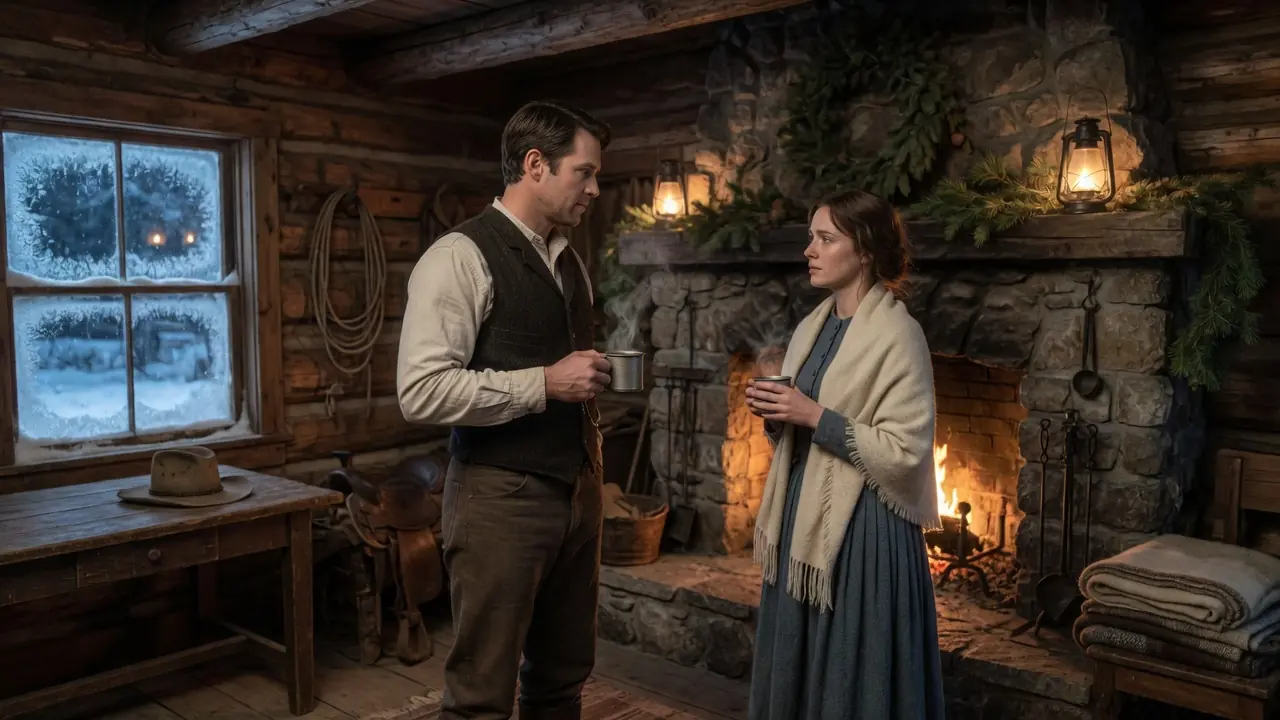
One bitter night, Grant sat by the fire with his ledger open.
Numbers didn’t lie.
The lost contract, the lost goodwill, it added up to a harder year ahead.
Not ruin, but cost.
Real cost.
Ruth entered quietly. Saw his burden. Understood immediately.
“I’m leaving tomorrow.” Her voice was steady, but tears tracked down her cheeks. “I brought you nothing but loss.”
Grant looked up.
Looked at her.
Really looked at this woman who had made his house feel like home, who had brought laughter back into rooms that had only known silence.
“You think I regret this?”
He stood and crossed to her.
“Woman, for ten years, this house was just walls and roof. You made it home. That’s worth more than any contract.”
“What about your reputation? Your standing?”
“I confused respect with connection. Had plenty of the first. Had none of the second.”
He reached out and took her hand.
“Not until you.”
First deliberate touch.
Her hand was warm, work-roughened, trembling slightly.
She didn’t pull away.
“Grant…”
“Whatever comes, we face it. But I’m not letting you go.”
She wept then, quietly, while he held her hand and the fire crackled.
Outside, the wind howled through a world that felt smaller and colder than it had any right to be.
But inside, between two people who had both learned that loneliness was its own kind of death, something grew that was stronger than judgment, deeper than reputation.
Home ain’t a place. It’s the people you’d ride through hell to get back to.
And Grant had just found his.
Grant woke to absence, a cold in the house that had nothing to do with temperature and everything to do with missing heartbeats.
He knew before he reached the kitchen.
Knew by the quality of silence.
The empty air where warmth should be.
The note sat on the table, folded once, his name written in careful script.
Grant,
You gave me more than I deserved. I won’t take your legacy. Be well.
His hands shook holding it.
The barn loft was empty. Her few possessions were gone. Even the cup she had used for coffee had been taken, like she had never existed at all.
Silas found him standing there, staring at nothing.
“She left,” Grant said. It didn’t sound like his own voice.
“When?”
“Before dawn.”
“Town council came yesterday. Said I needed to resign from all civic positions unless I corrected my household situation.”
Grant’s laugh was bitter.
“She heard them. Decided to correct it herself.”
“You going to let her go?”
Grant looked at the older man.
Silas had been there when Grant was sixteen and orphaned. Had stayed through the brutal years of rebuilding. Had never once judged him for his father’s failings.
“What do you think I should do?”
“I think,” Silas said slowly, “that you’ve been defending her to other folks, but you ain’t told her what she means to you.”
“Not really.”
“Not where it counts. I told her—”
“You told her you need her. That ain’t the same as telling her you love her.”
Silas spat tobacco juice.
“You’ve been standing for principle. But principle ain’t enough when a woman’s heart is involved. She needs to hear the truth. And not just from you. From everyone.”
Grant stared at the empty loft.
He remembered her laugh.
Remembered coffee by the fire.
Remembered the warmth that had returned to his life when he had stopped living alone.
“Town meeting,” he said suddenly.
“What?”
“I’m calling a town meeting tonight.” Grant turned and headed for the house. “If I’m going to say it, I’m saying it where everyone can hear. Where she can hear it, too.”
“She’ll be at the stage station by now. Ticket to Denver.”
“Then I better talk fast.”
Silas grinned.
“About damn time, boss.”
Grant saddled his horse.
The morning was bright and cold.
He rode hard toward town, sending word ahead.
Emergency meeting tonight. Mandatory attendance requested.
The land doesn’t lie. Neither should a man.
Grant had been lying by staying silent too long.
Time to stand up.
Time to speak truth.
Time to make Stillwater Creek look at itself and decide what kind of town it wanted to be.
The town gathered like jury and judge.
But Grant McCoy had come to testify not for himself, but for a woman they had condemned without trial.
Stillwater Creek’s town hall was packed.
Ranchers, merchants, families, church elders, everyone crammed into the space, curious and wary.
Single lanterns cast long shadows.
Outside, night had fallen cold and clear.
Inside, the air was close, stifling with body heat and tension.
Mayor Wilkins called for order.
“Grant, you requested this meeting. State your business.”
Grant stood.
Every eye turned to him.
He removed his hat and held it in both hands.
“I’m here to ask a question.” His voice was steady, clear. “What did Ruth Winslow do to deserve your contempt?”
Silence.
Uncomfortable shifting.
“I’ve been thinking on this for weeks,” Grant continued. “Trying to figure out her crime. Best I can tell, she’s guilty of three things: being widowed, being poor, and needing mercy.”
Virgil Hayes stood.
“Grant, this isn’t necessary.”
“It is necessary.” Grant’s gaze swept the room. “Because we’re about to become something we don’t want to be. And I won’t sit quiet while it happens.”
He took a breath.
This was it.
The moment everything changed or everything broke.
“This town was built by people who had nothing. Miners who struck it lucky. Ranchers who started with borrowed cattle and hope. Families who walked across half a continent looking for better. Every one of us, or our parents, needed help at some point. Needed someone to take a chance. Needed mercy when the world was hard.”
Heads nodded.
Some faces looked thoughtful.
Others remained stone.
“Ruth Winslow is no different. Her husband died owing money. She sold everything to pay. It wasn’t enough, but she tried. Then she came here looking for work and found judgment instead.”
“She’s brought scandal,” someone started.
“I brought scandal,” Grant interrupted. “By showing her basic human decency. By offering work and shelter. By treating her like she mattered.”
His voice hardened.
“If that’s scandal, then we’ve fallen farther than I thought.”
Mrs. Adelaide Hayes spoke up, voice sharp.
“You’re risking everything for… for what?”
Grant challenged her.
“For someone who needed help. That’s what I’m risking everything for. And maybe everything I built isn’t worth much if I can’t use it to help someone survive.”
Silence again.
Deeper this time.
Grant softened his voice.
“I’m asking Ruth Winslow to be my wife. Not just at my ranch. Here. In this community. As my partner, my family, my home.”
Gasps rippled through the crowd.
“If that costs me respect, I’ll carry it. But I won’t carry the shame of abandoning someone who needed me. I won’t become what you’re becoming, comfortable enough to forget compassion.”
He looked at Pastor Hail.
“You preach grace every Sunday, Pastor. About second chances. About loving thy neighbor. About mercy.”
His voice was gentle but firm.
“Maybe it’s time we practiced what you preach.”
Pastor Hail stood slowly. His face was troubled but resolved.
“Grant’s right.”
He turned to face the congregation.
“We’ve been wrong. I’ve been wrong. We’ve let fear and judgment poison what should have been compassion.”
Murmurs spread, some angry, some ashamed.
Virgil Hayes rose. His face was conflicted.
“Grant, maybe we’ve been hasty. Maybe we should have given the woman a chance.”
“She deserved more than a chance,” Grant said quietly. “She deserved basic human kindness, and we failed her.”
The mayor cleared his throat.
“Perhaps we should vote on formally welcoming Mrs. Winslow into our community.”
“Vote if you want,” Grant said, putting his hat back on. “I’m going to find her and tell her she matters. Whether you agree or not.”
He walked out.
Behind him, voices rose.
Debate. Argument. The sound of a town forced to confront what it had become.
Grant didn’t wait to hear the outcome.
He had one woman to find.
Mercy arrives quiet like first snow, but it changes everything it touches.
Grant found her at the stage station.
Ticket to Denver clutched in gloved hands.
Eyes fixed on a future that held nothing but more running.
He dismounted slowly and approached like she might spook and disappear if he moved too fast.
“Ruth.”
She turned.
Tears tracked down her face.
“Grant, what are you—”
“Come home.”
“I can’t. You heard what it cost you. I won’t—”
“You heard wrong.” He closed the distance between them and removed his hat. “It cost me nothing that mattered. But losing you would cost me everything.”
“The town—”
“I just told the whole town I’m asking you to marry me. Told them you’re the best thing that ever walked into my life. Told them if they can’t see that, the problem’s theirs, not ours.”
Ruth’s breath caught.
“You told them?”
“I told them the truth. Should have told you first, but I’m telling you now.”
He took her hands in his.
They were cold, trembling.
“I love you, Ruth. Don’t care if it’s too soon or improper or scandalous. I love you, and I’m asking you to stay. Not just at my ranch. With me. As my wife. As my partner. As the person who made me remember what a home actually is.”
“What did they say?”
Grant smiled.
“Does it matter? I’m asking you.”
She laughed, a sound caught between tears and joy.
“You’re impossible.”
“That a yes?”
“That’s a yes.”
He pulled her close, then held her while she wept into his coat, and the winter night surrounded them with cold that couldn’t touch the warmth they had found.
They returned to Stillwater Creek together.
The transformation came slowly, like thaw.
Families visited the ranch, tentative, carrying preserves and apologies.
Mrs. Adelaide Hayes invited Ruth to the quilting circle, face pink with shame.
“We were wrong, dear. Terribly wrong.”
Tom Brennan restocked Grant’s account at the mercantile on credit.
“Long as you need.”
Virgil Hayes shook Grant’s hand at Sunday service.
“You taught us something, son. About what matters.”
By April, spring had truly come.
The church wedding was simple, attended by a congregation that had learned mercy through being forced to see their own capacity for cruelty.
Pastor Hail spoke about second chances, about redemption, about how sometimes God’s grace came through the courage of ordinary people willing to stand for what was right.
Afterward, Grant and Ruth stood on their ranch porch.
Morning light spilled across thawed earth. Early crocuses pushed through mud, purple and brave and impossibly beautiful.
Ruth placed her hand on his.
He covered it with his own.
“You’re sure about this?” she asked, smiling.
“Surer than I’ve ever been.”
He looked across the land his father had left him. Acres and cattle and prosperity built through brutal years.
“You know what I realized?”
“What?”
“This place was never really mine until I had someone to share it with.”
He squeezed her hand.
“My father left me the land, but you taught me what it’s for.”
“What’s it for?”
“Building something that lasts. Not just property. Family. Home. Love.”
The gate stood open to the road.
The lamp in the window burned steady, even in daylight.
A symbol of welcome, of mercy given and received, of two people who had been alone finding belonging in each other.
Every storm ends with sunrise.
Every cabin built is a heart rebuilt.
Every fence mended is a life restored.
And on that spring morning in Montana Territory, 1888, kindness had done exactly what it promised.
It felt exactly like love.