Declan Hart was not the kind of man who missed things.
He had lived alone long enough that his eyes had grown sharper where most men’s got duller. He could notice a shift in the cattle before they bolted, read weather in the color of an afternoon sky, and catch the sound of something wrong in the middle of the night before he was even fully awake.
So when a figure appeared on his eastern ridge one morning and stood there without moving, without coming closer, without making a single sound, he noticed.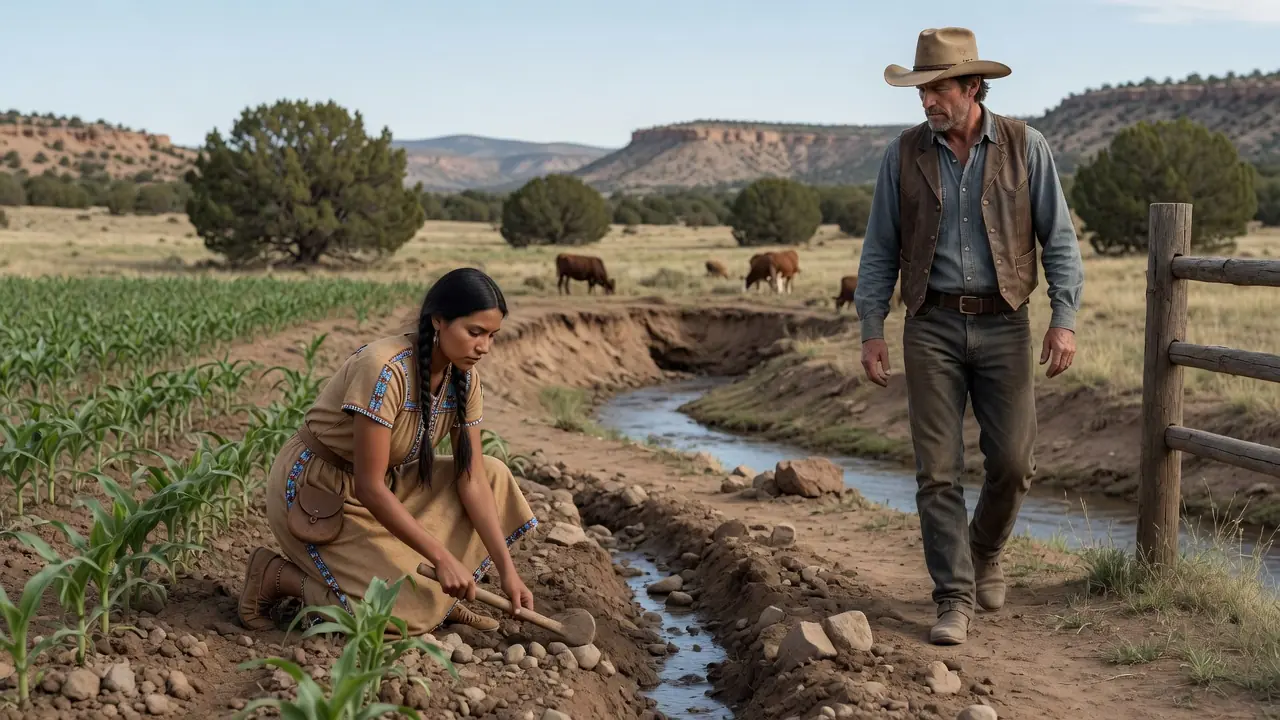
He just did not say anything about it.
He finished his coffee, went about his work, and let the morning pass the way mornings do out on the frontier, slowly under a sky so wide it makes a man feel both free and very small.
But that evening, when the light went orange and the ridge was empty again, Declan stood at his fence for a long time, looking east.
Whoever she was, she had been up there for hours.
And she had come back yesterday.
And the day before that.
Three mornings in a row, same position, same stillness, same unhurried patience.
In his experience, people who watched a man’s land that long without acting were not planning trouble. They were gathering courage.
And whatever she needed courage for, he figured it was about time he went and found out.
There was a particular kind of man the West produced in those decades after the war.
Not the loud kind. Not the kind you would see dramatized in a dime novel with pistols blazing and speeches ringing out across canyon walls.
The quieter kind.
Men who had come out here not to conquer anything, but simply because the noise of the world behind them had become unbearable.
Declan Hart was that kind.
He had come west from Tennessee fifteen years earlier with a mule, a broken compass, and the very specific ambition of being left alone.
He had built his ranch in a shallow valley between two ridges where the grass came in sparse but reliable, where a creek ran clear seven months of the year, and where the nearest town was a full day’s ride through country that discouraged casual visitors.
He ran about two hundred head of cattle with the help of two ranch hands who came and went with the seasons.
He kept a small kitchen garden.
He read when he could find books.
He did not drink to excess, did not gamble, and had never once in fifteen years fired a shot at another human being, which in that stretch of frontier country in those years was something close to a miracle.
The morning he walked toward the ridge, the sky was still pale at the edges and the ground was cold under his boots.
He had not taken his rifle.
He had thought about it for a full thirty seconds, standing at the door, and then decided against it.
If she meant him harm, she had had three days to act on it and had chosen not to.
That counted for something.
He climbed the eastern slope through scattered juniper and loose shale, moving steadily, not trying to be quiet. He let his footsteps announce him the way a man announces himself when he approaches a campfire he has not been invited to, openly, giving the other person time to make a decision.
She was standing when he reached the top.
Not crouched.
Not hiding.
Standing in plain sight with her arms at her sides, watching him come up the last twenty feet of slope with an expression that told him absolutely nothing.
She was young, perhaps eighteen or nineteen, wearing a deerskin dress and moccasins that had seen hard use.
Her hair was pulled back, and her face was angular and precise, the kind of face that looked like it was made for reading distances.
Her eyes were dark and perfectly steady.
She did not reach for anything.
She simply waited.
And in that waiting was a kind of composure that Declan found, in some way he could not immediately explain, deeply familiar.
It was the composure of someone who had already weighed the worst that could happen and made peace with it.
He stopped about ten feet away, and they looked at each other for a moment in the early quiet.
Then Declan said, “Morning.”
She said nothing.
He tried again, slower this time.
“You’ve been up here three days.”
Something shifted in her expression, just slightly.
Not surprise.
More like acknowledgment, as if she had expected him to notice and had been waiting to see how long it would take.
She was Apache. That much was clear to him.
The beadwork on her dress, the way she held herself, the specific stillness that spoke of someone who had grown up in a landscape where being seen could get you killed.
He had had enough dealings with the Mescalero Apache over the years, not always peaceful, but always honest, to know better than to make assumptions about what she wanted or what she meant.
He had learned early that most of the violence on this particular frontier had started not with bad intentions, but with men who thought they already knew the answer before they asked the question.
So he asked, “Is there something you need?”
She looked at him for a long moment.
Then she said, in English that was careful and deliberate, as if each word had been chosen in advance, “I need to speak with you about your water.”
Declan did not react the way she had perhaps expected him to.
He did not laugh.
He did not bristle or reach for the knife at his belt or tell her that his water was his own and she could take herself back wherever she came from.
He stood on that ridge in the pale morning light and thought about what she had said for a few seconds.
Then he said, “Come down to the house. I’ll make coffee.”
Her name was Nasha.
He learned that on the walk down the slope in pieces, the way you learn most things on the frontier, not in a rush, not all at once, but in the gaps between silences that neither of them felt the need to fill.
She had been sent by her grandmother, she said.
Her people had been camped two ridges over for the past two weeks, moving through a corridor they had used for generations on their way to summer grounds farther north.
But the creek that fed Declan’s land, the same creek that curved east of his ranch house and ran through a narrow canyon before eventually losing itself in the flats, was the last reliable water source for sixty miles in any direction.
And something upstream had changed.
Declan listened.
He poured the coffee and set a tin cup in front of her.
Nasha wrapped both hands around it the way people do when they are cold or tired or both, and she told him what her grandmother had sent her to say.
The creek was running thin, thinner than it had been in any of the past twelve years they had traveled this route.
The cattle, Declan’s cattle, had been grazing the upper banks all spring, and the vegetation that had once held the soil together along the creek’s edge had been stripped back.
Without it, the banks were eroding.
Silt was filling the channel.
The water that reached the canyon where her people camped was now arriving half-choked and barely a trickle.
She said all of this without accusation in her voice.
That was what struck him most.
The complete absence of anger in how she delivered information that could easily have been delivered with anger.
She was not there to blame him.
She was there because her grandmother had decided, after debating for three days, that the most practical solution was to go to the man who controlled the land and tell him the truth.
And so she had come.
And she had waited three days on that ridge to make sure she had read him correctly before she descended to speak to him.
Declan sat with his coffee and thought about the upper bank.
He had noticed the erosion in a distant, inattentive way.
The way a busy person notices something that is not yet urgent.
He had meant to rotate his grazing sections. He had meant to fence off that stretch of creek bank. He had been putting it off the way you put off the things that do not seem immediately pressing until suddenly they are.
“How many people?” he asked.
She told him.
He asked about their horses.
She told him that too.
He was quiet for a long time, staring out the window at the morning light spreading across his land, and Nasha did not rush him.
She drank her coffee and waited.
And the waiting had the same quality of patience she had shown on the ridge.
Not passive.
Not weak.
But the kind that comes from being absolutely certain that you have said the right thing, and now it is simply a matter of whether the other person is capable of hearing it.
He was capable of hearing it.
That was the thing about Declan Hart that the people who knew him even slightly understood, and the people who did not know him at all sometimes mistook for indifference.
He was slow to speak and slow to act, but the slowness was not emptiness.
It was the product of a man who had decided early in his life that most of the suffering he had seen had come from people moving too fast.
Acting before they understood.
Speaking before they listened.
Shooting before they asked.
He had built his whole existence on the premise that if you slowed down enough, the world would eventually show you what it actually was, rather than what you assumed it to be.
What it actually was right now was this: a young woman sitting at his table who had walked alone across rough country and waited three days on a cold ridge to ask him, with complete dignity and without a single word of threat, to pay attention to what his cattle were doing to a water source that other people needed to live.
And he had been about to go on not paying attention for another month, maybe more, until the damage was considerably worse.
“I can move the herd off the upper bank today,” he said. “I’ve been meaning to rotate that section anyway.”
He paused.
“The silt will take some time to clear on its own, but if I fence off the immediate bank and let the grass come back, give it two, three weeks…”
He stopped, working through the math of it in his head.
Nasha was watching him with an expression he was starting to be able to read.
It was the expression of someone recalibrating, adjusting an expectation that had been set somewhere south of what was happening.
“Will three weeks be too long?” he asked.
She shook her head.
“We can wait.”
Then, carefully, she said, “We did not expect this answer.”
Declan looked at her.
“What answer did you expect?”
She considered the question honestly.
“We expected to be told to leave.”
He thought about that for a moment.
Then he said quietly, and without drama, “This is your water too.”
There are sentences that change the shape of a conversation.
Not because they are eloquent or because the person saying them is trying to make an impression, but because they are simply true in a way that both people in the room know is true, and one of them has just said it out loud for the first time.
Nasha looked at him across the table, and something in her face shifted.
Not into softness exactly, but into a kind of careful attention.
The way you look at something you have decided deserves a second examination.
She left an hour later, back up the slope and over the ridge.
Declan spent the rest of that morning moving fence lines on the upper bank.
It was hard work in the growing heat, pulling posts and resetting them forty feet back from the water’s edge, stretching wire by hand while his two ranch hands, a quiet man named Ord and a younger one called Bram, watched him with the particular expression of people who had decided not to ask the question that was most obviously on their minds.
He told them what he was doing and why.
Ord nodded and helped without comment.
Bram asked one question.
“Apache?”
When Declan said yes, Bram nodded too and went back to work.
They were good men.
Declan had kept them on precisely because they were the kind of men who did not need things explained twice.
What happened in the days that followed was not what anyone would have scripted.
Declan had imagined vaguely that after his conversation with Nasha, the situation would simply resolve itself.
He would manage his land better, the creek would recover, her people would pass through without incident, and that would be the end of a small, contained piece of frontier diplomacy.
He was wrong about the contained part.
On the fourth day after their conversation, two riders came down from the north and stopped at his gate.
They were from the Western Spread, which ran cattle on the land north of his own and shared, at its southern edge, the same creek.
Boyd Weston was the older of the two, a broad man in his late fifties with the kind of face that looked permanently aggrieved.
His son Trace rode alongside him, younger but cut from the same cloth.
They had seen the fence repositioned.
They wanted to know why.
Declan explained.
Boyd Weston’s expression did not improve.
“You moved your fence for Apache,” he said in the same tone a man might use to announce that someone had lost his mind.
Declan said he had moved his fence because the bank was eroding, and it was going to cost him more in the long run to let it go than to fix it now.
That was true.
He did not lead with the Apache.
Boyd Weston squinted at him for a long moment, looking for the crack in that logic.
When he could not find one, he shifted his approach.
“They’re camped two ridges over,” he said. “You know that.”
Declan said he did.
“And that doesn’t concern you.”
It was not a question.
“Not particularly,” Declan said.
Boyd Weston sat on his horse and looked at the repositioned fence line for a while. Declan could see the man working through something, not changing his mind exactly, but deciding how far he wanted to push a conversation that was not going the way he had planned.
Eventually, Boyd said, “They move on in a few weeks. The pattern stays. Next year, they’ll come back expecting the same treatment.”
Declan said, “I expect they will.”
Boyd looked at him one more time, sharp and assessing.
Then he turned his horse and rode back north without another word, his son trailing behind him.
That evening, Declan sat on his porch and thought about Boyd Weston and about the general problem of men who treat reasonable things as threats.
It was not a new problem.
It was, in many ways, the oldest problem on the frontier.
This insistence that generosity was weakness.
That any acknowledgment of another person’s needs was somehow the first step toward losing something you could not afford to lose.
He had never been able to fully understand that thinking, even when he tried.
He had grown up poor enough to know what it felt like to need something and be told no for no good reason, and that memory had always made him slower to say no than most men in his position.
Two mornings later, Nasha came back.
Not from the ridge this time.
She came straight down the main trail to his gate in the early afternoon, which was itself a statement of a different kind.
She had brought something.
A small clay vessel sealed with a piece of deerskin, filled with a medicinal preparation her grandmother made from plants that grew in the high country.
She set it on the fence post without ceremony and said that it was for wounds.
Very good for wounds.
Her grandmother wanted him to have it.
Declan took it and thanked her.
There was a pause that had a different quality than their earlier silences.
Less careful.
More like the pause of two people who were starting to find the distance between them smaller than they expected.
She told him there was more she wanted to say if he had time.
He did.
They sat on the porch steps, not inside this time, in the bright afternoon with the land spread out in front of them, and she talked about her grandmother.
The old woman’s name translated to something like She Who Reads the Sky.
And she was, Nasha said, the most important person she had ever known.
She had grown up learning everything from her grandmother: how to track, how to read the land, how to understand what a stretch of grass or a line of stones could tell you about water, about weather, about what had passed through and when.
Her grandmother had been the one to decide that Nasha should make this trip.
Not the warriors.
Not the men who had argued for simply moving on and finding water elsewhere, accepting the loss as one more loss in a long series of losses.
Her grandmother had said, “Go and speak to the man. Tell him the truth. See what he is made of.”
Declan asked what her grandmother had thought when Nasha came back and told her what had happened.
Nasha smiled for the first time.
A real smile.
Brief and specific, the kind that arrives before a person realizes they are going to smile.
“She was not surprised,” Nasha told him. “She said she had read the land around your ranch from a distance for two days before she sent me, and land that is cared for like yours is usually kept by someone who pays attention.”
She paused.
“She wanted you to know that.”
He thought about that for a long time after Nasha had gone.
That her grandmother had spent two days reading his land the way a person reads a letter, looking for the character of the person who wrote it, and had found something in it worth approaching.
It was one of the stranger and more affecting things anyone had ever said about him, delivered secondhand across a fence post wrapped in a piece of deerskin, and he was not entirely sure what to do with it.
What Declan did not know yet, what he would only understand later when the full shape of that summer became visible, was that the conversation with Boyd Weston had not ended at his gate.
Boyd had ridden north and kept talking.
He was not a man who let things go, and what he had seen, a rancher repositioning his fence line for the benefit of Apache people passing through his range, had bothered him in a way he could not leave alone.
He talked to the men on his own spread.
He talked to a man named Pruitt, who ran a small trading operation out of a canyon three miles east.
Pruitt was a man with more enemies than friends and a particular hatred for the Apache that went back to a raid seven years earlier that he had not lost the taste for.
And Pruitt, who was the kind of person who needed only an occasion to act on what he had been feeling for years, listened with considerable interest.
The trouble started on a Tuesday.
Declan was in his barn working on a broken axle when Ord came in from the east field and said, flat and without alarm because Ord delivered everything without alarm, “There’s smoke coming from the direction of the canyon.”
Declan came out of the barn and looked.
It was not cooking smoke.
It was the thick, black smoke of something burning hard, and it was rising from the exact direction where Nasha’s people had camped.
He was in the saddle before Ord finished the sentence.
He rode hard for thirty minutes across country he knew well enough to push his horse through at a pace that would have been reckless to anyone less familiar with the terrain.
The canyon opened up in front of him.
He came through at a gallop and pulled up hard at what he saw.
Pruitt and four men were in the camp, or what had been the camp.
Two lean-tos had been burned to the ground.
Supplies were scattered.
Three horses were tethered to a line, and the men were in the process of cutting them loose, clearly intending to take them.
Pruitt had a rifle out and was using it to keep four Apache men from advancing, men who were unarmed because they had not expected to be attacked in the middle of the day in a place they had camped without incident for twelve years.
There was no sign of Nasha.
No sign of the older women.
Declan would learn later that they had been at the creek when the men arrived and had hidden in the brush downstream.
But in that moment, all he saw was a man with a rifle herding other men like animals.
And somewhere in the wreckage of that camp were the belongings of someone who had sat on his porch steps three days ago and told him her grandmother had spent two days reading his land.
He rode straight into the middle of it.
Whatever Pruitt expected, it was not Declan Hart coming through the canyon mouth at full speed and pulling up his horse between the rifle and the Apache men.
Pruitt swore and lowered the barrel slightly.
Not all the way.
He started saying something about Declan losing his mind, but Declan did not bother to hear him out.
He put his horse broadside to Pruitt’s group and looked at the man with the specific kind of attention that is not anger.
Anger can be read and managed and bargained with.
But this was something quieter.
Something considerably more final.
“Put the rifle down,” Declan said. “Take your men and ride out of this canyon.”
Pruitt laughed.
That was the wrong choice.
He said several things about Apache people and about what they deserved that are not worth repeating.
Declan waited until he was done.
Then he said, “Boyd Weston is north of here. Sheriff Garrett is south. I know both of them well enough to be taken seriously when I tell them what you’re doing in this canyon today.”
He let that sit for a moment.
“Take the horses if you want to add theft to it. Makes it simpler for Garrett.”
Pruitt was not a complicated man.
He was a man of appetites dressed up as grievances.
And like most such men, he was fundamentally a coward in the presence of anyone who showed no fear of him.
He sat on his horse and looked at Declan.
He looked at the Apache men.
He looked at his own four riders.
And he ran the math.
Then he told his men to leave the horses and rode out of the canyon without looking back, which was the smartest decision he had made in years.
The Apache men did not thank Declan.
They looked at him.
A hard, measuring look.
Then the oldest of them said something in their language, and two of the younger ones went downstream toward where the women had hidden.
Declan waited.
After a while, Nasha appeared from the brush along the creek bank.
Her grandmother was beside her.
A small woman with white hair and a face that contained, in its stillness, something so concentrated that Declan felt it before he saw it clearly.
The old woman looked at him for a long time.
She spoke to Nasha without looking away from Declan.
Nasha listened and then said quietly, “She says a man who rides into someone else’s trouble has decided that it is also his own.”
She paused.
“She wants to know if you understand what that means. What it will cost you.”
Declan looked at the old woman.
“I understand well enough,” he said.
The old woman held his gaze for another moment, then said something brief and turned to begin assessing the damage to the camp.
Nasha looked at Declan and said, “She says, ‘Good.’”
In the weeks that followed, the situation with Boyd Weston grew worse before it got better, as these things tend to do.
Word traveled the way word always traveled in those territories, fast and crooked, picking up embellishment at every stop.
By the time it reached the nearest town, the story had become something unrecognizable to Declan.
Some said he had ridden against a group of settlers defending their property from an Apache raiding party.
He spent two afternoons correcting the record with Sheriff Garrett, a careful man who listened without interrupting and then said he would look into Pruitt.
He did.
That investigation eventually resulted in Pruitt leaving the territory the following spring, which was a general improvement for everyone.
Boyd Weston stopped at Declan’s fence one more time, a week after the canyon.
He sat on his horse and looked at Declan for a long moment.
“Pruitt’s going to say you threatened him,” Boyd said.
Declan said, “Pruitt’s going to say a lot of things.”
Boyd was quiet for a moment.
Then he said something that surprised Declan in the way things sometimes surprise you by being more honest than you expected from a particular person.
“My father did something similar once,” Boyd said. “Long time ago. Different country.”
He did not say what the something was.
He did not say whether his father had been right to do it.
He just looked at the fence line, then turned his horse and rode north.
Declan watched him go and thought about fathers and the choices they leave behind them in the world, visible or not.
The Apache camp broke and moved on in the third week of July.
Declan knew they were leaving because Nasha came to tell him the morning before.
She stood at his gate in the early light and said that her grandmother wanted to give him something before they moved on.
He walked out to meet them at the edge of his property.
Nasha was there.
The old woman was there.
Two of the older men from the camp had come with them.
The old woman held a piece of worked leather, a small thing marked with symbols Declan did not know.
She said something to Nasha.
Nasha looked at Declan and said, “This is a marker. If any of our people find it on a fence or a gate, they know this land is safe to approach.”
She paused.
“It is not common to give this to someone outside the tribe.”
She paused again.
“She says you should know what it means before you decide whether to take it.”
Declan asked what it would mean for him, practically, in terms of what people would think if they saw it.
Nasha translated.
The old woman answered.
Nasha said, “She says the people who would be troubled by it are not the people you should be worried about troubling.”
Declan thought about that for a moment.
It was, he reflected, the most concise piece of wisdom anyone had offered him in recent memory.
He took the marker and thanked the old woman in the only Apache word he knew, which he had asked Nasha to teach him on her second visit.
The old woman looked at him when he said it, and her face did something that was not quite a smile, but was adjacent to one.
Then she turned and walked back toward the camp without another word.
Nasha lingered a moment at the gate.
There was something in the pause that both of them recognized as a different kind of moment from the ones before it.
Not a practical pause.
Not the space between a question and its answer.
She said, “My grandmother also says, ‘Next summer, if the creek runs clear, we will come back this way.’”
Declan said, “The creek will run clear.”
She looked at him one more time.
That same precise, careful attention she had brought to their very first conversation on the ridge.
“I know,” she said.
Then she turned and walked back up the slope.
He watched her go over the ridge until the desert light swallowed her.
He stood there at his gate for a while after she had gone.
The morning was already warming.
The sky was the pale blue of early summer, and his land stretched out on all sides of him in the particular quiet that comes just before a day gets going.
Before the heat sets in.
Before the animals start moving.
Before the small, practical machinery of keeping a ranch alive comes back online.
In that quiet, he thought about many things.
About the three days Nasha had spent on the ridge before deciding he was worth talking to.
About her grandmother reading his land from a distance, looking for the character of the person who kept it.
About the word she had used.
Safe.
And how rarely that word meant anything simple.
He walked back to the house.
There was work to do.
There was always work to do.
He nailed the marker to the gatepost on his way past without ceremony, where it could be seen clearly from the trail.
That afternoon, Ord noticed it and did not say anything.
Bram noticed it and said quietly, “Good.”
Declan nodded and went back to the axle he had been working on when all of this started.
It was still broken.
It still needed fixing.
And he fixed it before the sun went down.
There is a particular kind of peace that is not the absence of difficulty.
It is not the peace of a life without trouble, without people who misunderstand you or try to use force where patience would have worked, without drought or damaged fences or conversations that go sideways in the dark.
It is the peace that comes from understanding what you stand for clearly enough that when the trouble arrives, and it will always arrive, you already know what you are going to do.
Declan Hart had built that understanding over fifteen years on a piece of frontier land, working it and tending it and paying attention to it.
And when a young woman appeared on his ridge one morning and waited three days to ask him something unexpected, he had been ready to hear the answer rather than assume one.
That readiness was everything.
The marker stayed on the gatepost through that summer, through the fall, and through the long, cold winter that followed.
By the time the creek ran clear in the spring and the first Apache riders appeared on the ridge the following July, it was weathered but visible.
They saw it from a distance, as her grandmother had intended.
And they came down off the ridge and through the gate without hesitation, because someone they trusted had told them this was a place it was safe to approach.
And it was.