Daniel Mercer had not expected anyone to sit in the empty chair.
For seven years, that chair had belonged to his daughter, Lily. Before that, it had belonged to her laughter, her crayons, her little winter coat thrown across the back, and the way she used to kick her sneakers against the booth when she was happy. Now it held only a folded napkin, a glass of water, and a second meal Daniel always ordered but never touched.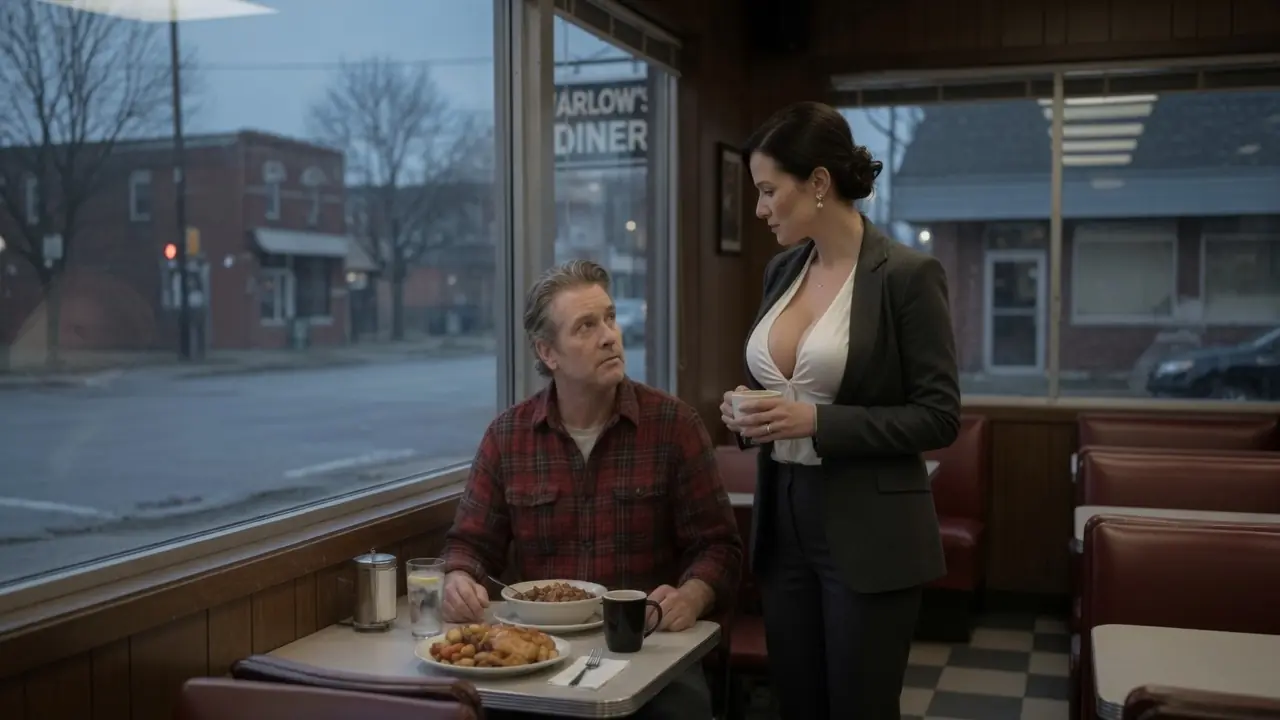
Every Friday at 6:15 p.m., he came to Harlow’s Diner and sat at the window table. He ordered meatloaf for himself and pancakes with strawberries for Lily, even though she was no longer a child and probably no longer liked the same things. The waitresses had stopped asking months ago, then years ago. The regulars had stopped staring because grief, when repeated long enough, becomes part of the furniture.
That Friday, rain moved softly across the street outside, blurring the neon sign on the opposite window. Daniel sat with his hands around a black coffee mug, his red plaid shirt damp at the shoulders, his eyes fixed on the door each time it opened. He had a folded letter in his jacket pocket, already creased from being read too many times. The lawyer’s words had been careful, but they had torn open a hope Daniel had been afraid to touch.
Evelyn Carter noticed him from the counter.
She had come to Harlow’s Diner expecting numbers. As CEO of Carter Table Group, she was supposed to meet the regional manager, review losses, inspect service standards, and decide whether the old diner still deserved saving. Instead, she found herself watching a tired man at a window table ordering two meals with the quiet seriousness of someone keeping a promise. The untouched plate across from him bothered her more than any financial report.
“Who is he?” Evelyn asked the waitress beside her.
The waitress, a woman named Ruth with silver hair and kind eyes, glanced toward the window. “That’s Daniel Mercer.”
“Regular?”
“Every Friday. Six-fifteen sharp.”
Evelyn looked again. “And the second meal?”
Ruth sighed softly. “For his daughter.”
“Does she come?”
Ruth shook her head. “Not anymore.”
Evelyn had trained herself not to interfere in strangers’ sorrow. In business, people brought pain everywhere, and a CEO who paused for every broken heart would never finish a single meeting. But something about Daniel’s stillness unsettled her. It was not performance. It was not self-pity. It was devotion made visible in the saddest possible way.
She took a coffee cup from the counter and walked toward his booth.
Daniel did not notice her at first. He was looking at the napkin folded beside the second plate, the one he always folded into a small triangle because Lily used to say it looked like a little tent. Evelyn stopped beside the table, suddenly uncertain. She had planned to ask a simple question, but the moment felt too sacred for business manners.
“Sir,” she said gently.
Daniel looked up.
Evelyn saw exhaustion first. Then embarrassment. Then the guarded expression of a man who had been pitied too often and helped too little.
“My name is Evelyn Carter,” she said. “I own Harlow’s now.”
Daniel nodded politely. “Nice to meet you.”
“My staff says you order two meals every Friday and leave one untouched.” She looked at the empty chair, then back at him. “Who are you waiting for?”
Daniel’s fingers tightened around the coffee mug. For a moment, he seemed to consider saying nothing. Then his eyes moved toward the rain-dark window, where the reflection of the untouched plate looked almost ghostly.
“Someone who promised she’d meet me here at 6:15,” he said.
Evelyn’s voice softened. “And she never came?”
Daniel touched the folded napkin, and the small movement broke something in his face. “No,” he whispered. “She came every Friday for seven years. This is the first place my daughter felt safe after her mother left.”
Evelyn slowly sat across from him.
Daniel looked startled, as if no one had dared occupy that chair since Lily disappeared. Evelyn almost stood again, but Daniel did not tell her to move. The untouched pancakes steamed between them, covered with strawberries and powdered sugar, bright and innocent against the old tabletop. Behind the counter, Ruth pretended to refill sugar canisters while watching with wet eyes.
“What happened to her?” Evelyn asked.
Daniel swallowed. “Her mother came back.”
He looked down at the table. “Lily was twelve. Her mother, Marissa, had been gone almost seven years by then. No birthday calls, no school plays, no fevers, no scraped knees. Then she showed up with a new husband, a lawyer, and a house that looked better to a judge than my little apartment over the repair shop.”
Evelyn’s hand tightened around her cup.
“I fought,” Daniel said quickly, as if he needed that part understood. “I sold tools. I borrowed money. I sat in court and told them I had raised that girl since she was five. But Marissa cried and said I worked too much, that Lily needed a mother, that I was unstable because I brought her to a diner every Friday like some broken ritual.”
His voice turned bitter at the memory.
“The judge gave Marissa temporary custody for the summer. She said Lily would come back before school started.” Daniel laughed once, but there was no humor in it. “They moved two states away three weeks later.”
“Couldn’t you find them?” Evelyn asked.
“I tried.”
He reached into his jacket and pulled out the folded letter. His hands shook as he opened it. “Marissa blocked my calls. Returned my letters. Then her lawyer sent papers saying Lily didn’t want contact with me. I was told pressing harder would only hurt my case.”
Evelyn looked at the letter. “But this is from a lawyer?”
Daniel nodded. “Different lawyer. Lily’s lawyer.”
The name alone changed the air.
Evelyn leaned forward.
Daniel stared at the paper as if it might vanish. “She’s nineteen now. She found old photos in her mother’s storage unit. Photos from this booth. Receipts with my notes on the back. Birthday cards I wrote but she never got. She hired someone to find me.”
His voice thinned. “The lawyer said Lily was told I stopped trying.”
Evelyn closed her eyes briefly.
Daniel folded the letter again, but not neatly. “She asked if I would be willing to meet. Here. Tonight. Six-fifteen.”
Evelyn glanced at the clock.
It was 6:42.
Daniel saw her looking and nodded slowly. “I know.”
The pancakes across from him had begun to cool.
“She may still come,” Evelyn said.
Daniel gave a sad smile. “I’ve been telling myself that since she was twelve.”
Outside, headlights passed across the wet window. Daniel turned at every movement, every shadow, every sound of the bell over the door. But the people who entered were not Lily. A truck driver came in and sat at the counter. Two nurses took a booth near the back. A teenage boy picked up takeout for his mother.
At 7:03, Daniel reached for his wallet.
Ruth appeared instantly, shaking her head. “Don’t you dare.”
Daniel looked up. “Ruth.”
“I said don’t.”
“I pay every Friday.”
“Not tonight.”
Evelyn looked at Ruth, then back at Daniel. He seemed embarrassed by the kindness, almost wounded by it. Some people accept cruelty more easily than mercy because cruelty asks nothing of them afterward. Mercy asks them to stay open.
Daniel placed the money on the table anyway.
Evelyn gently pushed it back. “Please let us do this.”
Daniel’s jaw worked. “I don’t need charity.”
“It isn’t charity,” Evelyn said. “It’s a witness.”
He looked at her.
She nodded toward the second plate. “If she comes tonight, let this table tell the truth before anyone else speaks.”
Daniel looked at the untouched pancakes, then at the door.
The bell rang again at 7:11.
A young woman stepped inside carrying a small suitcase and wearing a tan coat darkened at the shoulders from rain. She had long brown hair tucked behind one ear, and she paused just inside the entrance as if crossing that threshold took more courage than anyone in the diner could see. Her eyes moved across the room, searching, afraid to find what they sought. Then they landed on the window table.
Daniel stood too fast, bumping his knee against the booth.
The young woman’s hand flew to her mouth.
For one terrible second, neither moved. Evelyn stood quietly and stepped away from the chair, leaving the space open. Ruth stopped breathing behind the counter. Even the truck driver turned on his stool and fell silent.
“Lily?” Daniel said.
The young woman began crying before she answered.
“Dad?”
The word struck Daniel so hard he grabbed the edge of the table.
Lily Mercer crossed the diner slowly at first, then faster. Daniel stepped around the booth, and the moment she reached him, she folded into his arms like the seven years between them had finally lost their strength. He held her carefully, almost afraid she would disappear if he held too tight. Then she sobbed against his shirt, and he pulled her closer.
“I’m sorry,” Lily cried. “I didn’t know. I didn’t know you came here.”
Daniel shut his eyes. “I came every Friday.”
“She told me you left.”
“I never left.”
“She told me you stopped writing.”
“I wrote until they sent the letters back.”
Lily clutched his shirt like a child. “I thought you forgot me.”
Daniel pulled back just enough to look at her face. She was taller now, older, a woman and still his little girl all at once. He lifted one trembling hand and touched her hair the way he had when she fell asleep in the booth years ago.
“I ordered your pancakes every Friday,” he said. “I didn’t know if you still liked them.”
Lily looked past him at the untouched plate.
The strawberries had softened. The whipped cream had begun to melt. The pancakes were no longer hot, but they were there. Waiting.
Her face crumpled.
“You kept my seat,” she whispered.
Daniel nodded. “Always.”
Lily hugged him again, and this time Daniel broke completely. He cried without trying to hide it, one hand pressed to the back of her coat, the other shaking against her shoulder. Around them, the diner remained still. Nobody clapped. Nobody spoke. The moment was too holy for noise.
Evelyn stood near the counter with tears in her eyes.
She had bought failing restaurants, negotiated supplier contracts, fired executives, and saved brands from bankruptcy. But nothing in her career had prepared her for the sight of a father’s loneliness ending at a diner table. For the first time in years, Harlow’s did not look like an aging location on a spreadsheet. It looked like a place where someone had kept love alive with pancakes and patience.
After several minutes, Daniel and Lily sat down.
Lily took the chair across from him with visible care, as if afraid the seat itself might remember her. Evelyn quietly signaled Ruth, who brought fresh pancakes without asking. Daniel tried to explain that the first plate was tradition, but Ruth only set the new one down and said, “Tradition deserves to be warm.”
Lily laughed through tears.
The sound hit Daniel like sunlight.
For a while, they spoke in broken pieces. Lily told him she had found the box of old diner receipts in her mother’s storage unit after Marissa moved to Arizona. She had also found letters, unopened and bundled with a rubber band. Some were from Daniel. Some were from Ruth, who had sent birthday cards from the diner staff because Lily had once been their unofficial Friday night mascot.
“I read them all,” Lily said. “I read them sitting on the floor between boxes.”
Daniel covered his face with one hand.
“I hated you,” she said, voice shaking. “For years. I thought you didn’t fight.”
“I fought until fighting started hurting you,” Daniel said. “That’s what they told me. They said if I kept pushing, you’d think I cared more about winning than your peace.”
Lily shook her head. “I had no peace.”
Daniel reached across the table, and this time she took his hand.
Evelyn did not want to interrupt, but she saw something in Lily’s suitcase: a legal folder tucked into the outer pocket. Lily noticed her glance and looked up.
“You’re Evelyn Carter?” Lily asked.
Evelyn nodded. “Yes.”
“The lawyer said you own Harlow’s now.”
“I do.”
Lily swallowed. “I know this is strange, but I think this place may have records. Maybe old security footage, receipts, something. I’m trying to prove my mother interfered with contact. My lawyer said old receipts and witness statements could help.”
Daniel looked alarmed. “Lily, you don’t have to—”
“I do,” she said firmly. “Not for revenge. For the truth.”
The word truth settled over the table.
Evelyn looked at Daniel, then at Lily. “We may not have footage from seven years ago, but we have payroll records, shift schedules, and possibly archived receipt logs. Ruth has been here since before either of you started coming.”
Ruth, who had been hovering nearby, stepped forward immediately. “I remember everything.”
Lily turned to her.
Ruth’s eyes filled. “You always ordered pancakes with strawberries and extra whipped cream. You drew birds on napkins. Your daddy would cut the pancakes into squares because you said triangles tasted wrong.”
Lily laughed and cried at the same time.
Ruth continued, voice trembling. “And after you stopped coming, he brought birthday cards here every year. He would write them at this table and ask me if they sounded too sad. We mailed some. They came back. I kept copies.”
Daniel looked stunned. “You did?”
Ruth nodded. “In a shoebox under my counter. I thought one day she might need them.”
Lily pressed her hand to her mouth.
Evelyn straightened. “Then tomorrow morning, we find that shoebox. And our company attorney can coordinate with your lawyer to preserve anything relevant.”
Daniel looked at Evelyn. “You don’t have to do that.”
“No,” Evelyn said. “But I’m going to.”
Lily looked at Daniel, suddenly afraid. “Dad, I don’t know how to fix seven years.”
Daniel’s expression softened with a pain so deep it had become gentle. “We don’t fix seven years tonight.”
“What do we do?”
He looked at the pancakes between them. “We start with Friday.”
Lily nodded, crying again.
They ate slowly.
Daniel barely tasted his meal, but he watched Lily take her first bite of pancakes and close her eyes. For a moment, she was seven again, sitting with syrup on her fingers and asking if they could count red cars through the window. Then she opened her eyes, and she was nineteen, wounded by lies, carrying questions no father could answer in one evening. Daniel understood he had not gotten his little girl back. He had been given the chance to know the woman she had become.
That was enough.
At 8:30, the rain had softened to a mist. The diner had thinned out, but nobody rushed them. Evelyn canceled her meeting, then canceled the rest of her evening. She sat at the counter with Ruth and listened to the quiet rhythm of Daniel and Lily talking, stopping, crying, laughing, and beginning again.
Ruth eventually placed a small shoebox on the counter.
It was blue, faded, and tied with kitchen string. Inside were returned letters, copied cards, old receipts, and a Polaroid of Daniel and Lily in the booth on her eighth birthday. Lily held the photo like it might break if she breathed too hard.
“I remember that dress,” she whispered.
Daniel smiled sadly. “Yellow with little white buttons.”
“You bought it at the thrift store.”
“You picked it.”
“I told everyone it was designer.”
Daniel laughed, and this time the laugh did not hurt as much.
Evelyn watched them and thought about her own father. He had worked in a diner kitchen for thirty years and died before seeing her become CEO of the company that now owned places like this. She wondered how many stories had passed through booths like these without anyone in leadership ever noticing. A diner was not just tables and food. It was a storage place for ordinary devotion.
The next week, Harlow’s changed.
Not dramatically. Not with a ribbon-cutting or press release. Evelyn refused to let the company turn Daniel and Lily’s reunion into marketing. But she authorized the renovation budget that had been delayed for months, kept the original booths by the windows, and added one small brass plaque beneath table seven.
It read: Reserved for anyone still hoping.
Ruth cried when she saw it.
Daniel and Lily came back the following Friday at 6:15.
This time, both meals were eaten.
The week after that, they came again. Some Fridays were awkward because reunion is not magic. Lily was angry at things Daniel could not fix, and Daniel was careful in ways that sometimes frustrated her. They had missed graduations, birthdays, first heartbreaks, bad report cards, good report cards, and thousands of small ordinary days that could not be recreated.
But they had Fridays.
They learned each other again across the table by the window. Daniel learned that Lily now loved coffee but still hated onions. Lily learned that Daniel had kept her drawings in a box under his bed and still drove the same old truck because he could not bear to trade the vehicle that had carried her booster seat. They learned that grief could sit with them without owning every chair.
Three months later, Lily’s lawyer filed a formal petition using the returned letters, witness statements, and records from Harlow’s. The legal process did not erase the past, but it gave Lily something she had been denied for years: proof. Her mother had not simply moved on. She had hidden a father’s love and called it abandonment.
Lily wept when she read the affidavit Ruth signed.
Daniel did not speak when he read the court filing. He only folded it carefully and placed it in the same envelope where he had once carried the lawyer’s first letter. His hands were steadier now. Not healed, but steadier.
One Friday in late spring, Evelyn visited the diner again.
The sky outside was pale blue, and the windows reflected the street in clean evening light. Daniel and Lily were already at table seven, arguing playfully about whether strawberries belonged on pancakes or waffles. Evelyn paused in the doorway before they noticed her.
This time, the empty chair was gone.
Not physically. It still stood where it always had. But it no longer looked like a wound. It looked like a seat.
Daniel waved her over. “Ms. Carter.”
“Evelyn,” she corrected.
Lily smiled. “Sit with us?”
Evelyn hesitated. “I don’t want to take anyone’s chair.”
Daniel looked across the table at his daughter. Then he looked back at Evelyn with a quiet smile.
“This table learned how to make room.”
Evelyn sat.
Ruth brought coffee without being asked, and for a while, the three of them talked about ordinary things. Lily’s classes. Daniel’s repair shop. Evelyn’s plans for Harlow’s. The conversation moved easily, with pauses that no longer felt like grief.
At 6:15, the diner bell rang.
Daniel turned out of habit.
Lily noticed and reached across the table, touching his hand.
“I’m here,” she said softly.
Daniel looked back at her, and the old reflex settled.
“I know,” he said.
Outside, cars passed the window. Inside, plates clinked, coffee poured, and Ruth laughed at something near the counter. Harlow’s Diner was still worn around the edges, still old, still carrying the marks of years. But under the evening light, it looked less like a failing business and more like what it had always been.
A place where people waited.
A place where people returned.
A place where love, if stubborn enough, could keep a chair open until the truth finally walked through the door.