The morning sun filtered through the dusty windows of Miller’s Diner, falling across the worn linoleum floor in pale golden strips.
Grace Holloway moved between the tables with a coffee pot in one hand and an order pad tucked inside the pocket of her faded blue apron.
At forty-two, she had learned how to smile even when her feet ached, how to keep moving when her back begged her to sit, and how to make every customer feel like they were the reason she had shown up that morning.
She was not young anymore, though she did not think of herself as old. She was a single mother with a twelve-year-old son named Noah, a stack of bills on her kitchen counter, and a life that had taught her to count every dollar twice before spending it once.
The diner smelled of coffee, bacon grease, maple syrup, and toasted bread. From the kitchen came the familiar sounds of plates sliding across the pass, eggs cracking, sausage sizzling, and Tommy the cook muttering at the toaster like it had personally betrayed him.
“Here you go, Mr. Peterson,” Grace said, topping off an elderly man’s coffee near the window. “Two eggs over easy, wheat toast, no jelly, extra crispy hash browns.”
Mr. Peterson lowered his newspaper and smiled. “You already put it in?”
“Ten minutes ago,” Grace said. “After fifteen years, I know better than to wait for you to ask.”
He chuckled and wrapped both weathered hands around the mug. “That boy of yours still playing baseball?”
“Noah says he’s retiring from baseball because the coach made him run laps,” Grace said. “So naturally, he wants cleats for Christmas.”
Mr. Peterson laughed, and Grace moved on before the ache in her knees could convince her to stop.
Miller’s Diner had not changed much in all the years she had worked there. The red vinyl booths were cracked at the edges, the chrome trim had lost its shine, and the jukebox in the corner only worked when someone slapped the side twice and threatened it with retirement.
But the place had memory. Faded photos of the town covered the walls, and Grace knew almost every face that came through the door before noon.
She knew who needed decaf, who liked their bacon nearly burned, who had lost a spouse, whose children never called, and who pretended not to want pie before ordering it every Friday. Those small details mattered to her, because Grace knew what it felt like to be overlooked.
Her life had been built around holding things together quietly. She worked mornings at Miller’s, two evening shifts a week at the convenience store, and cleaned offices on Sundays when Noah stayed with her neighbor Mrs. Alvarez.
Noah’s father had left when the boy was five. He sent birthday texts sometimes, child support rarely, and promises whenever guilt made him briefly generous.
Grace had stopped waiting for people who only remembered responsibility when it was convenient. She had become the parent, the provider, the homework helper, the lunch packer, the fever watcher, the bill negotiator, and the woman who cried only in the shower because Noah hated seeing her sad.
That morning, her mind kept drifting to the envelope in her purse. Inside it were sixty-three dollars in tips from the week, money she had planned to use for Noah’s school shoes because his current pair had a hole starting near the toe.
She had told him they would get new ones Friday. He had nodded like it was no big deal, but Grace had seen him curl his foot under the chair at breakfast so she would not notice the worn rubber.
The bell above the door chimed, pulling Grace from her thoughts. She glanced up automatically and saw an elderly woman standing just inside the entrance.
The woman wore a faded brown coat, the kind that had been carefully brushed but could not hide its age. Her silver hair was slightly windblown, her pale blue eyes moved uncertainly around the room, and one hand gripped her purse as if it were the last solid thing she had.
Grace set down the coffee pot. Something about the woman’s face went straight through her.
It was not just confusion. It was embarrassment, fear, and pride all tangled together, the look of someone trying not to need help in a room full of strangers.
Grace had seen that look before. She had worn it herself at food pantries, school offices, pharmacy counters, and once at the electric company when she had begged for three more days.
She smoothed her apron and walked toward the woman. “Good morning,” she said gently. “Would you like a table?”
The elderly woman blinked as if Grace’s voice had reached her from far away. “Yes,” she whispered. “I think so.”
“That’s all right,” Grace said. “Come with me. I’ve got a quiet booth by the window.”
She led the woman to a table away from the front door and the louder customers. The woman sat carefully, moving like her joints had begun negotiating with pain before every action.
Grace placed a menu in front of her, but the woman only stared at it. Her fingers trembled slightly against the laminated edge.
“My name is Grace,” she said. “Can I get you something warm? Coffee? Tea?”
“Tea,” the woman said after a moment. “If it isn’t trouble.”
“No trouble at all.”
Grace returned with tea, honey, water, and a small plate of buttered toast. She did not write the toast on the ticket.
The woman looked at the plate. “I didn’t order that.”
“The kitchen made extra,” Grace said.
It was not true, but it was kind.
The woman’s eyes lifted slowly. “I don’t have much money.”
Grace sat on the edge of the opposite booth, just enough to show she was listening. “Then it’s a good thing extra toast doesn’t cost much.”
The woman’s face trembled with a dignity that made Grace’s chest hurt. After a moment, she picked up one piece and took a careful bite.
“What’s your name?” Grace asked.
“Rose,” the woman said. “Rose Mercer.”
“It’s nice to meet you, Rose.”
Rose nodded, but her gaze kept drifting toward the window. Every passing truck made her flinch, and every burst of laughter from another table seemed to make her shrink smaller inside her coat.
Grace lowered her voice. “Are you waiting for someone?”
Rose looked down at her purse. “I was supposed to take a shuttle.”
“What shuttle?”
“The clinic shuttle. Or maybe the church van.” Rose pressed one hand to her forehead. “There was a blue sign. I was supposed to wait near the blue sign, but there were two blue signs.”
Grace felt a familiar ache rise in her chest. “Where are you trying to go?”
“Home,” Rose whispered.
Then her eyes filled. “But I can’t find my wallet.”
Rose opened her purse and began searching with growing panic. Tissues, gloves, a folded church bulletin, a prescription bottle, peppermint candies, and an old comb appeared on the table, but no wallet.
“I had it,” Rose said quickly. “I know I had it. My son put money in it. He tells me not to carry too much, but I had enough for the ride.”
“No, it isn’t.” Rose’s voice sharpened with fear. “I don’t like when this happens. I don’t like forgetting. I don’t like people looking at me like I’m already gone.”
Grace went still.
She knew that sentence did not come from nowhere. It came from doctor’s offices, lost keys, missed turns, patient smiles, and people speaking too loudly to someone whose mind had begun to betray her in small public ways.
“I’m not looking at you like that,” Grace said softly.
Rose looked at her, and for the first time that morning, her face loosened. “You aren’t?”
“No,” Grace said. “I’m looking at you like someone who needs a little help getting home. That’s all.”
Rose closed her eyes. “I’m supposed to be stronger than this.”
Grace thought of Noah asleep at the kitchen table the night before, trying to finish math homework while she counted grocery money beside him. She thought of all the times she had told herself the same thing.
“I think strong people get tired too,” Grace said.
Rose opened her eyes again. “You sound like you know.”
“I do.”
Grace helped Rose search her purse again. Tucked inside the church bulletin, they found a small card, bent at the corners.
SAMUEL “BEAR” MERCER.
Beneath the name was a phone number and a logo Grace did not recognize at first. A winged skull, a motorcycle wheel, and curved lettering around the edge.
Hell’s Angels.
Grace’s hand paused.
Rose noticed.
“He’s a good boy,” she said quickly.
“I didn’t say he wasn’t.”
“People see the vest and decide things.”
Grace thought of people seeing her diner uniform and assuming she had no education, no pride, no story beyond refilling coffee. She thought of people seeing a single mother and deciding she must have chosen badly, lived carelessly, or deserved struggle.
“People do that too much,” Grace said.
She tried the number from the diner phone. It rang and rang, then went to voicemail.
She tried again.
No answer.
Grace called the clinic listed on Rose’s appointment slip next. After being transferred twice, placed on hold once, and spoken to like an inconvenience, she finally learned Rose had missed the return shuttle nearly an hour earlier.
“We assumed a family member picked her up,” the receptionist said.
Grace closed her eyes. “She is sitting in a diner fourteen miles from home.”
“Oh,” the receptionist replied.
Grace hung up before she said something Noah would not have been allowed to repeat.
When she returned to the booth, Rose had finished one piece of toast and half of the other. She was trying not to cry, which somehow made Grace want to cry more.
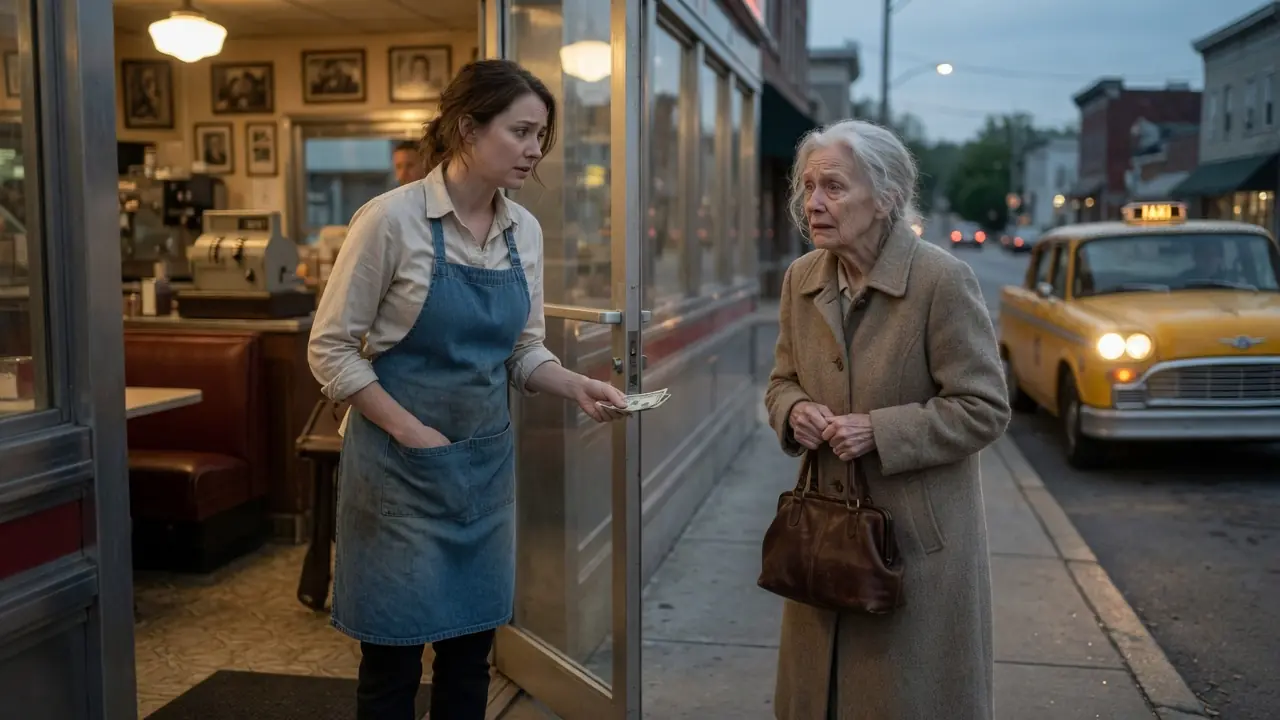
“I couldn’t reach your son,” Grace said. “But I can call a taxi.”
Rose’s hands tightened around her purse. “I don’t have money.”
“I know.”
“I can’t ask you to pay for me.”
“You didn’t ask,” Grace said. “I offered.”
Rose shook her head. “You work too hard. I can see it.”
Grace tried to smile. “That obvious?”
“Your shoes are worn at the sides, and your eyes look like you sleep only after everyone else is safe.”
Grace looked away.
Rose had seen too much.
“I have a son,” Grace said quietly. “Twelve.”
Rose’s face softened. “Then you know.”
Grace nodded. “Yes. I know.”
The taxi cost thirty-eight dollars.
Grace had sixty-three in her purse for Noah’s shoes and seventeen in her apron pocket from that morning. She paid the driver before Rose even stood up, then wrote down his cab number, license plate, and phone number.
The driver was Carl, a local man who came into Miller’s sometimes. He looked uncomfortable being inspected, but Grace did not apologize.
“Straight to Briar Glen,” she told him. “Mercer Road. Bluebird mailbox. You walk her to the door.”
Carl nodded. “I’ve got her, Grace.”
“I mean it.”
“I know you do.”
Rose held Grace’s hands before getting into the taxi. Her palms were cool and thin, but her grip carried old strength.
“You didn’t make me feel foolish,” Rose said.
Grace swallowed. “Because you’re not.”
“My son will pay you back.”
“He doesn’t have to.”
“He will.”
Grace smiled faintly. “Then I’ll argue with him when he tries.”
Rose looked at her one more time, then climbed into the cab. Grace watched the taxi pull away until it disappeared beyond the turn in the road.
Only then did she reach into her purse and count what was left.
Enough for groceries.
Not enough for Noah’s shoes.
She stood there for a moment, wind tugging at her apron, and closed her eyes.
Then she went back inside, because tables needed coffee and life did not pause just because kindness had a price.
One hour later, the phone behind the counter rang.
Trevor, the afternoon host, answered. “Miller’s Diner.”
His eyes flicked toward Grace.
Then widened.
“Uh… Grace?” he said, covering the receiver. “It’s for you.”
“For me?”
Trevor swallowed. “He says his name is Bear.”
The diner seemed to quiet around her.
Grace wiped her hands on her apron and took the phone.
“This is Grace.”
A deep voice came through the receiver. “Are you the waitress who paid for my mother’s taxi?”
Grace gripped the phone tighter. “Yes.”
A silence followed.
Then the man exhaled slowly. “This is Samuel Mercer.”
“Is Rose okay?” Grace asked immediately.
“She’s home.”
Grace’s shoulders dropped with relief. “Thank God.”
“She was sitting on the porch holding a diner napkin with your name on it when I pulled in,” Samuel said. “Cab driver said you paid him. Said you wrote down his plate. Said you made him walk her to the door.”
“I just wanted to make sure she got home safely.”
“You fed her.”
“She had toast.”
“You gave her tea.”
“She looked cold.”
“You called the clinic.”
“They lost her,” Grace said, unable to hide the anger in her voice.
Another silence came through the line.
When Samuel spoke again, his voice was lower. “You did more for my mother in forty minutes than that clinic did all morning.”
Grace leaned against the counter. “I’m just glad she’s safe.”
“How much do I owe you?”
“Nothing.”
“That wasn’t the question.”
“It’s the answer.”
A faint sound came through the phone, almost like a tired laugh. “My mother said you’d say that.”
Grace smiled despite herself. “Your mother is a smart woman.”
“She is.”
Then his voice changed. “I need to come by.”
Grace stiffened. “To the diner?”
“Yes.”
“You don’t have to.”
“I do.”
“No, really. It’s okay.”
“It isn’t about money, Grace.”
Her name sounded strange in his voice, heavy with sincerity.
“Then what is it about?” she asked.
“My mother won’t stop crying.”
Grace’s chest tightened. “She’s upset?”
“She keeps saying someone treated her like she was still a whole person.” His voice roughened. “I need to look you in the eye and thank you for that.”
Grace could not speak for a moment.
Around her, the diner moved in quiet fragments. Trevor watched from beside the register, Betty pretended not to listen from her corner booth, and Tommy leaned halfway out of the kitchen window with a spatula in his hand.
Finally, Grace said, “I’ll be here until two.”
“I’ll be there before then.”
The line went dead.
For the next forty-five minutes, the diner existed in nervous anticipation.
Every time a truck passed, Trevor looked out the window. Every time the bell chimed, Betty straightened in her booth.
Grace tried to act normal, but her hands felt unsteady around the coffee pot.
At 1:12 p.m., the sound came.
Not one engine.
Several.
Low, rolling thunder built from the far end of the street and grew until the windows trembled in their frames.
Seven motorcycles turned into the diner parking lot and parked in a clean line near the front windows. The riders cut their engines one by one, and the sudden silence afterward felt almost heavier than the noise.
The front door opened.
A man stepped inside.
He was big, broad-shouldered, with a gray-streaked beard and tattoos visible at his wrists beneath a dark jacket. His black leather vest carried patches Grace did not fully understand and one name patch she did.
BEAR.
Behind him came two other riders, then another two, but they stopped near the entrance and did not crowd the room.
Samuel Mercer removed his sunglasses.
His eyes were not cold.
That surprised Grace.
They were tired, deeply tired, the eyes of a man used to being judged before he spoke.
He scanned the diner once, then found her.
“You Grace?”
She stepped forward. “Yes.”
He crossed the room slowly, aware that everyone watched him. When he stopped in front of her, Grace had to tilt her head back.
For one second, she understood why people might be afraid of him.
Then he took off his glove and held out his hand.
“I’m Samuel Mercer.”
Grace shook it. His hand was enormous and calloused, but his grip was careful.
“Is your mother all right?” she asked.
“She’s resting. My sister’s with her.”
“I’m glad.”
Samuel looked at her for a long moment.
Then, to the shock of everyone in Miller’s Diner, the Hell’s Angel lowered his head.
Not a bow exactly.
Something older.
Respect.
“You got my mother home,” he said. “You kept her dignity intact. I don’t forget things like that.”
Grace felt heat rise behind her eyes. “She was scared. I know what that looks like.”
Samuel’s eyes sharpened slightly, not with suspicion, but understanding.
“You take care of someone.”
“My son.”
He nodded once. “Thought so.”
Grace glanced around at the staring customers. “You didn’t have to bring everyone.”
One of the riders near the door spoke. “Yes, he did.”
Samuel did not look away from Grace. “My mother wanted to come herself. I told her no. She told me I had better bring witnesses so nobody could say I thanked you poorly.”
Grace laughed before she could stop herself. “She sounds like herself again.”
“She is.”
He reached into his vest and pulled out an envelope.
Grace’s smile faded. “No.”
“You don’t know what’s in it.”
“I know enough.”
“It’s the taxi money.”
“I said no.”
“It’s also what she would have spent buying lunch if she hadn’t lost her wallet.”
“Samuel—”
“And a tip.”
Grace crossed her arms. “I don’t take tips from people who are trying to pay me back for being human.”
One of the riders coughed like he was hiding a laugh.
Samuel’s mouth twitched. “My mother said you’d argue.”
“Your mother is very wise.”
Samuel placed the envelope on the counter anyway.
Grace pushed it back.
He pushed it toward her again with one finger.
“Grace,” he said quietly. “This isn’t charity. It’s respect. Let my mother have the dignity of settling her debt.”
That stopped her.
Because he had chosen the one word she could not fight.
Dignity.
Slowly, Grace picked up the envelope. “Fine. But only the taxi fare.”
Samuel smiled faintly. “I’ll tell her you tried.”
Behind the counter, Grace’s phone buzzed.
She glanced down and saw a text from Noah.
Mom, don’t be mad. My shoe ripped at school. Teacher gave me tape. It’s okay.
Grace froze.
Samuel noticed.
“You all right?”
Grace turned the phone screen down. “Fine.”
He looked at her for one long second.
“You sure?”
“Yes.”
She had used that word too many times in her life when the truth was no.
Samuel did not push.
But Betty, who had no such restraint, stood from the corner booth.
“Grace was saving for her boy’s shoes,” she said.
Grace closed her eyes. “Betty.”
“What? It’s true.”
Mr. Peterson lowered his newspaper. “That boy’s been walking on worn soles for weeks.”
“Mr. Peterson.”
Tommy leaned out from the kitchen. “I noticed too.”
“Tommy, go burn something.”
Samuel looked at the envelope in Grace’s hand.
Then at her face.
“You spent your son’s shoe money on my mother’s cab.”
Grace lifted her chin. “I spent my tip money getting an elderly woman home.”
“You have a son.”
“Yes.”
“How old?”
“Twelve.”
“What’s his name?”
Grace hesitated. “Noah.”
Samuel turned to one of the riders near the door.
“Moose.”
The big rider straightened. “Yeah?”
“Find out where to buy good boys’ shoes in this town.”
Grace stepped forward immediately. “Absolutely not.”
Samuel looked back. “I didn’t ask.”
“I’m not taking shoes from strangers.”
“I’m not a stranger. I’m Rose Mercer’s son.”
“That does not make you responsible for my child.”
“No,” he said. “It makes me responsible for making sure helping my mother doesn’t punish yours.”
Grace stared at him.
The diner was silent.
Samuel’s voice softened. “My mother said you looked like a woman who gives until there’s nothing left and then apologizes for needing air.”
Grace’s eyes filled before she could stop them.
Rose had seen too much again.
“I don’t like needing help,” Grace whispered.
“Nobody does.”
“I’m used to managing.”
“I know.”
“I didn’t help Rose because I wanted anything.”
“I know that too.”
“Then why are you doing this?”
Samuel looked at her with an expression too steady to dismiss.
“Because kindness shouldn’t leave a single mother deciding between dignity and her child’s shoes.”
That sentence broke something in Grace.
Not dramatically.
Not loudly.
Just enough for her to turn away and wipe her face with the edge of her apron.
By evening, Noah had new shoes.
Not flashy ones.
Not expensive ones meant to embarrass her.
Good ones. Durable ones. The kind a twelve-year-old boy could run in without curling his toes to hide the damage.
Samuel did not hand them to Grace in front of the diner crowd.
He left them in a plain paper bag by the staff door with a note written in blocky handwriting.
From Rose. Do not argue with old women.
Grace cried in her car before driving home.
When Noah opened the bag, his eyes went wide.
“Mom,” he whispered. “These are really good.”
“I know.”
“Did you buy them?”
Grace sat beside him at the kitchen table.
“No,” she said honestly. “Someone helped us.”
Noah looked worried. “Do we have to pay them back?”
Grace thought about Rose’s dignity, Samuel’s tired eyes, and the envelope she had tried to refuse.
“Not always with money,” she said. “Sometimes we pay people back by remembering how it felt and helping someone else when we can.”
Noah nodded slowly.
Then he hugged her.
He was getting older and hugged less easily these days, so Grace held on longer than she meant to.
After that day, the bikers started coming to Miller’s.
Not every day.
But often enough that the diner changed.
At first, customers stared when motorcycles lined the lot. Then they got used to them.
Samuel’s riders ordered pancakes, omelets, bacon, biscuits, coffee, and enough pie to make Tommy declare that he had finally found his true audience.
They paid every bill.
They tipped every server.
They treated Betty like royalty, listened to Mr. Peterson’s stories, and fixed the squeaky front door one afternoon because Moose said he could not enjoy breakfast while “that hinge screamed like a haunted goat.”
Noah met Samuel two weeks later.
Grace had resisted it at first, not because she distrusted Samuel, but because introducing anyone to her son felt like opening a door she usually kept locked.
Noah came into the diner after school one rainy afternoon, wearing his new shoes and carrying a backpack nearly as big as his torso. Samuel was sitting at the counter with coffee.
His eyes dropped to the shoes.
Then he looked at Grace, but said nothing.
Noah stopped beside his mother.
“Is that him?” he whispered badly.
Grace sighed. “Noah.”
Samuel turned on the stool.
“I’m Samuel.”
Noah looked up at him with cautious curiosity. “Are you really a Hell’s Angel?”
Samuel’s mouth twitched. “Depends who’s asking.”
“I’m asking.”
“Then yes.”
Noah considered him. “Do you ride fast?”
“When it’s safe.”
“Do you know how to fix bikes?”
“Yes.”
“Can you fix a chain on a regular bike?”
Samuel looked at Grace.
Grace crossed her arms. “No.”
Noah said, “It’s been broken for two months.”
Grace closed her eyes.
Samuel sipped his coffee. “Sounds serious.”
“It is,” Noah said. “I have to walk everywhere.”
Grace pointed at her son. “You have a bus pass.”
“No one respects the bus.”
Samuel laughed.
Grace felt something in her chest loosen at the sound.
That weekend, Noah’s bike was fixed.
Not replaced.
Fixed.
Samuel made Noah help, explaining every tool, every movement, every mistake. He did not talk down to him, did not treat him like a kid who needed saving, and did not make Grace feel like less of a mother because she had not known how to repair a chain.
Noah came inside afterward with grease on his cheek and light in his eyes.
“Mom, I fixed it.”
Grace looked over his shoulder at Samuel on the porch.
Samuel only nodded once, then looked away.
The help kept coming, but never in a way that made Grace feel owned.
That mattered.
Rose visited the diner every Thursday once she was feeling better.
She sat in the booth near the window and drank tea with honey. Sometimes she remembered every detail of the day Grace had helped her, and sometimes she only remembered that Grace made her feel safe.
That was enough.
Rose adored Noah immediately.
She called him “young man” and made him sit up straight before eating pie. Noah adored her back, mostly because she slipped him peppermints and told stories about Samuel as a stubborn teenager who once tried to fix a motorcycle with kitchen utensils.
Samuel hated those stories.
Noah loved them.
Grace began to understand that Samuel was not only the frightening biker people saw from across a parking lot. He was also a son who checked his mother’s pill organizer twice a week, a man who carried extra blankets in his saddlebag because Rose got cold easily, and someone who never entered Grace’s house without asking from the porch first.
That respect did more damage to her defenses than any charm could have.
One evening, after closing, Grace was wiping down the counter when Samuel stepped inside with a paper bag.
“We’re closed,” she said.
“I know.”
“What’s that?”
“Rose made soup.”
Grace raised an eyebrow. “Rose made soup?”
“Red made soup. Rose supervised and insulted the carrots.”
Grace laughed.
Samuel set the bag on the counter.
For a moment, neither of them spoke.
Rain tapped against the diner windows, and the neon sign outside painted the booths red and blue.
Samuel looked at her. “You ever let yourself rest?”
Grace kept wiping the same clean spot.
“When Noah graduates college, maybe.”
“That’s a long time from now.”
“I’m aware.”
“You don’t have to prove you can do everything alone.”
Her hand stopped.
That sentence touched a place she guarded fiercely.
Grace looked up slowly. “I’ve had to do everything alone.”
“I know.”
“No,” she said, not angrily, but firmly. “You don’t. People say they know, but they don’t know what it’s like to hold a sick child at three in the morning and wonder if you can afford the urgent care copay. They don’t know what it’s like to tell your son new shoes can wait because rent can’t.”
Samuel did not interrupt.
Grace’s voice shook now, but she kept going.
“They don’t know what it’s like to be tired down to the bone and still smile because your kid is watching. They don’t know how humiliating it feels when help comes after you’ve already convinced yourself needing it means you failed.”
Samuel was quiet for a long moment.
Then he said, “You’re right.”
Grace blinked.
He continued, “I don’t know what it’s like to be a single mother. I know what it’s like to be judged from the doorway. I know what it’s like to carry someone you love through a life that keeps getting harder. But I don’t know your road.”
Her anger softened because he did not try to steal it from her.
Samuel looked down at his hands.
“My father left when I was nine. My mother raised me alone. Worked laundry shifts, diner shifts, motel shifts. I used to think she was unbreakable.”
He looked back at Grace.
“Then one night I found her crying over a pair of boots she couldn’t afford for me. I never forgot that. So when I saw your face over those shoes, I knew enough.”
Grace looked away, but tears slipped down her cheeks anyway.
Samuel stepped closer, stopping far enough away that she still had room to choose.
“I’m not trying to rescue you,” he said. “I’m trying to stand nearby so you don’t have to carry every heavy thing with both hands full.”
Grace pressed the towel against the counter.
“I don’t know how to accept that.”
“I can wait.”
She laughed weakly through tears. “You sound very patient for a man named Bear.”
“I’m patient with important things.”
That was the beginning of something neither of them named for a long time.
Grace did not have room for fairy tales. She had breakfast shifts, school meetings, laundry, rent, and a son entering adolescence with more questions than she knew how to answer.
Samuel did not rush her.
He came for breakfast.
He checked on Rose.
He fixed Noah’s bike again when Noah tried to jump a curb and bent the wheel.
He carried heavy groceries once, then learned not to do it without asking after Grace gave him a look sharp enough to cut rope.
He showed up.
That was the thing Grace trusted least at first.
Then, slowly, the thing she trusted most.
A year after Rose first walked into Miller’s, the diner hosted a small fundraiser for a local senior transport program. It had been Grace’s idea.
Not because she had extra time.
She did not.
But because she could not stop thinking about Rose sitting in the wrong place after the clinic lost track of her. She could not stop thinking about all the elderly people who were one missed shuttle away from fear.
Samuel’s club helped organize the ride.
Thirty-eight motorcycles filled the diner parking lot that Saturday morning.
Families came.
Seniors came.
Noah sold raffle tickets beside Betty, who corrected his math and stole half his fries.
Rose sat in her window booth wearing a blue scarf and looking proud enough to burst.
At noon, Samuel stood near the front of the diner and cleared his throat.
The room quieted.
Grace immediately grew suspicious.
“Don’t,” she mouthed.
He ignored her.
“A year ago,” Samuel said, “my mother got lost after a clinic appointment. A waitress here found her, fed her, protected her dignity, and paid for her ride home with money she needed for her own son.”
Grace closed her eyes.
Noah, standing beside her, slipped his hand into hers.
Samuel continued, “That waitress didn’t ask for attention. She didn’t ask for repayment. She just did the right thing when no one was watching.”
His voice roughened.
“My mother remembered that. So did I.”
Rose lifted her tea.
“She’s stubborn,” Rose announced.
Everyone laughed.
Samuel smiled, then looked back at Grace.
“Today, the ride raised enough money to fund senior transport vouchers for the next eighteen months.”
Applause filled the diner.
Grace covered her mouth.
Samuel’s eyes stayed on hers.
“And the fund has a name.”
Grace shook her head slightly.
No.
He nodded slightly.
Yes.
Rose stood slowly with help from Noah.
“The Grace Holloway Ride Home Fund,” she said.
The room erupted again.
Grace cried then, in front of everyone.
Not because she was embarrassed.
Because for once, the world had seen what single mothers often do in silence.
The small sacrifices.
The impossible choices.
The kindness given from pockets that were nearly empty.
Noah hugged her hard around the waist.
“I’m proud of you, Mom,” he whispered.
Grace bent and kissed the top of his head.
“I’m proud of you too.”
Later, after the crowd thinned and the sun began to lower over Miller’s Diner, Grace stepped outside.
Motorcycles gleamed in the parking lot.
The repaired front door opened and closed without a squeak.
Noah was teaching Rose how to take a selfie, and Betty was arguing with Moose about whether pie counted as lunch.
Samuel came to stand beside Grace.
“You mad?” he asked.
“Yes.”
“How mad?”
“Medium.”
“That’s survivable.”
She looked at him and smiled despite herself.
“You named a fund after me.”
“My mother named it. I just chose not to risk my life arguing.”
Grace glanced back through the window at Rose.
“That was wise.”
They stood quietly for a moment.
Then Grace said, “I used to think being a single mom meant never needing anyone.”
Samuel looked at her.
“And now?”
She watched Noah laughing inside the diner, his shoes no longer worn through, his shoulders lighter than they had been a year before.
“Now I think it means knowing who is safe enough to let close.”
Samuel’s face softened.
“That include me?”
Grace looked at him for a long moment.
Then she reached for his hand.
His fingers closed around hers carefully, like he understood the trust being placed there.
“Yes,” she said. “It includes you.”
The diner behind them glowed in the evening light.
A year earlier, Grace had paid thirty-eight dollars she could not afford so an elderly woman would not feel lost, foolish, or forgotten.
She thought she was only buying a taxi ride.
She had no idea she was opening a door.
Through that door came Rose, Samuel, a row of bikers with rough faces and loyal hearts, repaired bicycles, paid prescriptions, Thursday tea, a transport fund, and a community that refused to let her disappear under the weight of doing everything alone.
Kindness had not made her life perfect.
It had made her visible.
And for a single mother who had spent years being strong because there was no other choice, being seen felt like finally setting down a burden she had carried for too long.
Grace looked at Samuel, then back at Noah.
For the first time in years, she did not feel like she was surviving one shift at a time.
She felt like she was going home.
And it had all started with an elderly woman, a lost wallet, and a taxi fare paid by a tired waitress who still had enough heart left to help someone else.