Hannah Carter had five dollars left when the biker entered the diner.
The bill was folded twice inside the smallest pocket of her faded teal apron, separated from the loose change customers had left during the night. It was supposed to pay for the bus ride home and a carton of milk for her seven-year-old son, Noah. Hannah had already calculated that she could walk the final three miles if the milk cost more than expected.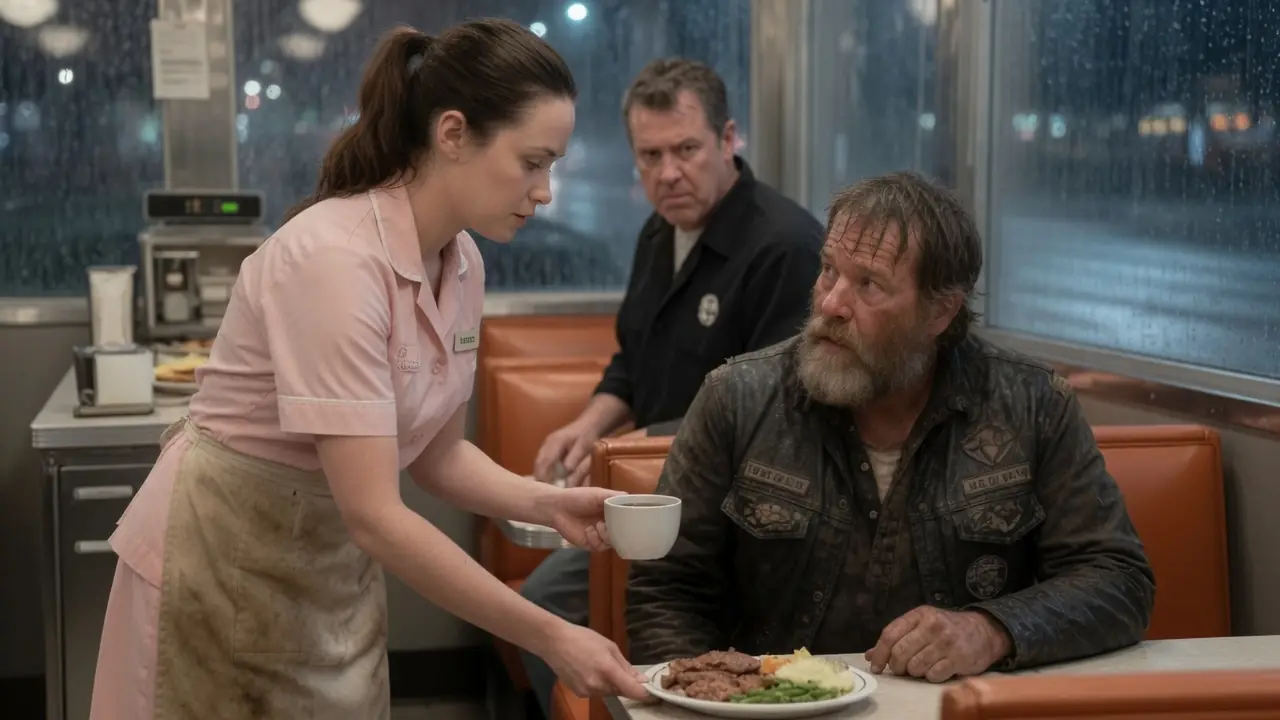
Rain struck the windows of the Ridgeway Diner hard enough to blur the highway beyond the glass. It was almost midnight, and the storm had emptied every orange vinyl booth except one occupied by two truck drivers finishing coffee. The old ceiling lights hummed, the kitchen exhaust rattled, and water dripped steadily into a bucket near the back door. Hannah had been working for ten hours without sitting down.
The biker stopped just inside the entrance.
He was tall and broad, with wet dark hair, a graying beard, and a black leather vest heavy with rain. One sleeve of his shirt had been torn near the shoulder, and a purple bruise darkened the side of his face. Mud covered his boots, while one hand remained pressed against his ribs as though every breath cost him effort.
Hannah noticed the small patch on his vest before she noticed anything else.
It showed a silver road beneath two wings and the words Guardians of the Mile. She had seen bikers wearing similar patches during charity rides through the county, but she knew nothing about the organization. To Hannah, he was simply a stranger who looked as though the storm had been trying to erase him.
“Kitchen closes in ten minutes,” Victor Shaw called from behind the register.
Victor was the night manager and the owner’s nephew. He had spent most of the evening sitting in the office, watching security cameras and appearing only when a customer might leave without paying. He looked at the biker’s soaked clothing, damaged face, and empty hands, then looked away with immediate disgust.
The stranger moved toward the nearest booth.
Victor stepped in front of him. “Pay first.”
The biker stopped. “I only need somewhere dry for a few minutes.”
“This is a diner, not a shelter.”
Hannah placed a clean towel on the counter. “He can sit while the rain slows.”
Victor looked sharply at her. “Did I ask?”
“No.”
“Then clean table six.”
Hannah carried the towel to the biker herself. He accepted it with a quiet nod and wiped rain from his face before lowering himself carefully into the booth. The effort made him wince, though he attempted to hide it by turning toward the window.
“Are you hurt?” Hannah asked.
“Nothing that won’t complain less tomorrow.”
“That was not an answer.”
He looked up at her for the first time. His eyes were gray and exhausted, but alert. “A truck forced me off the road about six miles east. The bike went into the ditch.”
“Did the driver stop?”
“No.”
“Did you call anyone?”
“My phone broke during the fall.”
Hannah glanced toward his bruised cheek. “Was all of that from the crash?”
He hesitated. “Not all of it.”
The two truck drivers paid and left, leaving the diner almost empty. Victor watched the biker from beside the register, clearly hoping he would disappear with them. Hannah brought him a glass of water without asking.
“What is your name?” she asked.
“Cole Maddox.”
“I’m Hannah.”
Cole drank slowly. His hands trembled slightly around the glass, and Hannah recognized the particular weakness beneath his movements. She had seen it in Noah during the weeks after her divorce, when money became so scarce that Hannah sometimes claimed she had already eaten.
“When did you last have food?” she asked.
Cole lowered his eyes. “Yesterday morning.”
“That is more than a day.”
“Closer to two.”
Hannah picked up her order pad. “Roast beef, potatoes, vegetables, and coffee?”
“I can’t pay.”
His honesty arrived without excuses.
Hannah looked toward Victor. He had returned to the office, though the door remained partly open. She could see the security monitor glowing inside and knew he was still watching.
Cole pushed the menu aside. “I only needed to get out of the rain.”
Hannah remained beside the table. “Wait here.”
She entered the kitchen and found the cook, Miguel Torres, cleaning the grill. Miguel was sixty-one and had worked at Ridgeway long enough to remember three different owners. He glanced toward the dining room, then toward Hannah.
“Victor said no food.”
“I heard him.”
“There is roast beef left.”
“How much is a staff meal?”
“Five dollars.”
Hannah removed the folded bill from her apron.
Miguel stared at it. “That is your bus money.”
“I know.”
“You walked home last week.”
“I can walk again.”
“In this rain?”
“It may stop.”
Miguel looked toward the office. “I could pretend the food was waste.”
“Victor counts everything.”
“He counts napkins when he is bored.”
Hannah placed the five-dollar bill beside the register. “Then tonight he can count this.”
Miguel said nothing for several seconds.
Finally, he filled a plate generously.
Hannah carried the hot food into the dining room with a fresh cup of coffee. Steam rose above the roast beef and mashed potatoes, carrying the smell of pepper, gravy, and cooked vegetables through the empty diner. Cole looked at the plate and then at Hannah as though he did not trust what he saw.
“I told you I cannot pay.”
“Then tonight, it is free. Eat while it is still hot.”
Cole noticed the five-dollar bill near the register. “That was yours.”
“It was.”
“All you had?”
Hannah placed the coffee beside him. “I can walk home. You should not have to face another night hungry.”
He did not touch the food immediately.
Instead, he studied her face. “Why would you do this?”
“Because I know what hunger looks like.”
“You have a child?”
Her hand moved instinctively toward the small photograph tucked inside her order book. It showed Noah wearing a paper crown from his school birthday celebration. “A son.”
“Then you need that money more than I do.”
“Hunger is not a competition.”
Cole looked down at the plate. His eyes shone briefly before he blinked the emotion away. Then he lifted the fork and took the first bite.
Victor emerged from the office before Cole swallowed.
“What did I say?”
Hannah turned. “He needed food.”
“I said he could not eat without paying.”
“He paid.”
Victor looked toward the register and saw the five-dollar bill. “You paid.”
“Yes.”
“That meal costs more than five dollars.”
“That is the employee price.”
“You are not buying it for yourself.”
Miguel appeared inside the kitchen doorway but remained silent.
Victor approached the booth. “Take the plate.”
Hannah stepped between him and Cole. “He has already started eating.”
“Then the rest comes out of your pay.”
“Fine.”
Victor’s eyes narrowed. “You barely earn enough to feed your own child.”
Cole placed the fork down.
Hannah’s face burned. Her private financial problems were no secret to Victor because he controlled the schedule and had rejected her request for additional hours. Still, exposing them in front of a stranger was meant to make kindness appear foolish.
Victor pointed at Cole. “People like him know exactly how to find weak women.”
Cole’s jaw tightened.
Hannah spoke before he could. “He did not ask me for anything.”
“He walked in looking filthy and waited for pity.”
“He said he couldn’t pay.”
“Exactly.”
Cole began to rise, but pain forced him back against the booth. “The woman has done enough. I’ll leave.”
“No,” Hannah said. “Finish eating.”
Victor laughed. “You do not give orders here.”
Hannah looked directly at him. “Neither does hunger.”
The diner became silent except for the rain.
Victor’s face changed. Hannah had disagreed with him before, but always quietly enough to preserve his authority. Tonight, exhaustion and the sight of Cole’s trembling hands had burned away the part of her that usually apologized first.
“You are finished,” Victor said.
Hannah did not understand immediately. “My shift ends at one.”
“Your job ends now.”
Miguel stepped out of the kitchen. “Victor, that is unnecessary.”
“Go back to the grill.”
“There are no customers.”
“There may be one less cook if you keep talking.”
Miguel stopped.
Hannah looked toward the schedule pinned beside the register. She was assigned six shifts the following week. Without them, she could not pay rent due in nine days.
“You cannot fire me for purchasing a meal.”
“I am firing you for insubordination, unauthorized discounts, and creating a disturbance.”
“You created the disturbance.”
Victor smiled. “Prove it.”
Cole slowly stood.
The weakness in his body remained, but something colder had entered his expression. “What is the owner’s name?”
Victor looked at him. “None of your business.”
Cole turned toward Hannah. “Your full name?”
“Hannah Carter.”
“Address?”
She became cautious. “Why?”
“So I can repay you.”
“You do not owe me anything.”
“I know.”
He removed a worn metal token from the inside pocket of his vest. One side carried the same winged-road symbol as his patch. The other contained a number engraved beneath the words No Rider Left Behind.
Cole placed the token in her hand.
“Keep this.”
“What does it do?”
“It tells my brothers and sisters that you helped one of us when you had nothing.”
Victor laughed from behind the counter. “She bought you dinner, not a kidney.”
Cole looked at him. “You should hope that is all this becomes.”
Hannah placed the token inside her apron. “You need medical attention.”
“I need a telephone.”
Miguel handed him the kitchen phone before Victor could object.
Cole dialed a number from memory. He spoke only a few sentences, giving the diner’s location, the road where his motorcycle had gone down, and Hannah’s name. Then he listened quietly before ending the call.
“My ride will be here soon.”
Hannah removed her apron.
The act felt unreal. She untied the fabric she had worn through hundreds of shifts, folded it on the counter, and placed her name tag on top. Victor watched with satisfaction while Miguel looked away.
“You still owe for the rest of the meal,” Victor said.
Hannah stared at him. “Deduct it from the paycheck you were already planning to withhold.”
She collected her coat and small handbag.
Cole followed her outside after finishing every bite.
The rain had softened, but cold water still ran along the edge of the highway. Hannah stood beneath the diner awning and checked the bus schedule on the cracked screen of her phone. The final bus had already passed.
“You are not walking home,” Cole said.
“I have done it before.”
“Not because of me.”
“This is not because of you.”
“I entered the diner.”
“Victor has wanted to fire me for months. You only gave him an excuse.”
Headlights appeared at the far end of the parking lot.
Three motorcycles entered despite the rain, followed by an old pickup pulling an enclosed trailer. The riders wore the same winged-road patch. They moved quickly when they saw Cole, helping him sit and checking his ribs before asking about the crash.
One rider was a woman named Lena Price. She was a paramedic and vice president of the local Guardians chapter. After examining Cole, she insisted he needed X-rays.
Before leaving, Cole turned toward Hannah.
“How far is home?”
“Five miles.”
Lena opened the passenger door of the pickup. “Get in.”
“I do not need—”
“You fed him,” Lena interrupted. “Let us drive you.”
Hannah looked toward the diner window. Victor stood inside watching them. She wanted to refuse simply to prove she did not need help, but the rain had soaked through the shoulders of her coat.
She accepted the ride.
Noah was asleep on the living-room sofa when Hannah reached the small apartment. Mrs. Bennett from across the hallway had stayed with him after Hannah called. The elderly neighbor left only after making Hannah promise to lock the door.
Cole’s token remained inside Hannah’s hand.
She placed it beside Noah’s school photograph and sat at the kitchen table.
The apartment was overdue on rent. The refrigerator held eggs, mustard, half a loaf of bread, and no milk. Her job was gone, and Victor had already texted that he would mail her final check after deducting uniform replacement costs.
Hannah wanted to cry.
Instead, she opened her laptop and applied for every diner, café, and motel position within bus distance. She completed eleven applications before dawn and slept for forty minutes beside Noah.
Cole spent the night at the hospital.
The crash had cracked one rib and badly bruised another, but the injuries were not life-threatening. The bruise on his face came from an attack at a gas station earlier that evening. Three men had attempted to take his wallet and motorcycle keys after recognizing the cash envelope he carried for a charity project.
Cole fought long enough to escape, but a truck later crowded his motorcycle off the road. He did not know whether the events were connected.
At sunrise, Lena placed a phone beside his hospital bed.
“You made the call,” she said.
“I did.”
“How many chapters?”
“All within one hundred and fifty miles.”
“That is a lot of riders for one waitress.”
Cole looked toward the rain clearing beyond the window. “She spent her last five dollars.”
“That does not answer me.”
“She looked at me like I was still a person.”
Lena nodded.
The Guardians of the Mile had begun twenty years earlier as a veterans’ riding club. Over time, it expanded into a network of mechanics, nurses, teachers, truck drivers, business owners, and former first responders. They escorted abused children to court, delivered supplies after storms, and raised money for families facing medical crises.
Cole was not merely a member.
He was the national road captain and one of the organization’s founders.
He rarely used that position for personal reasons. This time, he sent one message.
A single mother named Hannah Carter spent her last five dollars feeding me after I was hurt. Her manager fired her for it. Saturday breakfast at Ridgeway Diner. Come hungry. Bring cash. Be respectful.
The message traveled.
By Friday afternoon, more than five hundred riders had confirmed.
Hannah knew none of this.
She spent the next day applying for jobs and calling the utility company to request more time on the overdue bill. At three, her former husband, Travis Cole, arrived without warning.
Travis had not paid child support in four months.
He entered the apartment wearing a clean work jacket and the confident expression of a man who treated every visit as an inspection. He looked at the nearly empty kitchen, the overdue notice, and Hannah’s exhausted face.
“Heard you got fired.”
Hannah tightened her grip on the door. “How?”
“Victor called me.”
She felt cold. Travis and Victor had known each other since high school, but she had not realized they still spoke.
“Why would he call you?”
“He said you were giving free food to bikers.”
“I paid for the meal.”
“With money that should support Noah.”
“Do not discuss supporting Noah.”
Travis’s expression hardened. “I can take him until you get stable.”
“No.”
“You have no job.”
“I have interviews.”
“You are behind on rent.”
“So are you on child support.”
He stepped closer. “A judge may not care if you start bringing dangerous men around.”
“Cole never entered this apartment.”
“You know his name?”
“He told me.”
Travis smiled without warmth. “Be careful, Hannah. People lose children over bad judgment.”
Noah appeared in the hallway behind her.
“Daddy?”
Travis changed immediately, lowering his voice and opening his arms. Noah did not move toward him.
Hannah saw the disappointment cross her son’s face and hated Travis for making the child responsible for comforting him.
“You need to leave,” she said.
Travis looked past her toward the metal token beside the photograph. “What is that?”
“Nothing that concerns you.”
He left after warning her that he would return with paperwork.
That evening, Victor called.
He claimed the owner wanted Hannah to sign a statement admitting she violated policy and voluntarily resigned. If she signed, Victor said, he might provide a neutral reference.
Hannah refused.
“You will regret making enemies,” he told her.
“I only made one.”
She ended the call.
At four-thirty Saturday morning, Hannah returned to Ridgeway Diner.
She had no shift, but Miguel had called privately and asked her to collect personal belongings before Victor threw them away. The diner remained closed until six, and Victor was supposedly meeting a supply truck at another location.
Miguel left the side door unlocked.
Hannah entered beneath the weak glow of emergency lights. Her spare shoes, Noah’s drawing, and a photograph of her mother remained inside the employee locker. She packed them into a grocery bag and started toward the exit.
Then she smelled gasoline.
Not kitchen grease.
Not cleaning chemicals.
Gasoline.
The odor came from the storage corridor behind Victor’s office. Hannah moved closer and found two plastic fuel containers beside stacked cardboard boxes. A dark trail ran across the floor toward an old electrical outlet.
Her phone had no signal inside the corridor.
She turned toward the front door.
It would not open.
The deadbolt had been locked from the outside.
Hannah ran toward the kitchen exit, but a metal delivery cart had been wedged against it from the loading alley. Someone had trapped her inside.
A small flame appeared near the office.
It moved quickly along the gasoline trail.
Hannah screamed and grabbed the wall-mounted extinguisher. She pulled the pin and sprayed the flames, but the container was nearly empty. Victor had failed to replace it after the last inspection.
Fire climbed the cardboard boxes.
Smoke rolled along the ceiling.
Hannah covered her mouth and ran toward the kitchen, searching for anything heavy enough to break a window. Heat spread behind her, turning the narrow corridor orange.
Outside, the first motorcycles arrived.
Lena led the group into the parking lot shortly after five. She expected to find an empty building and planned to wait until opening. Instead, she saw smoke pulsing behind the side windows.
She jumped from her motorcycle.
“Call fire dispatch!”
Riders spread across the lot.
Several were firefighters, paramedics, or former military rescue personnel. They broke the glass near the front entrance, but thick smoke blocked the lobby. Another group moved toward the kitchen exit and found the delivery cart jammed against the door.
Cole arrived in the pickup because his injuries prevented him from riding.
He saw flames through the rear window.
“Hannah is inside,” he said.
“How do you know?” Lena asked.
“Her car isn’t here.”
“She could have come by bus.”
Cole looked toward the employee entrance. A grocery bag lay on the floor inside, visible through the glass. Noah’s drawing had fallen partly out.
“She is inside.”
Three riders moved the delivery cart.
Another used a pry bar on the kitchen door.
Hannah heard metal scraping beyond the smoke. She shouted, but coughing swallowed her voice. The air near the floor remained clearer, so she dropped to her hands and knees and moved toward the sound.
The door opened.
Cold morning air rushed inside.
A firefighter named Marcus Hale crawled through with breathing protection and found Hannah beside the prep counter. He wrapped an emergency hood over her face and guided her toward the exit.
The roof above the storage corridor collapsed seconds after they reached the alley.
Five hundred motorcycles filled the diner parking lot as fire crews arrived.
Their engines were silent now.
Riders stood along the highway while paramedics placed Hannah on a stretcher. Cole pushed through the crowd despite Lena ordering him to protect his ribs.
Hannah opened her eyes when she heard his voice.
“You came back.”
“So did a few friends.”
She looked beyond him.
Motorcycles stretched from the diner lot along both sides of the access road. Riders wore patches from chapters across Ohio, Indiana, Kentucky, Pennsylvania, and West Virginia. Some held cash envelopes intended for breakfast, while others carried food donations and signs thanking Hannah.
“Why?” she whispered.
Cole held the metal token she had dropped near the kitchen door.
“Because you taught us what five dollars can mean.”
Police arrested Victor later that morning.
Security footage from a neighboring gas station showed him and Travis entering the diner after midnight with fuel containers. Messages recovered from their phones revealed the plan.
Victor’s uncle intended to sell the struggling diner but could collect more through insurance if a fire destroyed it. Victor planned to blame old wiring and use Hannah’s presence to suggest she returned for revenge after being fired.
Travis agreed to help because Victor promised him money and evidence that could make Hannah appear unstable during a custody dispute.
Neither expected the riders to arrive before dawn.
The fire damaged the storage area and kitchen, but the main dining room survived. The building owner’s insurance company refused to protect Victor once the criminal evidence became clear. Victor and Travis faced charges connected to arson, reckless endangerment, conspiracy, and the attempt to frame Hannah.
Noah was never placed with Travis.
The recovered messages showed exactly why.
Hannah spent two days in the hospital for smoke inhalation. Cole visited only after asking permission and brought no crowd with him. He placed a fresh five-dollar bill on the bedside table.
“You already repaid me,” Hannah said.
“No.”
“You helped save my life.”
“That was not payment.”
“What is this?”
“The beginning of your emergency fund.”
She smiled weakly. “Five dollars will not go far.”
“Mine did.”
The riders had not spent their breakfast money.
Instead, they collected it.
Between cash, checks, and online donations, they raised enough to cover Hannah’s rent, medical expenses, child care, and several months without employment. Hannah initially refused the full amount until Lena explained that no donor expected control in return.
“This is not a debt,” Lena said. “It is a road being built beneath you.”
Miguel and several diner employees lost their jobs while the building remained closed. Hannah refused to accept help that protected only herself. She asked whether part of the fund could support them too.
That request changed the plan.
Three Guardians members owned restaurants. Another managed a credit union, and two were attorneys who specialized in small-business development. They helped Hannah and Miguel create a proposal to lease the surviving diner once repairs were complete.
The original owner agreed.
He had been preparing to sell because Victor’s management made the business appear unprofitable. An audit revealed missing cash, false supply invoices, and unpaid employee wages.
Four months later, Ridgeway Diner reopened under a new name.
The Five Dollar Table.
Hannah became majority owner, while Miguel controlled the kitchen and received an ownership share. The menu included a suspended-meal program allowing customers to purchase food for someone who could not pay.
No person had to prove hunger publicly.
A small brass hook near the register held Cole’s metal token.
Beside it, Hannah framed the original five-dollar bill he returned at the hospital. Beneath the frame were the words:
Kindness is never small to the person who needs it.
The reopening brought riders from across the country.
Not five hundred this time.
Nearly seven hundred.
They filled the parking lot, nearby fields, and the road leading toward town. Noah stood beside Hannah wearing a miniature apron and greeting each customer as though he had personally invited them.
Cole entered last.
His ribs had healed, the bruise on his face was gone, and his motorcycle had been rebuilt by riders from three chapters. He chose the same booth where Hannah first served him.
She approached carrying roast beef, mashed potatoes, vegetables, and coffee.
“How much?” he asked.
“Five dollars.”
“That seems low.”
“It comes with conditions.”
Cole raised an eyebrow. “What conditions?”
“You finish everything, and you stop disappearing after dangerous motorcycle crashes.”
“That second condition is difficult.”
“No meal, then.”
He placed a five-dollar bill on the table.
Hannah took it, then sat across from him during her break.
“You saved my life,” she said.
Cole shook his head. “The riders opened a door.”
“You brought them.”
“You gave them a reason.”
Hannah looked around the diner.
Miguel laughed from the kitchen while Noah delivered napkins to a table of retired firefighters. Lena stood near the register helping an elderly customer count change without rushing her. The building still carried repaired marks from the fire, intentionally left visible beneath clear protective panels.
They were not hidden.
They were proof that destruction had failed.
Hannah looked back at Cole. “You asked why I fed you.”
“I remember.”
“I thought I understood hunger.”
“And now?”
“Now I understand people can be hungry for proof that the world has not completely forgotten them.”
Cole’s voice softened. “You gave me that proof.”
“And you returned it with five hundred motorcycles.”
He smiled. “We are not subtle.”
One year later, The Five Dollar Table operated three suspended-meal boards and partnered with shelters, schools, and veterans’ groups. Hannah no longer walked home because she could not afford the bus. She sometimes walked anyway, with Noah beside her, because the road no longer felt like punishment.
Cole became part of their lives carefully.
He never confused gratitude with love, and Hannah never allowed rescue to become ownership. They built trust slowly through school pickups, Sunday breakfasts, motorcycle safety lessons, and evenings when Cole repaired broken chairs after closing.
Noah liked him first.
Hannah followed later.
On a rainy night near the anniversary of the fire, Cole entered the diner wearing the same repaired vest. Hannah placed coffee before him and noticed a small new patch beneath the winged road.
It read:
Five Dollar Table - No One Left Hungry
“You put my diner on your vest?” she asked.
“Our diner.”
Hannah folded her arms. “You own no shares.”
“I own a lifetime coffee agreement.”
“You pay every time.”
“Exactly. It is an expensive agreement.”
She laughed.
Cole reached across the table and offered his hand. Hannah looked at it for a moment before placing her fingers inside his.
The first time they met, he had arrived hungry, injured, and certain the world would continue passing him by. Hannah had been exhausted, nearly broke, and one cruel manager away from losing everything.
She gave him what little she had.
Three days later, the sound of five hundred motorcycles shook the diner windows and opened a path through smoke toward her life.
People later called it repayment.
Hannah knew better.
Kindness had not traveled in a circle because anyone owed anyone else. It had moved outward, gathering strength every time another person chose not to look away.
It began with one plate.
One tired single mother.
One hungry biker.
And the final five dollars she believed she could afford to lose.