The bank teller looked at the old man’s worn-out jacket and laughed.
Not loudly.
Not cruelly enough for the whole lobby to gasp.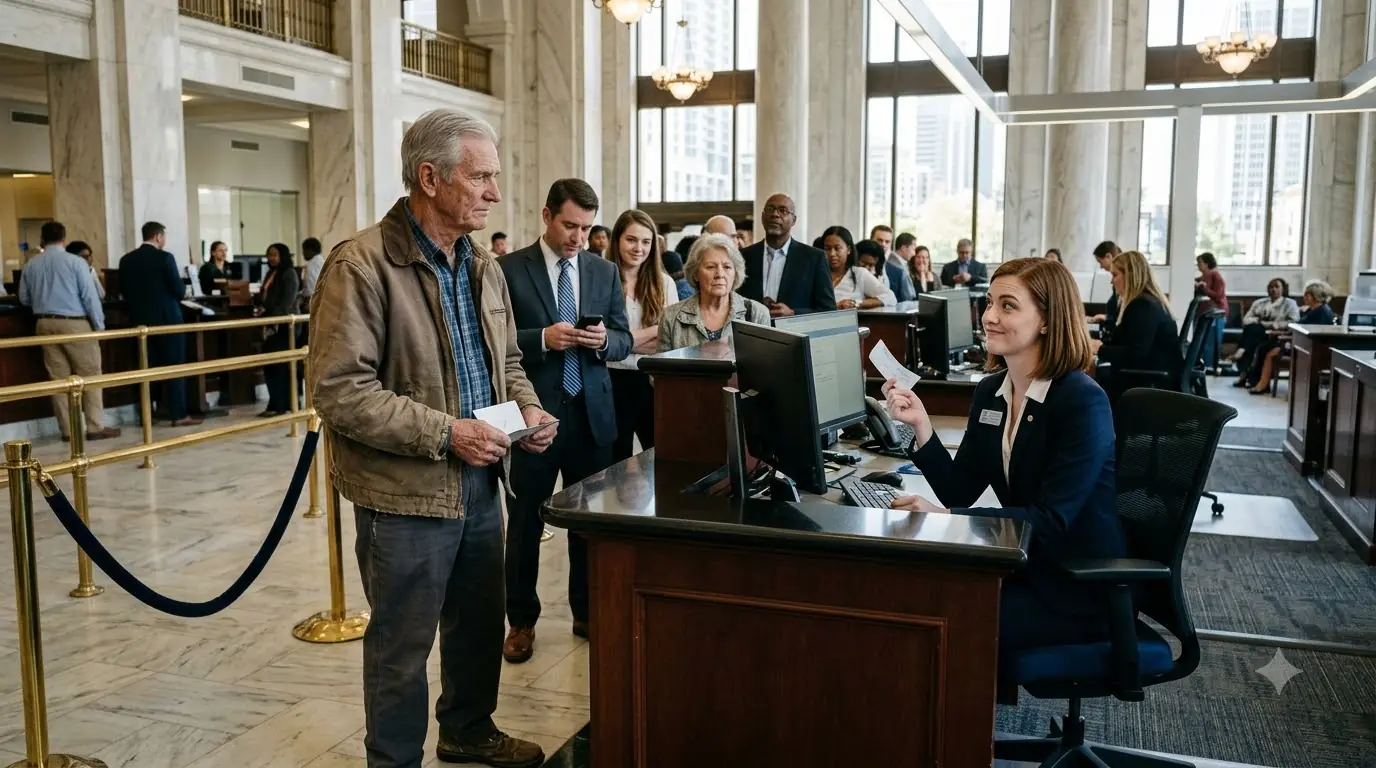
But not quietly enough either.
It was the kind of laugh people use when they believe they are safe in their judgment. Small, sharp, careless, and confident that the person standing in front of them has no power to answer it.
The old man heard it.
So did the people behind him in line.
A businessman in a navy suit lowered his phone and glanced over. A young woman holding a designer handbag looked up from her screen. An elderly couple near the velvet ropes shifted uncomfortably. A mother tightened her grip on her son’s shoulder, sensing the sudden change in the air.
The teller looked down at the withdrawal slip again, then back at the old man.
“Sir,” she said, her voice carrying more than she realized, “this withdrawal is impossible.”
The old man stood quietly on the other side of the counter.
His name was Arthur Bennett.
He was seventy-two years old, though the years sat on him with a kind of weathered dignity rather than weakness. His gray hair was neatly combed. His face was lined by sun, work, patience, grief, and a life that had demanded more from him than it had ever handed over freely.
His jacket was old.
That was true.
It had been dark brown once, but years of use had faded it at the seams and softened the elbows. The cuffs were frayed, and one button had been replaced with another that did not quite match. His shoes were polished, but old enough that no amount of care could hide the miles they had carried him.
He did not wear an expensive watch.
He did not carry a leather briefcase.
He had no driver waiting outside and no assistant standing behind him with a tablet.
He carried only a small white envelope, held carefully between both hands.
Melissa Carter, the teller behind the counter, glanced at the amount written on the withdrawal slip again.
One hundred fifty thousand dollars.
She nearly laughed a second time.
“Sir,” she said, tilting her head as if speaking to someone who had misunderstood the rules of ordinary life, “withdrawals of that size require actual funds to back them up.”
A few people behind Arthur heard every word.
One man coughed into his hand to hide a smile. Someone else shifted with embarrassment, but still did not speak. The young woman with the designer handbag raised her eyebrows and looked Arthur up and down, as if Melissa had merely said aloud what everyone else was thinking.
Arthur did not blush.
He did not argue.
He did not explain.
He simply looked at Melissa with calm eyes and let the silence after her words stretch long enough for her to become slightly uncomfortable inside it.
What she did not know was that the man standing in front of her had been a loyal customer of Crescent National Bank for thirty-two years.
She did not know he had walked into that same building when his hands were younger and his dreams were still held together by borrowed tools, fear, and faith.
She did not know that the bank’s oldest private lending officer still kept a photograph of Arthur Bennett shaking hands with the former branch president after financing his first warehouse project.
She did not know that over eight million dollars sat in Arthur’s accounts.
In that exact building.
At that exact bank.
She was about to find out.
The lobby of Crescent National Bank was unusually busy that morning.
It was a Tuesday, the kind of Tuesday that felt like every other Tuesday until something happened that made everyone remember exactly where they were.
The polished marble floor reflected the bright ceiling lights above. Customers stood in long, slow-moving lines divided by velvet ropes. The quiet rhythm of keyboards, printers, card machines, and murmured conversations filled the air with professional efficiency.
Businessmen in expensive suits checked their watches impatiently. A young woman in designer clothes scrolled through her phone, one manicured thumb moving with bored precision. Two construction workers in hard hats spoke quietly near the back, dust still clinging to their boots. A mother struggled to keep her young son from pulling on the velvet ropes like they were playground equipment.
Everyone was busy.
Everyone was distracted.
Everyone was trapped inside the small urgency of their own errands.
And at the very end of the line stood Arthur Bennett.
Most people barely noticed him.
Those who did assumed he did not belong there.
He had arrived by old pickup truck, parking several blocks away because he disliked the downtown parking garage and still preferred a walk when his knees allowed it. He had chosen his worn jacket because the morning air was colder than expected, not because he wanted to make a statement. He had eaten oatmeal for breakfast, watered the tomatoes in his garden, fed the stray cat that had decided his porch belonged to it, and then driven into the city for a transaction he had already planned carefully.
Arthur Bennett did not make impulsive decisions.
He had not built his life that way.
The white envelope in his hand contained three things: a withdrawal slip, a small handwritten note, and a photograph.
The withdrawal slip was for one hundred fifty thousand dollars.
The note listed the planned use for the money.
A new roof for his old church.
College tuition support for two students whose parents had once worked for him.
A medical fund for a former employee battling cancer.
The photograph was of his late wife, Margaret, standing beside him outside Crescent National Bank twenty-nine years earlier, smiling in a blue dress while Arthur held the keys to his first company truck.
He had brought the photograph because he still liked to talk to Margaret on important days.
Not out loud in public.
Just in his heart.
Arthur Bennett had not been born into wealth.
Not even close.
He grew up in a small town four hours from the city, in a two-bedroom house with a roof that leaked whenever the rain came hard from the west. His father, Samuel Bennett, was a mechanic. Honest, patient, hardworking, and usually tired. His hands were always stained with oil no soap could fully remove.
His mother, Louise, worked wherever work was available.
Some years she cleaned offices. Some years she took laundry from wealthier families. Some weeks she worked at the school cafeteria during the day and helped cook at a roadside diner at night. She wore her exhaustion quietly because there was no room in the house for complaint.
Money was always tight.
Not dramatic tight, not the kind neighbors whispered about.
Ordinary tight.
The kind where shoes were repaired instead of replaced. The kind where meat appeared mostly on Sundays. The kind where children learned not to ask for things twice because the first silence was answer enough.
Arthur never complained about it.
Even as a boy, he seemed to understand that resentment wasted energy better spent on work.
His father taught him how to fix carburetors, patch tires, sharpen tools, and shake hands properly. His mother taught him how to count change, stretch soup, write thank-you notes, and keep his word even when breaking it would be easier.
At thirteen, Arthur delivered newspapers.
At fifteen, he worked weekends sweeping a hardware store.
At seventeen, he spent one summer roofing houses with men twice his age, coming home with sunburned arms and palms blistered raw.
By nineteen, he was working on a construction site at the edge of the city.
The lowest position possible.
Moving materials.
Digging.
Hauling.
Sweeping debris.
Carrying lumber.
The kind of work that breaks younger men down after a week.
Arthur thrived.
Not because the work was easy.
It was not.
His back ached. His hands bled. His boots filled with dust. Some nights he fell asleep sitting up at the kitchen table before finishing dinner.
But Arthur paid attention.
While other workers argued over breaks and complained about supervisors, Arthur watched. He watched how projects were planned. How schedules failed. How budgets were built and broken. How small mistakes became expensive mistakes if ignored too long.
He listened to electricians.
He listened to plumbers.
He listened to architects when they visited the site, even when they spoke as if no one wearing work boots could understand them.
He asked questions during lunch breaks.
He read manuals at night.
He borrowed books from the library about estimating, concrete, contracts, framing, safety codes, project management, and business accounting.
When a foreman snapped at him once and said, “Bennett, you ask too many questions,” Arthur answered, “Yes, sir. That’s how I avoid making the same mistake twice.”
The foreman stared at him.
Then he laughed.
Two weeks later, that same foreman started teaching him how to read blueprints.
Within five years, Arthur was a foreman himself.
Within ten years, he started his own company.
It was just him and three workers at first.
A secondhand truck.
Basic tools.
Rented storage space.
One dented filing cabinet.
A phone line installed in the small house he and Margaret had just bought.
Margaret handled the early bookkeeping at their kitchen table, writing invoices while a pot of beans simmered on the stove. She was a school secretary with sharp eyes, careful handwriting, and the ability to spot a missing number in a ledger faster than Arthur could find a misplaced hammer.
Their first year nearly broke them.
A client delayed payment for ninety days. A truck transmission failed. A storm ruined materials Arthur had not yet learned to store properly. One of his three workers quit without warning, taking a set of tools with him.
Arthur considered quitting exactly once.
Margaret found him in the garage at midnight, sitting on an overturned bucket, staring at the truck.
“We could stop,” he said quietly.
She leaned against the workbench.
“We could.”
He looked at her.
“You think we should?”
Margaret shook her head.
“No.”
“Why not?”
“Because I married a man who only looks defeated when he’s about to learn something.”
Arthur laughed then, despite everything.
The next morning, he got up and went back to work.
Arthur had something rare.
Integrity.
When he said a project would be done by Friday, it was done by Friday. If weather made that impossible, he called the client before the client called him. When he gave a price, the final invoice matched it unless he had explained the change first. When a problem appeared on the job site, he did not hide it under excuses.
He called.
He explained.
He fixed it.
In construction, that kind of reputation spreads faster than advertising.
Small jobs became medium jobs.
Medium jobs became large contracts.
Office buildings.
Apartment complexes.
Government infrastructure projects.
Shopping centers.
School renovations.
Within twenty-five years, Arthur Bennett had built a business empire worth millions.
At its peak, Bennett Construction employed over three hundred people and worked across four states. Arthur knew the names of his crew leaders’ spouses. He contributed quietly when employees had medical emergencies. He kept men on payroll during slow months longer than his accountant liked because he understood what one missed paycheck could do to a family.
He became wealthy, but he never became flashy.
He bought good tools.
Good trucks.
Good boots.
But not much else.
Margaret once tried to convince him to buy a luxury car after they landed a major government contract.
“Arthur,” she said, laughing, “your truck has rust older than our grandchildren.”
“It starts.”
“It complains first.”
“So do I, but you still keep me.”
She shook her head, but she was smiling.
Through every single year of that journey, through every contract signed and every project delivered, through growth, setbacks, recessions, delays, lawsuits, payroll panic, and quiet victories, Arthur banked at Crescent National.
He opened his first account there thirty-two years earlier.
He was twenty-seven years old.
His initial deposit was four thousand dollars.
Everything he had saved.
The teller who helped him that day was a man named Gerald Simmons. Gerald was in his late fifties then, with silver hair, wire-rimmed glasses, and a voice that made banking forms sound less intimidating than they were.
Arthur had walked in wearing dusty work pants and carrying an envelope so tightly his fingers had creased the paper.
Gerald did not look down on him.
He did not rush him.
He did not treat the four thousand dollars like a small number.
He walked Arthur through every form. Explained every option. Asked about his business plans. Told him which account would save him fees. At the end, Gerald stood and shook his hand.
“Welcome to Crescent National, Mr. Bennett,” Gerald said. “We’re glad to have you.”
Arthur never forgot that.
As his business grew, his relationship with the bank grew with it.
Branch managers greeted him by name. Senior loan officers personally handled his accounts. Crescent National financed his first storage yard, then his second office, then his warehouse expansion. The bank processed payroll, equipment purchases, contract payments, and lines of credit large enough to make younger Arthur dizzy.
At one point, over ten million dollars moved through his accounts every year.
Arthur remained loyal.
Not blindly.
He was too practical for that.
But loyalty mattered to him when it was earned.
Crescent National had helped him when he was small.
He remembered.
Then, twelve years ago, Arthur retired.
Not because he stopped loving the work.
Because he had watched too many men in his industry work until their bodies gave out. He had seen men miss their children growing up, miss anniversaries, miss doctor appointments, miss life itself because they confused being needed with being alive.
Margaret’s illness changed him too.
She was diagnosed with heart failure two years before he sold the majority of his company shares. For months, Arthur sat beside her hospital bed, holding the hand that had written their first invoices and balanced their first books.
One evening, she looked at him and said, “Arthur, you built enough buildings. Come home while I’m still in it.”
So he did.
He sold most of his company shares to a longtime partner who respected the workers. He kept some investments, simplified his holdings, moved to a quiet home forty minutes outside the city, and spent the last eighteen months of Margaret’s life learning how to slow down.
He grew tomatoes.
Burned toast.
Took Margaret to morning appointments.
Read to her when she was too tired to hold a book.
Sat on the porch with her when the weather allowed.
After she died, Arthur kept the quiet life.
He gave away most of his expensive suits.
Sold the luxury car Margaret had finally convinced him to buy but rarely saw him drive.
Bought a comfortable old pickup truck.
Kept gardening.
Kept giving.
Kept banking at Crescent National.
Over eight million dollars remained quietly sitting there.
Earning interest.
Untouched.
Loyal.
Just like Arthur.
The line in the bank moved slowly forward.
Arthur waited.
Patiently.
Without checking a phone.
Without sighing.
Without fidgeting.
He had learned long ago that most things worth doing required waiting through some form of discomfort. He had waited on inspections, payments, permits, storms, concrete curing, hospital test results, and grief to soften enough that breathing stopped hurting.
A bank line did not trouble him.
When it was finally his turn, he stepped up to the counter.
Behind the glass partition sat Melissa Carter.
Her name tag gleamed against her navy blazer.
Melissa was twenty-four years old. Perfectly styled hair. Immaculate nails. Sharply pressed uniform. She had been at Crescent National for eleven months, long enough to learn the software, the security rules, the language of customer service, and the subtle hierarchy of who mattered most.
She had also learned bad habits from people who should have taught her better.
Watch the shoes.
Watch the watch.
Watch the bag.
Watch how they speak.
High-value customers looked a certain way, she had been told, not always directly, but often enough that she believed it.
Melissa wanted to rise quickly. She wanted a promotion into private banking, then wealth management. She wanted out of her small apartment, out of her student loans, out of the fear that she would become like her parents, always working, always tired, always one emergency away from begging relatives for help.
She admired wealth.
She feared poverty.
And like many people who fear something, she mistook distance from it for superiority over it.
She glanced up at Arthur.
Worn jacket.
Old shoes.
Rough hands.
Plain envelope.
Her mind made its decision before he spoke.
Without looking up fully from her screen, she said, “Next.”
Arthur stepped forward.
“Good morning,” he said pleasantly.
Melissa barely smiled.
“What can I help you with?”
Arthur placed the white envelope on the counter.
“I’d like to make a withdrawal today, please.”
Melissa opened the envelope, pulled out the slip, and read it.
Then she froze.
She read it again.
Looked up at him.
Looked back at the slip.
“You want to withdraw one hundred fifty thousand dollars?”
Her voice was flat.
Disbelieving.
The kind of voice that carries.
Arthur nodded calmly.
“Yes, please.”
Melissa stared at him for a long moment.
Then she laughed.
Small.
Quiet.
But not quiet enough.
Two people in line glanced over.
She leaned back slightly.
“Sir, are you sure about that number?”
“I am.”
Melissa tilted her head.
“This isn’t a payday loan office.”
Someone in line snorted.
Arthur remained still.
“I understand.”
Melissa crossed her arms slightly.
“Sir,” she said, gesturing around at the polished lobby, “this is a premier financial institution.”
Then she glanced again at his worn jacket, as if confirming her own judgment.
“Withdrawals of that size require actual funds to back them up.”
A few people in line were listening now.
Some shifted uncomfortably.
Some almost smiled.
Arthur said nothing.
He reached slowly into his jacket and placed his bank card on the counter.
Melissa picked it up casually, still wearing the faint trace of a smirk. She typed the card number into the system and hit enter.
Then something happened to her face.
Her fingers stopped moving.
Her eyes narrowed.
Then widened.
She leaned forward, typed again, and read the screen a second time.
Then a third.
Because the number on the screen did not match the old man in the worn jacket.
$8,247,613.52
Melissa’s mouth went dry.
The smile vanished completely.
The lobby felt different suddenly, though nobody yet knew why.
Melissa swallowed.
“Mr. Bennett?”
Her voice was completely different now.
Softer.
Smaller.
Arthur nodded.
Melissa sat up straight and smoothed the front of her blazer.
“Oh, I’m so sorry, sir. I didn’t realize.”
Arthur’s voice was quiet and calm, but each word landed like something heavy being placed on a table.
“You didn’t ask.”
Melissa opened her mouth.
Then closed it.
Her cheeks colored.
“I can process that withdrawal immediately, sir.”
Arthur raised one hand.
“No.”
Melissa froze.
“I’d like to speak with the branch manager.”
Her face turned pale.
“Mr. Bennett, that really isn’t necessary.”
“I believe it is.”
He said nothing more.
He did not need to.
Daniel Harper had been managing the Crescent National branch for eleven years.
He knew the bank the way a ship captain knows his vessel.
Every process.
Every policy.
Every high-value account.
Every long-standing client who kept the branch profitable and respectable.
He was in the middle of a budget call when his assistant knocked on the door.
Daniel muted himself and looked up.
His assistant handed him a note with two words written on it.
Arthur Bennett.
Daniel ended the call immediately.
He did not say “I’ll call you back.”
He did not wait for a polite closing.
He simply ended it.
Then he walked out of his office quickly, straightening his jacket as he moved down the corridor.
When he saw Arthur standing at the counter, Daniel’s face broke into a warm smile.
“Mr. Bennett.”
He crossed the floor and shook Arthur’s hand with both of his.
“It has been far too long. How are you, sir?”
Arthur shook his hand.
“I’m well, Daniel. Thank you.”
Daniel sensed the temperature in the room immediately.
Twenty-three years in banking had given him finely tuned instincts for trouble. He glanced at Melissa. Took in her pale face, tight posture, and frozen smile. Then he looked at Arthur’s calm expression.
He knew something had happened.
“Why don’t we step into my office?” Daniel said. “I’ll personally assist you today.”
Arthur nodded.
As they walked, several people in the lobby watched them go.
Melissa remained at her station, staring at the screen as if the number might change if she looked long enough.
Once the office door was closed, Daniel gestured toward the leather chair across from his desk.
Arthur sat.
Daniel did not sit immediately.
He stood for a moment, choosing honesty over performance.
“What happened today, Arthur?”
Arthur told him.
Not dramatically.
Not emotionally.
Simply.
The way a man describes a beam that cracked, a roof that leaked, a foundation that shifted.
Daniel listened without interrupting.
When Arthur finished, the room was quiet.
“I am deeply sorry,” Daniel said. “That should never have happened. It won’t happen again.”
Arthur looked at him.
“Daniel, I’ve been coming to this bank for thirty-two years.”
“I know.”
“When I first walked in here, I was twenty-seven years old with four thousand dollars. A man named Gerald helped me. He treated me like I was worth his time, like I was somebody worth knowing.”
Daniel lowered his eyes briefly.
“I remember Gerald. He trained half the senior staff before he retired.”
“He understood something this place used to understand,” Arthur said. “Money may open accounts, but respect keeps them.”
Daniel said nothing.
“I brought this bank my business for over three decades. I referred other business owners here. I trusted Crescent with payroll, loans, investments, and the future of people who worked for me. I never once asked for anything special.”
Arthur paused.
“Just basic respect.”
Daniel leaned forward.
“Arthur, I understand, and I take full responsibility for my team’s behavior.”
Arthur raised one hand gently.
“I’d like to close my accounts, Daniel.”
The words fell into the room like stones into still water.
Daniel’s expression did not collapse, but something behind his eyes changed.
“All of them?”
“All of them.”
Daniel sat back slowly.
The banker in him understood the numbers immediately. Eight million dollars leaving one branch was not a routine loss. It would trigger calls, reports, regional review, and difficult conversations with people whose patience depended on quarterly results.
The man in him understood something worse.
This was not about the withdrawal.
This was about trust.
And trust was harder to replace than money.
“Arthur,” Daniel said carefully, “I want to make this right. Let me assign you a dedicated private banker. Someone senior. Someone who knows your history with us. I will personally review what happened and take corrective action.”
“I believe you will.”
“Then let me prove it.”
Arthur looked toward the framed photograph on Daniel’s shelf, a picture of the branch staff at a charity event.
“Daniel, you are a good man. I believe every word you’re saying. But an institution is not just its best people. It is also its worst moments.”
Daniel went still.
Arthur continued.
“Today, I saw a moment that tells me something important about what this place has become.”
“Arthur, please.”
Arthur’s face softened.
“I’m not angry. I’m not trying to punish anyone. I am simply telling you that I can no longer keep my money somewhere that doesn’t see me.”
Daniel had no answer.
Because there was no answer.
The paperwork took time.
Large accounts do not disappear with the click of one button. Forms had to be completed. Transfers arranged. Verification calls made. Security procedures followed. Daniel handled as much personally as policy allowed.
Melissa watched from the lobby as senior staff moved in and out of Daniel’s office.
She heard fragments.
Closed accounts.
Wire transfers.
Portfolio liquidation.
Total balance.
Eight point two million.
Every word struck like a hammer.
By early afternoon, Arthur’s accounts were closed.
Checking.
Savings.
Investment portfolio.
Long-term deposit accounts.
Business legacy reserve.
$8,247,613.52.
Gone.
Arthur stood in Daniel’s office and buttoned his worn jacket.
Daniel stood too.
“I wish this had gone differently,” Daniel said.
“So do I.”
“For what it’s worth, I’m sorry.”
Arthur held out his hand.
Daniel shook it.
“I know you are,” Arthur said. “That is why I’m shaking your hand.”
Then he walked back through the lobby.
Past the marble floors.
Past the polished counters.
Past customers who now watched him with open curiosity.
Past Melissa, who stared at her keyboard and could not bring herself to look up.
Arthur paused near her station.
For a moment, Melissa thought he might speak.
Instead, he placed one small thing on the counter.
The photograph of himself and Margaret outside the bank nearly three decades earlier.
Melissa looked at it.
Young Arthur stood smiling beside a woman in a blue dress. Behind them was the same bank, though the lobby entrance had looked different then. Arthur held keys in one hand. Margaret held his arm.
On the back of the photograph, written in careful handwriting, were three words.
Gerald saw me.
Melissa looked up, but Arthur was already walking toward the door.
Out through the front entrance.
Into the afternoon air.
Back to his old pickup truck.
Back to his quiet life.
Back to being exactly who he had always been.
The lobby remained unnaturally quiet after he left.
No one wanted to be the first to speak.
Melissa picked up the photograph with shaking fingers.
For the first time all day, she saw the man she had laughed at not as an account balance, not as a mistake, not as an embarrassment, but as someone with a life before he reached her counter.
A younger man.
A wife.
A beginning.
A bank employee who had once treated him with dignity.
A relationship she had broken in less than five minutes.
Daniel called her into his office before the end of the day.
She entered with red eyes and both hands clasped tightly in front of her.
“Sit down, Melissa,” he said.
She sat.
There was no anger in Daniel’s face.
That made it worse.
“I’m sorry,” she said immediately. “I didn’t know who he was.”
Daniel leaned back in his chair.
“That sentence is the problem.”
Melissa swallowed.
“I mean, I didn’t know he was such a major client.”
“No,” Daniel said. “You didn’t know he was a person.”
Tears rose in her eyes.
“I made a mistake.”
“You made a judgment,” Daniel corrected. “A mistake is entering a wrong digit. A judgment is looking at someone’s clothing and deciding what level of respect they deserve.”
Melissa lowered her head.
Daniel pushed the photograph across the desk.
“Do you know who Gerald Simmons was?”
She shook her head.
“He was the best banker this branch ever had. He handled accounts from four hundred dollars to forty million with the same patience. He trained us to greet people by name when possible, and with respect always. He used to say, ‘The smallest account today may be the largest account tomorrow, but that is not why you treat people well. You treat people well because it is right.’”
Melissa wiped her cheek.
“I cost the bank eight million dollars.”
Daniel’s expression remained steady.
“Yes. But the money is not the worst part. You cost us trust that took thirty-two years to build.”
That broke her.
She cried then, quietly and without performance.
Daniel let her cry for a moment.
Then he said, “You will be placed on probation. You will complete retraining. You will write a formal apology, though Mr. Bennett is under no obligation to read it. And you will spend the next month shadowing our senior service team, beginning with community accounts.”
Melissa looked up.
“You’re not firing me?”
“I considered it.”
“Why not?”
Daniel folded his hands on the desk.
“Because I am hoping you become the lesson instead of only the warning.”
The story spread in the weeks that followed.
Not because Arthur told it.
He did not.
He was not that kind of man.
But other people had been there.
Sandra Lee, a retired schoolteacher, had been two people behind him in line. She told her sister, who told her book club, which included the wife of a local business owner.
Marcus Bell, a contractor who had worked on two of Arthur’s early projects decades ago, had been near the back of the line. He recognized Arthur only after Daniel called his name across the lobby. Marcus told three people before dinner.
Daniel’s assistant told no one directly, but when asked whether the rumor was true, her expression answered too much.
Word travels quickly in a business community.
Especially when the story involves eight million dollars and a teller who laughed at the wrong man.
Within three weeks, four of Arthur’s former business partners moved their accounts.
Franklin Pierce, a developer Arthur had once helped through a cash-flow crisis, moved twelve million dollars.
Claire Donovan, a property investor who had relied on Crescent National for years, moved seven million.
Two smaller business owners moved another combined six million.
Several contractors followed.
In total, over forty million dollars left Crescent National Bank.
Not because of a lawsuit.
Not because of a viral post.
Not because Arthur organized a campaign or publicly condemned the bank.
Simply because trust, once broken, has weight.
And people who know its value act accordingly.
Regional executives arrived at the branch with serious faces and leather folders.
Daniel took responsibility for the failure of training and culture. He did not blame Melissa alone, though it would have been convenient. He knew one teller’s behavior had grown from a soil the branch had allowed to harden over time.
High-value clients had been given warmth.
Ordinary clients had been processed.
People who looked wealthy had been welcomed.
People who looked difficult, poor, slow, or confused had been handled with impatience.
Melissa had not invented that culture.
She had simply revealed it.
Daniel began rebuilding immediately.
Every employee went through service retraining.
Not the shallow version with cheerful slides and empty phrases.
Real training.
They studied customer stories. They listened to complaints. They practiced slowing down, asking questions, and recognizing bias in the first thoughts that crossed their minds.
Daniel brought in retired employees who remembered the old culture. He found Gerald Simmons, now eighty-three and living with his daughter, and invited him to speak to the staff.
Gerald arrived using a cane but stood straight at the front of the conference room.
His voice was thinner than it had been decades earlier, but still carried the old warmth.
“I remember Arthur Bennett,” Gerald said. “Young man with calloused hands and fear in his eyes. Held that first deposit envelope like it was a newborn baby.”
A few employees smiled.
Gerald did not.
“You know why I treated him carefully? Not because I knew he’d be rich. I didn’t. Most people don’t become rich. That is not the point.”
He looked around the room.
“I treated him carefully because he had trusted us with what mattered to him. Four thousand dollars can be a fortune when it is all a man has.”
Melissa sat in the back, tears sliding silently down her face.
Gerald’s eyes found her.
Not accusing.
Just clear.
“We do not know what people carry when they walk through our doors. Money is only one kind of weight.”
After the session, Melissa approached him.
“I’m the one who laughed,” she said.
Gerald studied her.
“I know.”
“I’m sorry.”
“I’m not the one who needs to hear that.”
“I wrote to him.”
“Good.”
“He may not read it.”
Gerald nodded.
“Then become someone who would never write the same letter twice.”
Melissa did not leave the bank after three months.
She stayed.
But not as the same person.
For weeks, she moved through her work carefully, painfully aware of every assumption that rose inside her. When an elderly woman took too long counting cash, Melissa waited. When a construction worker came in with dust on his boots, she smiled and asked how she could help. When a young man with no credit history opened a small savings account with eighty-seven dollars, she treated the amount like it mattered.
Because it did.
One afternoon, a woman came in with two children and a handful of crumpled bills, asking how to avoid overdraft fees. Melissa spent twenty minutes helping her choose the right account.
After the woman left, Melissa went to the break room and cried for a different reason than before.
Not shame this time.
Recognition.
She was beginning to understand what Gerald meant.
Arthur Bennett never read Melissa’s apology right away.
The envelope arrived at his house two weeks after the incident. He recognized the bank’s return address and placed it on his kitchen table beside the salt shaker.
For three days, he left it there.
On the fourth, he opened it.
Melissa’s handwriting was careful, almost painfully neat.
She did not excuse herself.
She did not blame policy.
She did not say she was stressed or tired or misunderstood.
She wrote:
Mr. Bennett, I looked at you and decided I knew your worth before I knew your name. I was wrong before I ever saw your balance. I was wrong because I forgot you were a person. I am sorry for humiliating you. I am sorry for dishonoring your history with the bank. I am sorry for becoming the kind of person who needed your pain to teach me decency. I do not ask for forgiveness. I only want you to know that I am trying to change.
Arthur read the letter twice.
Then he folded it and placed it in the drawer where he kept Margaret’s recipes, old thank-you notes, and small things worth saving.
He did not move his money back.
Trust, once broken, did not repair itself that easily.
But he hoped Melissa meant what she had written.
Arthur now banked at a small regional credit union twenty minutes from his home.
The manager there was a woman named Patricia Gomez. On Arthur’s first visit, she came out from behind the counter, shook his hand, asked what he was looking for in a banking relationship, listened carefully, answered his questions, and offered him coffee.
She did not know about the eight million dollars when she offered the coffee.
That mattered.
Arthur told a friend afterward, “She reminded me of Gerald.”
That was the highest compliment Arthur Bennett gave.
He referred four people to that credit union within six months.
Not because Patricia asked.
Not for a reward.
Just because something good happened to him there.
That was what Arthur did.
When something was good, he said so.
When something was wrong, he removed himself quietly.
Both actions had power.
A year later, Arthur returned to Crescent National Bank for the first time since closing his accounts.
Not to reopen them.
Not to complain.
Daniel had invited him to a small ceremony honoring Gerald Simmons, whose portrait was being placed in the lobby as part of a new customer dignity initiative.
Arthur almost declined.
Then he thought of Gerald.
And went.
The lobby looked the same at first glance.
Marble floors.
Bright lights.
Counters.
Velvet ropes.
But the feeling was different.
A sign near the entrance now read:
Every customer has a story. Serve the person before the account.
Arthur stood before it for a long moment.
Daniel approached quietly.
“Arthur.”
“Daniel.”
They shook hands.
“I’m glad you came,” Daniel said.
“I came for Gerald.”
“I know.”
They both smiled faintly.
Across the lobby, Melissa Carter stood at a teller station helping an elderly man fill out a form. She looked up and saw Arthur.
For a moment, all movement seemed to stop inside her.
Arthur looked at her.
She did not smile too quickly.
Did not rush over.
Did not perform apology for the lobby.
She simply placed one hand over her heart and bowed her head once.
Arthur studied her.
Then he nodded.
It was not forgiveness exactly.
Not full restoration.
But it was something.
And sometimes something was where repair began.
During the ceremony, Gerald sat in a chair near the front while Daniel spoke about his decades of service.
“He taught us that banking is not only about deposits and loans,” Daniel said. “It is about trust. It is about stewardship. It is about remembering that every person who walks through our doors carries a life we cannot see.”
Arthur listened quietly.
Melissa listened too.
When the portrait was revealed, it showed Gerald as Arthur remembered him: silver hair, wire-rimmed glasses, warm eyes, and the steady dignity of a man who saw people before numbers.
Afterward, Gerald asked Arthur to sit beside him.
“You look older,” Gerald said.
Arthur laughed.
“So do you.”
“Fair.”
They sat together watching the lobby move around them.
Gerald tapped his cane lightly against the floor.
“I heard what happened.”
“I figured you did.”
“Bank lost a good man.”
Arthur looked toward Melissa, who was now helping a young construction worker open an account.
“Maybe it found a lesson.”
Gerald smiled.
“Always the builder.”
Arthur glanced at him.
“What do you mean?”
“You see broken things and wonder whether they can be made useful again.”
Arthur looked down at his hands.
“Not everything can.”
“No,” Gerald said. “But more than we think.”
There are two ways to hear Arthur Bennett’s story.
The first way is the obvious one.
Do not judge people by appearances because they might be rich.
That lesson is in there.
It is real.
It is valid.
Anyone who works in a bank, a store, a restaurant, a dealership, a hospital, or any place where people come needing service should remember it. The person in worn clothes might be wealthy. The person driving an old truck might own the company. The person counting coupons might have more influence than anyone realizes.
But that is not the deepest lesson.
Arthur Bennett deserved to be treated with respect whether he had eight dollars or eight million.
The worn jacket did not make him less.
The old shoes did not make him less.
The fact that he came in quietly, alone, with a white envelope, did not make him less.
He was a person with a history Melissa could not have read in four seconds even if she had tried.
None of us can.
That is the real lesson.
We move through life making rapid judgments about people.
What they are worth.
Whether they belong.
How much patience they deserve.
Whether they are important enough to impress or ordinary enough to dismiss.
Almost every time, we are working with incomplete information.
Think about the people who get looked past every single day.
The elderly woman at the grocery store who takes a little longer to count her change while people sigh behind her. Nobody wonders what she survived. Nobody asks how many children she raised, how many jobs she worked, how many losses she endured quietly.
The young man in the interview without the right clothes, judged before he finishes his first sentence. Nobody sees the night shifts, the borrowed shoes, the bus ride, the courage it took to show up.
The immigrant who struggles with the language, dismissed as less intelligent, when the truth is they are speaking their third language while carrying a whole world inside them.
The construction worker with dust on his boots who understands more about discipline than the executive checking his watch.
The man in the worn jacket who built three hundred jobs from nothing.
The woman who seems confused at the counter but once held a family together through grief, debt, and impossible choices.
Every person has a story.
A real one.
Longer and more complicated and more worthy of respect than a four-second read.
We just have to slow down enough to remember that.
Arthur Bennett still lives in his house outside the city.
Same garden.
Same old pickup truck.
Same quiet routines.
In the spring, he grows tomatoes, peppers, and beans. In the fall, he cleans the gutters himself even though his knees complain and his neighbor insists he should hire someone. Every Sunday, he brings flowers to Margaret’s grave and tells her what the weather is doing, what the cat has destroyed, and which young person he quietly helped that week.
The white envelope from Crescent National is gone now.
The photograph of him and Margaret outside the old bank sits on his mantel.
Sometimes, when visitors ask about it, Arthur tells them about Gerald.
About the first account.
About the handshake that made a young man feel like he might become more than dust and labor.
He rarely tells the rest unless someone needs to hear it.
But when he does, he always ends the same way.
“Money shows what people want from you,” he says. “But how they treat you before they know about the money shows who they are.”
Then he pauses.
Because Arthur Bennett is a fair man.
“And sometimes,” he adds, “people can learn to become better than who they were in their worst moment.”
That is why he kept Melissa’s letter.
Not because it erased what happened.
It did not.
Not because it restored the thirty-two-year relationship with Crescent National.
It could not.
But because it reminded him that correction, when received honestly, can become construction of a different kind.
Arthur had spent his life building things.
Warehouses.
Schools.
Offices.
Homes.
Trust.
He understood foundations.
He knew a cracked foundation could not be ignored. You either repaired it properly or everything above it eventually suffered.
That Tuesday in the bank revealed a crack.
Arthur did what he believed was right.
He removed what he had built there.
Daniel did what he believed was right.
He repaired what remained.
Melissa did what she should have done from the beginning, though late.
She learned to see.
And somewhere, perhaps, Gerald Simmons’s old lesson found new life in a lobby that had almost forgotten it.
The people who judge the fastest are usually the ones who know the least.
And the people who have been through the most are often the quietest about it.
Arthur never announced what he had built.
He never walked into Crescent National demanding anyone know his name.
He wanted what every person in that line wanted.
To be treated like he mattered.
That is not a big ask.
It has never been a big ask.
Arthur Bennett knew that.
He had known it since he was nineteen years old, standing in dust and heat on a construction site, being dismissed by people who never bothered to ask what he was learning while they looked away.
He spent a lifetime proving himself silently.
Without drama.
Without boasting.
One job at a time.
One payroll at a time.
One promise at a time.
And when a teller laughed at him in a lobby full of people, he proved something again.
Not that he was rich.
That was the least important part.
He proved that dignity does not need permission.
He proved that quiet people can make loud decisions.
He proved that respect lost in seconds can cost more than money.
And he proved that how you treat people matters.
Not because of what they have.
Not because of what they can do for you.
Not because they might secretly be important.
But because they are human beings.
And that is enough.