The morning Thomas Hayes carried his baby into the market, the whole town of Mercy Bend pretended not to see him breaking. He came through the door with dust on his boots, bloodshot eyes, and a bundle pressed against his chest so carefully that even the roughest men near the feed sacks stopped talking. His newborn son was wrapped in a thin white cloth, his tiny face pale, his mouth moving weakly without sound. Thomas looked at every woman in that room, every mother, every widow, every aunt and grandmother, and his voice cracked before pride could stop it.
“Please,” he said. “Someone help him. He hasn’t taken milk in three days.”
Silence fell harder than judgment. The store smelled of molasses, coffee beans, flour, and the cold fear people hide behind respectability. Mrs. Henderson stood near the counter with her black gloves folded in one hand, her mouth pinched like kindness was a debt she had no intention of paying. Two boarding house girls whispered behind a stack of sugar sacks, their eyes darting from Thomas to the bundle in his arms.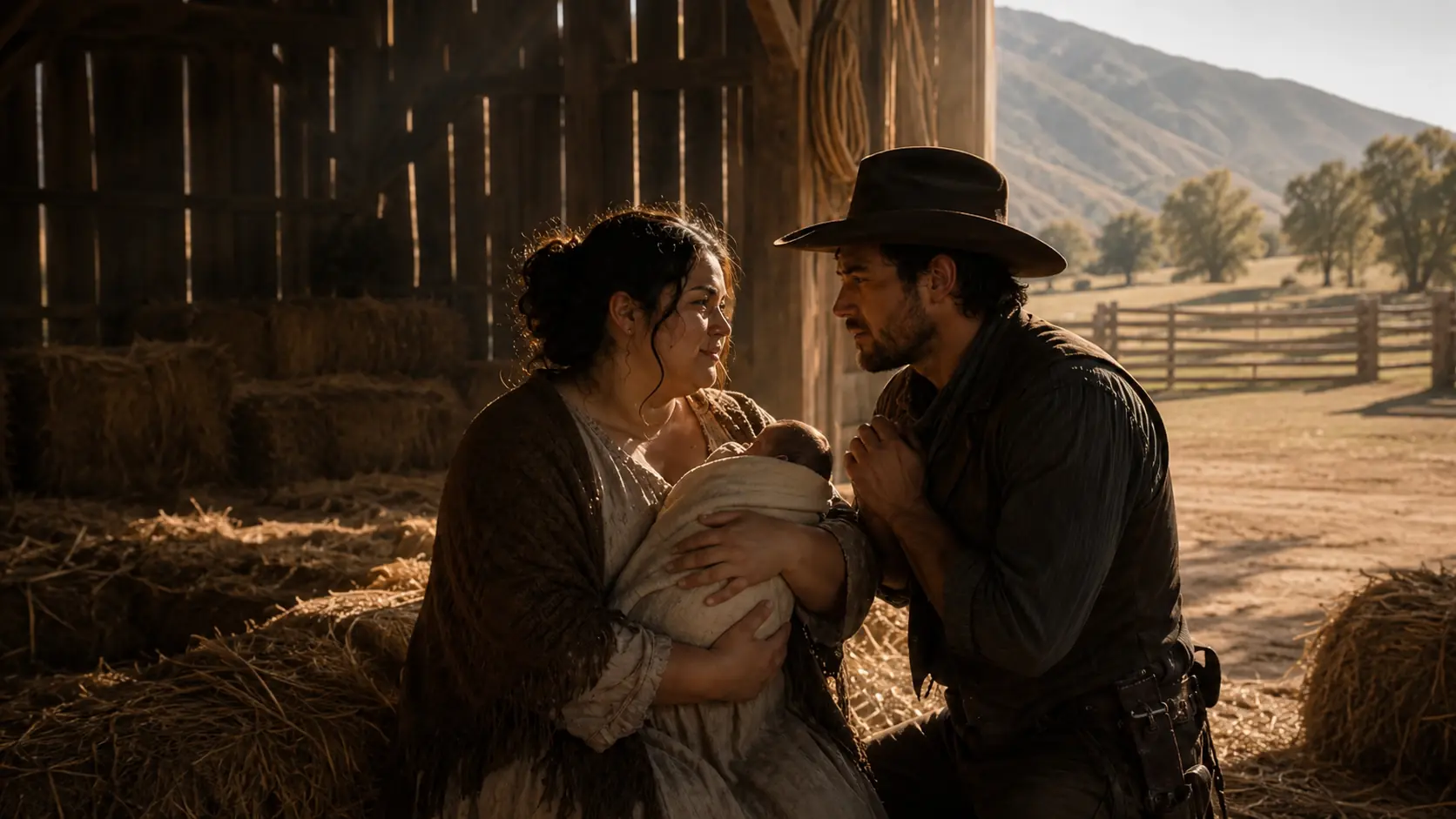
Norah Bell stood near the back with a basket of laundry soap and a small paper packet of yeast. She had come into town early, hoping to leave before anyone found a reason to stare at her. At twenty-eight, she was already called a widow in the tone people used for ruined furniture, something useful once but now too heavy to move. She was broad in the hips, soft in the arms, and large enough that cruel people thought her body gave them permission to be clever.
Her husband, Samuel, had died in a wagon accident the winter before. Her baby had followed silently into the world and out of it in the same hour, born too still to cry, too fragile even for the name Norah had chosen. Since then, the milk meant for that child had remained in her body like grief refusing to understand death. No one spoke of it gently. Most people simply looked away.
But Martha Wells, the baker’s wife, looked straight at Norah across the market. Her face changed as understanding dawned, and Norah felt dread rise before Martha said a word. “Norah,” Martha whispered, “you lost your baby recently. You may still be able to help.”
Every face turned.
The silence became something sharper.
One of the boarding house girls laughed first, a small ugly sound she tried to cover with her hand. “That fat widow?” she said. “She couldn’t even keep her own baby alive, and now she’s meant to save his?”
Norah felt the words land inside her like stones dropped into deep water. Her fingers tightened around the basket handle until the wire cut her palm. Thomas turned toward her, and for the first time she saw not the hot-tempered cowboy everyone feared, not the man who broke a saloon chair over another man’s insult, not the widower who had become a storm after his wife’s death. She saw a father holding the last piece of his life and watching it fade.
His wife, Clara, had died of fever two weeks after the baby came. Some said Thomas had driven too fast for the doctor. Some said the Hayes ranch was cursed. Some said no decent woman should go there because grief made men dangerous. Norah had heard all of it while kneading bread at the boarding house, pretending gossip did not sound like knives when spoken by clean hands.
Thomas took one step toward her. “Mrs. Bell,” he said, voice low with shame and desperation. “I would not ask if there was another way.”
Norah looked at the baby.
His mouth moved again, weak and searching.
In that moment, she no longer heard the girls laughing. She no longer heard Mrs. Henderson murmur that such things were indecent. She heard only the cry her own child had never made, echoing through a room full of people who cared more about appearances than life. Slowly, Norah set her basket down.
“Bring him,” she said.
A gasp passed through the market. Mrs. Henderson straightened. “Norah Bell, think carefully about your reputation.”
Norah looked at her, and something tired in her heart stood up. “A baby cannot drink reputation.”
Thomas stared at her as if she had given him breath. Then he followed her out of the market with the bundle in his arms, while Mercy Bend watched from behind windows, counters, and churchgoing mouths. No one offered a blanket. No one offered a wagon. They only watched, because watching cost nothing and could be mistaken for concern.
Norah took Thomas to her attic room above the boarding house. It was small, with a slanted ceiling, one iron bed, a cracked pitcher, and a Bible on the windowsill that had belonged to her mother. The room smelled of starch, lavender soap, and old sorrow. Thomas stood near the door, his hat crushed in one hand, not knowing where to put his eyes.
Norah turned her back slightly, arranging a shawl across her front with shaking hands. She did not look at Thomas when she spoke. “Sit by the window. Hold him until I say.”
Thomas obeyed.
The baby barely made a sound when Norah took him. He was lighter than grief should ever be. His skin was too cool, his tiny hands curled near his chest, and his breath came unevenly. Norah sat on the edge of the bed, closed her eyes for one second, and whispered the name of the child she had lost.
Then she fed Thomas Hayes’s son.
At first, nothing happened.
Thomas stood so still he seemed carved from the wall. Norah bowed over the baby with tears slipping down her cheeks, terrified the child was already too weak. Then his tiny mouth found strength. He began to take milk, slowly at first, then with desperate life returning in small uneven pulls.
Thomas made a sound behind her. Not words. Not even a sob. It was the sound of a man struck by mercy when he had prepared himself for burial.
“He’s drinking,” Norah whispered.
Thomas sank into the chair by the window and covered his face with both hands. “God forgive me,” he said. “I thought I was bringing him to town to die.”
Norah looked down at the child in her arms. The pain inside her did not vanish. It widened. It made room for another kind of ache, one that hurt because it was alive.
“What is his name?” she asked.
Thomas lowered his hands. His eyes were wet. “Eli.”
“Eli,” Norah repeated softly.
The baby fed until his breathing steadied. Color returned faintly to his cheeks. His fingers opened and closed against the blanket, no longer clenched in the stiff, fading way Norah had first seen. When he finally slept, it was not the sleep of surrender. It was the deep, exhausted sleep of a child who had found the world again.
Thomas stood near the bed, unable to stop looking at him. “Mrs. Bell,” he said, voice rough, “I owe you more than I can say.”
Norah did not look up. “You owe him a chance to keep living.”
“I’ll pay.”
Her eyes lifted then. “This is not something you buy, Mr. Hayes.”
Shame crossed his face. “I didn’t mean it that way.”
“I know.” Her voice softened. “But others will.”
He understood. Everyone in town would talk. They would turn mercy into scandal, grief into indecency, and Norah’s body into something shameful because it had done what theirs had refused to do. Thomas looked toward the door, his jaw tightening in the way men prepare for a fight.
Norah saw it and shook her head. “Do not start breaking tables for my honor.”
“They laughed at you.”
“They watched your son starve.”
That silenced him.
Thomas came back the next morning, and the next, and the next. At first, he brought Eli to Norah’s attic room under cover of early light. Then, when the baby grew stronger but still needed her, Thomas asked if she would come to the ranch. He offered a room, wages, and protection from the boarding house whispers.
Norah refused twice.
The third time, she looked at Eli sleeping in the crook of her arm and said yes.
The Hayes ranch sat three miles beyond town, where grass thinned into dust and the wind moved like it had nowhere better to go. The house had once been beautiful in a plain, hardworking way, but grief had left its mark on every corner. Dishes sat chipped in the cupboard. Curtains hung crooked. Clara’s sewing basket remained beside a chair no one had touched since she died.
Norah entered quietly, carrying Eli while Thomas held her small trunk. The place smelled of dust, ashes, and a loneliness so thick it seemed to have settled on the furniture. She looked around and understood that Thomas had not been living there since his wife died. He had only been surviving in rooms where she was missing.
“I haven’t kept it well,” he said.
Norah touched the back of a chair. “Grief is a poor housekeeper.”
For the first few days, they spoke mostly of practical things. Eli needed feeding, washing, warmth, and patience. Thomas needed sleep, though he resisted it until Norah ordered him to lie down on the parlor sofa before he fell over in the kitchen. Chickens needed grain, the porch needed sweeping, and the well rope needed mending before someone lost a bucket.
Norah worked because work kept her from drowning in memory. She baked bread, scrubbed floors, washed linens, and sang to Eli in a voice she had not used since before her own loss. Thomas moved around her carefully at first, as though kindness might frighten her away. He spoke softly, handed her what she needed before she asked, and never once looked at her with the smirk she had learned to expect from people in town.
One evening, after Eli had fed and fallen asleep, Norah stood by the kitchen table folding tiny cloths. Thomas came in from the barn, hat in his hand, hair damp with sweat. He paused in the doorway and watched her for a moment.
“What?” she asked without turning.
“This house sounds different.”
She glanced at him. “Houses don’t sound.”
“This one does.” His voice lowered. “It stopped sounding dead.”
Norah’s hands stilled over the cloth.
Thomas stepped closer, careful not to crowd her. “I don’t know how to thank you without making it too small.”
“Then don’t try tonight.”
He nodded, but did not leave. “Can I say something else?”
Norah braced herself. People often asked permission before saying the thing that hurt most.
Thomas looked at Eli’s cradle beside the fireplace. “When I carried him into that market, I thought begging would be the hardest thing I ever did. But it wasn’t.” His throat moved. “The hardest thing was seeing how many people could watch a baby fade and still worry about themselves.”
Norah looked down. “They will say worse.”
“Let them say it to me.”
“They won’t,” she said. “People like that rarely strike where the wall is strong. They look for soft places.”
Thomas’s eyes moved to her face. “Then I’ll stand by the soft place.”
She wanted to believe him. That was the dangerous part. Norah had lived long enough to know that men could be grateful in a crisis and ashamed later, once neighbors began looking over fences. Compassion could be praised in private and condemned by Sunday.
So she said nothing.
Peace lasted almost three weeks.
Eli grew stronger. His cheeks filled out, his cry returned, and his little hands began reaching toward light. Thomas laughed the first time the baby grabbed his finger and refused to let go. Norah had been kneading dough at the time, and the sound of Thomas laughing startled her so much that she pressed both hands into the flour and stood still.
He looked embarrassed. “Forgot what that sounded like.”
Norah smiled faintly. “It suits the house.”
After that, laughter came more often. Not loud. Not careless. But enough to soften corners. Thomas repaired the porch rail while Norah held Eli in the doorway. Norah replanted Clara’s neglected herb garden while Thomas brought water from the well. In the evenings, they sat near the hearth, not touching, not speaking much, but no longer feeling alone inside the silence.
Then Norah returned to the boarding house for her old Bible and heard the truth through a cracked kitchen door.
Mrs. Henderson was speaking to the preacher’s wife. Her voice had the calm cruelty of someone certain God shared her opinions. “Tomorrow we’ll go to the ranch. She must leave before people think Thomas Hayes is keeping an unnamed woman under his roof.”
The preacher’s wife gave a faint laugh. “Say she is staining the baby’s reputation. A desperate widow won’t dare argue.”
One of the boarding house girls added, sweet as poisoned jam, “Remember to mention her dead baby. Someone cursed like that shouldn’t pretend to be a miracle.”
Norah stood outside the door with her hand on the wall. For a moment, she could not breathe. The pain was not surprise. It was recognition. She had always known they were capable of cruelty, but hearing them plan it carefully, like women arranging flowers for church, made something inside her go terribly still.
She did not enter. She did not cry there. She simply took her Bible from the shelf near the back stairs and walked out.
That night, Thomas found her in the small room he had given her at the ranch. A tin box sat open on the bed. Inside lay a debt note from the boarding house that Thomas had quietly paid after learning Norah had been overcharged for rent. Beside it was Eli’s first tiny headcloth, washed and folded, the one he had worn the morning his cheeks finally turned pink again. At the bottom was a scrap of paper with names written carefully in Norah’s hand.
Thomas stood in the doorway. “What are you preparing?”
Norah closed the box gently. “A gift for the people who think they have the right to call life shameful.”
His face darkened. “Who?”
She told him.
With each name, his jaw tightened. When she finished, he turned toward the door like violence had called him by name. Norah rose quickly and caught his sleeve.
“No.”
“They’re coming here to threaten you.”
“Yes.”
“And you want me to stand still?”
“I want you to stand with me,” she said. “That is not the same thing as losing your temper for me.”
He stopped.
Norah’s voice trembled, but she did not release his sleeve. “They expect anger from you. They expect shame from me. Let us give them neither.”
Thomas looked at her hand on his sleeve, then at her face. Something in him softened, though the fury remained beneath it. “Tell me what you need.”
“Be there,” she said. “And if I begin to doubt myself, remind me why Eli is breathing.”
Thomas nodded slowly. “He is breathing because you chose mercy when they chose comfort.”
Norah looked away, tears threatening again. “Do you believe that when they call me sinful?”
“I believed it when I first saw you hold him,” Thomas said. “I believe it more now.”
The next morning, the carriage arrived after breakfast. Mrs. Henderson stepped down first, black dress pressed sharp, chin raised high enough to look righteous from a distance. The preacher’s wife followed, carrying a Bible she had no intention of opening for mercy. Three boarding house girls came behind them, their eyes bright with the pleasure of witnessing someone else’s fall.
Norah stood on the porch holding Eli close. Thomas was near the barn, visible but silent, exactly where Norah had asked him to be. The wind snapped a white sheet on the clothesline behind the house. Dust moved low across the yard.
Mrs. Henderson stopped at the foot of the porch steps. “Norah Bell, this little arrangement is over. You are coming back with us.”
Norah said nothing.
One of the girls laughed. “Don’t tell me you thought you were really Mrs. Hayes.”
Thomas took one step from the barn.
Norah lifted her hand slightly, and he stopped.
Mrs. Henderson’s eyes narrowed. “This child’s reputation will be ruined if you stay another night under this roof. A woman in your position should know better than to invite talk.”
Norah felt Eli’s warm weight against her chest. He smelled of milk, soap, and life. She looked at the women who had watched him fade and now dared to speak of reputation.
“His reputation began the morning you all watched him starve and called my milk shameful,” Norah said.
The preacher’s wife flushed. “How dare you twist Christian concern into accusation.”
Norah placed the tin box on the porch table. The sound of metal touching wood cut cleanly through the wind. “If you came here for Grace, for Eli, for reputation, or for my soul, then open this before you touch me.”
Mrs. Henderson looked at the box as if it might bite. “What is that?”
“Truth,” Norah said. “It is lighter than gossip, but harder to carry.”
Thomas came up the steps then and stood beside Norah. His voice was low, but every woman heard it. “Say one more word against the woman who saved my son, and you will leave this ranch with the truth tied to your name.”
One of the boarding house girls scoffed. “Are you threatening us?”
Thomas looked at her. “No. I’m warning you that I am finished letting cowards dress cruelty as decency.”
Mrs. Henderson opened the box with stiff fingers. The first thing she saw was Eli’s headcloth. Her mouth tightened. Beneath it was the list of names, the people present in the market when Thomas begged for help and no one moved. Beneath that was the boarding house debt note showing how much money she had taken from Norah after her husband died, including false charges for meals Norah had never eaten and medicine she had never received.
The preacher’s wife leaned closer, then went pale.
Norah’s voice stayed quiet. “If you want the town to discuss shame, I will let them discuss all of it. How you watched a newborn starve. How you mocked a grieving mother. How you charged a widow extra rent because you thought she had nowhere else to go.”
Mrs. Henderson snapped the box shut. “You ungrateful girl.”
Norah almost smiled. “There it is. I was waiting for the word you use when obedience runs out.”
The women left without taking her. Their carriage rolled away in a storm of dust, but Norah knew the matter was not finished. People like Mrs. Henderson did not surrender. They retreated, gathered sharper words, and looked for another door.
That afternoon, the post office called the ranch. Thomas answered first, then held the receiver out to Norah. His expression told her who it was.
Norah took it. “Yes?”
Mrs. Henderson’s voice hissed through the line. “What did you put in that box? Do you want the whole town to know what we did?”
Norah looked toward the cradle where Eli slept, one fist curled near his cheek. Thomas stood beside the window, watching her, not rescuing her, not speaking over her, only standing exactly where he had promised to stand.
“No, ma’am,” Norah said softly. “I only left behind the proof that when a baby needed saving, you all chose to stand and watch.”
There was silence on the line.
Then the call ended.
The story spread, because truth always travels faster when people tried to bury it first. By Sunday, Mercy Bend knew not only that Norah had nursed Thomas Hayes’s baby, but that half the town’s respectable women had refused help before condemning the one person who gave it. Some defended Mrs. Henderson. Some pretended they had not been in the market. Some suddenly remembered urgent errands that had kept them from speaking.
But some came to apologize.
Martha Wells arrived first with a loaf of bread and tears in her eyes. “I should have stood beside you,” she said.
Norah accepted the bread. “Yes.”
Martha nodded, ashamed. “I will do better.”
“That matters more than saying sorry.”
Others followed slowly. Not all. Never all. Cruel people often prefer silence to repentance. But enough came that Mercy Bend began to shift, not because it had become kinder overnight, but because one woman had refused to let them keep calling cowardice morality.
Thomas changed too. He no longer moved through town like a man looking for someone to fight. He carried Eli into the market proudly, letting people see the child’s round cheeks and bright eyes. When anyone asked who had saved him, Thomas gave the same answer every time.
“Norah Bell did.”
The first time he said it in front of Mrs. Henderson, the room went so quiet that even the scales behind the counter seemed to stop swinging.
Weeks passed. Eli grew stronger, louder, more demanding. Norah continued living at the ranch, though now no one could pretend she was hidden there. Thomas paid her wages openly, then added her name to the household account at the store so she would never again have to ask Mrs. Henderson for credit. When the preacher’s wife suggested that appearances still mattered, Thomas looked at her and said, “So does life.”
One evening, Norah stood on the porch holding Eli as the sunset burned low over the pasture. Thomas came from the barn, wiping his hands on a cloth. He stopped beside her, close enough that their shoulders nearly touched.
“Can I say something that might frighten you?” he asked.
Norah smiled faintly. “Most things frighten me. Say it anyway.”
“I don’t want you here only because Eli needs you.”
Her breath caught.
Thomas looked out at the pasture, as if facing the horizon made honesty easier. “I know grief brought you through my door. I know my boy tied your life to this house before either of us knew what we were choosing. But when you walk into a room now, Norah, it feels like the room remembers how to be home.”
Tears rose before she could stop them. “Thomas.”
“I am not asking you to forget Samuel. I am not asking you to replace Clara. I would never ask grief to make room before it is ready.” He turned to her then. “I am only telling you that if one day your heart can look toward mine without pain being the first thing it sees, I will be standing there.”
Norah looked down at Eli, who slept peacefully against her. Then she looked at Thomas, the feared cowboy who had begged without pride, raged without cruelty, and learned how to stand still when she needed strength more than rescue. Her heart did not open all at once. It opened like a door swollen from years of rain, slowly, painfully, but truly.
“I don’t know what I can promise,” she whispered.
Thomas nodded. “Then promise nothing tonight.”
She looked at him through tears. “You would wait?”
His voice softened. “You waited beside my son until he remembered how to live. I can wait beside you.”
Norah closed her eyes.
The wind moved across the porch, lifting the edge of Eli’s blanket. Somewhere in the barn, a horse shifted. Somewhere beyond the ranch, Mercy Bend kept talking, judging, forgetting, remembering, and pretending it had always known mercy when it saw it.
But on the Hayes ranch, in the quiet between grief and tomorrow, Norah Bell held a living child against her heart and stood beside a man who no longer saw her as shame, burden, or charity. He saw the woman who had answered when everyone else turned away. He saw the milk that had begun as grief become mercy in a dying child’s mouth.
And for the first time since burying her own baby, Norah felt that her body was not cursed.
It had carried sorrow.
It had carried love.
And when life begged from Thomas Hayes’s arms, it had carried salvation.