The laughter started before Wyatt Carver ever raised his bidder number. At sixteen years old, he looked almost absurd standing among the experienced equipment dealers at the Seibert Sale Barn outside Colby, Kansas, on a hot summer morning in 1977. He had ridden fourteen miles on a bicycle because his mother needed their only pickup for work, and the only money he carried was $340 stuffed into an old coffee tin. What made the grown men laugh hardest was the battered notebook in one hand and the compression gauge tucked beneath his arm.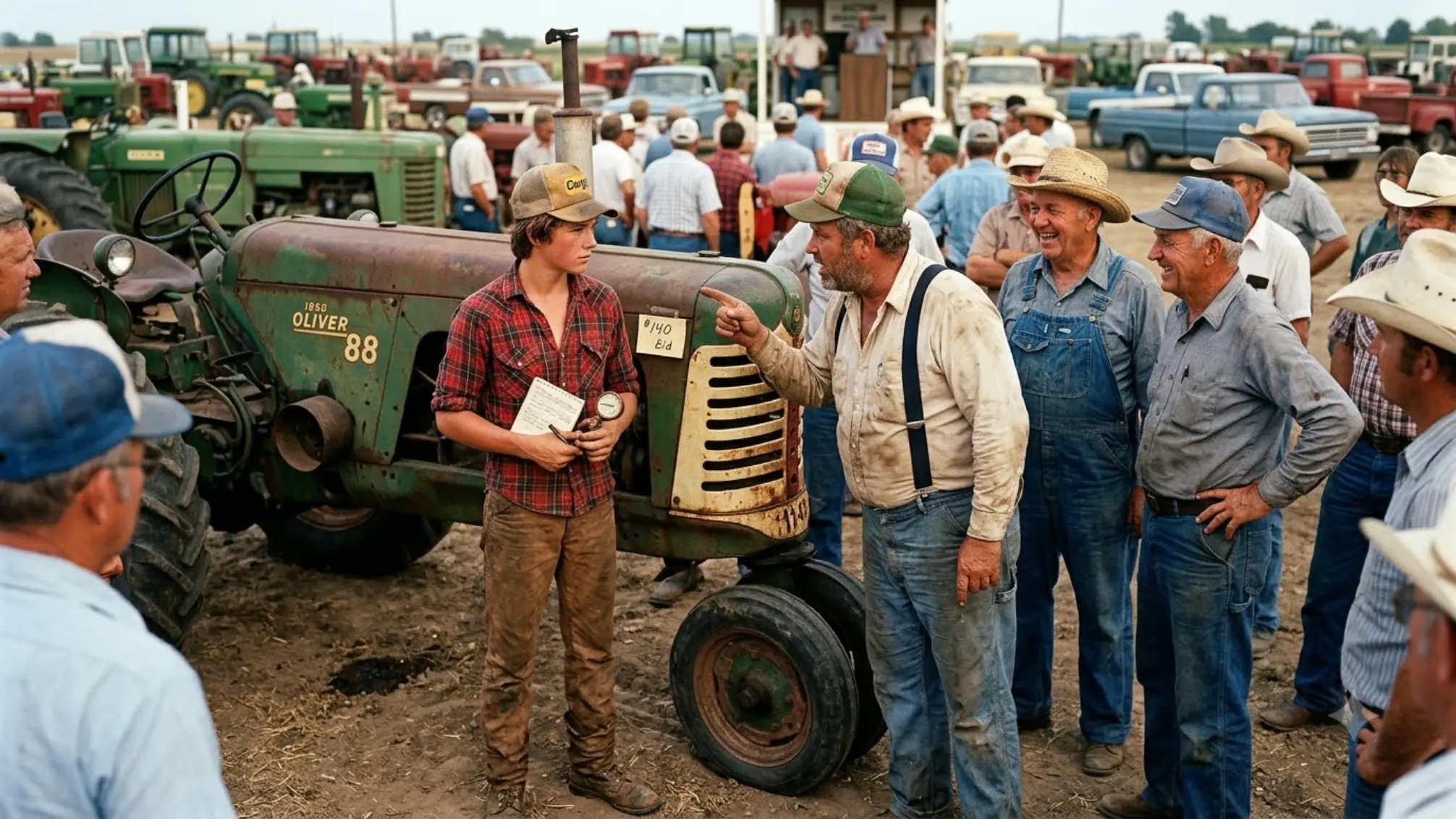
Hollis Merritt noticed Wyatt first. Hollis had been buying and reselling farm equipment for fourteen years, and he knew nearly every serious bidder in western Kansas by name. He watched the lanky boy crawl beneath tractors, check serial numbers, shine a flashlight into greasy openings, and scribble measurements into his notebook. Finally, he nudged another dealer and said loudly enough for Wyatt to hear, “Somebody’s boy is playing farmer.”
Wyatt heard him. He kept working. His grandfather had taught him years earlier that a man learned more by studying machinery than by answering people who mocked him. By eight o’clock, Wyatt had already inspected eleven pieces of equipment, but only one machine held his attention long enough to make several men stop and watch.
Lot 14 was a 1953 Oliver 88 row-crop tractor. Most of its green paint had disappeared beneath rust, one rear fender was missing, and the front end leaned noticeably to one side. Anyone with even moderate equipment experience could look at the machine and reach the same conclusion: the front axle had been bent by impact or rollover. The auction catalog reflected that assumption, estimating the tractor at only a few hundred dollars and warning buyers that the front axle showed visible damage.
Hollis had inspected it for thirty seconds. Several other dealers had done the same. Wyatt spent twenty-two minutes beneath it, measuring the distance between the wheel flange and axle centerline, checking four cylinders with his grandfather’s compression gauge, examining the transmission through the inspection cover, and studying the kingpin assembly from underneath. Then he sat back on his heels and opened an old leather notebook that had once belonged to his grandfather.
That was the moment several dealers began laughing again. To them, Wyatt looked like a child pretending to diagnose machinery with a schoolbook. What they did not know was that the leather notebook contained information copied from decades of factory service bulletins collected by Silas Carver, Wyatt’s grandfather. Silas had repaired tractors for forty years and had saved almost every technical notice manufacturers sent through western Kansas.
Wyatt had inherited forty-three binders after Silas died. He had read them the way other boys read sports magazines, first because he missed his grandfather and later because machinery became the one place where grief made sense. Machines had symptoms, causes, measurements, and solutions. Unlike death, they usually explained themselves if someone had enough patience to listen.
Silas had started teaching Wyatt seriously after Wyatt’s father died in 1974. Thomas Carver had been caught in a power takeoff accident while working on a hay machine, leaving thirteen-year-old Wyatt and his mother Marietta responsible for a heavily mortgaged farm outside Oakley. Marietta increased her hours at the feed store and began doing bookkeeping work on weekends. Silas quietly returned to the farm every week, inspecting equipment his son had left behind and teaching Wyatt whatever the boy was willing to learn.
One cold December afternoon, Silas placed a brass compression gauge on the workbench between them. “Every machine tells you the truth,” he told Wyatt. “Numbers don’t care whether you’re young, old, rich, poor, confident, or scared.” Wyatt remembered that sentence better than almost anything else his grandfather ever said.
Silas died the following spring, quietly in his chair inside the equipment shed. He left no letter and no grand speech, only his tools, binders, notebooks, and decades of accumulated knowledge. Wyatt interpreted the inheritance exactly as Silas intended. He began reading.
By sixteen, Wyatt knew more about certain older tractors than many men who had repaired equipment professionally for years. He did not know everything, and Silas had taught him never to pretend otherwise. But one machine he had studied obsessively was the Oliver 88. That mattered because an obscure 1956 factory bulletin described exactly what Wyatt saw beneath Lot 14.
Certain 1952 and 1953 Oliver 88 tractors developed visible front-end cant when kingpin bushings wore beyond tolerance. From the outside, the condition looked almost identical to structural axle damage. The repair required inexpensive replacement bushings and several hours of careful work, not a replacement axle. Wyatt’s measurement fell precisely inside the service bulletin’s range.
The axle was not bent.
The adults were wrong.
Wyatt closed the old notebook and walked to registration. Doreen, the longtime auction clerk, looked at his age, counted the $340 from his coffee tin, and handed him bidder number 47. Hollis watched the exchange from across the yard and shook his head.
“What’s he going to buy with three hundred forty dollars?” Hollis asked.
Another dealer shrugged. “An education.”
At nine o’clock, the auction began. Wyatt waited forty-five minutes while grain augers, planters, post-hole diggers, and another old tractor moved through bidding. He stood beside the Oliver with his number folded in his hand. He did not bid on anything else.
Finally, the auctioneer reached Lot 14. He read the catalog description: “1953 Oliver 88, engine runs, front axle shows damage, sold as-is.” He asked for $150 and received silence. He dropped to $100, then $75.
A salvage dealer raised his card.
Wyatt raised number 47.
Eighty dollars became ninety. Ninety became one hundred. The salvage dealer kept bidding because he calculated that the transmission and engine alone were worth more than the current price. Wyatt kept raising his number without changing expression.
At $130, the salvage dealer hesitated. Wyatt offered $140. The dealer looked at the leaning tractor, then at the boy standing beside it, and lowered his card.
“Going once.”
Wyatt’s pulse hammered.
“Going twice.”
Nobody moved.
“Sold. Bidder forty-seven. One hundred forty dollars.”
The gavel fell.
Laughter broke out nearby.
Wyatt folded his bidder slip and placed it carefully inside his shirt pocket. He still had $200 left, enough to purchase the parts he needed and cover transportation. Hollis Merritt walked toward him.
“Son,” Hollis said, pointing toward the Oliver, “that front axle is bent. You know that, right?”
Wyatt looked directly at him.
“The axle isn’t bent.”
Several nearby men turned.
Hollis frowned. “What?”
“The kingpin bushing is worn. Looks like a bent axle from outside, but it’s a different problem.”
Hollis glanced toward the tractor.
“How do you know?”
“Oliver issued a service bulletin in 1956. Covers the ’52 and ’53 models. Four to four-and-a-half inches of lateral cant at the wheel flange usually means bushing wear, not structural damage.”
The laughter disappeared.
Hollis stared at Wyatt.
“You measured it?”
“This morning.”
“How much to repair?”
“About twelve dollars in parts. Three hours if I don’t rush.”
Several farmers gathered closer. One of them was seventy-one-year-old Orel Tipton, who had known Silas Carver personally. Orel had watched Wyatt inspect the tractor that morning but had deliberately kept quiet.
Hollis looked beneath the Oliver again. The explanation made mechanical sense, and worse for his pride, it was specific enough that Wyatt clearly had not invented it on the spot. “Where’d you learn that?”
“My grandfather’s service binders.”
“Who was your grandfather?”
“Silas Carver.”
Hollis’s face changed.
“I knew Silas.”
“Yes, sir.”
“Good mechanic.”
“Yes, sir.”
Hollis extended his hand.
Wyatt shook it.
That handshake changed the mood around the tractor more than any argument could have. Men who had spent the morning treating Wyatt like entertainment began recalculating what they thought they knew about him. Respect had not arrived yet, but recognition had.
The auction continued, and Wyatt believed the difficult part of his day was finished. He was wrong. As he prepared to unlock his bicycle after the sale, a well-dressed man in clean khaki pants and expensive boots approached him with a business card.
“Garrett Voss,” the man said. “Regional manager, Corn Belt Equipment Corporation.”
Wyatt accepted the card.
Garrett smiled. “Nice work on the Oliver. I watched everything.”
“Thank you, sir.”
“I’ll save you the trouble of hauling it home. Four hundred dollars cash.”
Wyatt looked at him.
He had paid $140 less than three hours earlier. Taking $400 would mean an immediate $260 profit with no repair work, no transportation, and no risk. For a sixteen-year-old whose mother counted every dollar against the mortgage, the offer was enormous.
“Thank you,” Wyatt said, “but I’m keeping it.”
Garrett’s smile tightened.
“Four twenty.”
“It isn’t the price.”
“What do you mean?”
“I bought it to fix it.”
Garrett studied him. “Kid, this is a market. Small operators eventually sell to larger operators. That’s how markets work.”
Wyatt said nothing.
Garrett returned his business card to his pocket.
“Keep the tractor, then. Just don’t think you’ll play alone forever.”
He walked away.
Only after Wyatt had ridden several miles toward home did his hands begin shaking. Hollis’s laughter had not frightened him because Wyatt knew how to answer machinery. Garrett frightened him because the man had not been interested in the tractor. He had been interested in Wyatt.
The following Saturday, Wyatt borrowed a neighbor’s flatbed trailer and brought the Oliver home. He set his grandfather’s 1956 service bulletin beside the tool chest, ordered replacement bushings for $11.40, and began disassembly. The repair took two hours and forty minutes.
He torqued every bolt exactly to specification. When he drove the Oliver onto the county road afterward, the front axle tracked straight. Nothing structural had ever been wrong with it.
Two weeks later, a local farmer named Arlen Dowd bought the tractor for $480. Arlen needed an affordable second machine and trusted the Carver name because he had known Silas. Wyatt earned roughly $328 after purchase and parts.
He put $200 into an envelope for his mother’s mortgage payment.
Marietta found the money the next morning. She did not praise him dramatically or ask where every dollar came from. She simply used it for the September payment.
Word traveled.
Farmers began bringing equipment to the Carver shed. Hollis Merritt later brought Wyatt a Farmall M he could not sell because of a cracked block, and they arranged to split the resale profit if Wyatt could repair it. Wyatt did.
By seventeen, he was repairing machinery for farmers across several counties while finishing high school. By eighteen, people were calling the Carver place specifically because dealerships had quoted repairs they could not afford. Wyatt’s confidence grew.
Then he made a mistake.
A farmer named Percy Hatch owned a John Deere 730 diesel that lost power under load. Wyatt diagnosed the injection pump, quoted $600, removed it, sent it for rebuild, reinstalled it, and started the tractor. Forty-five seconds later, the same problem returned.
Wyatt stood beside the running machine and felt something inside him sink.
He had been wrong.
He took the tractor home and read his grandfather’s John Deere bulletins until he found a 1961 notice describing timing-gear wear that produced symptoms almost identical to pump failure. The actual repair required a nine-dollar part and several hours of work. Wyatt repaired it, returned the tractor, refunded the unnecessary rebuild cost, and charged nothing additional.
Percy thanked him.
Then he said he would not hire Wyatt again.
Three other jobs disappeared that week after word of the mistake spread. Wyatt sat alone in the equipment shed one evening, surrounded by Silas’s tools and binders, convinced one wrong diagnosis had erased years of work. Marietta eventually found him inside.
“Your grandfather was wrong sometimes,” she said.
Wyatt looked at her.
“He once spent four days failing to repair a neighbor’s combine. Dealer fixed it in three hours. Silas paid the dealer bill himself.”
Wyatt remained silent.
Marietta continued.
“He didn’t stop being Silas. He just knew one more thing afterward.”
She stood.
“Eat the loss. Learn. Get back to work.”
Wyatt opened his notebook that night.
He wrote:
Timing gear first. Pump second. Never reverse.
It became one of many rules he would carry for the rest of his career.
Nine months later, customers slowly returned. Some farmers decided they trusted a mechanic who admitted mistakes more than one who concealed them. Wyatt rebuilt his reputation job by job.
Then Corn Belt arrived in Colby.
A massive new regional service center opened beside Highway 24 under Garrett Voss’s management. Advertising promised factory-trained technicians, warranty coverage, modern diagnostic equipment, and “professional service instead of backyard mechanics.” Nobody needed Wyatt’s name printed in the advertisement to understand who the phrase targeted.
Garrett’s representatives visited farms directly. They warned that independent mechanics could not provide corporate guarantees and asked farmers whether they really wanted to trust expensive equipment to a young man working inside an old shed. Wyatt lost several customers.
Hollis Merritt visited the new Corn Belt shop pretending to be an ordinary customer. He returned to Wyatt furious. “Three technicians, mostly new equipment parts, and the counter manager doesn’t know what an Oliver 88 is.”
Wyatt smiled faintly.
“They’re not mechanics,” Hollis said. “They’re a warehouse with uniforms.”
Garrett drove to the Carver farm several weeks later. He entered Silas’s shed carrying a leather portfolio and placed a two-page contract on the workbench. Corn Belt wanted to purchase Wyatt’s operation.
The offer included $8,000 cash.
A $22,000 salary.
Health insurance.
A company truck.
Paid vacation.
A senior technician position.
And one condition Garrett considered minor.
Corn Belt wanted Silas’s tool chest and all forty-three service binders.
Wyatt did not touch the contract.
“The binders aren’t for sale.”
Garrett smiled. “We could display them. Name the counter after your grandfather.”
“No.”
“Think about your mother’s mortgage.”
“No.”
“Think about security.”
“No.”
Garrett closed his portfolio.
“You’re making business personal.”
Wyatt looked toward the shelves.
“It is personal.”
Garrett left the contract behind anyway.
Wyatt folded it and buried it beneath old invoices.
Two years later, Corn Belt went farther.
Marietta received a telephone call from Meridian Bank informing her that a corporation had inquired about purchasing the mortgage note on the Carver farm. The bank employee quietly disclosed the name.
Corn Belt Equipment Financial Services.
Wyatt finally understood Garrett’s strategy.
Buy the knowledge if possible.
Destroy the independent operation if necessary.
And if neither worked, buy the pressure point holding the family farm together.
Marietta looked across the kitchen table at her son.
“Silas would never sell the chest.”
Wyatt nodded.
“I won’t sell the farm.”
She stood.
“You do whatever comes next.”
Wyatt went to the shed.
He began reading.
All forty-three binders.
Again.
Six weeks passed.
Wyatt searched not merely for repair information, but for something Corn Belt’s modern technicians would overlook because their system depended only on current manufacturer recommendations. Silas had kept superseded bulletins that dealers were no longer required to reference. Eventually Wyatt found something buried inside an old John Deere volume.
A 1971 service bulletin described certain 4020 and 4320 diesel engines that appeared to have cracked blocks. Coolant entered the oil, compression dropped, and symptoms looked catastrophic. The actual cause could be an incorrect head-gasket torque sequence.
The repair cost roughly forty dollars in parts and six hours of labor.
Two years later, John Deere superseded the bulletin.
The newer recommendation called for block replacement.
Cost: thousands of dollars.
Wyatt copied both documents.
He said nothing.
Then widow Adelia Strickland called him before wheat harvest. Her husband had recently died, leaving her responsible for the family farm and a Case 1370 combine that suddenly stopped working. Corn Belt inspected the machine and quoted $2,800 for engine replacement.
Wyatt spent two hours examining it.
The engine was fine.
A cracked header-drive shaft and incorrect concave adjustment had caused the symptoms.
Parts: approximately $180.
Labor: another $180.
Wyatt worked through two nights and had the combine running before harvest.
Adelia paid him $360.
Then the story spread.
A $2,800 corporate diagnosis.
A $360 actual repair.
Farmers did not need Wyatt to accuse Corn Belt of anything.
They performed the subtraction themselves.
Garrett responded with a public event.
Corn Belt announced Farmer Appreciation Day, offering free barbecue, equipment demonstrations, and what advertisements called “a candid conversation about independent service providers.” Hollis brought the flyer to Wyatt.
“He’s going after you publicly.”
“I know.”
“You going?”
“Yes.”
Eighty-seven farmers attended.
Garrett stood beneath a canopy beside a new tractor wearing a blue blazer and the same practiced smile Wyatt remembered from 1977. He spoke about professionalism, warranty coverage, factory certification, and the dangers of trusting expensive farms to “backyard mechanics.”
Then he mentioned Wyatt directly.
“A talented young man who got lucky on an Oliver 88 five years ago.”
People turned.
Garrett smiled.
“Wyatt, since you’re here, perhaps you’d like to say a few words.”
Wyatt walked forward.
Hollis handed him a manila envelope.
Wyatt did not use the microphone.
“My name is Wyatt Carver. I fix farm equipment in my grandfather’s shed.”
The parking lot became quiet.
“Mr. Voss says I got lucky on an Oliver 88. He’s right in one sense. I was lucky my grandfather saved a 1956 service bulletin everyone else had forgotten.”
Several farmers smiled.
“But reading isn’t luck.”
Wyatt removed the 1971 John Deere bulletin.
He explained the cracked-block symptoms.
Then the inexpensive repair.
Then he held up the superseding 1973 bulletin recommending block replacement.
Farmers stopped eating.
Wyatt continued.
“Corn Belt quoted three cracked-block repairs in this area this year. Two farmers paid. One didn’t.”
Garrett’s face changed.
“That third farmer hired me.”
Wyatt held up the older bulletin.
“I used this procedure.”
He paused.
“His tractor is still running.”
Nobody moved.
Wyatt carefully avoided accusing Garrett of fraud. He said Corn Belt technicians might simply have never seen the older bulletin because the manufacturer had superseded it. Then he looked directly at Garrett.
“You called my business a handshake in a shed.”
Garrett remained still.
Wyatt continued.
“A handshake in a shed is older than your corporation.”
Several farmers nodded.
“My grandfather used one for forty years. My father used one. I use one.”
He pointed toward the crowd.
“When I shake a farmer’s hand, I’m telling him I’ll charge for the work that needs doing, not the work that makes the biggest invoice.”
The silence deepened.
“And if I’m wrong, I pay for being wrong.”
Wyatt looked toward Percy Hatch standing near the back.
“I’ve been wrong before.”
Percy slowly nodded.
“I’ll be wrong again someday.”
Wyatt folded the documents.
“But I’ll never pretend wrong is right because right pays less.”
He handed the papers back to Hollis.
“Thank you.”
Then Wyatt walked away.
One farmer set down his plate and left.
Another followed.
Then another.
By the time Wyatt reached his mother’s pickup, twelve trucks had started.
Hollis walked beside him.
“Son.”
Wyatt turned.
“You just cost that man his career.”
Wyatt shook his head.
“No, sir.”
He looked back toward Garrett standing alone beside the microphone.
“He cost himself his career.”
Wyatt opened the truck door.
“I just read.”
Six months later, Corn Belt’s Colby Regional Service Center closed. Financial problems extended far beyond one confrontation, but farmer confidence had collapsed and major service accounts moved elsewhere. The corporation withdrew its attempt to purchase the Carver mortgage.
Garrett moved away.
Wyatt stayed.
In 1983, at twenty-two years old, Wyatt opened Carver Agricultural Services.
There was no ribbon-cutting ceremony.
No corporate speeches.
Marietta arrived on the first morning carrying a cardboard box.
Inside was the old coffee tin.
The same one Wyatt carried to the auction in 1977.
She placed it above the register.
“For luck.”
Wyatt smiled.
“Wasn’t luck.”
Marietta looked toward him.
“I know.”
Years passed.
Wyatt hired employees.
The binder collection expanded.
Forty-three became fifty.
Then sixty-one.
Farmers began driving across western Kansas because the Carver name meant something simple: someone would keep looking until the machine explained what was wrong.
In 1994, Hollis Merritt stopped at Wyatt’s shed on the final day before retiring.
They stood in the yard talking about the old auction.
“I almost didn’t shake your hand that day,” Hollis admitted.
Wyatt laughed.
“You thought I got lucky.”
“I did.”
“I was lucky.”
Hollis shook his head.
“No.”
Wyatt waited.
“You were lucky your grandfather saved those bulletins.”
Wyatt nodded.
Hollis smiled.
“But the real luck was that you read them.”
He extended his hand.
Wyatt shook it.
Minutes after Hollis drove away, a thirteen-year-old boy arrived on a bicycle.
The boy wore boots slightly too large for him, carried a spiral notebook, and stood nervously at the shed entrance.
Wyatt set down his wrench.
“What’s your name?”
“Tobias Renner.”
“What can I do for you?”
“My dad has a Case tractor. Dealer says the hydraulic pump is dead.”
Wyatt waited.
Tobias swallowed.
“I think they’re wrong.”
That sentence transported Wyatt seventeen years backward.
“Why?”
“I read an old service manual. I think the pressure relief valve is stuck open.”
Wyatt looked toward the boy’s bicycle.
“How far did you ride?”
“Eight miles.”
“Your father know you’re here?”
“No, sir.”
Wyatt almost smiled.
He turned toward the shelf.
“Come inside.”
Wyatt pulled down the Case binder.
He opened it to a 1969 service bulletin.
The document described exactly what Tobias suspected.
Pressure-relief valve failure presenting as pump failure.
Twelve-dollar part.
Two hours of work.
The boy stared.
“How did you know which binder?”
Wyatt looked toward the sixty-one volumes lining the wall.
“I read them.”
“All of them?”
“Twice.”
Tobias looked overwhelmed.
Wyatt slid the binder across the workbench.
“There’s no shortcut.”
The boy began reading.
Wyatt stepped back and watched.
For the first time, he completely understood what Silas had given him.
Not tools.
Not bulletins.
Not a business.
A way of thinking.
Look carefully.
Measure.
Read.
Question assumptions.
Admit mistakes.
Never confuse experience with certainty.
And never sell knowledge simply because someone richer wants to own it.
Seventeen years earlier, men at an auction had pointed at Wyatt Carver and laughed because they believed a sixteen-year-old boy had paid $140 for a broken tractor.
They were not foolish men.
They simply saw what experience told them to see.
Bent axle.
Worthless machine.
Naive boy.
Wyatt saw something different because he had gone deeper.
One service bulletin.
One measurement.
One worn bushing.
Twelve dollars.
That tiny difference in knowledge turned a $140 tractor into $480.
More importantly, it turned a boy carrying a coffee tin into a mechanic who eventually defended an entire way of doing business.
Wyatt never became famous.
He never built a national corporation.
He never wanted to.
His success remained measured in working tractors, honest invoices, mortgages paid on time, farmers able to finish harvest, and young mechanics who learned to read before guessing.
The old coffee tin remained above the counter for years.
Visitors occasionally asked why.
Wyatt would tell them it once carried $340 to an auction.
Then someone would ask about the tractor.
He would smile.
“Everybody thought the axle was bent.”
“What was actually wrong?”
“Twelve-dollar bushing.”
The visitor would usually laugh.
Wyatt never did.
Because he remembered the men laughing before the auction.
He remembered Garrett Voss offering $400 before understanding what Wyatt truly owned.
He remembered his mother counting mortgage payments.
He remembered Percy Hatch telling him he would not call again.
He remembered every mistake that taught him more than success ever could.
And whenever another young mechanic walked into his shop convinced the older men had overlooked something, Wyatt never laughed first.
He opened the binder.
He turned the page.
And he asked one question.
“Show me what you found.”