She had lost her husband.
Was she about to lose her last chance at survival?
Could she really build a new life on a stranger’s ranch?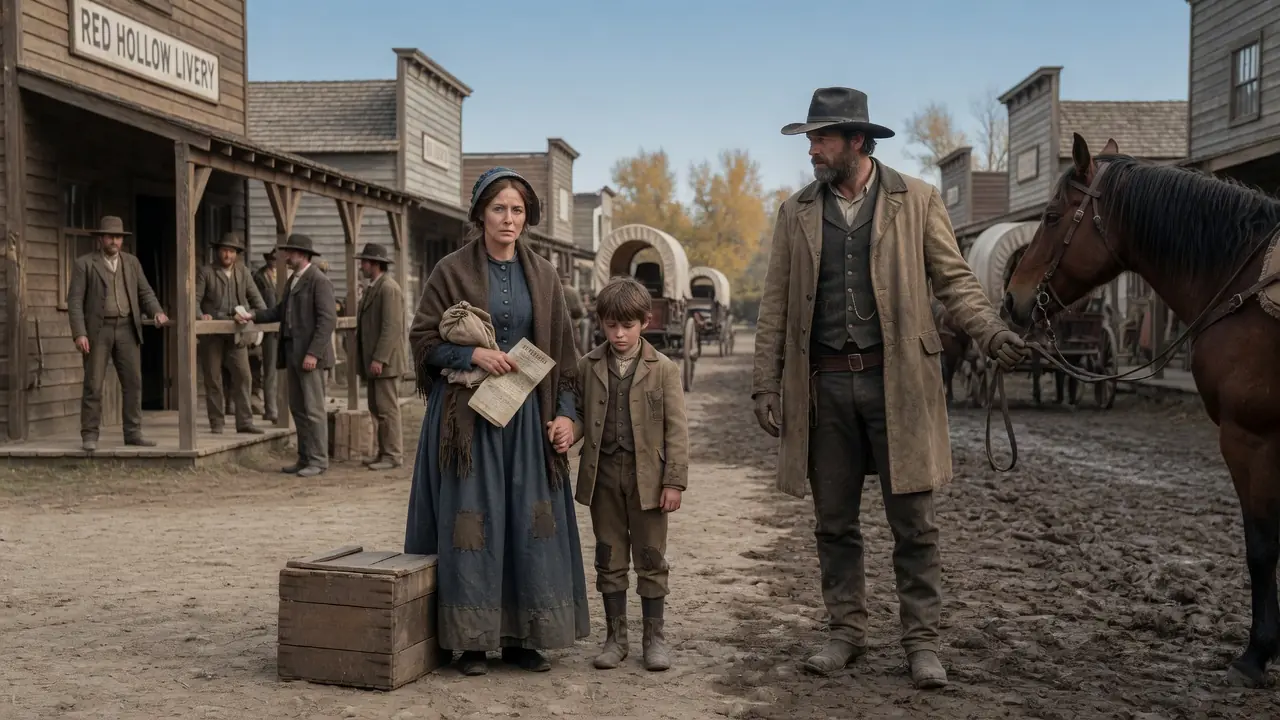
Why would the richest rancher in Wyoming help her?
The wind carried dust through the empty streets of Red Hollow, Wyoming Territory, in the autumn of 1887 as Margaret Harper tightened her trembling grip on her ten-year-old son’s hand.
The sheriff had nailed a notice to the boarding house door that morning, and by sunset every possession they owned fit inside a worn wooden crate and a faded cloth bundle.
The boarding house owner had looked away in shame when he told them they had to leave.
Her husband had been buried only six weeks earlier beneath a lonely cottonwood tree after a ranch accident, and now the world seemed determined to bury everything else he had left behind.
Little Samuel kept glancing toward his mother, trying to be brave even though hunger hollowed his cheeks and fear clouded his young eyes.
Every doorway closed before them. Every wagon passed without stopping. Every stranger seemed too busy to notice a widow and her son standing alone with nowhere left to go.
Margaret had never imagined life could change so completely in a single season.
Just months earlier, her husband, Thomas Harper, had worked as a dependable ranch hand whose honesty earned respect from nearly everyone in Red Hollow.
They had little money, but they had enough hope to dream about buying a few acres of land one day.
Those dreams disappeared when a frightened horse threw Thomas against a stone fence during a cattle drive.
He survived only long enough to squeeze Margaret’s hand and whisper that she should never stop believing decent people still existed.
Those words echoed painfully now, because every decent person seemed powerless against poverty.
Samuel tried not to complain about being hungry.
Whenever his stomach growled, he smiled instead, pretending everything would somehow be all right.
Margaret noticed the effort, and it broke her heart even more than the hunger itself.
A child should never have to comfort his own mother.
Yet Samuel quietly gathered firewood whenever he could, carried every bundle without being asked, and never once blamed fate for stealing his father.
As the evening shadows stretched across the dusty street, Margaret approached one final stable, hoping someone might allow them to sleep inside the empty hayloft.
Before she reached the entrance, a tall rancher stepped out, leading a broad-chested bay horse.
His weathered face spoke of hard years, and his clothes carried the dust of countless cattle drives.
His name was Jacob Mercer, owner of the largest ranch for nearly thirty miles.
He paused after noticing Samuel shivering beside his mother.
His eyes lingered on the boy’s worn boots, patched so many times that fresh leather barely remained.
Then he looked at Margaret’s exhausted expression before quietly asking the question neither of them expected to hear.
“Can you keep a kitchen?”
For several seconds, Margaret could not answer.
She had expected another refusal, another polite apology, another closed door.
Instead, she nodded carefully and admitted that cooking had always been her greatest strength.
She could bake bread, preserve vegetables, prepare hearty meals for ranch hands, and stretch the smallest supplies into enough food for many hungry mouths.
Jacob simply picked up their wooden crate, placed it inside his wagon, and told them to climb aboard before the temperature dropped further.
Neither Margaret nor Samuel understood why a successful rancher would trust complete strangers.
What they did not know was that Jacob had buried his own wife years earlier during a harsh winter fever.
Since then, his ranch had become orderly but painfully silent.
His housekeeper had recently retired because of poor health, leaving the large ranch house strangely empty despite dozens of hardworking cowboys eating there every day.
The Mercer Ranch rested beside a winding river surrounded by golden cottonwoods and wide rolling fields where hundreds of cattle grazed beneath endless western skies.
Margaret felt almost frightened by the size of the place.
Everything seemed too fine for someone who owned almost nothing.
The following morning, she rose before sunrise.
Without waiting for instructions, she scrubbed the kitchen from floor to ceiling, sharpened neglected knives, organized the pantry, baked fresh biscuits, fried salt pork, prepared eggs, brewed strong coffee, and filled the dining tables before the first ranch hands entered.
The men stopped in surprise.
For weeks, they had eaten hurried meals prepared without much care.
Now warm bread filled the room with comforting aromas that reminded many of their own mothers and wives waiting back home.
Samuel also found work without being asked.
Though still young, he carried water buckets, gathered eggs, swept porches, stacked firewood, and fed chickens with cheerful determination.
The older ranch hands smiled whenever they saw him racing across the yard, trying to prove he deserved the chance they had been given.
Weeks slowly became months.
Life settled into a peaceful rhythm.
Margaret laughed again while preparing Sunday dinners.
Samuel’s cheeks grew healthier, and his eyes regained a brightness that grief had stolen.
Jacob remained quiet, but everyone noticed he lingered a little longer in the kitchen after supper, sometimes helping carry dishes simply to enjoy hearing laughter inside the house once more.
One bitter December evening, a violent snowstorm swept across the valley.
Two ranch hands returning from repairing distant fences failed to reach home before darkness.
Without hesitation, Samuel remembered his father’s lessons about tracking in winter.
He noticed broken branches leading toward an abandoned hunting cabin hidden among the hills.
Jacob trusted the boy’s instincts.
Together, they rode into the freezing night.
Hours later, they found both men trapped beneath fallen timber after their wagon had overturned.
Had they waited until morning, neither man would likely have survived.
The rescue spread quickly throughout neighboring towns.
Everyone praised Jacob’s courage, but Jacob quietly insisted young Samuel deserved the real credit.
From that day forward, the ranch hands treated Samuel like a younger brother instead of a charity case.
They taught him to ride stronger horses, repair fences, rope calves, and respect honest labor.
Each lesson slowly replaced painful memories with confidence.
As spring arrived, Jacob rode into town and returned carrying official papers.
He gathered Margaret beneath the shade of the old cottonwood tree outside the ranch house and handed her the documents.
They were not employment papers.
They were the deed to a small cottage resting beside the eastern pasture.
The little home had once belonged to Jacob’s elderly foreman, who had recently moved east to live with family.
Jacob explained that the cottage now belonged entirely to Margaret and Samuel.
No rent.
No debt.
No conditions beyond living there with dignity.
Margaret could barely hold the papers because her hands shook so violently.
She had expected wages, perhaps even permanent work.
Never ownership.
Never security.
Never a place where her son could call somewhere home again.
Tears streamed freely down her face as she remembered Thomas’s final words about decent people still existing.
He had been right all along.
Years passed, and Samuel grew into a hardworking young ranch foreman known throughout the territory for his honesty and compassion.
Whenever travelers arrived hungry or families found themselves without shelter, he never allowed anyone to leave empty-handed.
He often repeated the lesson that had shaped his entire life: one simple act of kindness could rescue someone standing at the edge of hopelessness.
Margaret never stopped baking bread before sunrise.
Every loaf she placed on the kitchen table reminded her of the cold evening when she believed life had ended, only to discover that hope sometimes arrives disguised as a single unexpected question.
The Mercer Ranch became known not only for strong cattle and fertile land, but for open doors.
Widows found work there.
Orphan children found safety there.
Tired travelers found warm meals there.
Jacob never considered himself extraordinary.
He simply believed blessings were meant to be shared before they were counted.
As the evening sun settled beyond the western hills, Margaret stood on the porch of the little cottage that had once seemed impossible to imagine.
Samuel laughed while helping younger ranch children learn to throw a rope, and the smell of fresh bread drifted across the valley.
She realized that losing everything had led them to the one place where they were finally seen, valued, and loved.
Sometimes the greatest miracles do not arrive with gold, fame, or fortune.
Sometimes they begin with a tired widow, a frightened little boy, and a rancher willing to ask one simple question that opens the door to an entirely new life.