The wagon broke at the exact moment Martha Lancaster had nothing left to lose. One more mile, she had told herself through the last stretch of dusty Oklahoma road. One more mile toward work, toward bread, toward any tomorrow better than the frightened yesterday following her from Missouri. Then the rear wheel groaned, the axle split, and the covered wagon leaned sharply into the dirt as though it had finally surrendered before she did.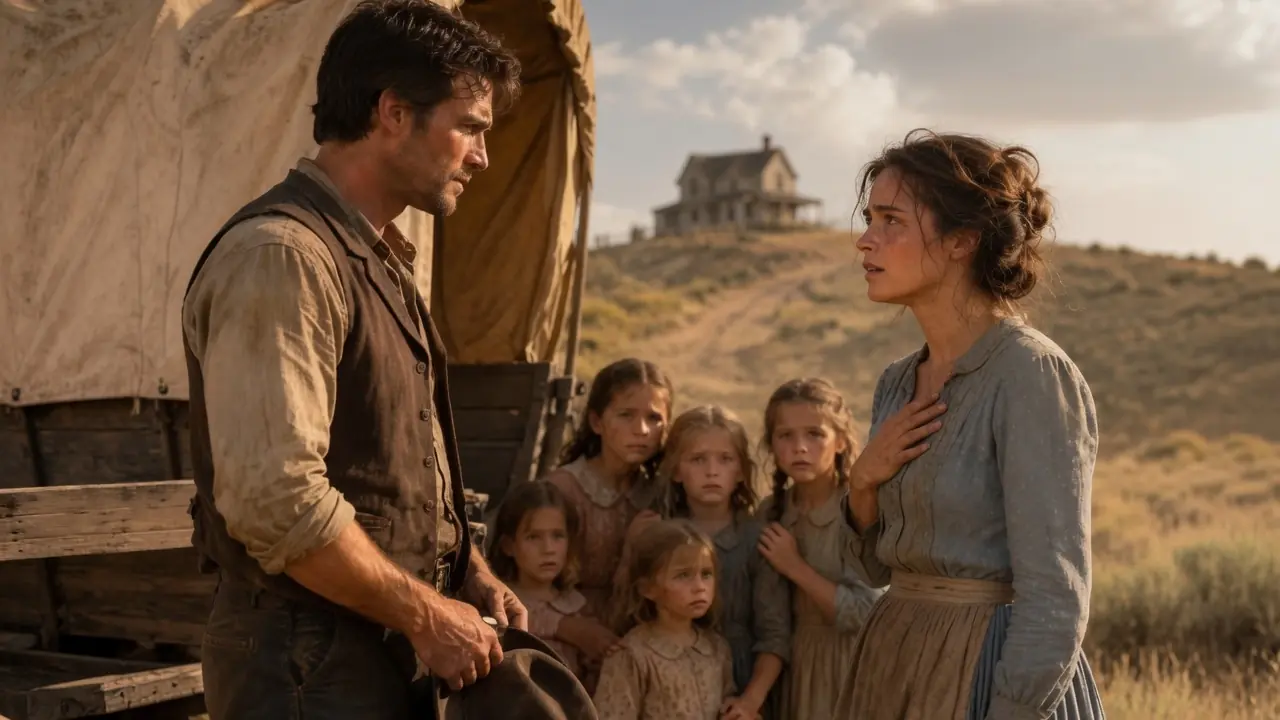
Martha pulled the reins until the exhausted mare stopped. The five girls walking beside the wagon stumbled away from the tilting frame, their faded skirts lifting in the dry spring wind. Eight-year-old Clara caught six-year-old Rose before she fell, while ten-year-old Elsie grabbed the smallest child by the shoulders. Annie, only four, stared at the broken wheel with the solemn expression of a child who already understood that repairs required money.
Martha climbed down and examined the damage despite knowing nothing about wagon axles. The wheel had separated from the hub, and a long crack ran through the wood beneath the wagon bed. Their blankets, cookware, clothing, and remaining flour sagged toward the injured side. Everything they still owned had become another weight pressing against something already broken.
“We can carry the bags,” Elsie offered.
Martha looked at the distant road shimmering beneath the afternoon sun. Oklahoma City remained several miles away, perhaps more, and the children had eaten only half a biscuit each that morning. The letter promising her employment rested inside her dress, softened by sweat and repeated handling. She had built every remaining hope around reaching the address printed beneath the signature.
“We’ll rest first,” Martha said.
Her voice sounded calm enough to fool the younger girls. Elsie did not look convinced. At ten, she had begun watching her mother with the guarded attention of someone preparing to catch whatever the adults dropped.
Martha sat beside the wagon and pressed both hands over her face. She did not intend to cry where the children could see her, but exhaustion had weakened every wall she had spent six months building. Her husband John had died three days after a horse kicked him behind their Missouri barn. Infection took him quickly, leaving Martha with a failing farm, unpaid loans, and five daughters who still woke expecting to hear their father’s boots.
She had sold the animals first, then the plow, the furniture, and finally the land. A woman named Beatrice Crowley had written from Oklahoma City offering cooking and cleaning work in a respectable lodging house. The wages seemed modest but sufficient, and the advertisement promised a small room where Martha’s daughters could stay. With no better choice, she bought a worn wagon, loaded what remained, and headed west.
Now the wagon had collapsed beside an unfamiliar fence line.
“Mama?” Annie whispered.
Martha wiped her cheeks before looking up. “I’m all right.”
Annie stepped closer and placed a dusty hand against her mother’s knee. “You make that face when you say something that isn’t true.”
Martha almost laughed, but the sound broke apart before leaving her throat. She pulled Annie close and kissed her hair. The other girls gathered around them until Martha could feel five small bodies depending on her strength.
That was when Benjamin Quincy heard the crying.
He stood half a field away carrying a freshly cut fence post across his shoulders. The sound floated along the wind, thin beneath the creaking harness and the dry scraping of wood against dirt. Benjamin lowered the post and listened. A man who had lived alone for three years knew every natural sound around his ranch, and this one did not belong to the land.
He crossed the field toward the road.
At thirty-two, Benjamin had already buried the future he once believed awaited him. His wife, Sarah, had died from consumption after two years of illness. They had built the large white farmhouse on the hill because they expected children, guests, and generations of noise. Instead, Sarah died before even one cradle occupied the room she had painted pale yellow.
Benjamin kept the ranch running because work required movement when grief demanded stillness. He rose before dawn, mended fences, branded cattle, repaired the barn, and ate supper alone beneath the ticking kitchen clock. The house remained clean, orderly, and silent. He had stopped entering the yellow room entirely.
When Benjamin reached the road, he saw the broken wagon first. Then he saw Martha sitting in the dirt with five girls gathered around her. Their dresses were clean despite the dust, carefully repaired at elbows and hems. The oldest girl stood slightly forward, as though she intended to protect the others from him.
Benjamin removed his hat. “Madam, do you need assistance?”
Martha immediately stood. She wiped her palms against her skirt and moved between Benjamin and the children. “I’m sorry. I didn’t mean to stop on your land.”
“You didn’t break the wagon intentionally, I assume.”
“No.”
“Then there is nothing to apologize for.”
Her eyes were green, swollen from crying, and guarded by exhaustion. Benjamin had seen frightened horses carry the same expression, ready to run despite lacking the strength. He crouched beside the broken wheel and examined the axle.
“How far are you traveling?” he asked.
“Oklahoma City.”
“This wagon will not reach it.”
Martha’s face tightened. “Can it be repaired here?”
“Not without a new axle and wheel.”
“How much would that cost?”
Benjamin looked at the patched wagon covering, the tired mare, and the empty water barrel. He understood that the honest answer would sound like a death sentence. “More than a quick roadside repair.”
Martha drew the folded work letter from inside her dress. “I have employment waiting. Cooking and cleaning at Crowley House.”
Benjamin looked up sharply. “Beatrice Crowley?”
“Yes. Do you know her?”
“I know the name.”
The answer made Martha uneasy. “Is something wrong?”
Benjamin had heard stories about Crowley House. Travelers called it a respectable lodging establishment, but local women knew Beatrice Crowley charged employees for beds, meals, uniforms, and invented damage until wages disappeared into permanent debt. He did not want to frighten Martha before confirming what her letter promised.
“May I see it?”
Martha hesitated before handing him the paper. Benjamin read the carefully worded offer. It promised room and wages but stated that transportation, meals, clothing, and “family accommodation” would be deducted from future earnings. Near the bottom, Martha’s acceptance signature appeared beneath a paragraph written in much smaller letters.
Benjamin folded the paper slowly. “Did anyone explain these deductions?”
“No. Mrs. Crowley said we would have a room.”
“It says she will charge separately for every child.”
Martha took the letter back and searched the fine print. “I didn’t see that.”
“There are other charges too.”
Her shoulders fell. “How bad?”
“If she calculates them the way I expect, you could work for years and still owe her money.”
Elsie stepped closer. “Mama, does that mean the job is gone?”
Martha looked at her daughter, then toward the broken wagon. Every route she had imagined seemed to close at once. Her hand tightened around the letter until the paper crumpled.
“I’ll find another,” she said.
Benjamin rose. “Not tonight.”
“I’m not asking for charity.”
“I didn’t offer it.”
“Then what are you offering?”
Benjamin looked toward the farmhouse on the hill. Twelve rooms stood inside it, most unused. The kitchen table had six empty chairs because Sarah once insisted they would need room for family. The ranch produced enough food for more than one man, while work accumulated faster than he could finish it.
“I’ve run this place alone for three years,” he said. “I have a strong house, good land, and too much work.”
Martha watched him cautiously.
“You and your daughters can stay tonight,” Benjamin continued. “You cook and help with the house if you wish. I will feed everyone and repair the wagon properly.”
“And after the wagon is repaired?”
“You decide where to go.”
Martha shook her head. “People do not offer rooms and food without expecting something.”
“Some do.”
“I have five daughters.”
“I counted.”
“We are six strangers.”
Benjamin looked at the girls gathered around the broken wagon. “Then I have six reasons to stop eating supper alone.”
Martha stared at him.
Little Annie stepped away from her sisters and approached Benjamin. She looked up at his sun-darkened face, then slipped her tiny hand into his rough palm. Benjamin froze, surprised by the trust.
“Mister,” Annie asked, “can Mama stay too?”
Benjamin knelt so they were closer in height. “Only if all six of you stay. A home should never separate a mother from her girls.”
Martha pressed one hand over her mouth.
“Then we’ll work for every meal,” she said.
Benjamin looked up at her. “No, Mrs. Lancaster. You’ll help build a home, and you’ll eat at the table as family.”
He immediately regretted the final word. It sounded too intimate, too close to a promise neither of them understood. Yet Martha did not reject it. She simply looked toward the farmhouse as though it were a light appearing where no road had existed.
Benjamin tied the mare behind his own wagon and loaded their remaining supplies. The girls climbed aboard carefully, carrying the smallest bundles. Martha tried to lift a heavy trunk despite her exhaustion, but Benjamin took it from her without comment. She released it only after he promised not to throw anything away.
The ranch house appeared larger as they approached. White paint covered the wooden exterior, though spring storms had worn several sections near the roof. A wide porch wrapped around the front, and two upstairs windows looked toward the pasture. The girls became silent as the wagon stopped.
“Is this all yours?” Clara asked.
“Mostly the bank’s,” Benjamin replied.
Rose whispered to Elsie, “The bank must be very rich.”
Benjamin smiled despite himself.
Inside, the house smelled of polished wood, flour, and the faint lavender soap Sarah had once made. Benjamin opened the windows while Martha examined the kitchen. Copper pots hung above the stove, and shelves held preserved beans, peaches, cornmeal, and dried herbs. Five children stared at the food with disciplined hunger.
Benjamin noticed. “There’s bread in the pantry.”
Martha touched Elsie’s shoulder before the girl could move. “We should earn supper first.”
“No,” Benjamin said.
She turned toward him.
“Hungry children do not owe labor before eating.”
Martha’s expression tightened with embarrassment. “I only meant to teach them gratitude.”
“Gratitude is easier on a full stomach.”
He cut bread, cheese, and smoked ham while Martha poured water into cups. The girls sat close together on one side of the table, leaving the chair at the head empty. Benjamin had occupied that place alone for years, but he chose a seat at the side instead.
Annie lifted the bread and looked at Martha. “Can I eat all of it?”
“Yes,” Martha whispered.
“And another piece?”
Benjamin answered first. “The loaf is not counting.”
The child smiled and took a bite.
Supper began quietly. Soon Rose asked why cattle slept standing, Clara asked whether wolves came near the house, and Elsie apologized each time one of her sisters spoke too loudly. Benjamin answered every question, even those with no sensible answer. The house absorbed their voices like dry soil receiving rain.
After the meal, Benjamin showed them the bedrooms. Martha and Annie would share the downstairs guest room, while the four older girls could use two upstairs rooms. He opened the pale yellow room last.
Five small beds did not stand inside. There was only an empty space, a covered cradle, and faded drawings of flowers around the window. Benjamin remained in the doorway while the girls entered.
“Was this for a baby?” Rose asked.
“Yes.”
“Where is the baby?”
“There wasn’t one.”
Martha looked at Benjamin and understood enough not to question him. “Girls, choose the other rooms tonight.”
Annie touched the covered cradle before leaving. “It looks lonely.”
Benjamin closed the door.
That night, Martha slept poorly despite the soft mattress. She woke repeatedly expecting a demand, a locked door, or Benjamin entering without permission. None came. At dawn, she found him outside feeding horses while the kitchen remained entirely hers.
She prepared biscuits, eggs, and fried potatoes. The children woke to the smell and descended the stairs in a noisy line. Benjamin entered last, removed his hat, and stopped when he saw every chair occupied.
“Sit down,” Martha said. “Food is getting cold.”
He obeyed.
During the following week, the ranch changed quickly. Martha cleaned without erasing Sarah’s things, and Benjamin noticed the distinction. She washed curtains, organized shelves, and repaired the torn cover on Sarah’s old sewing basket instead of placing it in storage.
The girls found their own responsibilities. Elsie learned to feed chickens and kept careful count of the eggs. Clara followed Benjamin along the fence line, asking so many questions that he finally gave her a small hammer. Rose swept the porch, while five-year-old May collected wildflowers and left them in cups throughout the house.
Annie followed Benjamin everywhere.
She sat on the barn step while he repaired the broken wagon axle. She asked why horses had large teeth, why nails bent, why clouds moved, and whether he was always quiet. Benjamin told her quiet men saved their words for emergencies.
“What is an emergency?” she asked.
“When someone eats the last biscuit without asking.”
Annie gasped and ran inside to warn her sisters.
Martha watched from the kitchen window as Benjamin pretended to search the barn for the missing biscuit. The sight stirred something dangerous inside her. Hope had become frightening because every good thing could still be taken away.
She kept the Crowley House letter inside her apron pocket. Benjamin had offered them shelter, but the arrangement had no clear ending. Martha feared becoming comfortable enough to forget that she and her daughters survived only by another person’s permission.
On the eighth day, she found Benjamin measuring new spokes for the wagon wheel.
“You’re almost finished,” she said.
“Two more days.”
“Then we’ll leave.”
The saw stopped.
Benjamin kept his eyes on the wood. “Do you have another position?”
“Not yet.”
“Money?”
“No.”
“Then where will you go?”
“Oklahoma City.”
“To search with five children behind you?”
“I cannot remain here indefinitely.”
Benjamin placed the spoke on the workbench. “I thought the work arrangement was helping both of us.”
“It is.”
“Then why leave?”
Martha looked toward the house, where laughter drifted through an open window. “Because they are beginning to love it.”
Benjamin’s expression softened. “That sounds like a reason to stay.”
“It is a reason to leave before staying becomes something you regret.”
“I have not said I regret it.”
“You may.”
“So might you.”
Martha folded her arms. “You do not know what six additional mouths cost.”
“I keep the accounts.”
“You do not know what raising five girls requires.”
“No. But I can learn.”
“You are not their father.”
The words struck harder than Martha intended.
Benjamin stepped away from the workbench. “I know exactly who I am not.”
“I’m sorry.”
“No. You’re afraid.”
“I am responsible.”
“Those are not the same.”
Martha looked down. “John was a good man. After he died, everyone offered advice, but no one offered a place where we could all remain together. I cannot let the girls believe this is their home if one morning you decide it is not.”
Benjamin was silent for a moment.
“Then we make it clear,” he said. “A written employment agreement, fair wages, and rooms guaranteed for one year. Either of us may end it with thirty days’ notice.”
Martha looked up. “You would do that?”
“Yes.”
“Why?”
“Because trust should not depend on one man’s mood.”
They visited an attorney in Oklahoma City the following morning. The contract listed Martha as ranch housekeeper and accounts assistant with monthly wages, private family rooms, meals, and the right to keep her daughters with her. Benjamin refused to include deductions for food or lodging.
Martha signed.
For the first time since John’s death, she possessed an agreement designed to protect rather than trap her. She folded the copy carefully and placed it beside her marriage certificate. The wagon remained repaired in the barn, but she stopped packing.
Summer approached.
Martha discovered Benjamin’s ranch books were badly organized. He recorded cattle sales accurately but forgot repair costs, seed purchases, and payments owed by neighboring farms. She created new ledgers and found more than four hundred dollars in unpaid invoices.
“You were letting people forget debts,” she accused.
“I wasn’t letting them.”
“You never sent reminders.”
“I assumed they remembered.”
“People remember debts best when someone else owes them.”
Benjamin allowed her to manage the accounts. Within two months, the recovered money paid for roof repairs and schoolbooks for the girls. Martha’s wages remained untouched in a bank account under her own name.
The children transformed the yellow room themselves.
They asked Benjamin for permission before removing the sheet from the cradle. Then they cleaned the windows, hung drawings on the walls, and arranged blankets inside a wooden chest. Annie declared the space a reading room for anyone who felt lonely.
Benjamin stood in the doorway one evening while Martha read aloud to the girls. Rose sat inside the empty cradle despite being too large for it, and Annie leaned against Benjamin’s leg. The room no longer felt like a grave.
Then Beatrice Crowley arrived.
A black carriage stopped outside the ranch on a hot August afternoon. Beatrice stepped down wearing a dark green dress, a feathered hat, and an expression sharpened by entitlement. Beside her stood Deputy Warren Cole, a young lawman who seemed uncomfortable before anyone spoke.
Martha recognized Beatrice from a small photograph included with the employment letter. Her stomach tightened.
“You failed to report for work,” Beatrice said.
“My wagon broke.”
“Three months ago.”
“I chose different employment.”
Beatrice removed a folded paper from her handbag. “You accepted my offer and used the transportation advance I provided.”
Martha stared at her. “You provided nothing.”
“The letter states travel costs would be advanced against wages.”
“I paid for the wagon myself.”
“Then you misunderstood the agreement.”
Benjamin came from the barn and stopped beside Martha. “Is there a problem?”
Beatrice examined him. “This woman is under contract with Crowley House.”
Benjamin held out his hand. “Show me.”
She refused.
Deputy Cole cleared his throat. “Mrs. Crowley claims Mrs. Lancaster owes seventy-eight dollars in placement expenses and another hundred for five reserved child accommodations.”
Martha’s face went pale. “We never reached her house.”
“The rooms were held,” Beatrice said. “Food and bedding were purchased.”
Benjamin looked at the deputy. “Does she have receipts?”
“Not with her.”
“Then why are you here?”
Beatrice’s voice became cold. “Because this widow signed a legal labor agreement.”
Martha’s daughters had gathered on the porch. Elsie held Annie behind her, while Clara stood with both hands clenched. Beatrice looked at the children as though they were numbers in an account.
“I can take the older girls into service as well,” she said. “Their wages will reduce the family debt.”
Martha moved in front of them. “You will not take my daughters.”
Beatrice smiled. “Then pay what you owe.”
Benjamin stepped closer, but Martha touched his arm. She knew what Beatrice expected: a wealthy man paying the debt and becoming the next person holding power over her. Martha refused to exchange one form of dependence for another.
“I signed after you hid the charges in smaller writing,” Martha said.
“You signed willingly.”
“I was desperate.”
“Desperation does not cancel a contract.”
Little Annie pushed past Elsie. “Mama works here.”
Beatrice looked down at her. “Your mother promised to work for me first.”
“She didn’t promise us,” Annie replied.
The child’s words silenced the porch.
Martha knelt beside her. “Go inside.”
“No.” Annie held her mother’s hand. “That lady wants to split us.”
Benjamin turned toward Deputy Cole. “The contract promised family accommodation, yet she is threatening to separate the children.”
The deputy looked increasingly troubled. “Mrs. Crowley, is that correct?”
“I am protecting my financial interest.”
Benjamin went inside and returned carrying Martha’s copy of the employment letter. He also brought the contract signed at the attorney’s office. Martha watched him carefully.
“This is not my argument to make,” he said, handing the papers to her. “But you will not face it alone.”
Strength moved through Martha at those words.
She showed the deputy the letter and pointed out every hidden deduction. The promised monthly wage was smaller than the projected charges for six beds and meals. Even if she worked every day, the debt would increase.
Deputy Cole read the final paragraph twice. “This arrangement may violate territorial labor statutes.”
Beatrice’s face hardened. “You are not an attorney.”
“No,” a voice called from the road, “but I am.”
Attorney Samuel Weller approached in a small carriage. Benjamin had sent Clara to the neighboring ranch earlier, asking them to telegraph him after seeing Beatrice’s carriage on the city road. Samuel carried a folder containing affidavits from three former Crowley House employees.
Each woman described the same trap.
Beatrice charged impossible fees, withheld wages, and threatened to separate mothers from children when they tried to leave. One woman had worked eleven months and finished owing more than when she arrived. Another lost custody of her son after Beatrice claimed the child had been abandoned.
Deputy Cole removed his hat. “Mrs. Crowley, you will need to come with me.”
She stared at Martha. “This is your fault.”
“No,” Martha said steadily. “It is the result of what you chose.”
Beatrice stepped toward the wagon, but Benjamin blocked her path without touching her. The girls remained behind Martha, watching their mother stand upright before a woman who had expected fear.
Deputy Cole escorted Beatrice to the carriage.
Before leaving, he apologized to Martha. “I should have examined the documents before coming.”
“Yes,” she replied. “You should have.”
Benjamin looked at her with quiet approval.
That evening, the girls celebrated with blackberry pie. Rose ate two slices, May asked whether villains always wore feathered hats, and Clara declared that Annie had defeated Beatrice with one sentence. Annie accepted the praise seriously.
After the children went upstairs, Martha found Benjamin on the porch.
“You could have paid her,” she said.
“I considered it.”
“Why didn’t you?”
“Because you were right. Paying would have made me the man who decided your freedom for you.”
Martha sat beside him. “You gave me the papers instead.”
“They were yours.”
For a while, they watched stars appear above the pasture.
“I told you that you weren’t their father,” Martha said.
“You were correct.”
“But you have become the man they look for when something breaks.”
Benjamin smiled faintly. “Many things break around here.”
“Not only wagons.”
He turned toward her.
Martha’s hand rested on the porch between them. Benjamin moved his own closer but stopped before touching it. After several seconds, Martha closed the distance herself.
His fingers folded gently around hers.
“I loved John,” she said.
“I know.”
“I still do.”
“I know that too.”
“I don’t want him erased.”
Benjamin looked toward the yellow room’s upstairs window. “Love does not become smaller because the house makes room for more of it.”
Tears filled Martha’s eyes.
“You loved Sarah,” she said.
“I still do.”
“Then perhaps we understand each other.”
They did not marry that season.
Benjamin continued paying Martha’s wages, and the written contract remained in force. She stayed because she chose to, not because affection had erased the need for security. Their trust deepened through ordinary days rather than sudden promises.
Winter brought snow across the Oklahoma Territory. The girls lined their boots near the door, filled the house with lessons and arguments, and decorated the yellow room with paper stars. Benjamin built a longer table because the old one no longer held everyone comfortably.
On Christmas morning, the children gave him a wooden sign carved with uneven letters.
QUINCY-LANCASTER RANCH: SIX REASONS TO SMILE
Benjamin read it twice before turning away to hide his tears. Annie climbed onto his lap and wiped his cheek with her sleeve.
“Quiet men cry quietly,” she explained to her sisters.
The following spring, Benjamin repaired the covered wagon one final time. He painted the wheels, replaced the canvas, and brought it to the front of the house. Martha stood beside him while the girls crowded around.
“Are we leaving?” Rose asked fearfully.
“No,” Benjamin said.
“Then why fix it?”
Martha understood before he explained.
The wagon had carried them through grief, hunger, and uncertainty. Leaving it to rot would mean treating survival like something shameful. Benjamin placed it beneath a wooden shelter near the barn, preserving it as part of the ranch.
Later that afternoon, he found Martha alone beside it.
“I have something to ask,” he said.
She looked at the small ring in his hand but did not speak.
“I am not asking you because you need a house,” Benjamin said. “You already have one for as long as you choose.”
Martha’s eyes filled.
“I am not asking because the girls need food, schooling, or protection. Those things will remain whether you answer yes or no.” He took a breath. “I am asking because the sound of your footsteps has become the sound I wait for.”
Martha looked toward the porch.
Five girls stood pretending not to listen.
“Benjamin,” she said softly, “I cannot promise never to be afraid.”
“I cannot promise never to grieve.”
“I may question kindness even when you have earned my trust.”
“And I may spend twenty minutes searching for spectacles sitting on my head.”
She laughed through her tears.
Annie shouted from the porch, “Say yes before he loses the ring!”
The other girls tried to silence her.
Martha stepped closer and placed her hand in Benjamin’s. “Yes.”
They married beneath the oak tree beside the ranch house. Samuel Weller served as witness, and the five girls wore dresses Martha had sewn from blue and cream fabric. No one spoke of Benjamin replacing John or Martha replacing Sarah.
They spoke instead of joining what remained.
Years later, travelers still saw the old covered wagon sheltered beside the barn. The ranch house became known for its long table, open door, and five young women who grew into teachers, ranchers, shopkeepers, and mothers. Annie eventually inherited Benjamin’s habit of rescuing broken things and became the territory’s first woman known for repairing wagons.
Martha kept the original Crowley House letter locked beside her fair employment contract. She showed both documents to each daughter when they became old enough to understand. One represented desperation disguised as opportunity, while the other represented dignity protected by choice.
Benjamin never forgot the afternoon he heard crying beside the road.
He had believed he was rescuing a stranded widow and five hungry girls. In truth, they had arrived beside the ranch at the moment his own life had broken beneath the weight of silence. Martha brought courage, the girls brought laughter, and together they repaired the home he had stopped believing could live again.
The wagon had failed one mile before Martha’s final hope.
Yet perhaps it had not failed at all.
Perhaps it had simply reached the place where their new life was meant to begin.