Lieutenant Commander Arwin Blackwood stood alone at the end of a formation filled with hardened operators, her posture straighter than the men surrounding her and her expression unreadable beneath the sharp morning light. She was thirty-four, strikingly beautiful, with clear fair skin, piercing green eyes, and dark brown hair secured in a flawless low bun. Her dark-blue uniform carried only the decorations her public record permitted, leaving entire years of her career hidden behind sealed files and restricted access codes.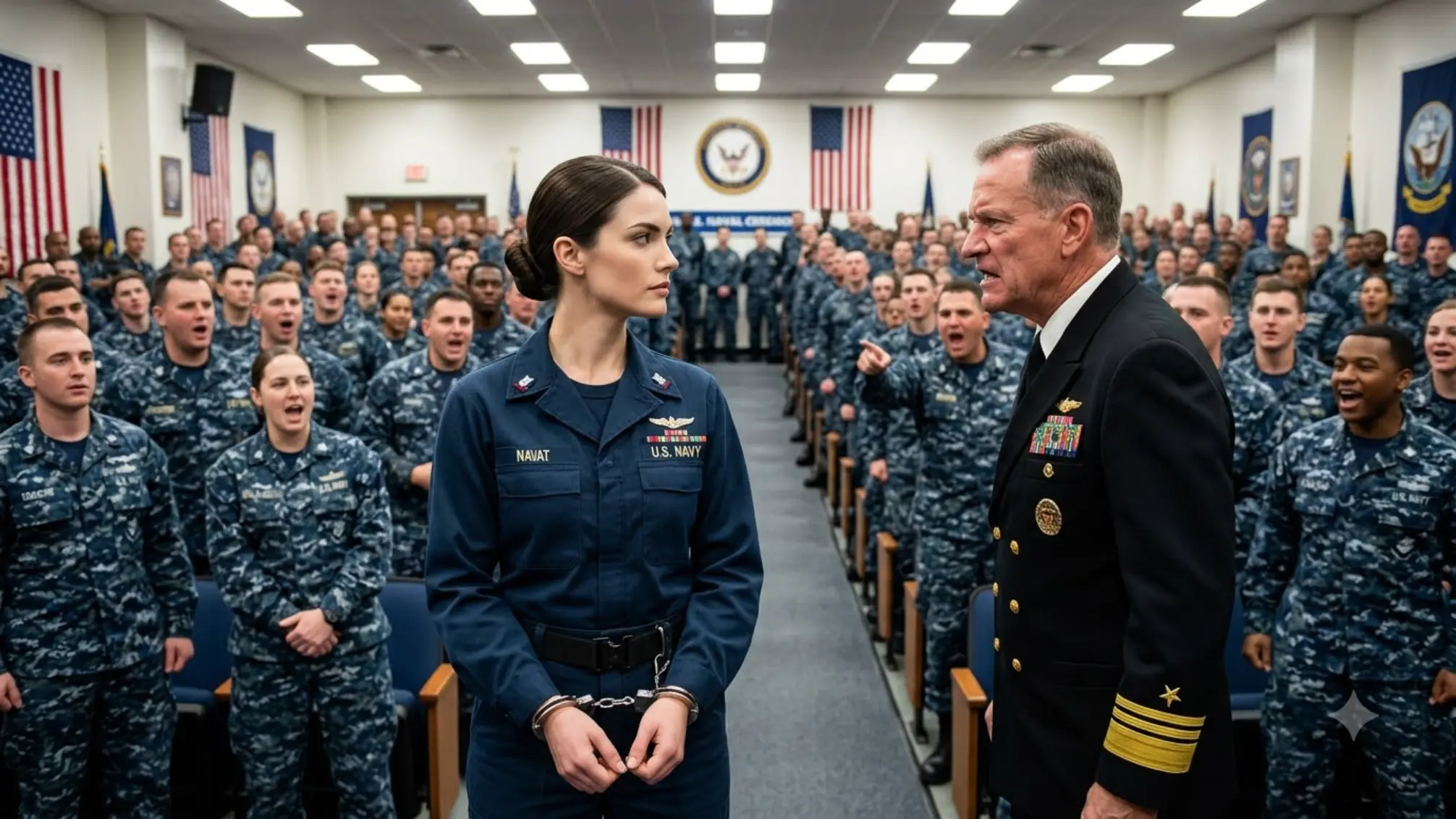
Admiral Victor Hargrove stopped directly in front of her.
At sixty-two, Hargrove possessed the polished confidence of a man whose reputation had protected him for decades. Gold stripes circled his sleeves, decorations filled his chest, and every officer on the training grounds knew that he opposed the program that had brought Arwin there.
He examined her uniform for several long seconds.
Admiral Hargrove (coldly, measuring the edge of her cap): “Your cover is out of alignment.”
Arwin knew it was not.
Lieutenant Commander Blackwood (calmly, holding his stare): “I’ll correct it immediately, sir.”
A few men exchanged knowing smiles. Hargrove had inspected nineteen other operators without finding a single problem. With Arwin, he always discovered something.
Her boots were too polished. Her reports were too brief. Her silence was disrespectful. Her confidence was arrogance.
The accusations changed every day, but the intention remained the same.
Hargrove wanted her gone.
Commander Zephyr Coltrin stepped before the formation after the inspection. He was a disciplined training officer who had spent seventeen years evaluating operators under extreme conditions. Unlike Hargrove, he kept his private doubts separated from his professional responsibilities.
Commander Coltrin (firmly, addressing the formation): “Today’s exercise is a fifteen-mile maritime approach, submerged entry, package retrieval, and offshore extraction.”
Subtle tension passed through the ranks.
The exercise belonged in the final week of training. They were only halfway through the program.
Hargrove moved beside Coltrin and looked directly at Arwin.
Admiral Hargrove (mocking, clasping his hands behind his back): “Command accelerated the schedule. Some candidates may discover they were never prepared to stand here.”
Lieutenant Orion Thade smirked from three positions away. He was broad-shouldered, powerful, and respected by almost everyone in the program. He also believed Arwin’s presence lowered the value of everything he had earned.
As the formation broke, he drove one shoulder against hers.
Arwin barely moved.
Lieutenant Thade (taunting, walking past her): “Hope you’re a strong swimmer. Your equipment got heavier overnight.”
Arwin said nothing.
Inside the equipment room, she lifted her tactical vest and immediately detected the imbalance. Two additional pounds had been inserted into the left side, enough to weaken her during the long swim without attracting attention during inspection.
She removed the weights, redistributed the remaining load, and continued preparing.
Captain Vesper Reeve entered while the others checked their equipment. Her naval intelligence insignia seemed ordinary, but the way she observed Arwin suggested a familiarity neither woman intended to explain.
Captain Reeve (quietly, pausing beside her): “Lieutenant Commander.”
Lieutenant Commander Blackwood (carefully, securing her vest): “Captain.”
Their eyes met for only a moment.
The silent exchange drew Lieutenant Kelwin’s attention from across the room. He was young, observant, and too disciplined to stare openly, but he noticed that Reeve spoke to Arwin with something beyond professional courtesy.
Respect.
Perhaps even caution.
Minutes later, the teams boarded transport aircraft and flew toward the offshore training structure. Beneath them, the Pacific Ocean churned beneath an overcast sky.
Arwin sat across from Commander Coltrin, studying the wind, the water, and the aircraft’s changing angle. Her eyes moved with the precision of someone calculating every variable automatically.
Coltrin watched her.
Her public file described intelligence work, surface operations, and recent selection for the integration program. Nothing explained the instincts he kept seeing.
At the drop point, the operators entered the water in two teams.
Thade’s group moved first. Arwin followed with Kelwin and two other operators thirty seconds later.
Beneath the surface, she took the lead without argument. Her hand signals were compact and unfamiliar, but they conveyed more information than standard signals. Kelwin followed because her movements left no room for hesitation.
They reached the submerged entrance to the abandoned offshore structure and paused beneath a rusted platform.
Standard procedure required reconnaissance before entry.
Arwin gave one sharp signal and disappeared through the opening.
Her team followed.
Visibility dropped almost immediately. Training sensors covered the flooded corridor, designed to detect the approach patterns the operators had spent years learning.
Arwin avoided every one.
She moved through the structure like she had studied its weaknesses long before the exercise began. When a sensor turned toward them, she used the current to redirect a hanging cable across its field. When another system activated, she guided the team beneath a damaged support beam that concealed their movement.
Kelwin felt his uncertainty turning into disbelief.
These were not improvised decisions.
They were practiced techniques.
When Arwin’s team reached the extraction package, Thade already had both hands on the reinforced case. His operators formed around him, prepared to defend their position within the exercise rules.
Lieutenant Thade (triumphantly, gripping the case): “Too slow, Blackwood.”
Arwin studied the corridor above him.
Lieutenant Commander Blackwood (coldly, pointing past his shoulder): “You triggered the secondary system.”
Thade glanced around.
That half-second was enough.
Arwin released a damaged pressure valve, driving a cloud of rust and sediment through the narrow space. Thade’s visibility vanished. His team moved toward the false threat while Arwin redirected the package through a lower service channel.
By the time the water cleared, she was gone.
Her team surfaced at the command vessel nearly four minutes before Thade.
Admiral Hargrove waited on the deck.
He did not congratulate them.
Admiral Hargrove (dismissively, examining the case): “Unconventional tactics suggest poor discipline.”
Lieutenant Commander Blackwood (steadily, removing her equipment): “The objective required successful extraction, sir.”
Admiral Hargrove (sharply, stepping closer): “Real operations require obedience, not clever tricks.”
Something almost resembling amusement passed through Arwin’s eyes.
Lieutenant Commander Blackwood (quietly, holding his gaze): “Understood, sir.”
Captain Reeve watched from the other side of the deck.
That evening, Commander Coltrin announced that the program would end with a formal call-sign ceremony. Senior officials, command representatives, and foreign observers would attend.
Each operator would receive a name reflecting the quality that defined them under pressure.
Lieutenant Thade looked toward Arwin.
Lieutenant Thade (mocking, folding his arms): “Call signs are earned. They aren’t given to fill a policy requirement.”
Arwin continued gathering her notes.
She offered him nothing.
After the briefing, Captain Reeve intercepted her in a secluded corridor.
Captain Reeve (quietly, checking the empty hall): “Hargrove is behaving exactly as predicted.”
Lieutenant Commander Blackwood (controlled, lowering her voice): “Has he compromised the operation?”
Captain Reeve (seriously, studying her face): “Not yet. The final assessment remains at the ceremony.”
Arwin’s expression tightened.
Lieutenant Commander Blackwood (softly, looking toward the secured wing): “The package?”
Captain Reeve (firmly, holding her stare): “Arrives tomorrow. Seven years to the day.”
For the first time, emotion touched Arwin’s face.
Not fear.
Memory.
Seven years earlier, six men had disappeared during a mission in denied territory. Their capture threatened an international crisis, and official rescue plans were abandoned after analysts concluded the political risk was too high.
One operative entered alone.
She crossed hostile terrain, penetrated a secured compound, and brought all six men home. She carried one of them for miles after his leg failed.
The rescued men never saw her face.
They knew only the designation whispered through restricted channels.
Iron Widow.
The following days brought increasingly aggressive exercises. Arwin’s team received poor equipment, altered schedules, and incomplete intelligence. Each obstacle was subtle enough to appear accidental.
She overcame all of them without revealing the full extent of her abilities.
During a tactical planning session, Thade excluded her from the discussion and later accused her of contributing nothing.
Hargrove supported him.
Admiral Hargrove (contemptuously, closing her report): “Operational awareness cannot be manufactured by paperwork.”
Commander Coltrin (carefully, reviewing the results): “Her team recorded the lowest projected losses.”
Admiral Hargrove (coldly, pushing the report aside): “Simulations do not replace real experience.”
Arwin remained silent.
Hargrove believed he was insulting her lack of experience.
He had no idea he was speaking to the person who had once carried him out of captivity.
That night, Thade confronted her in the equipment room.
Lieutenant Thade (aggressively, moving into her space): “You think surviving this program makes you one of us?”
Lieutenant Commander Blackwood (calmly, tightening a strap): “I think the mission matters more than your opinion.”
Lieutenant Thade (furious, stepping closer): “My team against yours tonight. No excuses.”
Arwin finally looked at him.
Lieutenant Commander Blackwood (coldly, meeting his stare): “Approved.”
The night exercise required both teams to infiltrate a simulated communications center hidden beyond miles of dense terrain. Thade selected the direct route, moving quickly beneath tree cover.
Arwin’s team appeared to remain near the insertion point.
Inside the command center, Hargrove watched the tracking display with growing satisfaction.
Admiral Hargrove (smugly, pointing at the screen): “Blackwood hasn’t moved in thirty minutes.”
Commander Coltrin (suspiciously, studying the data): “Or she doesn’t want us to see how she moved.”
At the one-hour mark, Thade’s team approached the target.
An alert suddenly swept across the simulation.
The opposing force detected them and sealed the direct entrances. Thade’s team became trapped between automated defenses and a reinforced patrol unit.
Hargrove leaned toward the display.
Admiral Hargrove (angrily, searching the map): “Where is Blackwood?”
A technician checked the target systems.
His face changed.
Training Technician (stunned, turning from the console): “Inside the objective, sir.”
The communication center’s defenses failed one after another. Cameras displayed brief images of Arwin’s team moving through maintenance corridors that did not appear on standard maps.
They secured the objective without firing a simulated shot.
Thade’s team remained pinned outside.
During the debriefing, Hargrove demanded an explanation.
Lieutenant Commander Blackwood (professionally, pointing toward the map): “We used a seasonal drainage route beneath the sensor grid.”
Commander Coltrin (impressed, leaning toward the display): “That feature isn’t marked.”
Lieutenant Commander Blackwood (calmly, changing the image): “It appears in historical environmental surveys.”
Thade shook his head.
Lieutenant Thade (suspiciously, pointing at her equipment): “Your team crossed the terrain too quickly.”
Lieutenant Commander Blackwood (steadily, displaying the modified configuration): “We redistributed our loads and reduced unnecessary movement.”
Hargrove slammed his palm onto the table.
Admiral Hargrove (furious, rising from his chair): “Enough. You used restricted methods you were never trained to perform.”
Lieutenant Commander Blackwood (coldly, facing him): “My full training record is classified above this room’s access.”
Admiral Hargrove (shouting, jabbing a finger at her): “I hold the highest clearance in this command!”
Arwin let the silence settle.
Lieutenant Commander Blackwood (quietly, locking eyes with him): “Yes, sir. You do.”
The implication struck everyone.
If Hargrove could not access her complete record, Arwin had served somewhere beyond his authority.
Captain Reeve stepped forward before he could question her again.
Captain Reeve (firmly, moving between them): “Her team completed every objective. The debrief is finished.”
Hargrove looked from Reeve to Arwin.
He sensed a hidden structure around him, but pride prevented him from admitting he no longer understood it.
Two days before the ceremony, a close-quarters exercise began inside a multistory training facility. Hargrove observed from the control room beside senior guests.
Without warning, alarms sounded.
Smoke poured into the eastern corridors. Security doors sealed, trapping Thade and three operators inside the building.
The technicians lost control of the system.
Arwin’s team reached an exit, but she turned deeper into the structure.
Admiral Hargrove (furiously, striking the console): “Order her to evacuate!”
Commander Coltrin (tense, watching the monitor): “She’s heading for the control node.”
Arwin moved alone through the smoke. She bypassed a sealed door using a sequence no one in the control room recognized, freeing Thade’s team before continuing toward the central system.
Thade stumbled through the doorway, coughing heavily.
He looked back and saw Arwin disappear into the smoke.
Minutes later, the facility returned to normal operation.
Every trapped operator escaped.
Hargrove summoned Arwin to his office immediately.
Admiral Hargrove (furiously, circling his desk): “How did you know those override codes?”
Lieutenant Commander Blackwood (calmly, standing at attention): “Previous training.”
Admiral Hargrove (shouting, moving into her face): “Your record contains no such training!”
Lieutenant Commander Blackwood (coldly, refusing to retreat): “The record you can access does not.”
He studied her with growing unease.
Admiral Hargrove (suspiciously, lowering his voice): “Who are you?”
Lieutenant Commander Blackwood (quietly, holding his stare): “The officer completing the mission you placed in front of her.”
Captain Reeve entered without waiting for permission.
She removed Arwin under the excuse of an operational debrief and led her into a secured communication room.
Once the doors locked, Reeve’s expression changed.
Captain Reeve (urgently, activating a secure terminal): “The system failure was deliberate.”
Lieutenant Commander Blackwood (focused, stepping toward the screen): “Hargrove?”
Captain Reeve (grimly, displaying the access records): “His authorization codes.”
Arwin studied the timestamps.
Seven years earlier, those codes had accessed the mission file that exposed the six-man team. Hargrove always claimed an unknown person had used his credentials.
Now the codes had been used again.
A message appeared across the secure monitor.
WIDOW PROTOCOL INITIATED. PACKAGE READY.
Arwin stared at the words.
Lieutenant Commander Blackwood (coldly, closing the terminal): “We finish this at the ceremony.”
The hall was filled the following evening.
Flags stood behind the polished stage. Senior officials occupied the front rows, and operators lined the walls in formal uniforms.
Hargrove called each graduate forward and announced a call sign chosen by peers and instructors.
Thade received the name Beacon.
Arwin remained alone in the front row when every other operator had been recognized.
Hargrove stepped toward the podium.
Admiral Hargrove (smugly, addressing the hall): “Standards must never bend for appearance, politics, or pressure.”
His eyes settled on Arwin.
Admiral Hargrove (mocking, lifting the ceremonial glass): “Lieutenant Commander Blackwood, come forward.”
She approached the stage.
The room became silent.
Hargrove held the glass just beyond her reach.
Admiral Hargrove (cruelly, smiling before the crowd): “Before this room recognizes you, perhaps you can name one achievement proving you belong here.”
Lieutenant Commander Blackwood (controlled, standing before him): “My operational record is classified, sir.”
Hargrove laughed.
Admiral Hargrove (mocking, turning toward the audience): “Convenient. Then tell us the call sign you claim to have earned.”
Several men shifted uncomfortably.
They understood the trap. Arwin had been excluded from the discussions and should have had no answer.
She looked directly into Hargrove’s eyes.
Lieutenant Commander Blackwood (deadly calm, extending her cuffed hands): “Iron Widow.”
The ceremonial glass slipped from his fingers.
It struck the floor and shattered.
Hargrove staggered backward as every trace of color drained from his face.
Admiral Hargrove (horrified, gripping the podium): “That designation is classified.”
Lieutenant Commander Blackwood (coldly, stepping closer): “Seven years ago, six operators were abandoned inside a hostile black site.”
Thade slowly rose from his seat.
Arwin continued.
Lieutenant Commander Blackwood (steadily, watching Hargrove): “One asset entered without authorization and brought all six home.”
Thade stared at her.
Lieutenant Thade (shaken, stepping into the aisle): “You carried me through the mountains.”
Arwin turned toward him.
Lieutenant Thade (emotionally, touching his healed leg): “They told us you were a local operative.”
Captain Reeve walked onto the stage. She removed the insignia covering her true rank, revealing the stars of a rear admiral.
Rear Admiral Reeve (firmly, facing the room): “Iron Widow’s identity remained sealed to protect a seven-year investigation.”
Security officers entered through both side doors.
Hargrove’s eyes moved toward them.
Rear Admiral Reeve opened a black evidence case containing access logs, recordings, and copies of the compromised mission file.
Rear Admiral Reeve (coldly, placing the evidence before him): “The operation that captured those six men was exposed through your credentials.”
Admiral Hargrove (desperately, shaking his head): “Someone used my terminal.”
Lieutenant Commander Blackwood (fiercely, holding his stare): “You left it unsecured, concealed the breach, and spent seven years destroying anyone who came close to the truth.”
Hargrove looked toward the audience.
No one defended him.
Thade stepped forward and saluted Arwin.
One operator followed him.
Then another.
Within seconds, the entire hall stood.
Every decorated officer, operator, and commander raised a hand in formal recognition of the woman Hargrove had brought onto the stage to disgrace.
Arwin stood beneath the flags, her wrists still locked before her and her expression finally touched by emotion.
Hargrove had asked for her call sign as a joke.
Instead, two words reopened the mission he had buried, exposed the authority he had abused, and forced every person in that hall to recognize the warrior standing before them.
Rear Admiral Reeve approached Arwin and unlocked the cuffs.
She placed a small black-and-red widow insignia on Arwin’s collar.
Rear Admiral Reeve (proudly, stepping back): “Lieutenant Commander Arwin Blackwood, call sign Iron Widow. Your mission is complete.”
Arwin looked across the saluting formation.
She did not smile for the cameras.
She did not celebrate Hargrove’s removal.
She simply returned the salute.
Because the name had never been about reputation.
It belonged to the promise she had made in darkness seven years earlier.
She had brought six men home.
Now she had brought the truth with them.