The dump truck raised its bed before Elsie Wren reached the fence.
A wet black mixture of crushed sugarcane fiber, mud, ash, and syrup residue slid from the steel box in one steaming mass, striking the ground with enough force to shake the fence posts. Sixteen-year-old Elsie stood ten yards away with both gloved hands wrapped around the handle of a shovel, her red plaid shirt darkened by sweat and her faded overalls streaked with Louisiana mud. Beyond the truck, Ridgeline Sugar Processing’s stacks rose over the cane fields like a reminder that the company had been bigger than her family for longer than she had been alive.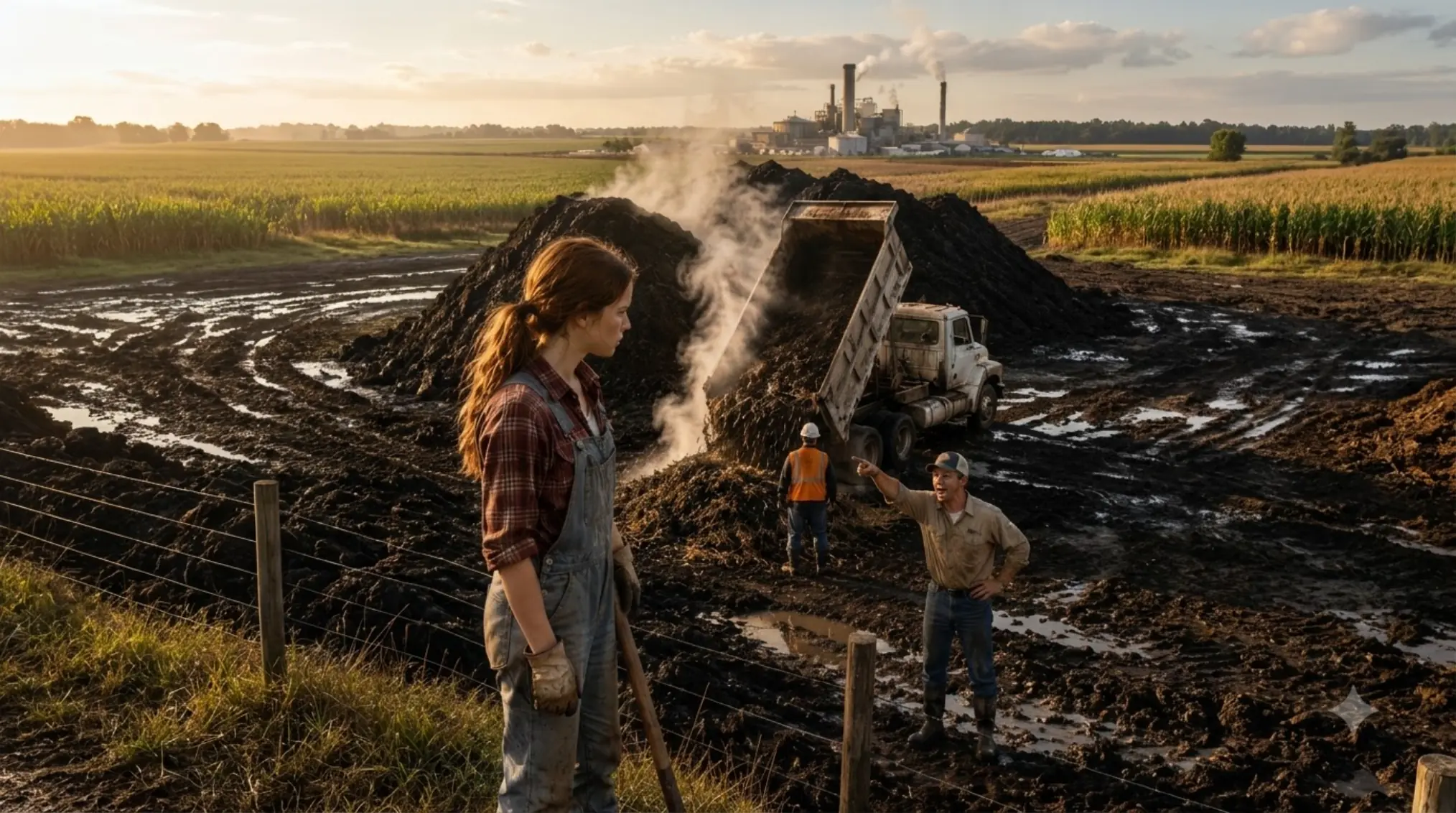
Supervisor Cole Maddox stood below the truck wearing work boots and a dusty tan shirt.
He pointed toward her.
“Your family was paid for this strip years ago, girl, so move that shovel before I bury your fence under the next truck too.”
Elsie stepped closer to the wire.
“You didn’t pay for our soil. You poisoned it, and you’ve been calling it waste because you’re too blind to see what it can become.”
Maddox laughed.
Two mill workers looked at one another.
“Pretty speeches won’t stop this mill, sweetheart. Men with real numbers already decided this land was finished.”
Elsie’s green eyes moved toward the smoking pile.
Then back to him.
“Then dump one more load and come back at harvest.”
Maddox raised an eyebrow.
Elsie tightened her grip on the shovel.
“Because the best ground in this parish is about to grow out of your trash.”
The driver lowered the empty truck bed.
Maddox laughed again, but this time it sounded less certain.
The truck rolled away.
Elsie remained at the fence until the dust settled.
Behind her, thirty-seven acres of the Wren family farm stretched toward a narrow line of cypress trees. The eastern fields were green with sugarcane, but the eight acres nearest the mill boundary looked different. Water collected in low patches, weeds grew unevenly, and a dark crust appeared after every heavy rain.
Six years earlier, the ground had been their best.
Her grandfather used to call it the kitchen field because anything planted there seemed to eat well.
Beans.
Corn.
Cane.
Sweet potatoes.
Then Ridgeline expanded.
The mill bought a narrow easement along the adjoining property from a land company that no longer existed. According to Ridgeline, the agreement permitted temporary storage of nonhazardous agricultural material.
Temporary became permanent.
One truck became twenty.
Twenty became hundreds.
Every crushing season, piles of bagasse and filter residue appeared beside the Wren property.
Some decomposed.
Some washed downhill.
Some sat hot enough to steam for weeks.
The company called it agricultural byproduct.
Elsie’s father called it trouble.
Her father, Thomas Wren, was forty-eight and looked older every year Ridgeline’s trucks arrived. He had spent most of his adult life farming land inherited from his father and believed problems were usually solved by persistence rather than confrontation. For the first three years, he complained politely.
Then formally.
Then through an attorney they could barely afford.
Ridgeline responded with reports.
The material was organic.
The dumping was on licensed ground.
Runoff testing showed no prohibited contamination.
No regulation required removal.
Technically, the company was right often enough to remain there.
Technically did not help Thomas when two acres stopped draining correctly.
It did not help when cane yields fell.
It did not help when one corner developed a sour smell after rain.
And it certainly did not help when the attorney’s final bill arrived.
Thomas stopped fighting.
“Plant around it,” he told Elsie one afternoon when she was fourteen.
She looked toward the black mounds.
“That’s surrender.”
“That’s farming.”
“No.”
Thomas turned.
“You think farming means winning every fight?”
“I think it means not letting somebody else ruin what Granddad built.”
His face changed.
Elsie immediately regretted saying it.
Thomas loved the land more than anyone she knew.
He also understood what unpaid bills looked like.
“Your grandfather didn’t leave us enough money to fight a sugar company for ten years.”
Elsie lowered her head.
“I know.”
“No, you don’t.”
He softened his voice.
“And I hope you don’t have to.”
Elsie did not argue again.
Not with him.
Instead, she started taking samples.
At first she had no plan.
She simply hated not knowing what was happening.
She filled old canning jars with black soil from the damaged edge, healthy soil from the northern field, and pieces of the fibrous material Ridgeline discarded.
She wrote dates on masking tape.
Then she started reading.
The first thing she learned was the word bagasse.
It was the dry, fibrous residue left after sugarcane stalks were crushed for juice.
Ridgeline produced mountains of it every harvest.
Bagasse could be burned for energy.
Made into paper.
Used in building products.
And composted.
That last word changed everything.
Elsie sat at the family kitchen table late one night reading an agricultural extension article on an old laptop.
Composted bagasse could improve soil structure.
Increase organic matter.
Hold moisture.
Feed beneficial microorganisms.
But raw bagasse could create problems if used incorrectly.
Its high carbon content could temporarily tie up nitrogen.
Wet piles could become anaerobic.
Improper mixtures could smell.
Poor drainage could create exactly the conditions damaging the Wren field.
Elsie read until after midnight.
Then she opened a school notebook.
At the top of the first page she wrote:
WHAT IF THE WASTE ISN’T THE PROBLEM?
Below it:
WHAT IF THE WAY THEY DUMP IT IS?
That question became the beginning.
She learned about carbon-to-nitrogen ratios.
Moisture.
Aeration.
Temperature.
Microbial decomposition.
Cane filter cake.
Molasses residue.
Manure.
Green material.
Finished compost.
The science was more complicated than simply letting waste rot.
That excited her.
Elsie liked problems that became more difficult once understood because difficult problems usually meant nobody had completely solved them yet.
Her mother, Rachel, discovered the notebook first.
She entered Elsie’s bedroom carrying folded laundry and saw diagrams spread across the bed.
“What is all this?”
Elsie tried covering them.
“Nothing.”
Rachel looked at a page labeled BAGASSE TRIAL A — 25% MANURE.
“That looks extremely unlike nothing.”
Elsie sighed.
“I’m trying something.”
“With Ridgeline’s waste?”
“Yes.”
Rachel sat on the edge of the bed.
“Does your father know?”
“No.”
“Why?”
“Because he’ll tell me not to.”
“That is usually one reason people tell their parents things.”
Elsie looked toward the window.
“I’m not going near the mill equipment.”
“That wasn’t my question.”
“I want to compost it.”
Rachel blinked.
“The black stuff?”
“Some of it isn’t black until they let it sit wrong.”
Rachel listened.
Elsie explained the difference between dumped waste and managed compost. She talked about oxygen, moisture, nitrogen, microbes, and why the material might actually become useful if mixed correctly. Her words accelerated until Rachel lifted both hands.
“Slow down.”
Elsie stopped.
Rachel smiled.
“You really believe this.”
“Yes.”
“Could it work?”
“I don’t know.”
That answer convinced Rachel more than false confidence would have.
“What do you need?”
Elsie looked up.
“Permission?”
Rachel laughed.
“I meant equipment.”
The first compost pile occupied an abandoned corner behind the machinery shed.
Elsie built it from bagasse that had blown or washed onto Wren property, old cow manure from a neighbor, grass clippings, spoiled hay, and a small amount of filter residue she collected from the boundary.
She measured everything by bucket.
Not because bucket measurements were scientifically perfect.
Because buckets were free.
Every three days, she turned the pile with a pitchfork.
Every morning before school, she checked the temperature with an old meat thermometer tied to a wooden rod.
Rachel bought her a real compost thermometer two weeks later.
“Your father thinks I ordered kitchen supplies.”
Elsie grinned.
“Technically true.”
The pile heated.
One hundred ten degrees.
One hundred twenty.
One hundred thirty-seven.
Elsie wrote every number.
Then the pile cooled too quickly.
She added water.
Nothing.
She added more green material.
Temperature rose again.
Trial A smelled terrible.
Trial B became too wet after rain.
Trial C attracted flies.
Thomas discovered Trial C.
He stood behind the machinery shed staring at the pile.
Elsie froze.
Thomas looked at her.
“What is this?”
“Research.”
“It smells like something died.”
“Trial C has drainage issues.”
Thomas rubbed both hands over his face.
Rachel appeared behind him.
“I knew.”
He turned.
“Of course you knew.”
“She had a plan.”
“It smells like Louisiana lost a war.”
Elsie almost laughed.
Thomas pointed at the pile.
“You’re not hauling anything from Ridgeline.”
“I’m using material that crossed onto our side.”
“That does not make it yours.”
“They gave us enough of it.”
“Elsie.”
She stopped.