The first orange flag went into the ground at 2:17 on a gray afternoon in late spring, three years after Laura Bennett had spent almost every dollar she had on land everybody else had called useless.
She remembered the time because she had looked at her watch before kneeling. She had been working since dawn on the northern ridge, cutting back a knot of invasive vines that had wrapped themselves around young hardwood trunks and buried the old footpath beneath a green wall. Her shoulders ached, her gloves were damp with sweat, and a stripe of mud ran from one knee to the cuff of her work trousers. She had been thinking, not for the first time, that the real estate agent might have been right. The land was worth only a little more than what she had paid for it, even after three years of labor, and she was dangerously close to running out of money.
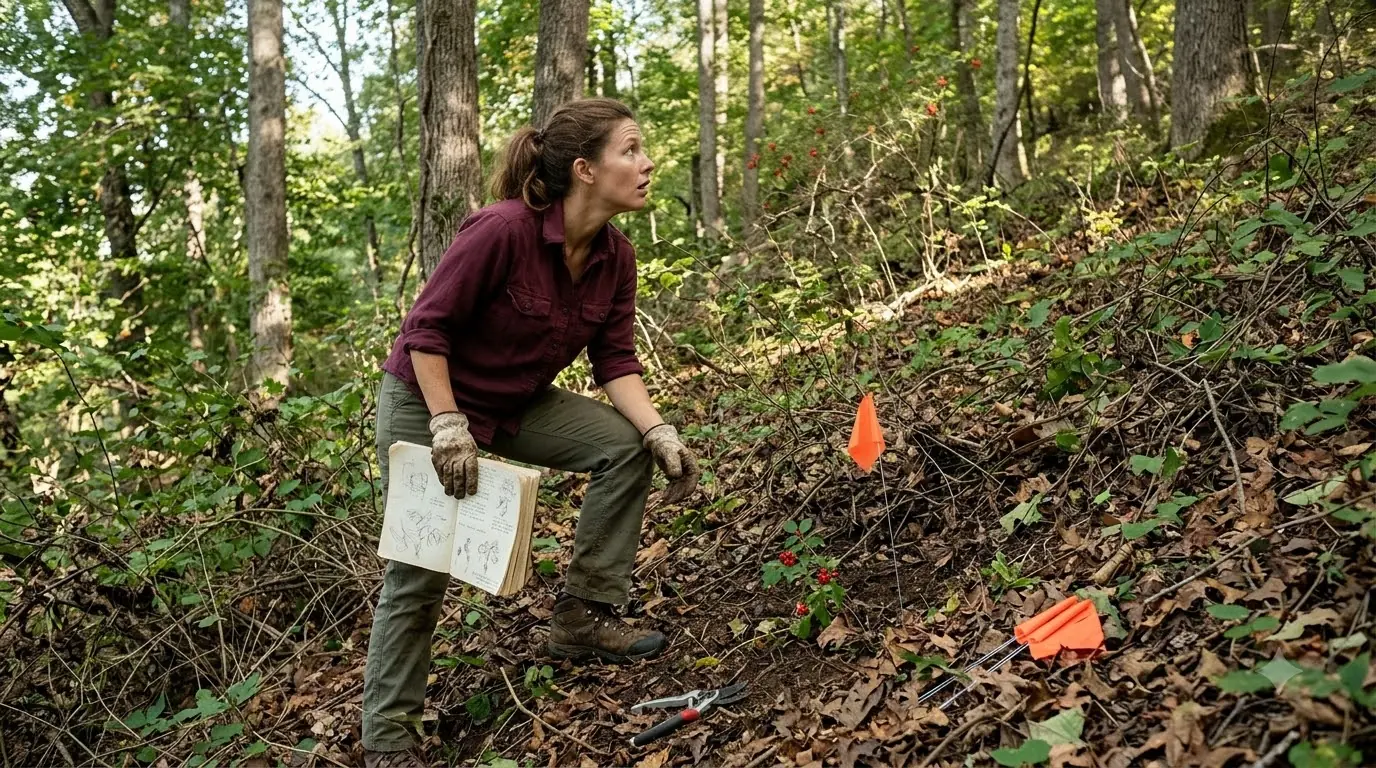
Then she saw the red berries.
At first Laura thought they belonged to another weed. She had learned enough by then to know that a bright color in the woods did not automatically mean value, and she had made enough expensive mistakes to distrust any sudden burst of optimism. Still, there was something about the little plant that stopped her. Five leaflets spread outward beneath a small cluster of berries, the stem thin but upright, the whole thing almost hidden under last year’s leaves.
She did not touch it.
That decision would matter later.
Instead, Laura pushed herself to her feet, retrieved a bundle of orange marking flags from the back pocket of her work pants, and placed one several inches away. Then she crouched again and studied the ground around it. A few feet upslope she found another. Then another farther beneath the shadow of a maple. Within an hour she had marked eight. By the end of the afternoon she had counted twenty-three.
Twenty-three plants in a section of forest she had almost ignored because it was too steep and too shaded for any crop she had once imagined growing there.
Laura stood among the orange flags while evening wind moved through the canopy overhead. The ridge looked exactly as it had that morning: rough, overgrown, dim, inconvenient. Nothing had changed except what she knew.
And because of that, everything had changed.
Three years earlier, when Laura raised her bidding card at a county auction and agreed to pay $125,000 for ninety-four abandoned acres in the Appalachian foothills, someone behind her whispered, “She just bought poison ivy with a mortgage.” Another person laughed softly. By the time she signed the final papers, the joke had already traveled farther than she had.
The property had been empty for more than twenty years. Tangled vines covered sections of fence. Invasive shrubs swallowed the old access road so completely that the first time Laura visited, she had to leave her car near the entrance and walk. Several trees had fallen across the creek. The only building was a small farmhouse with a leaking roof, damp interior walls, and a porch that leaned slightly to the left as though it had spent two decades trying not to fall.