Marcus Bennett stepped out of a taxi in front of Royal Crest Motors just after nine in the morning, carrying no briefcase, no polished leather folder, and no sign that he belonged anywhere near the glass palace in front of him. The dealership stood on the edge of Buckhead in Atlanta, Georgia, a towering luxury showroom with marble floors, floor-to-ceiling windows, and rows of imported cars shining under clean white lights. Marcus wore a faded brown jacket, a simple plaid shirt, worn trousers, and dusty work boots that had seen more gravel roads than marble floors. At seventy-four, he moved slower than he used to, but his back remained straight, and his eyes still noticed everything.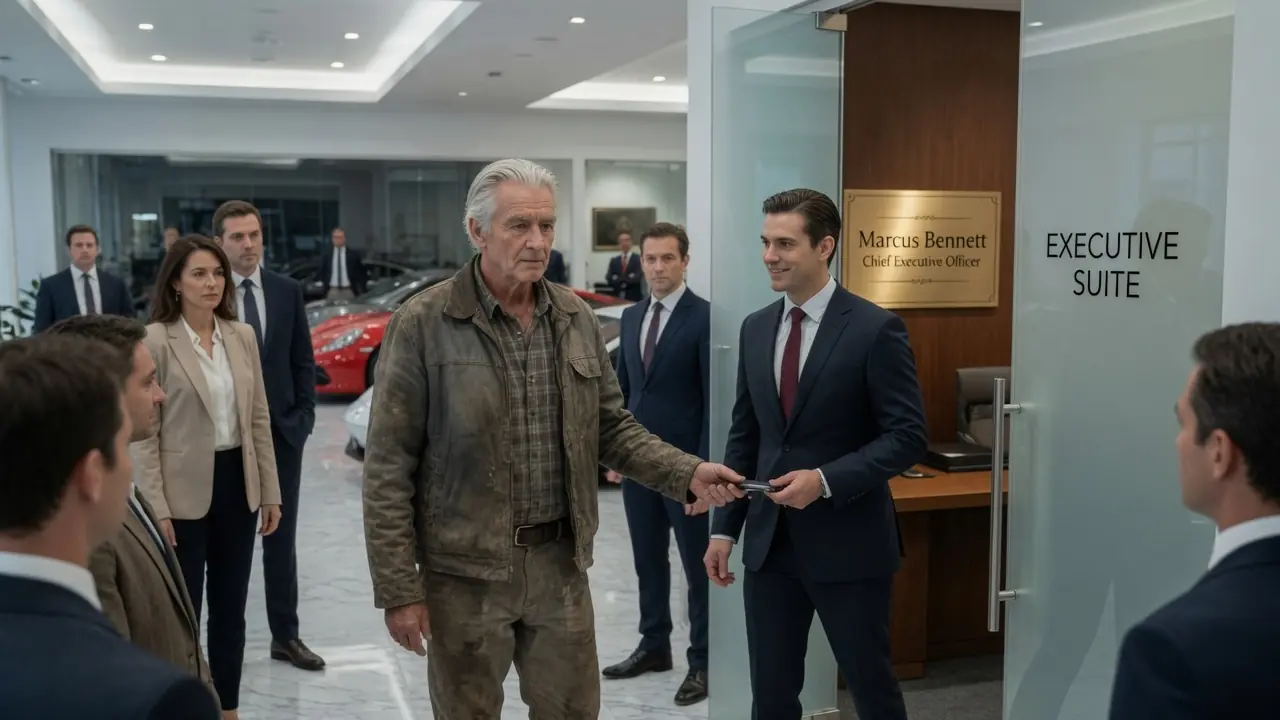
He paused outside the entrance and looked through the glass. Inside, young salesmen in fitted suits moved around like actors on a stage, smiling at customers with expensive watches and ignoring anyone who did not look profitable. Marcus had built Royal Crest Motors from one used-car lot behind a gas station into a five-state luxury dealership group, but almost no one in that building knew his face anymore. He had stepped away from public appearances after his wife died, letting regional executives handle speeches, ribbon cuttings, and staff meetings. Today, he had come quietly because numbers on a report had told him something was wrong.
The dealership was profitable, but complaints had grown. Customers had written about being judged, ignored, mocked, or rushed out because of clothing, age, accent, or appearance. Marcus had read every complaint himself, late at night in the study of the old house where he and Evelyn had once planned the company together. One sentence had stayed with him more than all the others: “They treated me like I was wasting their air.” Marcus had closed the report, put on his oldest jacket the next morning, and decided to walk in without warning anyone.
The automatic doors opened, and cool air rolled over him. A woman near the reception desk glanced at him once, then looked past him as if waiting for someone more important to enter behind him. Two salesmen standing beside a silver coupe stopped talking and smirked at each other. Marcus heard one of them whisper, “Wrong door.” He kept walking.
His boots made soft marks on the polished floor. He could feel eyes following the dust at his heels, not his face. The showroom smelled of leather, coffee, and expensive cologne, the kind of smell people built to hide fear of being ordinary. Marcus passed a black luxury SUV with a price tag higher than the first house he had ever bought. He laid one hand gently on its hood, feeling the cold shine of the metal.
“Sir.”
The voice came from behind him, sharp and impatient.
Marcus turned.
A young sales manager in a navy suit walked toward him with a smile that looked polished but not kind. His name badge read Trevor Lane, Senior Sales Manager. He was maybe thirty-two, handsome in the way mirrors reward, with perfect hair, expensive shoes, and eyes that had already made their judgment. Behind him, two salesmen slowed down to watch.
Trevor stopped a few feet away and looked at Marcus’s hand on the vehicle. “Please don’t touch the cars.”
Marcus removed his hand calmly. “I was just looking.”
Trevor’s smile widened. “That’s clear.”
The two salesmen laughed under their breath.
Marcus looked at them, then back at Trevor. “Is looking not allowed here?”
“Looking is allowed for serious buyers,” Trevor said. “But this is a luxury dealership, not a place for window shopping. If you can’t afford anything here, turn around and leave before you waste everyone’s time.”
The words moved through the showroom like a hard slap. A couple near the reception desk turned to stare. A receptionist lowered her eyes. One older customer, standing beside a red convertible, frowned but said nothing.
Marcus did not move.
Trevor seemed encouraged by the silence around him. “Sir, I’m trying to save you the embarrassment. These vehicles are not cheap. We don’t have anything here for someone just wandering in from the street.”
Marcus studied him. “You decided all of that from my jacket?”
Trevor glanced down at Marcus’s boots. “And the floor.”
Another laugh came from behind him.
Marcus looked at the faint dust marks near his feet. He thought of the first lot he ever owned, where the sales office had leaked during rain and customers stood in gravel while he shook their hands. Back then, he had sold cars to teachers, mechanics, nurses, farmers, widows, and young couples with babies in their arms. Some had come dressed in suits, some in uniforms, some in work clothes. His rule had been simple: greet the person before judging the pocket.
Trevor stepped closer. “Do you need directions somewhere? There’s a bus stop two blocks down.”
The insult was quiet, but not hidden.
Marcus’s face remained calm, though something inside him grew cold. “What is your name?”
Trevor blinked, surprised by the question. “Trevor Lane.”
“Sales manager?”
“Senior sales manager,” Trevor corrected.
Marcus nodded slowly. “And your training tells you to speak this way?”
“My training tells me not to let people waste time on cars they can’t afford.”
Marcus looked past him at the showroom. “Interesting.”
Trevor folded his arms. “Sir, I’m going to ask you one more time. Leave the showroom.”
Marcus did not raise his voice. “No.”
The word was quiet, but it changed the air.
Trevor’s face tightened. “Excuse me?”
“I said no.”
One of the salesmen behind him shifted uncomfortably. The receptionist looked toward the glass offices on the second level. A few customers pretended to check their phones while listening harder than before.
Trevor lowered his voice. “Old man, don’t make me call security.”
Marcus looked at him with a sadness that made Trevor even angrier. “You still have not asked my name.”
“I don’t need your name.”
“No,” Marcus said. “That is the problem.”
Trevor pointed toward the entrance. “Out.”
Marcus turned away from him and began walking deeper into the showroom.
A murmur passed through the room.
Trevor followed immediately. “Hey. Where do you think you’re going?”
Marcus did not answer. He moved past the silver coupe, past the glass wall of the finance office, past a display of keys laid out under spotlights. His steps were slow, steady, and deliberate. At the back of the showroom stood a frosted glass door with black lettering: Executive Suite, Authorized Access Only.
Trevor hurried ahead and blocked the door.
“Absolutely not,” he snapped. “That office is private.”
Marcus stopped in front of him.
Trevor laughed, loud enough for everyone to hear. “The showroom is over there. The CEO’s office is private, not for window shopping.”
Marcus looked at the frosted glass, then at Trevor. “Private? Good. Then this door should know me.”
Trevor’s smile faltered. “What did you say?”
Marcus reached into his jacket pocket and pulled out a black access card with a gold crest on it. It was old, simple, and worn at the edges, not like the shiny badges the new executives carried. Trevor stared at it for one second, then smirked again.
“You found a card somewhere?”
Marcus stepped past him.
Trevor grabbed his arm.
The showroom went still.
Marcus looked down at Trevor’s hand gripping his sleeve. Then he looked up slowly. His voice, when it came, was no longer soft.
“Take your hand off me.”
Trevor released him, but his face stayed hard. “You’re finished. Security.”
Before anyone could move, Marcus pressed the black card against the reader beside the door.
The light flashed green.
The lock clicked.
The sound was small, but it struck the showroom like thunder.
Trevor froze.
Marcus opened the frosted glass door and stepped inside.
Everyone could see through the open doorway. The executive office was large and quiet, with a walnut desk, framed company awards, and a wall of photographs showing the history of Royal Crest Motors. On the wall behind the desk was a polished brass plaque. The letters were clear, sharp, and impossible to misunderstand.
Marcus Bennett, Chief Executive Officer.
A woman at the reception desk covered her mouth.
One of the salesmen whispered, “Oh no.”
Trevor stood outside the door with his face slowly losing color.
Marcus turned back from inside the office and looked at him. “Come in, Mr. Lane.”
Trevor did not move.
Marcus’s voice hardened. “Now.”
The young manager stepped into the office like a man entering court. Behind him, staff and customers gathered at a distance, not daring to come too close, but unable to look away. Marcus walked behind the desk and stood beneath the brass plaque bearing his name. He did not sit. He wanted Trevor to see the full weight of the room he had tried to guard from its owner.
Marcus placed both hands on the desk. “Tell me again what this office is not for.”
Trevor swallowed. “Mr. Bennett, I didn’t realize...”
Marcus cut him off. “That is the point.”
Trevor’s mouth closed.
“You didn’t realize who I was,” Marcus said. “You didn’t realize I owned the building. You didn’t realize my signature is on your pay structure, your commission plan, and the policy manual you clearly never read. So you showed me who you are when you thought I was nobody.”
Trevor looked toward the doorway, humiliated by the watching faces. “Sir, I apologize. It was a misunderstanding.”
“No,” Marcus said. “A misunderstanding is when a man asks for service and you send him to the wrong desk. This was contempt.”
The word landed heavily.
Marcus walked around the desk and stopped only a few feet from Trevor. “You called me a window shopper. You told me I could not afford to stand near the cars. You threatened to call security because my clothes did not match your idea of wealth. Then you put your hand on me.”
Trevor’s voice dropped. “I was trying to protect the showroom.”
“From what?” Marcus asked. “Dust? Age? Work clothes? A man who did not flatter your ego by looking rich enough?”
Trevor looked down.
Marcus turned toward the doorway. “Everyone who laughed, stay where you are.”
Two salesmen near the hall stiffened.
Marcus pointed to them. “Names.”
The first one barely spoke. “Caleb Price.”
The second swallowed. “Darren Hill.”
“You laughed when he insulted me.”
Neither answered.
Marcus nodded. “That is an answer.”
The receptionist, a young woman named Mia, stepped forward with tears in her eyes. “Mr. Bennett, I’m sorry. I should have said something.”
Marcus looked at her for a long moment. “Why didn’t you?”
Mia’s voice shook. “Because Trevor runs the floor. People who challenge him don’t last.”
Trevor snapped, “That’s not true.”
Marcus turned sharply. “Be quiet.”
Trevor fell silent.
Marcus looked back at Mia. “Thank you for telling the truth.”
From upstairs, two executives rushed down after hearing the commotion. One was regional director Alan Pierce, a man who had sent Marcus reports full of polished language and declining complaint numbers. The other was Evelyn Grant, head of human resources. They entered the office breathless, then stopped when they saw Marcus standing under his plaque with Trevor pale in front of him.
“Mr. Bennett,” Alan said. “We didn’t know you were coming today.”
“I know,” Marcus replied. “That is why I came.”
Alan glanced at Trevor. “What happened?”
Marcus looked at the showroom floor through the open door. “Your sales manager treated an elderly man in worn clothes like trash. The elderly man happened to be me.”
Alan’s face went white.
Evelyn Grant’s eyes closed briefly, as if she had feared this day would come.
Trevor spoke quickly. “Mr. Bennett, I made a mistake. I thought he was just...”
Marcus turned toward him. “Finish that sentence.”
Trevor froze.
“You thought I was just what?”
No answer.
Marcus waited.
Trevor’s shoulders lowered. “Just a poor old man.”
The showroom heard it.
Marcus nodded slowly. “There. Finally, something honest.”
Alan stepped forward. “Mr. Bennett, we will handle this immediately.”
“You will not handle it quietly,” Marcus said.
Alan stopped.
Marcus walked out of the office and into the showroom. Every eye followed him. He stood near the black SUV he had touched earlier, the same car that had started the insult. His dusty boots were still on the marble floor. This time no one looked at the dirt.
“I want every employee on this floor to listen,” Marcus said.
The showroom froze.
“This company was not built by judging people at the door. It was built by respecting the man who saved for ten years to buy one car, the woman who walked in after a double shift, the retiree who wanted dignity, the mechanic buying his first truck, the widow replacing her husband’s vehicle, and yes, even the person who only came to look.”
Trevor stood near the office doorway, unable to lift his head.
Marcus continued, “Window shopping is not a crime. It is how dreams begin for people who are still saving. If your pride cannot survive someone admiring a car they may not buy today, then you do not belong in sales.”
A few customers nodded quietly.
Marcus looked at Caleb and Darren. “You laughed because your manager laughed. That is how cruelty becomes culture. One person says the ugly thing, and weaker people make it normal by smiling.”
Both men looked ashamed.
Then Marcus turned to Alan Pierce. “How many complaints were minimized before they reached me?”
Alan hesitated too long.
Marcus’s eyes sharpened. “Answer carefully.”
Alan exhaled. “Several were reclassified as service misunderstandings.”
Evelyn Grant looked at him in shock. “Alan.”
Marcus’s face did not change, but the room felt colder. “So the reports were cleaned.”
Alan’s voice weakened. “I believed the language was too harsh.”
“The behavior was too harsh,” Marcus said. “The language was accurate.”
He turned to Evelyn. “Suspend Mr. Pierce pending review.”
Alan’s mouth opened. “Marcus, please. I’ve been with the company twelve years.”
“And forgot what those twelve years were supposed to teach you.”
Alan had no answer.
Marcus looked at Trevor Lane. “As for you, your employment ends today.”
Trevor stepped forward, panic finally breaking through his pride. “Sir, please. I have a family. I made one bad call.”
Marcus studied him. “No. A bad call is pricing the wrong trim package. You built a habit so ugly that your staff feared correcting you.”
Trevor’s eyes reddened. “Please.”
Marcus’s voice softened slightly, but did not weaken. “I hope this changes you. But you will not learn that lesson while holding power over customers in my building.”
Trevor was escorted to the side office by HR.
No one clapped. No one smiled. It was not a victory that made the room happy. It was the painful relief of a rotten board finally being pulled from the floor.
Marcus turned to the customers. “I apologize to everyone who witnessed this. More than that, I apologize to anyone who has ever walked into one of our dealerships and felt smaller when they left. That failure belongs to leadership, and today leadership will answer for it.”
The older customer beside the red convertible raised his hand slightly. “Mr. Bennett?”
Marcus nodded. “Yes, sir.”
“My wife and I came in last month. We waited twenty minutes. Nobody helped us until I mentioned I was paying cash.”
Marcus’s jaw tightened. “Who helped you after that?”
The man looked toward Darren.
Darren’s face flushed.
Marcus nodded once. “Evelyn, take his information. We are documenting everything today.”
Then the young couple near the front desk spoke up. They had been ignored because they looked too young. A delivery driver said he had been told to use the service entrance. A woman in nurse scrubs said she had been asked if she was picking someone up. Each story was small by itself, but together they became a map of a dealership that had learned to worship appearances instead of people.
Marcus listened to all of them.
He did not defend the company.
He did not explain away the staff.
He listened until the showroom understood that the old man in dusty boots was not only angry. He was grieving what his company had become.
By noon, Royal Crest Motors closed its showroom for the day. A sign was placed on the front door apologizing for the inconvenience and explaining that staff training and leadership review were underway. Some customers left impressed. Others left shaking their heads. By evening, the story had spread across Atlanta.
The next morning, Marcus returned wearing the same boots.
This time, every employee stood when he entered.
He did not smile at that. Fear could imitate respect for a day. He wanted something deeper.
For the next month, he worked from the executive office three days a week. He reviewed complaints personally. He met with employees one by one. Some were embarrassed. Some were defensive. A few resigned when they realized the old culture was gone and would not be protected.
Marcus created a new rule and printed it on a plaque at the showroom entrance. It read: Every guest is to be greeted with dignity before any question of purchase, payment, or appearance.
Under it, he added a second line in smaller letters: Window shoppers are welcome. Dreams are allowed here.
Mia, the receptionist who had told the truth, was promoted to customer experience manager. Caleb and Darren were placed on probation, not because Marcus believed they were innocent, but because they admitted their failure and asked for the chance to change. Their training did not happen in a conference room. Marcus sent them to spend a week with service technicians, finance clerks, cleaning staff, and delivery drivers, so they could understand the company did not run on suits alone.
Six months later, an elderly woman in a faded coat walked into Royal Crest Motors and stopped near a white sedan. Caleb saw her first. For a second, old instinct crossed his face, then he remembered the day Marcus had stood under the CEO plaque. He walked over, smiled gently, and said, “Good morning, ma’am. Take all the time you need. Would you like to sit inside it?”
The woman smiled with surprise.
She did not buy that day.
She came back three weeks later with her son and bought the car.
When Marcus heard about it, he only nodded. That was how trust worked. Sometimes it arrived in worn clothing. Sometimes it came back later with a check. And sometimes it never bought anything at all, but still deserved a chair, a smile, and a clean cup of coffee.
Trevor Lane wrote a letter months after his firing. It was not polished. It did not ask for his job back. He wrote that he had taken work at a smaller dealership outside the city and had started over at the bottom. He said he greeted every customer now because he finally understood that humiliation could cost more than a sale.
Marcus read the letter twice, then placed it in a drawer.
He did not reply.
Some lessons needed time to prove themselves.
One year after that morning, Marcus stood in the showroom again, dressed in a dark suit this time, though the same dusty boots were on his feet. The dealership had changed. Customers lingered comfortably. Staff greeted people faster. Complaints had fallen, not because Alan Pierce was editing them, but because the floor had become warmer, humbler, and more human.
Mia walked up beside him. “You still wear those boots on inspection days.”
Marcus looked down at them. “They tell me who notices the wrong thing first.”
She smiled. “And if someone notices?”
“Then we still have work to do.”
He walked toward the executive office, swiped his old access card, and opened the door. The brass plaque still carried his name, but Marcus no longer looked at it with pride alone. He looked at it as a warning. A name on a door meant nothing if the people outside that door were being treated like they did not matter.
Before stepping inside, he turned back toward the showroom.
A young father in a mechanic’s shirt had just entered with his little daughter. Caleb was already walking toward them with a warm smile, not checking the man’s shoes, not glancing at the door, not measuring worth by clothing. Marcus watched the greeting happen and felt, for the first time in a long while, that the company might still remember its soul.
He stepped into the CEO’s office and left the door open.