The first blow sounded like a building giving way.
Steel screamed beneath the jaws of the hydraulic grapple as it pressed down through the roof of the dark-green fastback. The windshield burst outward in a glittering spray. The roof buckled in the middle. The old Mustang's driver-side door twisted at the hinges, then folded inward as if some invisible hand had clenched the entire car in a fist and refused to let go.
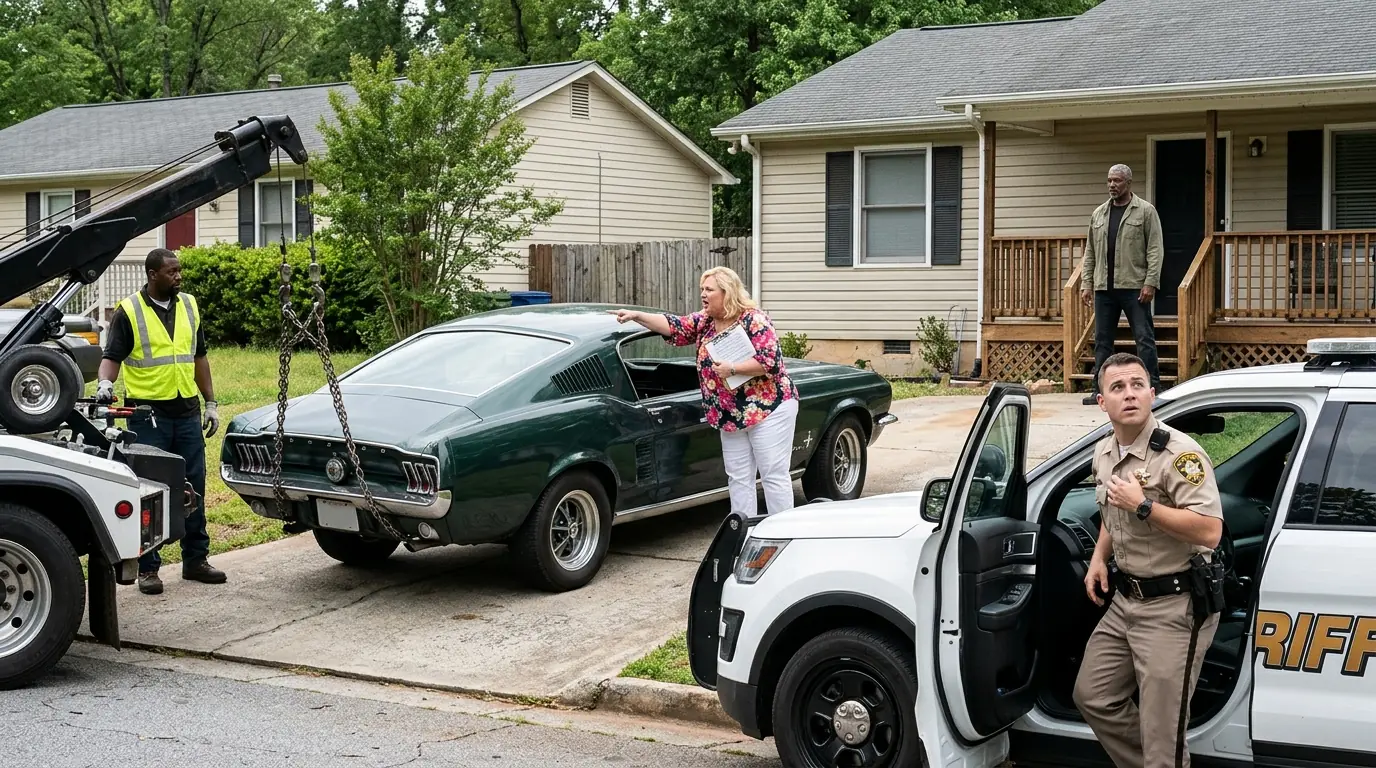
Karen Whitmore did not flinch.
She stood beside the massive salvage crane in a loud floral blouse and white trousers, her gold bracelets flashing in the sun as she slapped her HOA clipboard against the fender and pointed toward the driveway like a general ordering artillery fire.
"Crush it!" she shouted. "I want that eyesore gone!"
The words carried across the bright Pine Hollow Estates afternoon and bounced off neat lawns, manicured shrubs, and the broad front windows of houses that had always been built close enough to hear neighbors' business and far enough away to pretend not to. The ranch house at the center of the scene sat back from the street behind a trimmed line of boxwoods and a wooden porch polished by years of care. It was the sort of house people called tasteful because every repair had been done with restraint.
Marcus Bennett stood on that porch with both fists clenched at his sides.
He was fifty-eight, tall and powerfully built, with short gray hair, a trimmed gray beard, and the kind of steady dark eyes that made louder people uneasy because they could not read panic in them. He wore a faded olive work jacket, dark jeans, and brown boots. Even from the yard it was obvious he was holding himself very still by force.
The Mustang had not been an eyesore.
Anyone with eyes could see that.
Even now, beneath the first damage, the car remained recognizably beautiful: a restored 1967 Ford Mustang fastback in deep dark green, waxed enough to hold light in its curves, with chrome trim that still flashed beneath the dust of the driveway. Hours earlier it had sat beside the porch like a statement of patience and pride. Now its roof lay caved in, its windshield split open, and a jagged seam of twisted metal ran down the driver's side where the grapple had begun folding decades of steelwork into ruin.
Marcus took one step off the porch, then another, and stopped at the edge of the top stair.
"Stop," he called.
He did not yell the word.
That made it cut harder.
The crane operator, perched high in the raised cab behind sheets of dusty glass, looked down with open uncertainty. He was a large man in a faded cap, both hands on the controls, his eyes moving from Karen to the car to Marcus and back again in short nervous sweeps. He had the posture of a man who knew too late that the paperwork he trusted had not prepared him properly for the moment he was in.
Karen turned toward the cab and sliced one hand through the air.
"Do it again!" she screamed.
The hydraulic arm descended.
The steel jaws closed around the already damaged roofline, bit deeper, and then lifted.