The tractor appeared in Ruth Callahan’s yard on a Thursday afternoon without permission.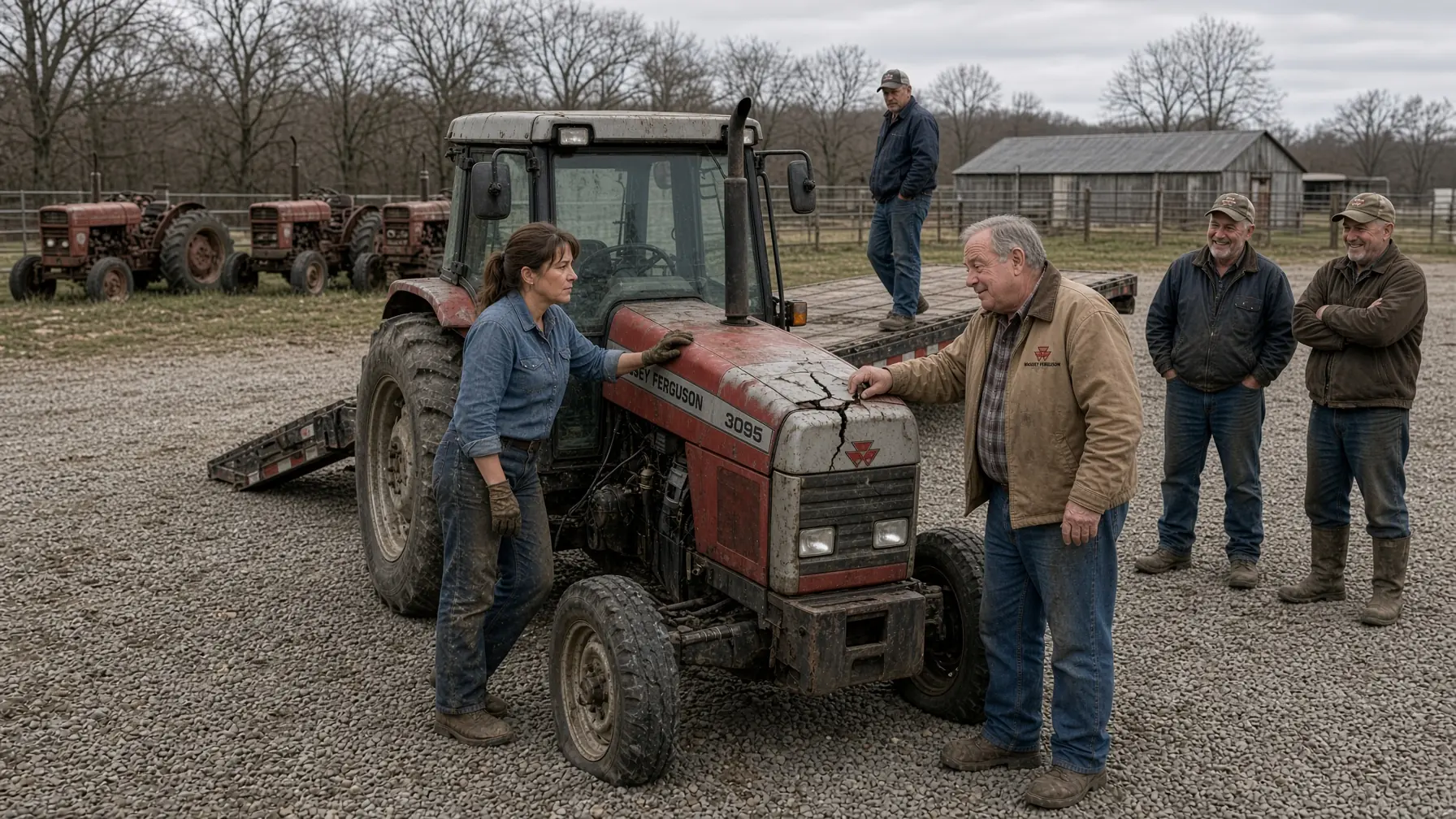
She heard the diesel flatbed before she saw it.
By the time Ruth stepped out of the old farmhouse and crossed the gravel drive, the driver had already backed the trailer toward her barn.
“What are you doing?”
The driver looked over his shoulder.
“Delivery.”
“I didn’t order anything.”
He lowered the ramps anyway.
A red Massey Ferguson 3095 rolled slowly backward off the trailer under the pull of the winch.
The machine looked terrible.
Dust coated the cab windows.
One rear tire was completely flat.
A crack stretched across the top of the hood where someone had smeared silicone over it in a failed attempt to stop it from spreading.
The body panels were faded.
Grease had turned black around several fittings.
And the tractor had the tired posture of a machine that had spent more than a decade being asked for one more season.
Ruth folded her arms.
“Who sent this?”
The driver pointed at the seat.
“Paper’s there.”
Then he climbed back into the truck.
“Wait.”
He didn’t.
The flatbed rolled out of the yard before Ruth had even reached the tractor.
She climbed onto the step and picked up the single sheet lying on the seat.
Transfer of title.
Already signed.
Her name was written across the new-owner line.
At the bottom was a handwritten note.
Ruth,
This one’s yours.
Too far gone to sell.
Good luck with it.
Dale.
Ruth read the note twice.
Then she looked through the dirty windshield at the tractor.
“Too far gone.”
She said it quietly.
Not because she agreed.
Because she disliked the phrase.
Ruth Callahan was forty-four years old in 2003.
She had heard people use versions of those words before.
Too old.
Too broken.
Too expensive.
Not worth repairing.
Not worth the time.
They had said similar things about old combines, balers, hydraulic pumps, engines, and tractors that later left her barn running.
And years earlier, after her husband Frank died suddenly at fifty-one, a few people had almost said it about Ruth too.
Not directly.
People were kinder than that.
They asked what she was going to do now.
They asked whether she would sell the property.
They asked whether she could maintain forty acres alone.
They asked whether she planned to go back to teaching.
Nobody asked whether she intended to turn Frank’s old dairy barn into an agricultural repair shop.
Because Ruth herself had never planned to.
Frank had collected tools for thirty years.
Wrenches.
Pullers.
Presses.
Test gauges.
Old service manuals.
Half-used boxes of fittings.
Parts whose purpose Ruth only partly understood when he was alive.
After his death, all of it remained.
So did the mortgage.
So did the land.
So did Ruth.
The first repair job came from a farmer Frank had known.
Then another.
The dealerships were expensive and booked for weeks.
Ruth knew machinery from fourteen years teaching agricultural education.
But teaching how an injection system worked and rebuilding one with your own hands were two different things.
So she learned.
She read manuals at night.
Called one of Frank’s mechanic friends when she got stuck.
Took things apart carefully.
Labeled everything.
Measured twice.
Wrote down what she discovered.
The first machines she repaired came back running.
Then the farmers came back too.
By 1996, people across several counties knew there was a woman outside Attica, Indiana, who would work on the old equipment bigger shops no longer wanted.
Ruth never advertised herself as anything special.
She had one rule.
Tell people exactly what was wrong.
Fix exactly what you said was wrong.
Charge exactly what the work was worth.
That was enough.
And over time, something unexpected happened.
Ruth became exceptionally good at old Massey Ferguson equipment.
Not because she loved the brand.
Because the small farms around her owned a lot of it.
And those were exactly the farmers who could not afford dealership prices every time something leaked, rattled, smoked, or lost pressure.
So old Massey tractors kept arriving at Ruth’s barn.
She listened to them.
That was how Frank had once described real mechanical work.
“The manual tells you how the machine was built,” he had said.
“The metal tells you what happened after.”
Ruth had eventually understood what he meant.
She could hear a bad bearing before some owners noticed vibration.