The first truck arrived at 6:12 on a Monday morning, just as sixteen-year-old James Thorn was fastening a broken section of fence behind his family’s sugarcane field. Its engine growled across the narrow dirt road, scattering dust over the pale, cracked ground. Without warning, the driver raised the steel bed and released a steaming avalanche of shredded cane fiber, mud, and sour-smelling factory residue onto the land beside the fence. James watched the pile rise until it was nearly as tall as the truck’s tires.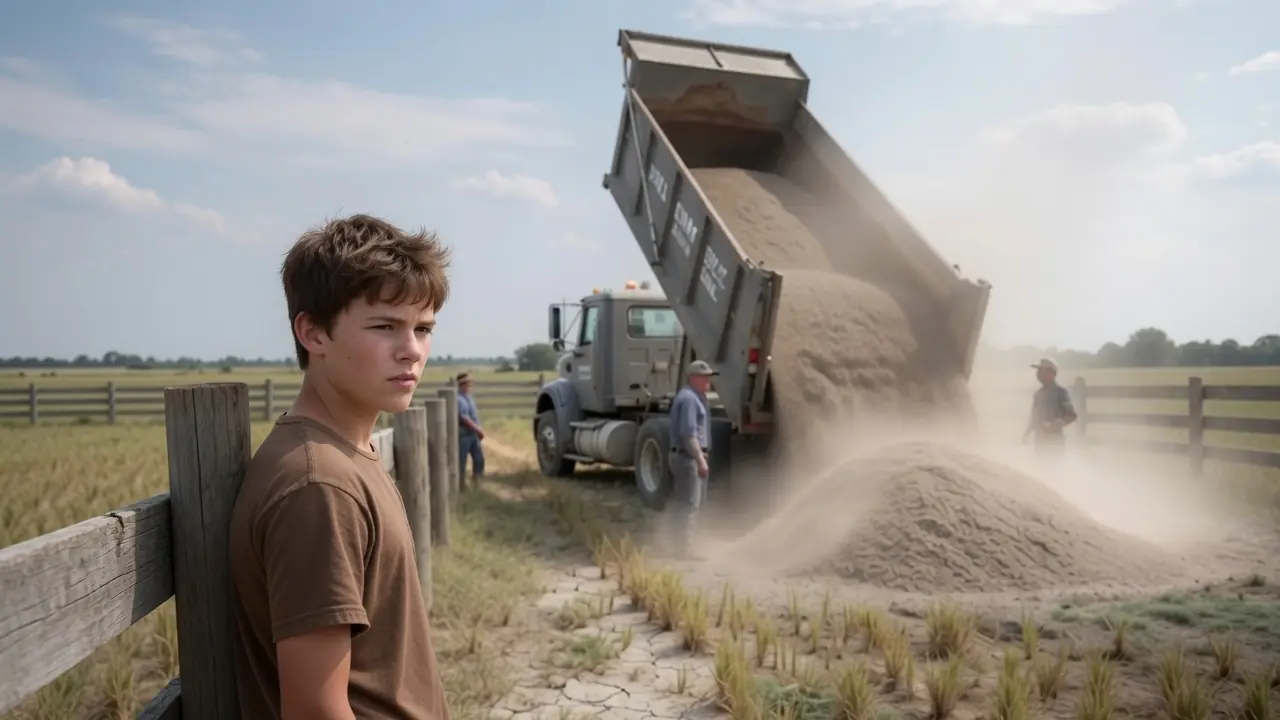
A heavyset foreman named Wade Mercer stepped down from the passenger side. He wore a gray factory shirt stretched across his stomach, dark work jeans, and a grin that made James’s hands tighten around the hammer. Wade glanced at the Thorn farmhouse in the distance, then toward the exhausted field where only thin rows of cane had survived the summer heat.
“Your family can’t stop us, kid,” Wade said. “This rotten waste belongs on your dying farm now.”
James stared at the company name painted on the truck.
RIDGELINE SUGAR PROCESSING
“You don’t own this land,” James replied.
Wade laughed. “Tell that to a lawyer.”
The truck lowered its empty bed and drove away. Wade followed in a white company pickup, leaving James alone beside a mountain of steaming waste. The smell spread through the morning air, thick and fermented, carrying sweetness mixed with rot.
It was not the first pile.
For nearly three years, Ridgeline had dumped sugarcane bagasse and processing residue behind the Thorn farm. At first, the company claimed the dumping was temporary while equipment at its disposal site underwent repairs. Then one week became a month, and a month became years.
James’s father, Samuel Thorn, complained repeatedly. Ridgeline sent polite letters, delayed meetings, and promised inspections that never occurred. When Samuel threatened legal action, the factory’s attorney produced a faded agreement allegedly signed by James’s grandfather decades earlier, granting Ridgeline temporary access to the property.
The agreement had no clear expiration date.
Samuel could not afford the lawsuit required to challenge it.
The Thorn farm had belonged to the family for four generations. It once covered nearly two hundred acres of fertile Louisiana soil, but debt and bad seasons reduced it to sixty-three. Samuel sold machinery, livestock, and eventually half the western field to keep the bank from taking the farmhouse.
James’s mother, Claire, worked morning shifts at a nursing home in town. Samuel repaired tractors for neighbors between planting seasons. James attended school, worked the fields, and spent evenings pretending not to notice the collection notices hidden beneath the kitchen telephone.
The dumping made everything worse.
Rain carried brown liquid from the waste piles into drainage ditches. Flies gathered near the fence. Neighbors complained about the smell and began avoiding the road. The bank’s inspector photographed the piles during a property assessment and reduced the farm’s value.
Ridgeline had not merely thrown away its waste.
It had made the Thorn family’s land look worthless.
That evening, Samuel stood beside the latest pile with his hands on his hips. At forty-five, he looked older than his age. Sun and worry had carved lines around his eyes, and the knee he injured years earlier made him lean slightly whenever he became tired.
“We’ll move it away from the drainage ditch,” he said.
“With what?”
“The old loader.”
“The hydraulic line is leaking again.”
“Then I’ll repair it.”
James looked toward the factory lights visible beyond the distant trees. “They’ll bring another truck tomorrow.”
Samuel said nothing.
“They know we can’t fight them.”
“I know.”
“Then why keep moving it?”
“Because your mother has to breathe this air. Because the drainage ditch runs near our well. Because doing nothing makes it easier for them.”
James kicked a clump of dry soil.
The ground broke apart like dust.
Their cane stalks stood short and yellow because years of growing the same crop had exhausted the soil. Fertilizer prices had doubled, and the farm could no longer afford the quantities needed to restore nutrients. Even if Ridgeline stopped dumping tomorrow, the land might not produce enough to save them.
Samuel touched his son’s shoulder.
“I’m sorry this is what you inherited.”
James turned toward him. “I haven’t inherited it yet.”
His father managed a weak smile. “That’s the spirit.”
But both knew the bank’s final deadline was approaching.
They needed to make a payment by the end of the next harvest. If yields did not improve dramatically, the farm would be sold.
James spent that night researching sugarcane waste on an old laptop in his bedroom. He expected to find photographs of polluted land and legal complaints. Instead, he discovered studies about bagasse—the dry fiber left after factories extracted juice from cane.
Some factories burned it for energy.
Others converted it into paper, fuel pellets, animal bedding, compost, or biochar.
The word biochar appeared repeatedly.
Biochar was a carbon-rich material created by heating agricultural waste in a low-oxygen environment. When added to soil, it could improve water retention, support beneficial microbes, and hold nutrients that would otherwise wash away.
James read until nearly two in the morning.
The factory waste behind their farm contained more than bagasse. It included mud, leaves, ash, and spoiled cane. Some of it might contain contaminants, but much of it was organic material that could be composted or converted into soil amendments.
What Wade called trash might not be worthless.
It might simply be unfinished.
The following afternoon, James filled three buckets.
The first contained ordinary soil from the weakest section of their field. The second mixed soil with partially decomposed bagasse. The third contained soil, dried cane fiber, ash from the outdoor furnace, and chicken manure from a neighbor’s coop.
He planted bean seeds in all three.
Samuel found the buckets lined along the porch.
“What are you doing?”
“Testing something.”
“Does your mother know you put chicken manure near her rocking chair?”
“I’m moving it before she gets home.”
Samuel examined the mixtures. “That factory waste could contain chemicals.”
“I’m not planting food in the field yet. I’m testing germination.”
“Where did you learn this?”
“Online.”
His father gave him the look adults often used when the internet had apparently transformed a teenager into an expert.
“Be careful.”
“I will.”
For the next two weeks, James measured moisture, recorded temperatures, and watched the seedlings. The beans in ordinary farm soil emerged first but remained thin. The beans planted directly in wet bagasse developed mold and died.
The third bucket surprised him.
Its soil stayed moist longer, and the plants grew darker, broader leaves.
James repeated the experiment.
This time, he separated the materials more carefully. He composted wet bagasse with manure and dry leaves, turning the pile every few days. He burned another portion slowly inside an old metal barrel with limited airflow, producing brittle black chunks that crumbled between his fingers.
The process smoked badly and nearly set fire to a patch of grass.
Claire ran outside carrying a bucket of water.
“James Thorn, are you trying to burn down what little property we have left?”
“No.”
“Then why is the backyard full of smoke?”
“I’m making biochar.”
She looked at the black barrel.
“You’re making what?”
Samuel arrived from the workshop, saw the smoke, and sighed. “I told him to be careful.”
Claire folded her arms. “You knew?”
“I knew there were buckets.”
James explained the idea.
His parents listened skeptically as he described how biochar could improve exhausted soil. He showed them photographs from agricultural studies and the results of his bean experiment.
Claire picked up one of the healthy plants.
“This grew in factory waste?”
“Not raw waste. Compost mixed with biochar.”
Samuel crushed a black piece between his fingers. “How much would we need for an entire field?”
“More than I can make in one barrel.”
“Then what good is it?”
“A test plot.”
Samuel looked toward the factory piles.
“You think those men accidentally delivered fertilizer?”
“No. I think they dumped a raw material because they were too lazy to use it.”
His father remained doubtful, but he allowed James to create a small trial area behind the equipment shed. James divided the ground into four equal plots and planted the same variety of sugarcane in each.
One received no treatment.
One received commercial fertilizer.
One received composted bagasse.
The final plot received bagasse compost mixed with crushed biochar.
James measured every stalk.
He recorded rainfall, soil moisture, and growth.
At school, his agriculture teacher, Mrs. Landry, noticed him reading a soil chemistry article during lunch. She was a practical woman in her fifties who had grown up on a rice farm and disliked students who copied conclusions without understanding the work.
“What are you researching?” she asked.
James described the waste piles and his experiment.
Mrs. Landry became serious.
“Have you tested the material for heavy metals or industrial chemicals?”
“No.”
“Then do not spread large amounts until you do.”
“I can’t afford laboratory testing.”
“The state university runs a youth agriculture program. They may test samples if the project has educational value.”
James contacted the program that evening.
Two weeks later, a graduate student named Priya Shah visited the farm. She collected samples from fresh factory waste, older piles, compost, biochar, and untreated soil.
Wade Mercer noticed them.
He stopped his pickup near the fence and leaned out the window.
“What are you doing with company property?”
James walked toward him. “You said it belonged to us after you dumped it.”
Wade’s smile vanished.
“That material came from Ridgeline.”
“And landed on Thorn land.”
Priya raised her phone and photographed the company truck behind him.
Wade looked toward her university badge.
“You people need written permission to test industrial materials.”
Priya answered calmly. “We have the landowner’s permission to test material placed on his property.”
Wade pointed at James. “You’re creating trouble your family can’t afford.”
James met his eyes. “Keep dumping. I finally discovered what your factory threw away.”
Wade laughed. “That stinking pile will bury this farm before you grow anything.”
James held up a jar containing his first finished soil amendment.
“Come back after harvest.”
The laboratory results arrived in early summer.
Most contaminant levels were low enough for agricultural use after proper composting. The raw filter mud was acidic and high in moisture, while the bagasse lacked nitrogen and decomposed slowly. However, when blended correctly with manure, crop residue, and biochar, it became a useful amendment.
Priya included recommendations.
James followed them carefully.
His small trial plots began changing.
The untreated cane remained weak.
The fertilizer plot grew quickly but dried during a two-week rainless period.
The compost plot performed better.
The compost-and-biochar plot remained green when the others curled. Its soil stayed moist beneath the surface, and earthworms appeared where none had been seen in years.
Samuel began taking the experiment seriously.
He helped James construct a safer biochar kiln from two steel drums and an old propane tank that had been properly cleaned and cut. They worked late into the evening, welding vents and building a chimney that reduced smoke.
Claire kept records of every expense.
“This project has cost us six hundred and twelve dollars,” she announced one night.
James looked up from the kitchen table. “That includes the soil tests.”
“It includes everything.”
“How much did fertilizer cost last year?”
“Almost nine thousand.”
Samuel leaned back in his chair. “If the boy’s mixture works on five acres, we save more than he spent.”
Claire looked between them.
“You’re both planning something.”
James smiled.
They expanded the trial.
With permission from two neighbors, they collected manure, grass clippings, and discarded vegetable waste. James mixed these materials with bagasse in long compost rows behind the shed.
The smell initially worsened.
Then the piles heated properly, and the sour odor began fading.
He turned them with the old loader after Samuel finally repaired the hydraulic line. Steam rose in white clouds each time the bucket cut through the material.
People driving past slowed to watch.
Some laughed.
Others asked questions.
One neighbor, Mr. Broussard, called the project “the world’s largest pile of cow breakfast.”
James ignored him.
At school, Mrs. Landry entered his work in the Louisiana Youth Agriculture Innovation Challenge. James prepared charts comparing soil moisture, plant growth, nutrient retention, and costs.
He hated public speaking.
Still, he stood before a panel of university professors and explained how illegal dumping had damaged his family’s land, then described converting the same material into compost and biochar.
One judge asked whether the process could make Ridgeline’s waste problem worse by encouraging more dumping.
James answered, “The factory should still be held responsible. Reusing the waste doesn’t erase what they did. It proves they had valuable options and chose the cheapest, cruelest one.”
He won first place.
The prize was five thousand dollars and access to a university pilot-scale biochar unit for three months.
Local reporters visited the farm.
For the first time, photographs of the waste piles appeared beside James’s name rather than as evidence of the Thorn family’s declining property. Headlines described a teenager turning sugarcane residue into “black gold.”
Ridgeline’s executives did not appreciate the attention.
A company attorney arrived in a polished sedan and handed Samuel a cease-and-desist letter. It accused the family of misappropriating proprietary industrial byproducts and damaging Ridgeline’s reputation.
Samuel read the letter twice.
“You dumped the material on my land,” he said.
The attorney adjusted his glasses. “The company never surrendered ownership.”
“You left it exposed for years.”
“It remains traceable to Ridgeline operations.”
James stepped forward. “So you admit it came from the factory?”
The attorney glanced toward the reporter recording the exchange.
“I did not say that.”
“You just called it proprietary.”
The video spread online that evening.
Ridgeline issued a public statement claiming it had always followed environmental regulations. The company blamed “historical misunderstandings” and offered to remove the waste.
James refused to let them act before investigators documented the site.
Mrs. Landry contacted the state environmental agency. Priya’s university supervisor provided laboratory results. Samuel located years of letters showing Ridgeline had ignored complaints.
An inspection began.
Investigators discovered that the agreement cited by Ridgeline covered only temporary transport access, not waste disposal. The company had altered a copied map to make the dumping zone appear part of an industrial easement.
Wade Mercer had signed dozens of delivery logs.
He stopped smiling after investigators interviewed him.
Meanwhile, the Thorn farm’s first treated field grew taller than anyone expected.
The compost-and-biochar section produced cane with stronger stalks and deeper roots. During heavy rain, the amended soil absorbed water instead of allowing it to rush toward the ditch. The field needed less fertilizer and survived dry periods better.
Samuel walked between the rows, running one hand along the leaves.
“I haven’t seen cane like this since your grandfather was alive.”
James knelt and lifted a handful of soil.
It was dark, crumbly, and full of life.
“This used to be gray dust.”
Samuel nodded. “Now it looks expensive.”
James smiled. “Black gold.”
The harvest confirmed the difference.
The treated acres yielded nearly forty percent more cane than the untreated section. Costs were lower, and the soil improved instead of weakening further.
The bank manager who had once reduced the farm’s value returned for another assessment. This time, he saw organized composting rows, university equipment, media coverage, and purchase requests from neighboring growers.
James had not planned to sell the material.
Farmers began asking anyway.
They wanted bags of finished compost, crushed biochar, and custom soil blends.
Claire created a name.
THORN BLACK EARTH
Samuel wanted something more traditional, but Claire reminded him that she handled the accounts.
They used the contest prize to purchase bags, protective equipment, and a small grinder. James designed simple labels explaining the ingredients and recommended application rates.
Their first customer was Mr. Broussard.
He arrived with an empty trailer and avoided eye contact.
“You still think it’s cow breakfast?” James asked.
Mr. Broussard cleared his throat. “Cows know good food.”
Within six months, Thorn Black Earth earned enough to cover the farm’s overdue loan payment.
The bank canceled the foreclosure process.
Claire cried when the confirmation letter arrived.
Samuel carried it outside and sat on the porch steps for nearly an hour, holding the paper between both hands. James joined him without speaking.
Finally, Samuel said, “Your grandfather used to tell me land remembers how you treat it.”
James looked toward the darkened fields.
“Maybe people do too.”
The environmental investigation ended the following spring.
Ridgeline Sugar Processing was fined for unauthorized dumping, falsified transport records, and failure to control runoff. The company was ordered to remove contaminated material, restore drainage areas, and fund independent soil monitoring.
Then Ridgeline made an unexpected proposal.
Its new president invited James and Samuel to a meeting.
The company wanted to license the Thorn composting process and purchase biochar from their business. Public pressure had forced Ridgeline to develop a sustainable waste program, and executives believed partnering with James would repair its reputation.
Samuel expected his son to refuse.
James considered the offer.
“I’ll agree under conditions,” he said.
The company attorney looked surprised. “What conditions?”
“Ridgeline pays restitution to every landowner affected by dumping. The waste becomes available free to local farmers who can use it safely. Independent laboratories test every batch. Wade Mercer has no role in the program.”
Wade had been dismissed after the investigation.
James continued.
“And the training center goes on our farm.”
The president leaned back. “Why?”
“Because the community should see where the idea came from.”
Negotiations lasted three months.
Ridgeline eventually agreed.
The partnership gave Thorn Black Earth access to clean, separated bagasse rather than mixed waste. It also provided equipment capable of processing far larger amounts.
James remained suspicious of the company, so he required public reporting of waste volumes and test results. Priya became an independent adviser after completing her degree.
The training center opened beside the field where the first illegal pile had once stood.
Students, farmers, and environmental groups visited to learn composting, soil restoration, and small-scale biochar production. A glass display near the entrance held four jars.
The first contained pale, exhausted soil.
The second held raw bagasse.
The third contained finished compost.
The fourth displayed rich black earth from James’s successful field.
Wade Mercer returned once.
He stood near the entrance wearing ordinary clothes instead of his factory uniform. He looked smaller without the truck, the company logo, and the confidence of a man protected by power.
James found him studying the jars.
“You came back after harvest,” James said.
Wade looked embarrassed.
“I needed work.”
James said nothing.
“My wife left after Ridgeline fired me. Nobody in town wants to hire the man from those videos.”
“You threatened my family for years.”
“I followed orders.”
“You enjoyed them.”
Wade lowered his eyes.
James could have turned him away.
Instead, he offered a temporary position loading compost bags under the supervision of Samuel. The job paid fairly but came with no authority.
“Why help me?” Wade asked.
James looked toward the field.
“Because turning waste into something useful is what we do here.”
Wade accepted.
He never mocked the farm again.
Two years after the first experiment, James graduated from high school. He received scholarship offers from several agricultural colleges but chose Louisiana State University so he could remain close to the business.
At graduation, Mrs. Landry handed him a small wrapped box.
Inside was the original jar of black soil he had brought to class.
“You kept it?” he asked.
“You were holding the future and didn’t know it yet.”
James smiled. “I thought I was holding dirt.”
“That’s usually what the future looks like before someone understands it.”
The Thorn farm changed.
Fields once too exhausted to plant supported sugarcane, vegetables, and cover crops. Deep-rooted grasses protected drainage areas. The composting business employed six local workers and supplied farms across three parishes.
Samuel stopped repairing tractors at midnight.
Claire reduced her nursing-home shifts and managed the company full-time.
For the first time in years, they ate dinner without collection notices hidden beneath the telephone.
One summer evening, James stood beside the wooden fence where he had confronted Wade. A Ridgeline truck arrived carrying separated, tested bagasse under the new agreement.
The driver stopped and handed James a delivery document.
“Where do you want it?”
James pointed toward the covered processing area.
“Not near the ditch.”
The driver nodded.
The truck unloaded slowly, sending a clean pile of dry cane fiber onto the concrete pad. There was no rotten smell, no runoff, and no mocking foreman claiming the land was too weak to fight back.
Samuel joined James at the fence.
“You know, when that first truck came, I thought it was the final insult.”
“So did I.”
“It nearly was.”
James looked toward the processing center, the green fields, and the farmhouse his family no longer risked losing.
“They saw something useless,” he said.
Samuel placed a hand on his shoulder.
“You saw what it could become.”
James shook his head.
“I was just angry enough to study it.”
His father laughed.
Sometimes salvation arrived as rain.
Sometimes it arrived as money, machinery, or a perfect harvest.
For the Thorn family, it arrived inside a mountain of rotting cane waste dumped by people who believed a struggling farmer and his teenage son were too powerless to object.
Ridgeline had intended to bury the farm beneath its trash.
Instead, the factory delivered the raw material James used to rebuild the soil, save his family’s land, and create a future no company could take from him.
The waste never became less insulting.
James simply refused to let the insult remain worthless.
And from the dirt everyone else had abandoned, he made black gold.