“You made me spill my drink, old man.”
The massive young man growled the accusation as he loomed over Arthur Vance. Around them, the dive bar gradually fell silent. Arthur, wearing a faded red button-down shirt, did not flinch.
He looked bored.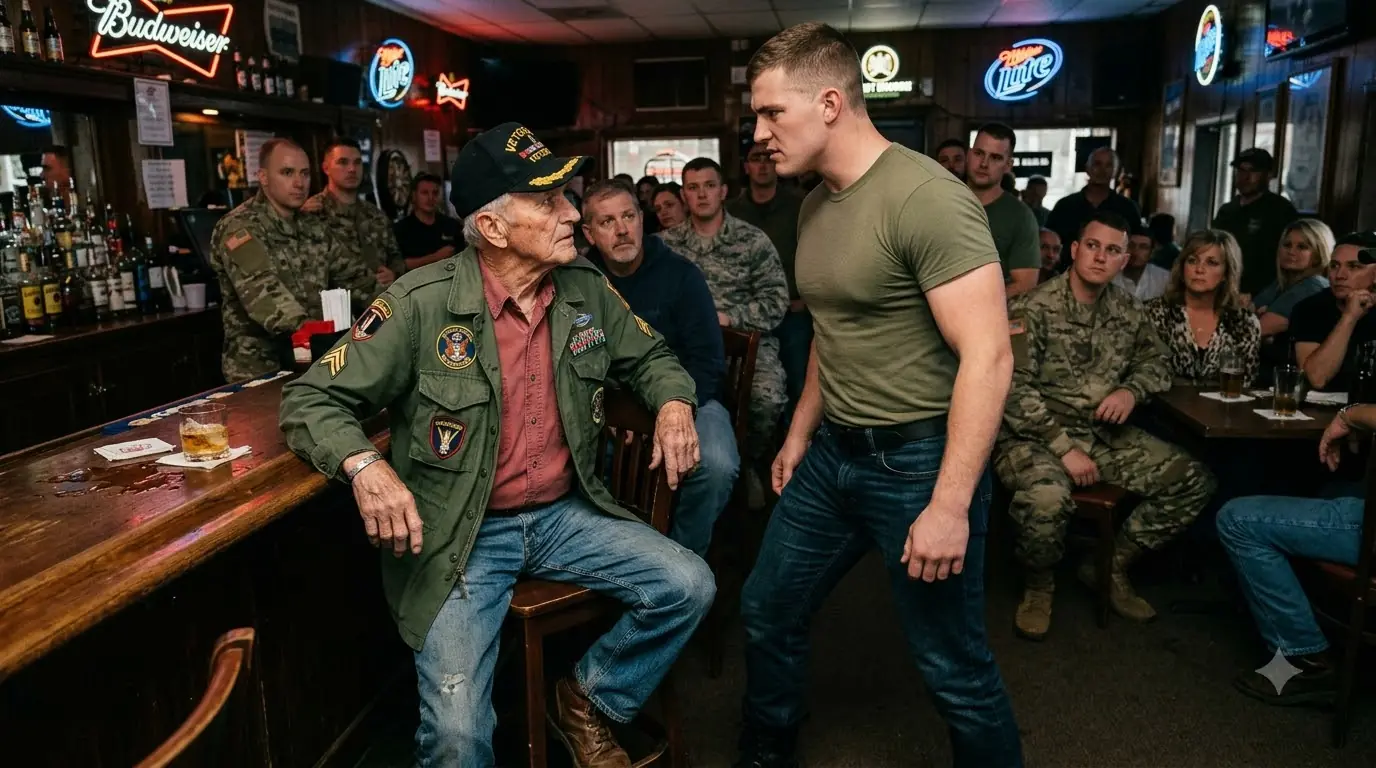
“I’m waiting for an apology,” the young man continued, stepping closer. “Do you know what I do for a living?”
Arthur smiled, but his eyes remained cold.
“I know exactly what you are,” he said. “You’re a tourist in a world men before you built.”
The young man scoffed.
“Who are you supposed to be?”
Arthur’s voice fell almost to a whisper.
“They didn’t call me a hero. They called me Cyclone.”
The young man’s expression changed.
The glass slipped from his hand and shattered against the floor.
A few minutes earlier, the confrontation had begun with a warning delivered loudly enough for half the bar to hear.
“You need to check your perimeter, old-timer, before you get hurt.”
The voice was thick with false bravado and cheap bourbon.
Arthur had not looked up. He remained seated at the bar, watching condensation slide down the side of his water glass. His red shirt stood out beneath the pulsing lights, but everything else about him seemed designed to disappear into the background.
The Drop Zone was crowded that Friday night. Located near Fort Liberty, it attracted active-duty personnel, veterans, contractors, and people who simply liked being close to those worlds.
The music was loud enough to vibrate through the stools. Perfume mixed with beer, fried food, and the faint metallic scent of rain carried in each time the door opened.
It was the kind of place where confidence often became performance and performance occasionally became violence.
Arthur knew how he appeared inside that room.
At seventy-six, he looked like somebody’s grandfather who had wandered into the wrong building. His hair had gone almost completely white, his shoulders had narrowed with age, and one of his hands sometimes trembled when he was tired.
Nothing about him seemed dangerous.
That was why the young man had chosen him.
“I’m talking to you, Red.”
The voice came again, closer this time.
A heavy hand closed around Arthur’s shoulder.
Arthur sighed. The sound disappeared beneath the bass rolling from the speakers.
He placed his glass carefully on its coaster and rotated his shoulder with one smooth movement. The hand slipped away without Arthur appearing to use any force.
“I heard you the first time, son.”
Arthur’s voice was not loud, yet it carried through the surrounding noise with a dry, gravelly clarity.
He turned on the stool.
Standing in front of him was a broad young man who could not have been more than twenty-five. His fitted green T-shirt stretched over heavily muscled arms, and his hair was cut high and tight.
He carried himself with the aggressive pride of a man who had recently earned a place among an elite group and believed that accomplishment required everyone around him to recognize it.
His name was Petty Officer Cole Miller, though his friends called him Bricks.
Three other young men stood behind him in similar shirts. They were grinning, and two already had their phones raised to record whatever humiliation they believed was about to occur.
“You bumped into me,” Miller said, pointing toward a puddle of beer on the floor. “You made me spill my drink.”
Arthur glanced at the beer.
“That’s a serious offense in this bar,” Miller continued. “You spill it, you clean it up.”
The people nearest the bar stopped talking.
The music continued, but the attention of the room tightened around the confrontation.
They had seen scenes like this before. A strong man found someone weaker, invented a reason to challenge him, and turned the outcome into entertainment.
Arthur examined the puddle and then looked back at Miller.
The smiles behind Miller disappeared.
Color rose into his face.
He stepped closer until his chest nearly touched Arthur’s shoulder.
“You have a smart mouth for a civilian.”
Arthur said nothing.
“Do you know where you are?” Miller continued. “This is the Drop Zone. This place is for warriors, not tourists wearing bright red shirts like they’re asking to become targets.”
Miller grabbed the collar of Arthur’s shirt and twisted the cloth in his fist.
“See? Bright red. Like a target.”
Arthur looked down at the hand gripping his shirt.
Then he moved.
He did not strike Miller.
He simply raised one hand and placed it around the young man’s wrist.
Arthur’s fingers appeared thin and old, the skin wrinkled over the bones. Yet when his grip tightened, Miller inhaled sharply.
The young man’s eyes widened.
The pressure felt impossible, as though an industrial clamp had closed around his wrist.
“Release the shirt,” Arthur whispered.
Miller let go immediately and stumbled half a step backward.
He rubbed his wrist and stared at Arthur with a mixture of confusion and embarrassment.
The phones behind him remained raised, but their owners were no longer laughing.
The story they expected to record had begun changing.
“Who do you think you are?” Miller demanded.
He pushed his chest forward again, attempting to recover the authority he had lost.
“I’m an operator,” he said. “I go where other people can’t. I hunt dangerous men in the dark. What did you ever do? Sell insurance? Fix toilets?”
Arthur rose from the stool.
He was not tall, perhaps five feet nine inches before age had shortened him slightly. Yet he unfolded with such controlled dignity that several people instinctively stepped away.
He smoothed the front of his red shirt.
“I did my job,” Arthur said, “so men like you would have the chance to do yours.”
Miller barked out a laugh.
“Here it comes. The old ‘I served too’ speech.”
He turned toward his friends.
“Let me guess. He worked in an office. Maybe a supply room. Probably got a medal for surviving a paper cut.”
The young men behind him laughed again, though less confidently than before.
Miller leaned close to Arthur’s weathered face.
“Come on, hero. What was your call sign? Speedy? Grandpa? Paper Pusher?”
Arthur stared at him.
For a moment, the changing lights of the bar reflected in his eyes and turned them dark red.
His left hand moved toward his right wrist.
A silver POW/MIA bracelet circled it. The metal had been scratched and worn smooth by more than five decades of use.
A name remained engraved across its surface, though the letters had become difficult to read.
Arthur ran his thumb across the cold silver.
Back and forth.
Back and forth.
“They didn’t call me Speedy,” he said.
Miller cupped one hand against his ear.
“What was that? Speak up.”
“They called me Cyclone.”
The word settled between them.
Miller blinked.
Then a smirk appeared.
“Cyclone? What, because you talked a lot? Or because you were full of hot air?”
Arthur no longer heard him.
His thumb pressed harder against the bracelet.
The cold metal against his pulse became a key opening a door Arthur had spent years trying to keep locked.
The bar began disappearing.
The smell of stale beer, lime, and cologne vanished. The pounding bass warped into the rhythmic beating of helicopter blades.
The colored lights dissolved into a white tropical glare.
The solid floor beneath Arthur’s boots became mud.
The air grew hot, heavy, and filled with the smells of wet jungle, fuel, smoke, and fear.
Arthur Vance was no longer standing in North Carolina.
He was back in the A Shau Valley.
It was May 1968.
Arthur’s hands were no longer wrapped around a water glass.
They gripped the handles of an M60 mounted in the open doorway of a UH-1 Huey.
The helicopter cut through humid air above a continuous canopy of jungle. Wind struck Arthur’s face and made his eyes water while the aircraft descended toward a valley hidden between steep green ridges.
“Coming in hot,” the pilot warned through Arthur’s headset. “Watch the tree line.”
Arthur leaned outward against his safety harness.
Below them, the jungle appeared almost peaceful, an endless field of emerald leaves broken only by thin streams and rising mist.
Somewhere beneath that canopy, a six-man reconnaissance team was trapped.
Radio reports indicated that a much larger enemy force was closing around them. The team had wounded men, limited ammunition, and almost no route of escape.
“I see green smoke,” the copilot called. “Three o’clock, low.”
Arthur spotted it.
A thin column of smoke climbed through the trees from a small clearing.
“Roger,” Arthur said into his microphone.
He prepared the weapon and checked the belt feeding into it.
“Get us down there, Lieutenant. I’ll cover the approach.”
The Huey banked sharply.
The force pressed Arthur against the frame as the aircraft dropped toward the valley. The beating of the rotors grew louder until it seemed to fill his entire body.
Then the jungle opened fire.
At first, it sounded like heavy rain striking sheet metal.
Small impacts rang against the aircraft’s skin.
“Taking fire,” the copilot shouted. “Both sides!”
Bright streaks crossed the open doorway.
Arthur pressed the trigger.
The M60 came alive with a heavy rhythmic roar that shook his shoulders. Empty casings spilled onto the metal floor and rolled beneath the crew chief’s boots.
Arthur directed his fire toward flashes appearing beneath the trees. Leaves and branches broke apart while dirt jumped along the forest floor.
The weapon’s vibration traveled through his arms and into his spine.
There were too many positions to count.
The jungle below seemed filled with movement.
“We’re taking heavy hits,” the pilot said. “Hydraulics are getting sluggish. I can’t hold her steady.”
“Don’t pull away,” Arthur answered. “The team is right below us.”
Then he saw them.
Six soldiers were packed tightly inside the clearing. Two fired toward the surrounding tree line while another dragged a wounded teammate behind a fallen log.
They waved frantically toward the helicopter.
The Huey hovered approximately ten feet above the ground, swaying under fire and the pilot’s increasingly difficult attempts to control it.
A sudden impact struck the cockpit.
The forward glass fractured.
The pilot collapsed against his harness.
“Jimmy!” the copilot shouted.
He grabbed the controls and fought to keep the aircraft level.
The Huey lurched violently to the right.
The tail section struck branches, and the aircraft began rotating.
The movement was not slow.
The helicopter spun with violent force, turning the jungle outside into a blur of green, brown, and white.
Arthur was thrown against the doorway. Only the safety strap connecting him to the aircraft prevented him from being thrown into the clearing.
“We’re losing control!” the copilot yelled. “Brace!”
The Huey did not immediately strike the ground.
The copilot fought the controls, keeping the damaged aircraft only a few feet above the trapped reconnaissance team.
Without the tail rotor functioning properly, the helicopter continued spinning like a broken top.
The enemy force saw the wounded aircraft and began advancing toward the clearing.
Arthur could see movement emerging from several directions.
The six soldiers below were nearly out of room.
In that moment, fear left him.
He stopped thinking about Tennessee, home, or the young woman who had promised to wait for him.
He stopped thinking about whether the helicopter would survive.
He locked his boots against the skid and tightened his grip on the weapon.
The damaged aircraft’s rotation gave him a full field of fire.
“Feed the belt!” he shouted toward the crew chief. “Keep it moving!”
As the Huey spun, Arthur continued firing.
The weapon traced a wide defensive circle around the clearing. Each rotation pushed the approaching force back and created a temporary barrier between the reconnaissance team and the men closing around them.
The crew chief knelt behind Arthur and fed ammunition forward with both hands.
The barrel grew dangerously hot.
Heat rolled back into Arthur’s face, yet he refused to release the trigger.
The aircraft turned again.
Arthur directed the weapon outward, following the edge of the clearing and the lines of movement beneath the trees.
Another rotation.
Then another.
From the ground, the pattern must have resembled a storm of light circling the trapped soldiers.
A cyclone.
“Keep her turning!” Arthur yelled through the headset. “I have the perimeter!”
The copilot could not stop the rotation, but he managed to keep the Huey above the clearing long enough for the stranded team to move.
One soldier grabbed a skid.
Then another.
The others pushed the wounded men toward the aircraft and secured them as best they could.
Arthur continued covering them.
His hands began cramping around the grips. The recoil drove through old injuries, and his arms shook from the strain.
Still, he continued.
The crew chief fed another belt forward.
The Huey rose gradually, rotating as it climbed.
Arthur kept firing toward the jungle until the clearing disappeared beneath the trees.
At last, the helicopter reached enough altitude to escape the heaviest fire.
It climbed into a bank of white cloud.
Arthur released the trigger.
The sudden silence felt louder than the weapon had.
He collapsed against the interior wall with his chest heaving.
His hands remained curled around invisible grips, muscles refusing to release their shape.
His flight suit was soaked with sweat, rain, and leaking hydraulic fluid.
The crew chief crawled closer.
His face was pale and his eyes enormous.
“Good Lord, Arty,” he whispered. “You turned this bird into a storm.”
Arthur looked toward the open door.
Outside, the clouds drifted peacefully as though nothing had happened beneath them.
He felt the silver bracelet striking lightly against his wrist with every vibration of the damaged aircraft.
“Did we get them?” Arthur asked.
His voice was almost gone.
“The team. Did we get all of them?”
The copilot answered through the headset.
“Yes. They’re holding the skids and secured inside. Every man is with us.”
His breathing broke.
“You saved them, Vance. You saved every one of them.”
Arthur closed his eyes.
As the adrenaline drained from him, exhaustion and grief filled the empty space.
The pilot, Jimmy, would not return home.
The six men below would.
Something inside Arthur had changed during those rotations above the clearing.
The young man who entered the valley had burned away inside the noise, heat, and fear.
What came out of the clouds was Cyclone.
The beat of the helicopter blades slowly transformed back into the bass of the Drop Zone.
The scent of wet jungle and smoke became spilled beer and cologne.
Arthur blinked.
He was once again standing beside the bar, his thumb pressed firmly against the silver bracelet.
His heart hammered against his ribs.
The only visible evidence of where his mind had gone was the faint trembling in his hand.
Miller watched him.
The young man’s confidence remained, but cracks had appeared around its edges.
“You went somewhere for a second,” Miller said with a nervous laugh. “I asked whether Cyclone was a weather joke.”
Arthur released the bracelet.
He studied his trembling fingers. Some of the damage had never completely left them.
“It wasn’t a joke,” he said.
His voice sounded tired now.
“It happened a long time ago. Forget it. Enjoy your evening.”
Arthur turned toward the exit.
He did not want to fight.
He wanted to go home.
Miller stepped into his path.
“Wait.”
Arthur stopped.
“You don’t get to throw out a dramatic call sign and walk away,” Miller said. “You’re stealing valor, aren’t you? You bought that bracelet at a surplus store.”
Arthur’s expression hardened.
“You never served,” Miller continued. “You’re a fraud.”
He pushed one finger against Arthur’s chest.
A hand slammed against the bar.
The sound cut through the room like a gunshot.
Every face turned.
The bartender had come around the counter. He was an older man with a gray crew cut and a prosthetic hook replacing his left hand.
Most people called him Gunny.
He was not looking at Arthur.
He stared directly at Miller.
“Take your hand off him.”
“Stay out of this, Gunny,” Miller replied. “I’m exposing somebody pretending to be something he isn’t.”
“I know exactly what he is.”
The bartender’s voice dropped.
“If you touch him again, I will personally remove you from this building.”
Miller scoffed, though he pulled his hand away.
“Why? Who is he? Your father?”
“No,” another voice said.
The crowd separated.
A man had been sitting alone inside a shadowed booth near the rear wall. He stood slowly and reached for a cane beside his chair.
He appeared to be around seventy, dressed in a dark suit, with white hair and a posture shaped by old injuries. His movement was stiff, but the authority in it was immediate.
He crossed the room.
When he reached Arthur, he looked first at Miller and then at the old man in the red shirt.
The cane slipped from his fingers and struck the floor.
The man straightened as much as his back allowed.
Then he raised his right hand to his brow.
His salute was precise.
It was also trembling.
“Sir.”
Arthur studied the lined face.
The white hair and years had changed it, but the eyes remained familiar.
“Tom Kowalski?” Arthur whispered.
The man smiled as tears gathered in those eyes.
“General Kowalski now, Arty. But yes. It’s me.”
Kowalski lowered his hand.
He turned toward Miller.
“You asked for his call sign?”
Miller said nothing.
“You thought it was funny?”
The general pointed toward Arthur.
“This man is the reason I am alive. He is the reason my children were born and my grandchildren exist.”
He reached into his jacket and removed a worn black-and-white photograph.
The general placed it on the bar beside the puddle of beer.
The image showed a heavily damaged helicopter. Its body was punctured in dozens of places, its cockpit broken, and its tail visibly damaged.
Beside it stood a much younger Arthur Vance.
He was shirtless, streaked with soot, and staring toward the camera with the hollow expression of somebody who had not yet understood that he had survived.
Kowalski faced the room.
“Our reconnaissance team was trapped in the A Shau Valley,” he said. “Six of us against a force large enough to close every route out.”
His voice tightened.
“We had wounded men, almost no ammunition, and no reason to expect rescue.”
He looked at Miller.
“Then Cyclone came down.”
The general touched the edge of the photograph.
“The pilot was lost, the aircraft was badly damaged, and the Huey started spinning above our position. Arthur secured himself inside that doorway and used the rotation to protect the entire clearing.”
The bar remained silent.
“He held them back long enough for all six of us to reach the helicopter. He continued even after being injured and even when the weapon and aircraft were nearly failing.”
Kowalski lifted Arthur’s wrist.
“This bracelet is not decoration. He wears it for Jimmy, the pilot who did not come home that day.”
His voice broke.
“He has carried that name on his wrist for fifty-six years.”
Ice shifted inside a glass somewhere behind the crowd.
It was the only sound.
Miller stared at the photograph.
Then he looked toward the general.
Finally, he faced Arthur.
All the color had drained from his face.
The old man he had chosen as an easy target had become something else before his eyes.
Not larger.
Not stronger.
Simply real in a way Miller had not prepared himself to understand.
“I didn’t know,” he managed. “I had no idea.”
Arthur bent down and retrieved Kowalski’s cane.
He handed it back.
“That is the problem with young men who believe history began on the day they joined,” Arthur said gently. “You forget that people were carrying the weight before you arrived.”
He did not speak with anger.
That made the words land harder.
“You don’t owe me a performance,” Arthur continued. “But you owe the general a drink.”
The silence inside the Drop Zone no longer felt like anticipation.
It carried the weight of history.
Miller remained frozen beside the bar.
The confidence he had worn minutes earlier seemed to lie broken beside the glass on the floor.
“I didn’t know, Chief,” he repeated.
Arthur touched the edge of the old photograph.
His finger moved across the blurred image of the damaged cockpit.
“You weren’t supposed to know,” he said. “That is the point.”
Arthur looked around the room.
The phones had gradually lowered. No one appeared interested in recording anymore.
“You young men enter places like this with new insignia on your uniforms and believe you invented courage,” Arthur said. “You have the training, equipment, stories, and movies, so you start believing valor belongs only to you.”
His eyes returned to Miller.
“An emblem does not make a warrior. Sacrifice does.”
Arthur touched the silver bracelet.
“The people who sacrificed the most rarely speak about it in bars. They don’t demand that strangers admire them. They carry it quietly.”
Miller swallowed.
Behind him, his friends looked toward the floor. None could meet Arthur’s gaze.
The shame surrounding them was complete.
Miller drew a breath.
Then he stepped back and gave Arthur room.
Without arguing or trying to recover his reputation, he picked up a cleaning cloth from the counter and lowered himself to one knee.
In front of everyone, the large young SEAL began wiping the beer from the floor near Arthur’s boots.
It was a small act, but no one mistook what it meant.
When the floor was clean, Miller stood.
“Gunny?”
The bartender watched him.
“Bring out the best bottle you have. Put it on my tab.”
Gunny studied the young man for several seconds.
Then he nodded.
He returned behind the counter and placed a crystal bottle with three small glasses on the bar.
Miller poured carefully, though his hands were still shaking.
He placed one glass in front of Arthur, another before General Kowalski, and kept the third.
“I cannot take back what I said,” Miller told Arthur. “But I can show respect now—to Cyclone and to the men in that valley.”
Arthur looked at the amber liquid.
He lifted the glass but did not drink.
Instead, he tilted it slowly and poured its contents onto the floor.
“For Jimmy,” he whispered.
General Kowalski nodded.
He emptied his glass beside Arthur’s.
“For the crew.”
Miller hesitated for only a moment.
Then he poured out his drink as well.
“For the fallen.”
The gesture became a bridge between generations.
Arthur’s expression softened.
He reached forward and placed one hand on Miller’s shoulder—the same shoulder attached to the wrist he had nearly crushed earlier.
“You have plenty of muscle, son,” he said. “Make certain your character becomes stronger than your arms.”
Miller lowered his eyes.
“That is the only strength people remember after you are gone.”
Arthur turned toward Kowalski.
“It’s good to see you, General, but it’s past my bedtime. My wife worries when I’m not home before the evening news ends.”
“I’ll walk you out, Cyclone.”
Arthur picked up his water glass and started carrying it toward the bar out of habit.
Miller stopped him.
“Leave it, Chief. I’ll take care of everything.”
Arthur nodded.
He straightened the front of his faded red shirt and began walking toward the exit.
Something happened as he crossed the room.
It started with two old bikers seated near the rear wall.
They stood.
They did not salute. A formal gesture would have felt too stiff for the moment.
Instead, they faced Arthur and nodded.
Another man stood.
Then a woman near the jukebox.
Within seconds, nearly everyone in the bar was on their feet.
No one cheered.
No one clapped.
They simply made eye contact as the old man walked past.
A silent wave of respect followed him toward the door.
Arthur stepped outside with General Kowalski beside him.
The heavy wooden door closed behind them.
Inside, the music did not immediately resume.
Gunny took a roll of masking tape from beneath the bar and walked toward the stool where Arthur had been sitting.
He tore off a strip and pressed it onto the worn leather seat.
Using a black marker, he wrote two words.
CYCLONE’S SEAT.
Gunny faced the room.
“No one sits there.”
A few people thought he was joking.
His expression made it clear he was not.
“Not tonight. Not next week. That seat belongs to the man who brought six soldiers home.”
Miller stared at the empty stool and then at his reflection in the mirror behind the bar.
He appeared different to himself.
Smaller, perhaps.
But also more honest.
He had entered the Drop Zone looking for a confrontation that would prove he was powerful.
He would leave understanding that true power did not need to announce itself.
Outside, the night air was cool and quiet.
Arthur and Kowalski reached an old Ford pickup parked near the edge of the lot.
For a moment, neither man spoke.
Kowalski looked at Arthur’s wrist.
“You still wear it every day.”
“Every day.”
“I tried to find you.”
“I know.”
“You could have answered.”
Arthur gave him a tired smile.
“I spent enough years being Cyclone. I wanted some time to be Arthur.”
Kowalski nodded.
“You saved my life.”
“We saved each other.”
Arthur opened the truck door.
“Come by the house sometime. My wife will feed you until you regret becoming a general.”
Kowalski laughed quietly.
“I would like that.”
Arthur climbed into the driver’s seat.
Before closing the door, he glanced again at the silver bracelet. Moonlight moved across the scratched metal and briefly illuminated the nearly vanished name.
The trembling in his hand had stopped.
He was no longer inside the helicopter.
He was no longer the young gunner circling above the valley.
He was Arthur Vance.
Just Arty.
He started the truck and drove home knowing that the truth of what happened in that clearing had survived for another generation.
Behind him, inside the Drop Zone, one stool remained empty.
Above it, two handwritten words waited beneath the neon light.
Cyclone’s Seat.