At eleven, Noah watched his parents spend more money on fields that produced less every year. While the adults argued over expensive solutions, he noticed something they kept pushing to the edge of the farm and forgetting. His first experiment was too small for anyone to take seriously, and his second earned him more criticism than encouragement. Years later, the people who had told him to stop wasting his time would come to his gate with a very different question.
“One patch doesn’t prove anything.”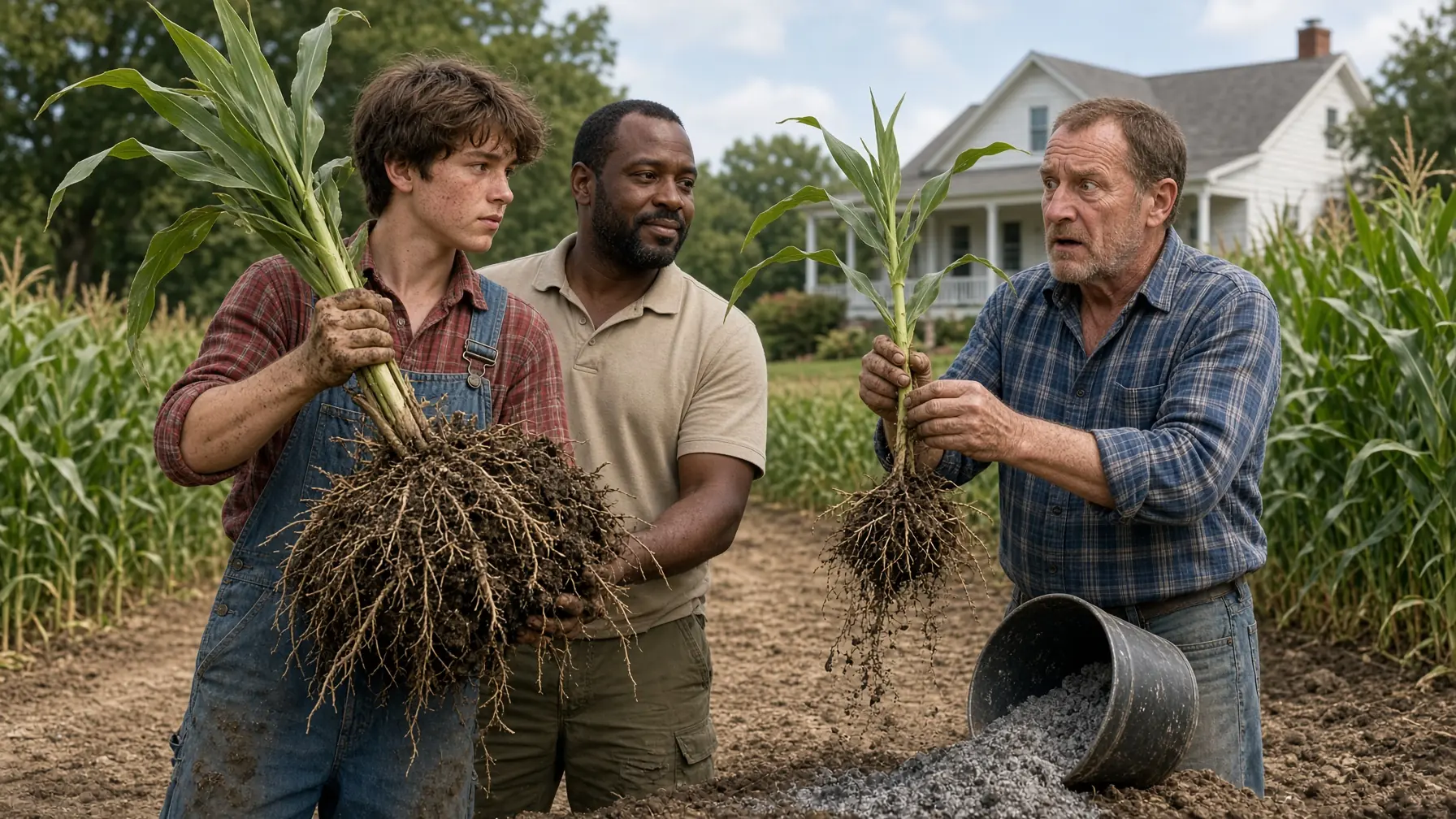
Noah’s father said it while standing between two rows of corn, his work shirt darkened with sweat and his hands resting on his hips.
Noah held a ruler against a stalk.
The plant was taller than the one beside it. Its leaves were a deeper green, and the ground beneath it had not opened into the same dry cracks visible farther along the row.
He looked up.
“The patch next to it is different.”
His father followed his gaze.
“Fields are different.”
“They got the same rain.”
“That doesn’t mean they held the same rain.”
Noah moved the ruler to another plant.
This one was taller too.
His father watched him for a moment, then looked toward the tractor waiting near the lane.
“We’ve got work.”
Noah lowered the ruler.
He knew what that meant.
Not that his question was foolish.
Not exactly.
It meant that a question asked by an eleven-year-old belonged below a list of jobs that could not wait, bills that had to be paid, and problems his father had been trying to solve since before Noah understood there were problems.
His father started walking.
Noah remained beside the corn.
At the edge of the patch, two short stakes marked the area where he had worked the previous fall.
One had a strip of blue cloth tied around it.
The other had a crooked letter scratched into the wood.
A.
For ash.
He looked at the plants once more.
Then he followed his father.
The farm had not become poor all at once.
That would have been easier for Noah to understand.
A storm could destroy something in a night. A machine could fail with a bang. A person could point to the broken part and say that was where the trouble began.
The fields were different.
They grew a little less each year.
The corn still came up.
The rows still turned green.
From the road, the farm looked like a farm.
Only the people working it noticed how much effort went into getting less from the same ground.
Noah noticed because his father no longer whistled while bringing the harvest figures into the kitchen.
He noticed because his mother stopped asking whether they could replace things and began asking whether they could make them last another year.
He noticed because conversations ended when he entered the room.
Sometimes he heard enough before the silence.
Fertilizer.
Lime.
Freight.
A machine payment.
Something called an amendment that sounded less like a way to help the soil than another way to spend money they did not have.
One evening, his father sat at the kitchen table with a brochure spread beneath his elbow.
The paper showed a bright field under a clean blue sky.
Their own field was visible through the window behind him.
Noah looked from one to the other.
“Does that stuff work?”
His father lifted his eyes.
“Sometimes.”
“Then why don’t we get it?”
His mother, standing beside the sink, turned off the water.
His father folded the brochure.
“Because things cost more than the picture.”
Noah nodded as though he understood.
He understood enough to stop asking that question.
But he began asking others.
Why did the ground become hard so quickly after rain?
Why did some rows stay greener than others?
Why did they keep removing material from the farm, then buy other material to bring back?
And why did the piles left after the fall burn disappear without anyone trying to use them?
Every autumn, after harvest, the family cleared accumulated field residue and clean fallen branches.
Noah did not manage the fires.
That work belonged to adults.
He watched from a distance, helping with the ordinary jobs before and afterward.
When everything had cooled, there were pale drifts of ash and darker pieces of charred material where the piles had stood.
Wind pushed the fine ash toward the fence.
Rain carried some of it into shallow depressions.
Eventually, his father leveled the area and moved on.
Nothing about it seemed valuable.
That was what interested Noah.
Useful things usually had to be bought.
This was already there.
He watched a thin gray layer collect against an old bucket and wondered whether a thing could be useless only because nobody had asked it to do anything.
The thought did not arrive in those words.
At eleven, he did not think in speeches.
He thought: What if I put some in the dirt?
The first patch was small.
He chose an edge of the field where his father rarely stopped except to turn equipment.
There was enough space to work without interfering with the rows that mattered to the harvest.
He waited until the material was completely cold.
Then he filled a bucket and carried it to the patch.
The bucket was heavier than he expected.
He set it down twice.