Toby Miller enters the county livestock auction with Barnaby, a small black Berkshire pig everyone assumes has no chance against the enormous corporate-backed champion owned by Sterling Vance. The wealthy breeders ridicule Toby’s clothes, his struggling family farm, and the undersized animal, unaware that months of careful conditioning and an old heritage bloodline have made Barnaby far stronger and healthier than he appears. When the judge begins examining what money and size cannot hide, the contest becomes a public showdown between a ten-year-old boy fighting to save his family farm and a corporation determined to prove that bigger always means better.
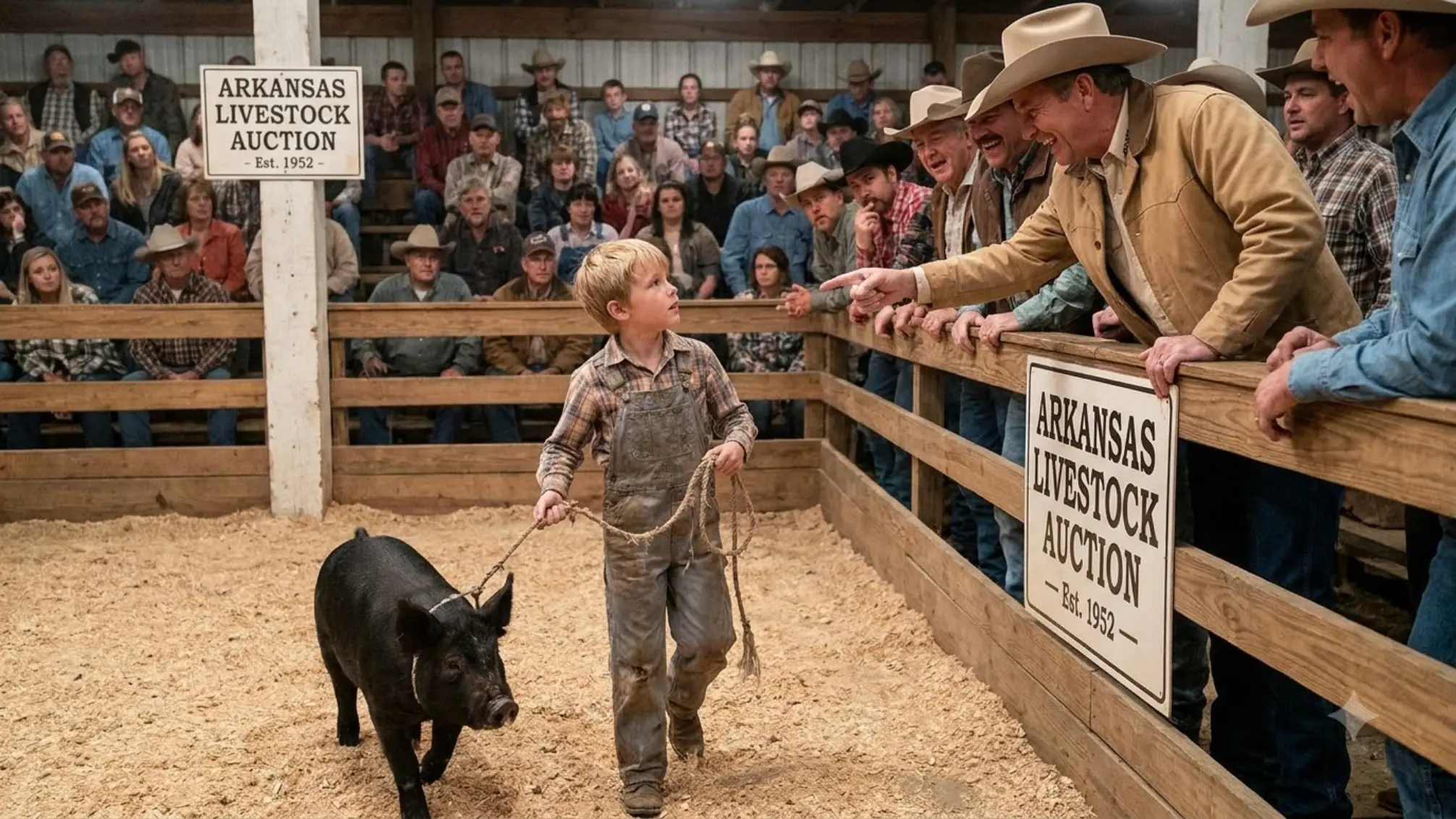
The livestock pavilion smelled of sawdust, diesel exhaust, hay, and the sweat of men who had spent their lives beneath an unforgiving Arkansas sun. Hundreds of farmers, buyers, business owners, and families filled the wooden bleachers while animals shifted nervously inside holding pens beneath the bright overhead lights. Yet the loudest sound in the building was not cattle or auctioneers. It was laughter directed toward the small boy standing in the center of the ring.
Toby Miller was ten years old, narrow-shouldered and dusty from the farm, wearing a faded tan cap over brown hair, a red-and-navy plaid shirt beneath worn canvas overalls, and boots still carrying red clay from home. His hands were wrapped tightly around a frayed lead rope because he knew if he loosened his grip, everyone might notice they were trembling. Beside him stood Barnaby, a black Berkshire pig so much smaller than the giant animals waiting near the rail that he looked almost misplaced. Three wealthy breeders in cowboy hats leaned toward one another and laughed openly.
Sterling Vance laughed louder than all of them. He was forty-eight, broad through the chest, perfectly groomed, and dressed in a tan ranch jacket that probably cost more than everything Toby wore combined. Sterling was chief livestock coordinator for AgGrowth International, a corporation that had spent the previous five years buying farms, contracting feed operations, and converting family acreage into industrial livestock facilities. Standing behind him was Titan, the enormous pink hog Sterling expected to win the championship without serious competition.
Sterling leaned across the rail and pointed at Barnaby. “Kid, that runt belongs in a petting zoo, not my auction.” Laughter broke out behind him, and Toby felt heat climb into his face as several men slapped their knees. He tightened his grip on the rope and answered, “Then stop laughing and put your champion beside him.”
Sterling’s smile weakened slightly. “My hog outweighs yours twice over. You’ll leave this ring crying.” Toby lifted his head and stared directly at him. “Then bring him in, Mr. Vance, and let the judge decide which one of us brought a fraud.”
The pavilion changed. Some people still laughed, but others leaned forward because a ten-year-old farm boy had just challenged one of the wealthiest agricultural executives in the county without looking away. Toby’s father, Samuel Miller, stood near the rear wall wearing a faded denim jacket and work boots held together with fresh stitching. He said nothing, but his eyes remained fixed on his son.
The Miller farm lay eighteen miles outside town where asphalt gave way to gravel and gravel eventually surrendered to rutted dirt. Toby’s grandfather had purchased the property after leaving the mines with little more than savings, determination, and a belief that forty difficult acres could become a home. Samuel had kept the farm alive through drought, recession, equipment failures, and seasons when crop prices dropped below the cost of planting. Recently, survival had become harder than farming itself.
The tractor was twenty-eight years old. The barn roof leaked badly enough that buckets appeared beneath it whenever rain came from the west, and the combine had been sold two years earlier to cover property taxes. At night Toby sometimes walked into the kitchen for water and found his father sitting beneath a single yellow bulb surrounded by bills, bank notices, and unpaid invoices. Samuel always covered the papers when he saw his son, but children often understand more than adults want them to.
The county fair represented more than a ribbon. A championship animal could earn significant prize money, and the premium auction afterward could push the sale price far beyond normal livestock value. If Barnaby performed well enough, the Millers could pay back taxes, buy seed for spring, repair part of the barn roof, and perhaps prevent the bank from forcing another conversation about restructuring their debt. Toby knew exactly what failure meant.
Barnaby had not looked like a future champion when he was born. He was the smallest pig in a litter of twelve, pushed away from the sow by stronger siblings and barely able to reach the trough without being knocked aside. Samuel had looked at the tiny animal and said they could not afford to spend expensive feed on a pig unlikely to survive. Toby asked for one week.
That week became a summer. Toby bottle-fed Barnaby before sunrise, carried water during afternoon heat, and slept in the barn during two violent storms because the little pig panicked whenever thunder shook the roof. He gathered windfall apples, wild acorns, black walnuts, and clover to supplement the modest amount of commercial grain the Millers could afford. Somewhere between those long mornings and quiet evenings, Toby stopped thinking of Barnaby as livestock and began thinking of him as a partner.
He trained the pig carefully. Barnaby learned to walk beside him with only a small movement of the lead and eventually responded to the lightest tap of a wooden guiding stick. Toby walked him across rolling pasture every morning, building endurance and keeping his body lean rather than allowing him to become heavy simply for appearance. The pig grew slowly, but every pound seemed solid.
Samuel watched from a distance. He never told Toby exactly why Barnaby’s development interested him so much. A year earlier, Samuel had traded an antique seed drill to an elderly breeder three counties away in exchange for access to a heritage Berkshire boar whose bloodline had nearly vanished from local farming. The line had been developed for health, strong feet, functional muscle, and exceptional meat quality rather than enormous weight.
Barnaby carried that bloodline.
Most people would never recognize it. Corporate breeders no longer considered heritage genetics commercially efficient because the animals gained weight too slowly and required more time before market. AgGrowth preferred pigs that reached enormous weights quickly through carefully designed feed programs and highly controlled environments. Sterling Vance measured success in growth curves, conversion ratios, market uniformity, and numbers on spreadsheets.
Titan embodied that philosophy. He lived in a climate-controlled barn, ate a scientifically formulated high-protein ration, and was monitored by employees whose only job was maximizing his size before the fair. By show day, Titan looked enormous enough to dominate photographs. His body seemed to fill an entire corner of the holding area.
Sterling considered the championship already won. He had brought investors from the city, arranged professional photographs, and privately told buyers that Titan would demonstrate the superiority of AgGrowth genetics. He had also spent much of the year pressuring independent farmers to sign production agreements that gave the corporation control over breeding, feed, and pricing. The Miller farm was one of the properties he wanted most.
Their acreage sat between two AgGrowth holdings. Sterling had offered Samuel more money than the struggling farm might normally bring, but the contract required surrendering the house, barns, and grazing rights within sixty days. Samuel refused. Sterling interpreted the decision as stubbornness rather than loyalty.
That morning at the fair, Sterling noticed the Millers’ rusted truck before he noticed Barnaby. He made jokes about both. When Toby walked past with his pig, Sterling asked whether Samuel had forgotten to feed the animal for six months. Several corporate breeders laughed.
Toby kept walking.
Later Sterling approached the auction committee and argued that underdeveloped animals should be removed from the premium competition before judging. He claimed poor entries wasted buyers’ time and damaged the fair’s professional image. Everyone understood which animal he meant. The committee refused because Barnaby met the written requirements.
Sterling decided humiliation would accomplish what rules could not.
The moment Toby entered the judging ring, several AgGrowth employees began laughing loudly from the front rows. Another breeder asked whether Toby had accidentally brought a farm pet instead of a market hog. A paper cup landed in the sawdust near Toby’s boots, followed by more laughter. Barnaby remained calm.
Sterling stepped closer to the rail. “There’s still time to walk out, boy.” Toby looked toward him. “Why? Afraid the runt might embarrass you?”
The crowd reacted sharply.
Sterling’s face hardened. “Careful.” Toby did not move. “You should tell your friends that.”
Samuel watched his son from the back wall and fought the instinct to intervene. Every insult aimed at Toby felt like something physical striking his chest, but he understood his son had chosen to enter that ring knowing what waited there. If Samuel rushed forward now, he would unintentionally tell Toby that he could not stand by himself. Instead, Samuel placed both hands on the rail and nodded once when Toby looked toward him.
The head judge entered shortly afterward. Silas Warren had evaluated livestock for forty years and belonged to a generation that cared less about polished presentations than healthy animals. He was in his late sixties, with weathered hands, a permanent bend in one knee, and eyes that missed very little. Sterling immediately approached him.
“Titan is ready whenever you are.”
Silas looked toward the enormous hog.
“So are the others.”
Sterling leaned closer. “Some of them barely qualify as market animals.”
Silas followed his glance toward Barnaby.
“Then judging should be easy.”
Sterling did not like the answer.
The inspection began with the largest entries. Silas examined legs, feet, breathing, muscle structure, skin condition, movement, and overall health while assistants recorded his comments. Titan attracted immediate attention because his scale and weight were impossible to ignore. Sterling smiled broadly while photographers moved closer.
Silas placed one hand against Titan’s shoulder. The hog shifted uneasily. Its breathing was heavier than Silas expected considering the short distance it had walked from the holding pen.
Sterling began talking about growth efficiency.
Silas raised one finger.
“Let me judge.”
Sterling stopped.
When Barnaby’s turn came, whispers spread through the pavilion again. Toby guided him forward with two light taps of the stick and no pulling on the rope. Barnaby walked cleanly across the sawdust, stopped when Toby stopped, then repositioned with another subtle cue.
Several older farmers sat straighter.
They understood how difficult that kind of handling was.
Silas circled Barnaby.
He pressed along the pig’s back, shoulders, loin, and legs. He examined the hooves carefully, then crouched lower and studied the animal’s ears and facial structure. The inspection lasted much longer than Sterling expected.
Sterling began looking irritated.
“Judge, we have a schedule.”
Silas ignored him.
He ran both hands along Barnaby’s frame again.
Then he looked at Toby.
“Who bred him?”
“My father.”
“What line?”
Toby glanced toward Samuel.
Samuel answered from behind the rail. “Old Harrow Berkshire stock.”
Silas’s eyes immediately changed.
“Harrow?”
Samuel nodded.
“Through Clayton Boone’s boar.”
Silas slowly stood.
Several old farmers began whispering among themselves.
Sterling looked confused.
“What is Harrow stock?”
Silas turned toward him.
“Something older than your company.”
A few people laughed.
Not at Toby this time.
Sterling’s face tightened.
Silas asked assistants to bring the official scale into the center of the ring. The crowd murmured because weights had already been recorded before the event, and repeating them publicly was unusual. Toby looked toward his father, who shrugged.
Barnaby stepped onto the scale first.
His weight was nowhere near Titan’s.
Sterling smiled again.
“There. Exactly what I said.”
Silas did not respond.
He asked Toby to walk Barnaby twice around the ring. The pig completed the circuit easily and returned beside Toby without labored breathing.
Then Titan was brought forward.
The huge hog resisted immediately.
Two handlers pushed and guided him toward the scale while Sterling ordered them to move faster. Titan finally stepped onto the platform, producing an enormous number that caused several investors to applaud. Sterling spread both hands as though the weight settled everything.
Silas watched the animal’s legs.
“Walk him.”
The handlers looked surprised.
Sterling frowned. “You already inspected him.”
“Walk him.”
Titan moved.
After less than half a circuit, his breathing became loud enough to hear from the front rows. His rear legs trembled slightly, and his feet spread outward each time he placed weight onto them. The animal stopped near the rail and refused to continue.
Silas approached.
Sterling stepped between them.
“He’s tired from the transport.”
“So are the others.”
“He’s twice their size.”
Silas looked at him.
“That’s the problem.”
The crowd went quiet.
Sterling’s face became red.
“You’re penalizing size?”
“I’m judging livestock.”
Silas pointed toward Titan’s feet.
“That animal can barely support what you put on him.”
Sterling laughed angrily.
“He’s the strongest hog in this building.”
Silas looked toward Toby.
“Bring Barnaby over.”
Toby guided the smaller pig forward.
Silas positioned both animals several feet apart.
The visual difference was almost ridiculous.
Titan towered over Barnaby.
Sterling regained some confidence.
Silas asked both handlers to move their animals simultaneously.
Toby gave Barnaby a small cue.
The black pig stepped forward immediately.
Titan resisted.
His handlers pulled harder.
The enormous animal finally moved several steps before stopping again.
People began whispering.
Silas walked between the animals. “Weight is useful when the frame can carry it.” He touched Barnaby’s shoulder. “Muscle, structure, sound feet, conditioning, breathing, and genetics matter too.”
Sterling pointed at Toby’s pig.
“That runt has half the market value.”
“According to whose market?”
“Everybody’s.”
Silas smiled faintly.
“We’re about to find out.”
Sterling realized the room was slipping away from him.
He approached Silas and lowered his voice.
“Think carefully about what you’re doing.”
Silas stared at him.
“Are you threatening a judge inside a livestock ring?”
Sterling stepped back.
“No.”
“Good.”
Silas returned to Barnaby.
Toby’s heart hammered so violently he could feel it behind his ribs.
For months he had imagined winning, but standing there now, he realized the ribbon mattered less than he expected. He simply wanted someone knowledgeable to see Barnaby clearly. He wanted his father’s breeding decision and his own summer of work to mean something.
Silas eventually stepped to the microphone.
The pavilion became silent.
He spoke first about the purpose of livestock judging. Size mattered, he explained, but championship animals were supposed to demonstrate functional quality rather than merely produce the largest number on a scale. He spoke about soundness, health, movement, genetics, structure, and responsible breeding.
Sterling folded his arms.
Silas continued.
“I have seen big animals.”
His eyes moved toward Titan.
“I have seen expensive animals.”
Then toward Sterling.
“And occasionally I see a true one.”
His cane pointed toward Barnaby.
Toby stopped breathing.
“The Grand Champion is Barnaby, Miller Farm.”
For one second, nobody reacted.
Then the pavilion exploded.
Local farmers leaped to their feet. People shouted, clapped, whistled, and stamped their boots against the bleachers. Toby stood frozen while Silas walked toward him carrying the blue ribbon.
Sterling stared in disbelief.
“No.”
Nobody heard him.
Silas attached the ribbon near Barnaby’s halter.
Toby looked toward his father.
Samuel had both hands over his face.
When he lowered them, tears ran openly down his cheeks.
Toby started crying too.
Samuel climbed over the low rail and wrapped both arms around his son.
“You did it.”
Toby shook his head.
“We did.”
Barnaby stood between them chewing calmly at the sawdust as though nothing unusual had happened.
Sterling stormed toward the judging table.
“This is fixed!”
The cheering weakened.
Silas turned.
Sterling pointed toward Titan. “You’re giving the championship to a child because everyone wants an emotional story.”
Silas’s face became cold.
“I gave it to the better animal.”
“That pig is tiny.”
“That pig can walk.”
Sterling stepped closer.
“You’ll regret this.”
Silas tapped the competition rule sheet.
“Any animal unable to complete showing requirements under its own power can be disqualified.”
Sterling looked toward Titan.
The giant hog’s legs suddenly buckled.
It sank into the sawdust.
Gasps swept across the pavilion.
Handlers rushed forward.
Titan was conscious and breathing, but exhaustion had overwhelmed him. They brought water and attempted to cool him while a veterinarian approached. Nobody laughed.
Sterling’s public champion had become visible proof of the weakness Silas identified.
The veterinarian eventually stabilized Titan and ordered him removed from further competition. Sterling watched investors backing away from the rail, whispering among themselves. Several men who had arrived beside him quietly left the pavilion.
Sterling turned toward Toby.
“This isn’t over.”
Samuel immediately stepped between them.
“It is for today.”
Sterling looked at him.
“You still owe the bank.”
Samuel’s expression hardened.
“And?”
“You think one ribbon saves your farm?”
Toby looked up at Sterling.
“Wait for the auction.”
Sterling stared at the boy.
Then walked away.
The premium auction began two hours later.
Barnaby entered with the blue ribbon attached.
The auctioneer opened bidding above ordinary market price.
Hands rose immediately.
A local butcher bid.
Then a restaurant owner.
Then an independent Berkshire breeder.
The price climbed.
Samuel stared at the board.
He had calculated the amount they needed to pay the most urgent taxes and purchase spring seed.
The bids passed that number.
Then doubled it.
Toby looked toward his father.
Samuel looked almost frightened.
The city restaurant group entered the bidding, but an elderly heritage breeder named Franklin Avery continued raising his card. Franklin had spent forty years preserving traditional Berkshire genetics and wanted Barnaby as a breeding sire rather than meat.
The auctioneer called another number.
Franklin raised his card.
The restaurant group stopped.
The hammer fell.
The final price was higher than any hog had brought at the county fair in recent memory.
The pavilion erupted again.
Samuel lowered his head.
The money would cover the overdue taxes.
Repair the barn.
Buy seed.
Make several equipment payments.
And leave enough to create a modest savings account for Toby.
Franklin approached after the auction.
Toby stood beside Barnaby.
“Will you take care of him?”
Franklin nodded.
“He won’t be slaughtered.”
Toby looked surprised.
“What happens?”
“He goes to my breeding farm.”
Franklin smiled.
“If he carries the bloodline Silas thinks he does, Barnaby has work ahead of him.”
Toby hugged the pig around the neck.
Barnaby grunted.
For the first time that day, Toby laughed without fear.
Across the pavilion, Sterling Vance stood alone beside an AgGrowth banner.
His executives were making phone calls.
The photographs designed to show corporate dominance would now show something else.
A ten-year-old boy.
A small black pig.
And an enormous corporate champion unable to finish the competition.
Sterling left before sunset.
He did not congratulate Toby.
He did not speak to Samuel.
But he also did not repeat his offer to buy the Miller property.
The corporate company quietly withdrew its expansion proposal several weeks later after local farmers became increasingly skeptical about AgGrowth’s livestock methods.
The fair triggered questions.
Not accusations.
Questions were enough.
Farmers wanted to know why animals were being pushed toward such extreme growth.
Veterinarians discussed leg health.
Breeders reconsidered what they had been selecting for.
The county agricultural board introduced stronger welfare requirements for future exhibitions.
Samuel returned home with Toby in the old truck.
Barnaby traveled separately with Franklin’s crew.
The passenger seat held the blue ribbon.
For several miles neither father nor son spoke.
Then Samuel pulled onto the shoulder.
Toby looked at him.
“What?”
Samuel stared through the windshield.
“I was going to sell.”
Toby froze.
“The farm?”
Samuel nodded.
“When?”
“Next month.”
Toby felt his stomach tighten.
“Why didn’t you tell me?”
“Because you’re ten.”
Toby looked down.
Samuel continued.
“I didn’t want you carrying my problems.”
Toby looked toward the ribbon.
“I already was.”
Samuel closed his eyes.
“I know.”
They sat quietly.
Then Samuel placed one hand on Toby’s shoulder.
“You bought us time.”
Toby shook his head.
“Barnaby did.”
“No.”
Samuel looked at him.
“You did.”
The following Monday, they went to the bank.
Samuel paid the overdue property taxes and brought several loans current.
The bank manager looked surprised by the auction documents.
“You won?”
Toby answered before his father.
“Barnaby won.”
The manager smiled.
“I heard.”
Samuel did not smile.
“You also told me six months ago this farm had no future.”
The banker looked uncomfortable.
“I was looking at the numbers.”
Samuel nodded.
“So was Sterling Vance.”
They left.
Back at the farm, roof repairs began before the next major rain.
The barn stopped leaking.
A used seed drill arrived in spring.
Samuel planted on time.
The farm remained difficult.
No ribbon could change weather, commodity prices, machinery breakdowns, or debt entirely.
But breathing room changed everything.
Toby visited Barnaby three months later.
Franklin Avery’s breeding farm sat in rolling hills two counties away.
Barnaby had grown.
Not enormously.
Solidly.
He recognized Toby’s voice before seeing him.
When Toby called his name, the pig lifted his head and crossed the pasture.
Franklin smiled.
“He remembers.”
Toby crouched beside the fence.
“Of course he does.”
Years later, Barnaby’s genetics appeared in herds throughout the region.
Independent breeders began asking for Berkshire lines that emphasized soundness rather than extreme growth.
The change did not destroy corporate farming.
Nothing that simple happened.
But the auction reminded people there were alternatives.
Sterling Vance eventually left AgGrowth.
Publicly, the company said he pursued other opportunities.
Privately, several investors blamed him for turning a local livestock competition into a public relations disaster.
Toby rarely thought about him.
He had more important work.
The Miller farm survived another year.
Then another.
Toby grew taller.
His boots changed sizes.
The blue ribbon slowly faded inside a wooden frame near the kitchen table.
Samuel never replaced it.
One evening when Toby was sixteen, he asked why.
“The color’s almost gone.”
Samuel looked toward the ribbon.
“That isn’t what I see.”
“What do you see?”
Samuel smiled.
“The day you stopped letting rich men tell you what something was worth.”
Toby looked away, embarrassed.
His father laughed.
The story around the county became exaggerated over time.
Some people claimed Barnaby was half Titan’s size.
Others said the corporate hog collapsed instantly.
A few versions turned Toby into a fearless child who never felt humiliation.
Toby always corrected that part.
He had been terrified.
He had almost cried.
His hands had shaken.
Courage had not been the absence of those things.
It had been remaining in the ring anyway.
That lesson followed him longer than the prize money.
When Toby eventually took over more responsibilities on Miller Farm, he kept heritage Berkshire hogs.
He used modern veterinary medicine.
Modern equipment.
Modern record keeping.
But he refused the idea that progress required forgetting everything older farmers knew.
He believed technology should improve judgment, not replace it.
Every autumn, Toby returned to the county fair.
Sometimes he entered animals.
Sometimes he helped younger children prepare theirs.
One year, a nervous nine-year-old girl arrived with a small lamb that several competitors immediately dismissed.
Toby noticed her standing alone near the holding pens.
He walked over.
“Good animal?”
She nodded.
“You raised her?”
“Yes.”
“Then let the judge judge.”
The girl looked toward several boys laughing nearby.
“They think she’s too small.”
Toby smiled.
“I’ve heard that before.”
He helped her tighten the halter.
No dramatic miracle followed.
Her lamb finished third.
But the girl left smiling.
Toby understood then that Barnaby’s greatest legacy had never been one championship.
It was the knowledge that ridicule did not constitute evidence.
Money did not constitute quality.
Size did not constitute strength.
And loud people were not automatically correct.
The Miller farm never became enormous.
That pleased Toby.
It remained a family farm where machinery occasionally broke, neighbors still borrowed tools, and animals were known by more than inventory numbers.
The soil remained difficult.
Some seasons produced excellent crops.
Others barely covered costs.
But nobody standing around the Miller kitchen table ever again mistook struggle for worthlessness.
The county auction pavilion remained too.
New lights replaced the old fixtures.
Digital screens replaced handwritten boards.
Sponsors changed.
Corporate companies still attended.
Yet inside the judging office, framed beneath glass, hung one photograph from years earlier.
A skinny boy in worn overalls.
A black Berkshire pig.
A blue ribbon.
And in the background, a wealthy man no longer laughing.
Visitors sometimes asked why the photograph remained.
Silas Warren, before retiring, gave the simplest explanation.
“Because every judge needs reminding.”
“Of what?”
Silas would point toward Barnaby.
“To look at what’s actually standing in front of you.”
That was the entire story.
Sterling Vance saw a runt.
The crowd saw a poor boy.
AgGrowth saw an inefficient farm that should disappear.
Toby saw something else.
He saw the pig he had carried through storms.
The animal he had fed before sunrise.
The partner that walked beside him every morning while the rest of the county slept.
He knew Barnaby’s value before anyone put him on a scale.
And when the laughter finally stopped, the lesson inside that crowded livestock pavilion became impossible to ignore.
The biggest animal did not win.
The richest man did not win.
The loudest voice did not win.
A small boy who refused to leave the ring did.