The first thing people noticed about Caleb Durst was his boots. Not in the way you notice a man's boots when they're polished and purposeful, but in the way you notice them when they're held together at the toe by a strip of electrical tape, when the left heel has worn down a quarter inch lower than the right, when the mud on them is two days old and dried to the color of ash. He walked through the gate of the Harding County Agricultural Auction in central Nebraska on a Tuesday morning in late October, carrying a small thermos and nothing else. No bidding paddle reserved in advance. No companion. He found a place near the back fence, not the bleachers, not the folding chairs set up under the temporary canvas canopy, just the fence, where he stood with one boot propped on the lowest rail and watched the crowd settle in.
A dealer from Omaha noticed him first, said something to the man beside him. They both looked over at the boots, at the thermos, at the single bid paddle Caleb had picked up at the registration table without stopping to give his name properly. The dealer said something else, quieter, and the other man smiled. Nobody gave him much more thought than that. That was, perhaps, the first mistake. If you've ever walked into a room and felt the weight of being invisible, if you've ever had something figured out that no one around you could see, stay with this, because what happened next at that auction in Harding County is the kind of thing people still talk about in that part of Nebraska, quietly and with a particular kind of respect that takes a long time to earn.
The Harding County sale happened twice a year, spring and fall, and the fall edition always drew a larger crowd because the sellers were more desperate and the buyers knew it. October in that part of Nebraska carries a particular quality of light, low and pale gold, like the sun is already apologizing for leaving early. By 9:00 in the morning, the temperature had dropped to 44°. The wind moved in slow, steady pulses off the open plains, carrying the smell of dry grass, diesel exhaust from the equipment lined up in the south lot, and underneath it all, the faintly sweet animal warmth of the livestock pens along the eastern fence.
The auction grounds were a permanent facility, a central ring with tiered concrete seating, flanked by an auctioneer's booth, elevated about six feet above the floor, with a public address system that crackled slightly on hard consonants. Around the perimeter, temporary tables had been set up by dealers who'd driven in from Omaha and Lincoln, and a few from as far as Kansas City. These were men in clean Carhartt jackets and new boots who moved through the lots with tablet computers and practiced expressions of mild indifference. The practiced indifference of people who had already decided what things were worth before they arrived.
The catalog for the day ran to 47 lots, mostly equipment, a 2009 John Deere combine with a cracked header, three flatbed trailers in varying states of neglect, a grain bin kit still crated in its original steel bands, assorted hand tools, two irrigation pivots with documented service records, and near the bottom of the list, lot 39, a parcel of mixed farming implements described simply as “Contents of storage unit, Baker Road property, sold as is, buyer responsible for removal.” Caleb had read the catalog. He'd read it three times, in fact, at his kitchen table two nights before, with a yellow highlighter and a cup of instant coffee going cold beside him. He'd highlighted two items. He circled lot 39.
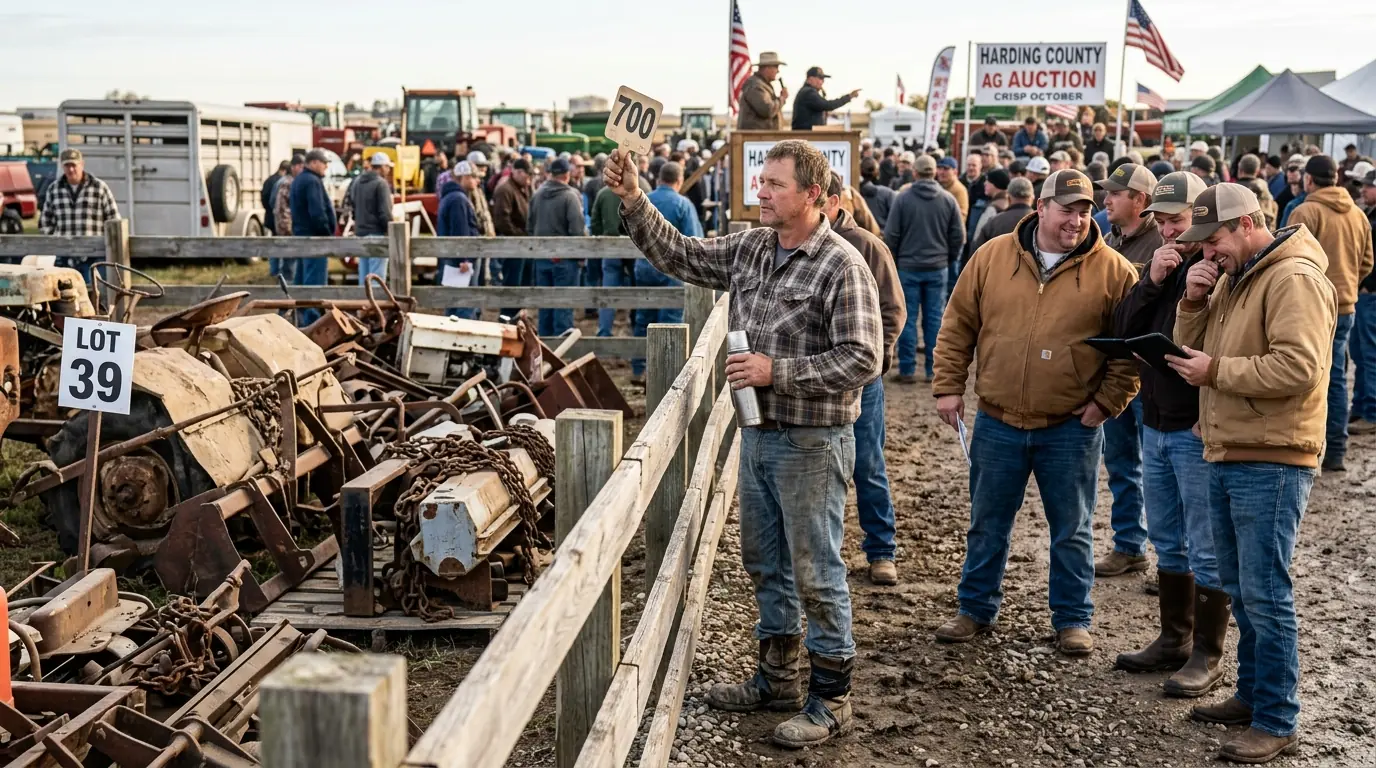 Caleb Durst was 53 years old. He ran 280 acres of dry land, corn and winter wheat, about 12 miles northwest of town, land that had been in his family since his grandfather broke sod there in 1951. The operation was small by current standards. Most of his neighbors had consolidated or sold out to the larger corporate interests that had been quietly absorbing the county over the past decade. Caleb had not sold. He had also not expanded. He simply continued, year after year, in the careful, methodical way of a man who has accepted the terms of his life without drama. The terms were not comfortable ones. His operating line at the bank sat at $34,000. Most of it rolled over from the previous year. The combine needed a new feeder house bearing that he’d been nursing through with grease and patience since July. The checking account, on the morning of the auction, held $1,140. He’d set aside 700 of it for the day in cash, and told himself that was the ceiling.
He was not a figure of local sympathy or admiration. He was simply a figure, present at the co-op, present at the grain elevator on harvest days, present at the diner on Wednesday mornings. People knew his name the way they knew the name of a county road because it was there and occasionally useful, and not particularly interesting. His wife, Marie, had passed four years earlier. Their son worked in Denver in something involving software. They spoke on Sundays.
What most people in the county did not know about Caleb Durst was that he read. Specifically, he read agricultural history, not the romantic version, not the sentimental kind found in gift shops, but the technical and economic history of American farm equipment, soil management, and commodity markets. He subscribed to two academic journals that arrived in his mailbox each quarter, journals that his mail carrier had once asked about, assuming they were medical. He’d developed this habit not from ambition, but from the long quiet of grief during the two winters following Marie’s death, when the evenings were very long and the television offered nothing he could stand.
He was standing at the back fence now, thermos in hand, watching the crowd and noticing things. The lots opened at 9:30. The auctioneer, a heavy-set man named Phil Garrett, who'd been calling sales in Harding County for 22 years, moved through the first dozen items with practiced efficiency. The combine went for $31,000 to a buyer on the phone. The irrigation pivots went to a dealer from Kearney. The crowd warmed up slowly, the way auction crowds always do, cautious at first, then looser, then almost social, the bidding becoming less about necessity and more about the competitive pleasure of the thing. Caleb watched from the fence. He watched the dealers. He watched what they bid on and, more importantly, what they walked past without looking at. He watched where their eyes went when the lots changed.
When the catalog description for lot 39 was read aloud, “Contents of storage unit, Baker Road property, sold as is, buyer responsible for removal,” three of the four dealers looked down at their tablets. The fourth, the one from Omaha who had noticed Caleb at the gate, turned to the dealer beside him and said something under his breath. The other man glanced at the screen showing the photos from Baker Road and shook his head once, already done with it. Caleb's expression did not change. He unscrewed the cap of his thermos and took a slow sip of coffee. He had a reason for that circle around lot 39. It had taken him two years to be in a position to act on it. He wasn't going to explain it to anyone standing at this fence.
In the winter of 2021, Caleb had spent six weeks reading a technical history of American farm implement manufacturing between 1880 and 1960. The book, 540 pages, published by a university press, never reviewed in any publication his neighbors might have encountered, documented in careful detail the production histories of dozens of manufacturers, including several who had operated in the Great Plains states before industry consolidation reduced the landscape to a handful of major names. One chapter, which Caleb had read twice and then returned to a third time, described a small manufacturer based in Columbus, Nebraska, that had produced a specialized line of grain handling equipment in the late 1930s and early 1940s. The equipment had been engineered specifically for dry land operations in the high plains, designed to move grain with minimal mechanical damage at low moisture levels, a problem that the major manufacturers hadn't adequately solved until decades later. The company had ceased operations in 1948. Most of its equipment had been worked to failure over the following decades, but some pieces left in barns, in storage units, in the back corners of sheds that hadn't been opened since the 1970s had simply sat unmaintained, but also unworked. Intact.
The academic value was modest. A few agricultural museums held pieces. A small community of collectors existed. But there was another dimension of value which the book mentioned in a single paragraph near the end of that chapter. Several of the design elements patented by the Columbus manufacturer had never been licensed and had never entered mainstream production. The tolerances on the auger flights, specifically, allowed grain movement at angles and speeds that modern equipment still struggled to replicate without moisture loss. A persistent problem that cost commercial operators measurable revenue every harvest season. A grain handling equipment company based in Winnipeg, Northgate Grain Systems, had in 2019 begun quietly filing patent applications built on the expired foundations of that original Columbus design. They were, at the time of the auction, in the middle of a product launch that had drawn serious attention from large commercial grain operators across the northern plains. Caleb had read about Northgate in one of his quarterly journals eight months before the Harding County sale. He had not mentioned it to anyone.
Lot 39 came up at 12:14 in the afternoon. The morning crowd had thinned. Some buyers had left after securing what they came for. Some had drifted to the catering truck parked outside the east gate. The concrete bleachers were about half full. The energy in the ring had gone a little slack. The way it does when an auction moves past its most coveted items and into the residue of the day. Phil Garrett read the lot description in the same practiced tone he used for everything. A few heads turned toward the small screen mounted beside the booth which cycled through photographs taken the previous week. A dim storage unit interior. Canvas tarps over angular shapes. Exposed metal surfaces showing the orange-brown bloom of long-term oxidation. Nothing that suggested urgency. Nothing that suggested value.
Phil started the bidding at $400. There was a silence of about four seconds, which is a long silence at an auction, before a hand went up near the front. It belonged to a salvage dealer named Hess who ran a scrap operation outside of Grand Island. He was bidding on the weight of the metal, not on what the metal was. “400,” Phil confirmed. “Do I hear 5?” A pause. “450,” Phil offered, dropping the increment without being asked, which is an auctioneer’s quiet signal that a lot is struggling. Hess shrugged from his seat and raised his paddle again. Silence returned. Phil looked around the room with the mild professional patience of a man who has presided over the full range of human indifference. “500? Anyone at 500?” There was a small sound from somewhere in the seating, a kind of suppressed laugh, though it wasn't clear at what exactly. Maybe the lot. Maybe the idea that anything in that storage unit was worth $500.
Caleb raised his paddle. He was standing at the back fence, but the fence ran along the open side of the ring, and the auctioneer's booth had a clear line of sight to it. Phil Garrett acknowledged him with a nod. “500. Thank you. Do I hear 550?” Hess, the salvage dealer, turned in his seat and looked at Caleb with the mild curiosity of a man who finds something puzzling but has no strong opinion about it. He raised his paddle. “550.” From somewhere in the bleachers, one person said to another, just loud enough to carry, “What's he think he's doing?” Not mean, exactly, just the instinctive question of people watching something they can't account for. A few nearby heads turned. Caleb bid 600.
Now, there was a perceptible change, not dramatic, but real. A few conversations stopped. A woman two rows up in the bleachers looked at her companion, then back at the fence where Caleb was standing. Hess looked at Caleb again. He looked at the screen cycling through photos of the rusted storage unit contents. He looked back at Caleb. Something in the calculation had shifted for him, though he couldn't have articulated why. He raised his paddle. “650.” “700,” Caleb said, speaking it aloud rather than using the paddle, which is unusual, and which Phil Garrett acknowledged with a slight raise of his eyebrows. The Omaha dealer, the one who had made the comment at the gate that morning, the one who had shaken his head at the lot 39 photos, pulled up his tablet and began typing quickly. He was looking something up, but lot decisions at auction happen in seconds, not minutes, and he was already behind.
Hess shook his head. He was out. $700 was more than scrap value on an unknown lot he hadn't personally inspected, and he was a practical man. Phil Garrett looked around the room. "$700. Any advance on 700?" A moment. The Kansas City dealer was still on his tablet. He opened his mouth, seemed to hesitate, and closed it. “700 going once.” A man in the second row laughed a short, quiet laugh and leaned toward his neighbor. The neighbor smiled without looking up. “700 going twice.” Caleb stood at the fence with his thermos at his side. His expression was the expression of a man waiting for a traffic light to change. “Sold. $700.” The laughter, such as it was, lasted about 45 seconds after the gavel came down. Small, good-natured, the kind of laughter that isn't cruel so much as reflexive. The auction crowd's equivalent of a shrug. A man in worn-out boots had just paid $700 for a unit of rusted equipment that a scrap dealer had walked away from. It was mildly funny in the way that small, inexplicable things are mildly funny when you've been standing in the cold since 9:00 in the morning.
Caleb walked to the registration desk, settled his account in cash, fourteen $50 bills, which was most of what he'd brought, and most of what he had counted out with quiet deliberateness, and arranged with the auction staff to return with a trailer on Thursday morning. He drove home in his 2003 Ford F-250 with the heater running on the passenger side only because the driver's side vent had stopped working two winters ago. He stopped at the co-op for a bag of mineral supplement. He was home by 2:00 in the afternoon.
That evening he made one phone call. It was to Northgate Grain Systems in Winnipeg. He had found the number four months earlier and written it in the back of a pocket notebook kept in the kitchen drawer. The call lasted 11 minutes. Northgate Grain Systems, the Winnipeg-based company whose product launch Caleb had been tracking, had released its new auger line the previous spring to strong commercial interest. The design, as Caleb had understood from his journal reading, was built on a core principle first demonstrated by the Columbus, Nebraska manufacturer in 1941. A specific helical pitch on the auger flight that reduced grain cracking by approximately 30% compared to standard commercial designs, particularly at the low moisture levels common in high plains harvests.
The patents on the original design had expired decades ago, but the working examples, the physical embodiments of that engineering, were extraordinarily rare. Most agricultural museums had photographs, not equipment. A few collectors had partial examples, incomplete or modified. Northgate's product development team had been working from measurements taken off a single surviving unit held by a museum in South Dakota. They had made it work, but their lead engineer had described the process in the trade journal article Caleb had read using the word "approximate."
What was in the Baker Road storage unit, what Caleb had recognized beneath the tarps on the Friday preview visit, because he had spent six weeks reading about these exact machines in granular technical detail, were three intact units of Columbus-manufactured grain handling equipment from approximately 1943. Surface rust, mechanically sound, complete. They were not museum pieces in the decorative sense. They were reference objects that an active engineering team genuinely needed.
Northgate sent a representative from their Winnipeg product development office to Nebraska 12 days after the auction. He arrived in a rental car, examined the three units in Caleb's machine shed, and spent two hours taking measurements and photographs. He was methodical and did not say much, which Caleb respected. The conversation that followed took place at Caleb's kitchen table over instant coffee. The Northgate representative explained what the units represented to their calibration process. Caleb listened. He asked two questions, both of them practical. They agreed on a figure for a short-term loan arrangement. The units would remain on Caleb's property, available for periodic measurement access, with an option for eventual purchase. The agreement was documented by a lawyer in town who charged $180 for the paperwork. The total figure was $47,000 paid in two installments, the first arriving by wire transfer within the week, the second upon execution of the purchase option six months later.
Caleb used the first installment to repair the fence line on the north side of his property, which had been deteriorating for three years, and to replace the hydraulic cylinder on his grain cart, which had been leaking since August. He put the remainder in a savings account at the bank in town where he had kept his accounts for 26 years. He did not tell anyone how much he had received. The auction receipt was public record: $700 for lot 39, and a few people in town made comments in the friendly, needling way of small communities, about the farmer who bought the junk pile. Caleb received these comments with the same expression he'd worn at the fence: calm, patient, not unfriendly.
By the following spring, word had begun to move in the quiet, indirect way that word moves in small agricultural communities. Not about the money—Caleb had been careful about that—but about the fact that something had happened. That the man people had half noticed for years, standing at the back fence of the auction with his thermos and his electrical tape boots, had apparently known something that four professional buyers with tablets and expense accounts had not known. Phil Garrett, who heard most things eventually, tracked Caleb down at the co-op in April and asked him directly in the manner of a man who has been turning a question over for months and finally decided to simply ask it. “What did you see in those units that nobody else did?” Caleb considered the question for a moment. “I read about them,” he said. “That's all.” Phil nodded slowly, as if this were a more complicated answer than it appeared. In a way, it was.
At the next fall auction, Caleb arrived with the same thermos and found the same spot at the back fence. But this time, two of the dealers from the previous year positioned themselves within a few feet of him, not close enough to be obvious, just close enough to watch where his eyes went. Caleb noticed this. He said nothing about it. He bid on a set of seed drill coulters in lot 12, paid $230, and left before the afternoon session. Some forms of reputation are worth more over time than money, and some are worth both.
There is a particular kind of knowledge that accumulates slowly in the margins of ordinary life without announcing itself. It doesn't look like expertise from the outside.