Dalton Voss waited until Thomas had stopped the tractor before pointing at the crooked steel hanging behind it.
“You dragged all that garbage home to wreck your field?”
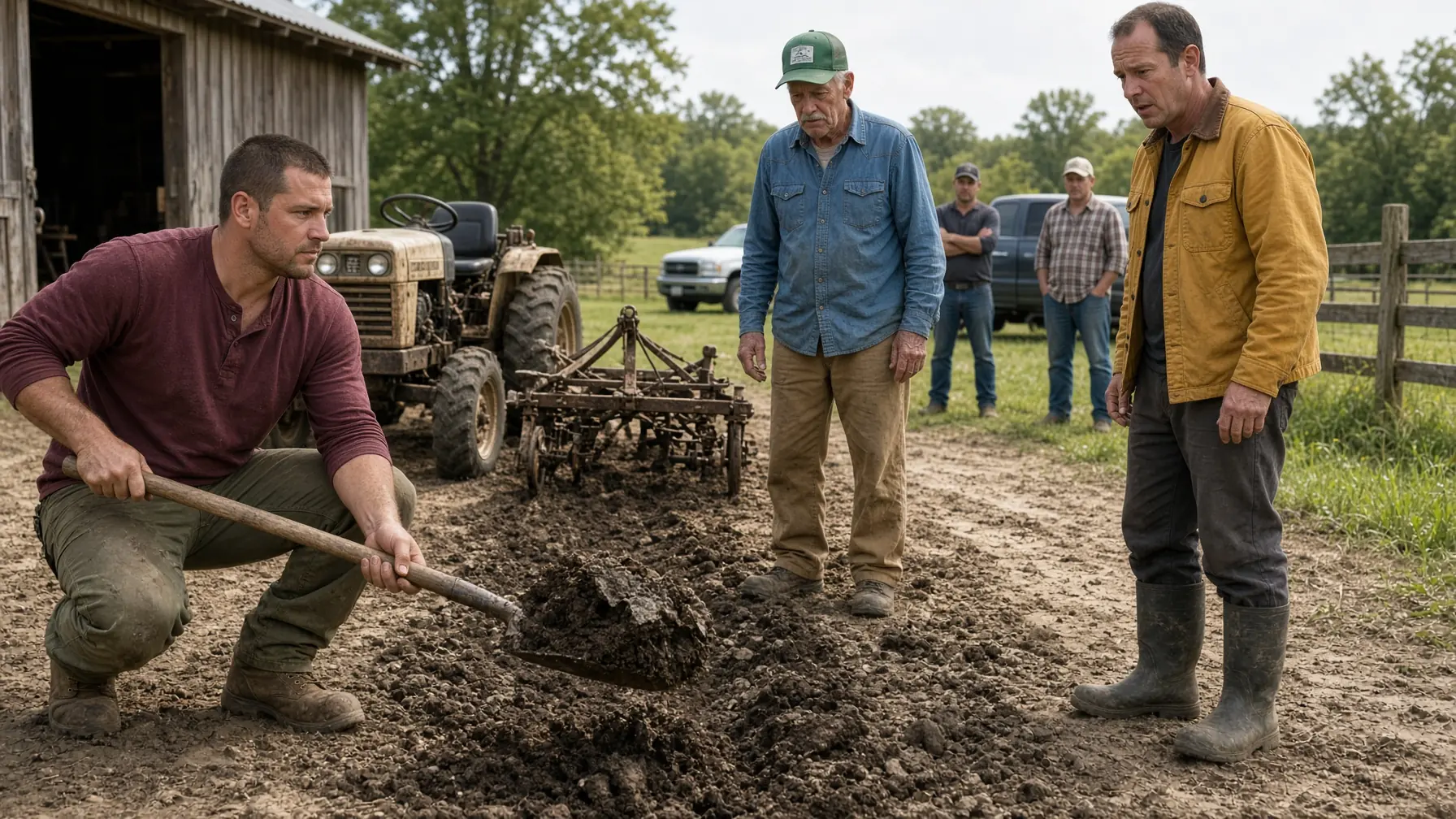
The laughter reached Thomas over the engine’s uneven idle. Beside Dalton, Oren Pike shook his head, and the two farmers standing near the pickups joined in as though they had been waiting for someone to say it.
Thomas rested a hand on the tractor’s fender. From where they stood, he knew exactly what the implement looked like.
Rusted truck leaf springs. Bent steel rods. A rough arrangement of used metal behind an old compact tractor that had already worked harder that morning than its appearance suggested it should.
There was nothing about it that asked strangers to have confidence.
Thomas had been losing confidence in it himself until late the previous evening.
He had stood inside the open barn with a work light aimed toward the floor and a loose piece of steel in his hand. His boots ached, his shirt stuck to his back, and the job he had told himself would take another hour had carried him past supper.
Outside, darkness had settled over the pasture. The planting strip beyond the barn disappeared into it, though he could have walked to the troubled patch without a light.
He knew that ground too well.
During dry weather, its surface hardened until even a shallow shovel cut required effort. After rain, it held itself in a way that made him stop and look, wondering whether he was seeing a problem that could be managed or one he had helped make worse.
He had tried to ignore that question at first.
There was always another job. A loose hinge on a gate. A tractor that needed attention. Supplies to collect before a store closed, or something living that could not wait while he considered the condition of an empty strip of land.
The planting strip had waited.
Then it had begun costing him time in other ways.
He would go out with one task in mind and find himself stopping to break a clod apart, pushing his boot into the ground, or staring at the mark left by a passing tire. He kept returning to the same few places, as if looking often enough might produce an answer.
Eventually he began taking the shovel with him.
He did not like what he found.
That was when the advice started.
Some of it was useful. Some came from people who understood his farm only as a place they passed on the road.
Thomas listened to more of it than he wanted to. At thirty-four, he was old enough to know that experience mattered and young enough to discover how often people used the word to mean that he should stop asking questions.
He had broad shoulders, a sturdy frame, and hands that looked as though they ought to be able to solve most problems by working longer. The assumption followed him around.
If something remained unfinished, people tended to believe he had not put enough effort into it.
Thomas could have shown them the barn after midnight.
He could have shown them the cracked skin beside his thumb or the stack of parts he had set aside because using a questionable piece would only make the next job worse. Instead, he kept working, which allowed everyone to continue thinking the work was simple.