The scrap buyer laughed when Malik Carter raised his hand.
Not cruelly.
More like a grown man watching a sixteen-year-old make a mistake he would eventually understand.
“You sure about that, boy?”
Malik stood near the back fence of Whitford Farm Equipment with both hands shoved into the pockets of his winter coat.
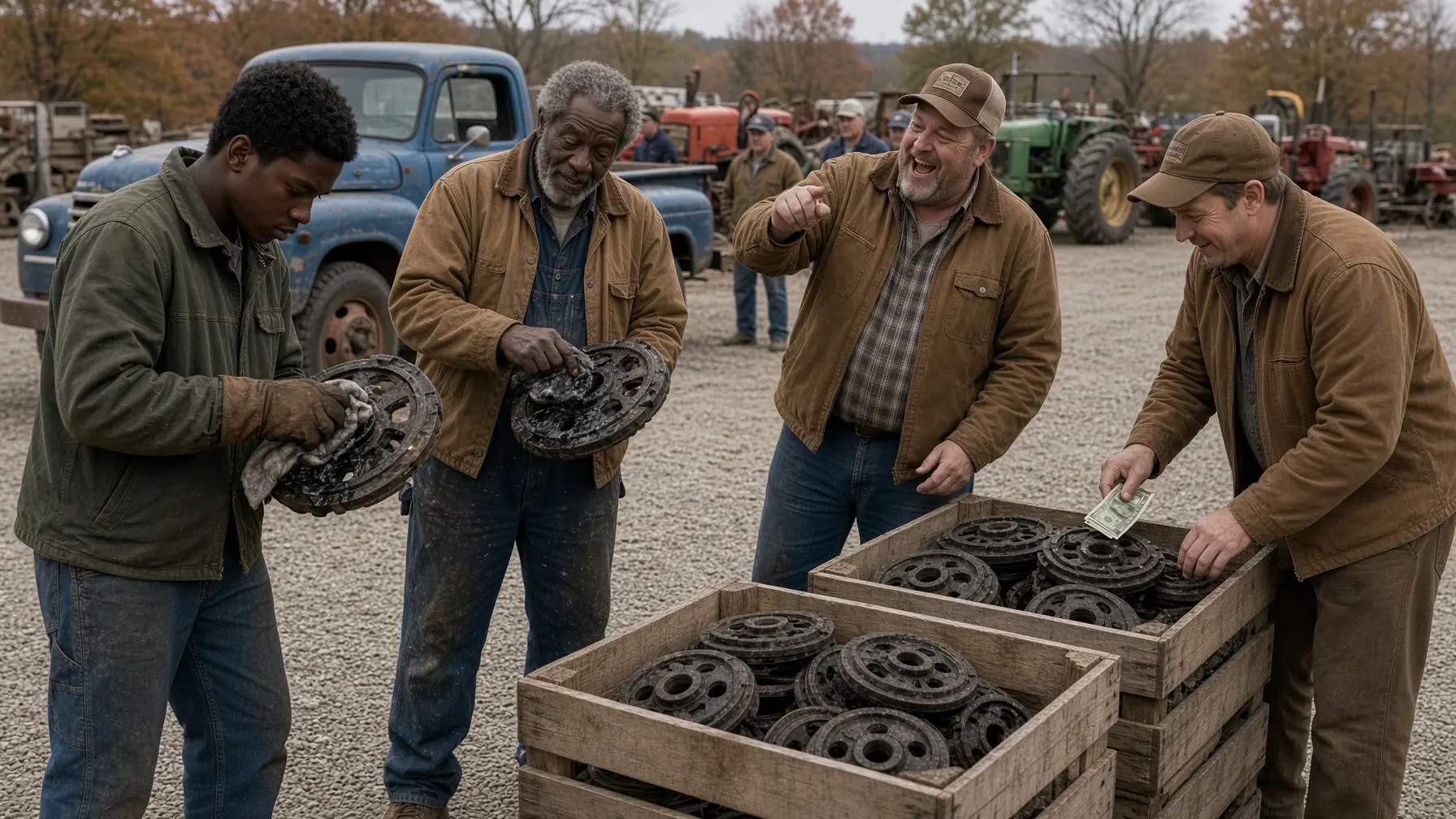
In front of him sat several old wooden crates.
Inside them—
hundreds of rust-streaked cast-iron discs.
Greasy.
Heavy.
Dirty.
Most had probably not moved from that fence line in twenty years.
The auctioneer’s assistant tapped one crate with the toe of his boot.
“Old seed plates.”
He shrugged.
“Planters haven't been made for these in decades.”
Malik lifted one.
Turned it over.
Rubbed his thumb across the underside.
Beneath the dried grease, something appeared.
Numbers.
Faint.
Cast directly into the iron.
A string of digits.
Then a letter.
Malik cleaned another patch.
Different number.
Another plate.
Different again.
He looked toward the assistant.
“How many?”
“About nine hundred.”
“Nine hundred?”
“Near enough.”
The assistant smiled.
“We’re selling the whole pile with scrap iron.”
Malik looked at the crates.
Then reached into his coat.
He had $186.
Most of what he had earned that summer after school repairing equipment at Bell Farm Equipment Repair.
Money he had planned to save.
The scrap buyer watched him counting bills.
Then laughed.
“You aren't actually buying those.”
Malik looked at him.
“Why not?”
“Because they’re worth whatever the scrap yard pays by the pound.”
Malik turned the plate over again.
Looked at the number.
Then at the other crates.
Something bothered him.
Manufacturers did not cast numbers into iron for decoration.
Malik looked toward the auction assistant.
“One hundred eighty dollars.”
The man blinked.
“For all of them?”
“Yes.”
The scrap buyer laughed louder.
“Boy wants to buy scrap iron by the piece instead of by the pound.”
A farmer nearby shook his head.
“Good luck sorting that mess.”
The assistant looked at the crates.
Then at Malik.
“Hundred eighty?”
Malik nodded.
The man held out his hand.
“Sold.”
Malik gave him almost every dollar he had earned that summer.
And for several seconds after the money left his hand, even Malik wondered if he had just done something incredibly stupid.
Nobody standing in that gravel lot could have told him otherwise.
Not the auctioneer.
Not the scrap buyer.
Not the farmers searching for tractors and tillers.
Not even Malik.
He did not know what he had bought.
He only knew one thing.
Those numbers meant something.
And numbers cast into iron were not put there by accident.
Whitford Farm Equipment had been selling machinery from that location for fifty-three years.
By October 1990, it was finished.
The business was closing.
Everything had to go.
Planters.
Harrows.
Combines.
Tools.
Old dealership inventory.
The useful machines attracted crowds.
The small obsolete parts did not.
That was why the seed plates had ended up behind the building.
They looked worthless.
Malik knew appearances could be misleading.
He had learned that from Otis Bell.
Mr. Bell was sixty-eight years old and had repaired farm machinery longer than Malik had been alive.
His shop stood a few miles outside town.
Nothing about it looked impressive.
Tin roof.
Oil-stained concrete.
Old manuals stacked in cabinets.
Parts hanging from nails.
Coffee that tasted like something drained from a diesel engine.
But farmers sometimes drove fifty miles to see him because Mr. Bell could listen to a machine for ten seconds and say:
“Shut it off.”
Then point to the exact place something was about to break.
Malik had started helping there after school.
Sweep floors.
Wash parts.
Carry tools.