The room went quiet when Paul Wickham read the number.
Not respectful quiet.
Not ordinary auction quiet.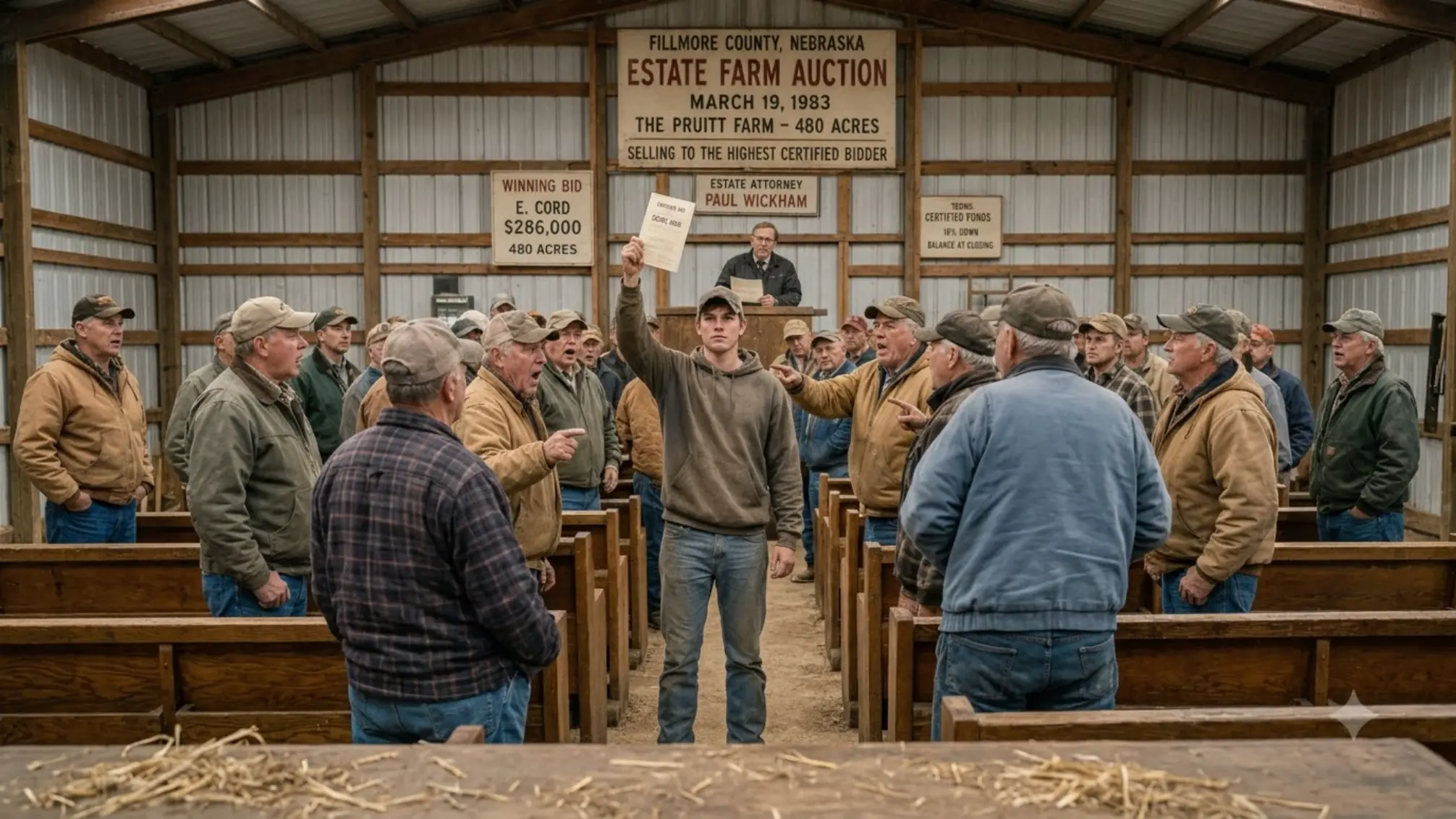
The kind that comes when thirty people simultaneously realize they have misunderstood the person standing directly in front of them.
“Two hundred eighty-six thousand dollars.”
Paul Wickham adjusted his glasses and looked once more at the certified papers in his hand.
Then he looked toward the center aisle.
“Elias Cord.”
Every face turned.
Elias stood between two rows of worn wooden benches inside the Fillmore County estate-sale hall wearing a faded brown sweatshirt, dirty jeans, work boots, and the gray cap he had owned since high school.
He looked twenty-two because he was twenty-two.
That had been the problem all morning.
Older farmers had smiled when he entered.
One man had asked whether Elias was helping unload chairs.
Another had joked that the 4-H sale was next month.
A land investor from Lincoln named Raymond Fletcher had glanced at Elias’s work clothes and said loudly enough for three rows to hear, “Someone better tell the boy this isn’t a machinery raffle.”
Men had laughed.
Elias had not answered.
Now Fletcher was no longer smiling.
Paul Wickham continued.
“The offer is fully certified and satisfies the estate requirements.”
Raymond stood.
“You’re telling us that kid has two hundred eighty-six thousand dollars?”
Elias slowly lifted the certified bid papers.
The room erupted.
“Where’d he get it?”
“Who’s backing him?”
“There’s got to be a bank behind this.”
“His father?”
“Some investor?”
Raymond pointed toward Elias.
“Sit down, kid. Men with real money are buying this farm.”
Elias finally looked at him.
“Then one of those men should’ve bid more than two hundred eighty-six thousand.”
Several people stopped talking.
Raymond stepped into the aisle.
“You expect us to believe a twenty-two-year-old owns that kind of money?”
Elias raised the papers higher.
“Don’t believe me.”
His voice was calm.
“Read the deed when my name replaces yours.”
Nobody laughed.
Eight years earlier, Elias Cord had been fourteen years old and riding an old bicycle down County Road 7.
It was August 1974.
Nebraska heat had turned the afternoon air heavy, and cicadas screamed from cottonwoods beside the drainage ditches.
Elias had been carrying a wrench in one pocket and a bottle of warm water in the other because his father had sent him to help repair an irrigation pump on a neighboring farm.
He stopped his bicycle beside the eastern fence of the Pruitt property.
Four hundred eighty acres stretched beyond it.
The wheat was green-gold beneath the sun.
Windbreaks stood along the northwestern boundaries.
Drainage channels cut clean lines through low sections of ground.
Nothing about the farm was extravagant.
There were no grand gates.
No white mansion.
No decorative sign announcing wealth.
It looked serious.
Useful.
Permanent.
Harold Pruitt was driving a tractor near the far field.
Elias watched him make a slow turn.
He had known Harold his entire life.
Everyone in Fillmore County knew Harold.
He was not rich in the way city people imagined rich men.
He wore patched coveralls.
He drove old machinery longer than most farmers thought reasonable.
But Harold owned good ground.
More importantly, he understood it.
Elias rested both hands on the handlebars.
Something settled inside him.
Not a fantasy.
Not a wish.
A decision.
Someday, he was going to own that farm.
He told nobody.
That mattered.
If Elias had told his friends, they would have laughed.
If he had told his mother, she would have hugged him and worried.
If he had told his father, Roger Cord would probably have explained agricultural debt, land prices, interest rates, and why a fourteen-year-old should focus on finishing high school.
Roger would not have meant to discourage him.
Roger was simply practical.
He farmed 160 acres east of the Pruitt property and understood exactly how quickly land dreams became bank obligations.
Every year Roger planted corn.
Every year he harvested.
Every year money entered the operation.
And every year much of it disappeared again.
Fuel.
Seed.
Repairs.
Taxes.
Interest.
Equipment payments.
Elias watched his father work harder than nearly anyone he knew and still spend winter evenings calculating whether another loan would be needed before planting.
Roger was not failing.
That was what disturbed Elias.
His father was doing almost everything correctly.
And still the system owned too much of him.
Elias decided that if he ever bought serious acreage, he wanted enough money behind him that the land belonged to him more than it belonged to a lender.
At fifteen, he began baling hay.
The work was miserable.
Dust collected inside his shirt.
Hay scratched his arms.
The summer sun heated metal wagons until touching them bare-handed hurt.
Elias worked anyway.
A neighboring farmer named Bernard Haas paid him by the field.
At the end of the first week Bernard handed Elias an envelope.
“Go buy yourself something.”
Elias nodded.
He deposited almost all of it.
At sixteen he took weekend shifts at the grain elevator.
At seventeen he started driving combines during harvest.
People learned quickly that Elias took equipment seriously.
If someone loaned him a truck with a full tank, he returned it full.
If a belt started squealing, he stopped before it snapped.
If he borrowed a wrench, it came back cleaned.
Those details made him employable.
One farmer recommended him to another.
Then another.
Soon Elias could work nearly every available hour during planting and harvest seasons.
His friends bought pickups.
Elias kept driving an old Chevrolet his father helped him repair.
A classmate bought a stereo system expensive enough to shake the windows of the school parking lot.
Elias bought work boots.
Another friend spent an entire summer’s earnings on a motorcycle.
Elias deposited his pay.
His mother eventually asked him one evening while washing dishes.
“You saving for something?”
“Yes.”
“A truck?”
“No.”
“College?”
“Maybe some classes.”
She waited.
Elias dried a plate.
His mother smiled.
“You going to tell me?”
“Not yet.”
She studied him for a moment.
“All right.”
That was one of the things Elias loved about her.
She knew when curiosity was useful and when it was merely curiosity.
His father knew about the bank account because Roger had helped open it.
One evening Roger looked at the statement.
“You’re either the most disciplined teenager in Nebraska or the most boring.”
Elias looked up from supper.
“Could be both.”
Roger laughed.
Neither man mentioned the account again.
Meanwhile Elias kept studying the Pruitt farm.
Not officially.
He simply paid attention.
Harold Pruitt sometimes visited the Exeter grain elevator.
Most men talked to Harold about prices.
Elias asked about soil.
“Why’d you tile that eastern section?”
Harold looked at him.
“Water sat there too long.”
“Was it worth the cost?”
“Eventually.”
“How long?”
Harold thought.
“Six years before I’d say the yield paid it back.”
Elias remembered that.
Another time he asked about the windbreaks.
“Everybody says you sacrificed productive acres planting those trees.”
Harold snorted.
“Everybody sees the rows I gave up. Nobody counts the topsoil I kept.”
Elias liked that answer.
He wrote it down later.
Over several years he learned that Harold kept soil tests going back decades.
He tracked fertilizer applications.
He documented yields.
He remembered which field flooded in 1957, which froze badly in 1968, which section recovered fastest after drought.
To most people, Harold owned 480 acres.
To Harold, he knew 480 acres.
Elias wanted to inherit that attitude even if he never inherited anything else.
Then Mabel Pruitt died.
Harold changed after that.
He still farmed.
Still maintained machinery.
Still kept records.
But people saw the silence grow around him.
Harold and Mabel had never had children.
Everyone in Fillmore County understood what that meant without discussing it directly.
Eventually the property would be sold.
Elias was nineteen when he realized his childhood decision might actually have an ending.
He worked more.
He added seasonal jobs.
He started repairing equipment for cash.
When neighbors needed someone overnight during harvest, Elias went.
When a grain truck broke down after midnight, Elias was usually one of the first people called.
He did not feel deprived.
People later assumed saving that aggressively required extraordinary sacrifice.
It did not feel that way to Elias.
Buying the Pruitt farm was what he wanted.
The money was only useful if it moved him toward the land.
Harold died in October 1982.
The news reached Elias while he was helping his father service a combine.
Roger shut off the engine.
“Harold Pruitt passed last night.”
Elias remained still.
He had known Harold was ill.
Still, hearing it made the world feel slightly less permanent.
Roger wiped grease from his hands.
“Good man.”
“Yes.”
“Best farmer in the county.”
Elias looked toward the west.
Pruitt land lay four miles away.
“What happens to the farm?”
Roger shrugged.
“His sister’s in Omaha. Brother’s in Grand Island. Neither farms.”
Elias nodded.
He said nothing more.
That winter, the estate notice appeared.
PRUITT ESTATE — 480 ACRES.
Elias read it three times.
He folded the newspaper.
Then drove to Fairbury.
Paul Wickham’s office occupied the second floor above an insurance agency.
The attorney was fifty-eight, silver-haired, careful, and professionally polite.
He had handled enough estate sales to recognize unrealistic buyers quickly.
Elias expected skepticism.
He got it.
Not insult.
Skepticism.
Wickham explained the sale structure.
Serious offers required certified documentation.
The estate expected substantial bids.
Comparable acreage indicated a price somewhere between approximately $260,000 and $310,000.
Elias listened.
Then Wickham asked, “Do you mind telling me your age?”
“Twenty-two.”
Wickham leaned back slightly.
“And you have access to funds appropriate for a property of this size?”
“Yes.”
“Through an agricultural lender?”
“I brought financial documentation.”
Elias placed the papers on the desk.
Wickham began reading.
His expression changed gradually.
Years of deposits.
Steady.
Regular.
No sudden inheritance.
No unexplained transfer from wealthy relatives.
No trust fund.
Work income.
Savings.
Planning.
Wickham eventually looked up.
“You did this yourself?”
“Yes.”
“How long have you been preparing?”
“Eight years.”
“For this particular property?”
“Yes.”
Wickham removed his glasses.
“You decided at fourteen you were going to buy Harold Pruitt’s farm?”
“I decided I wanted to.”
“And you never told him?”
“No.”
“Why not?”
Elias thought about it.
“Talking wouldn’t help me buy it.”
For the first time, Wickham smiled.
Several serious buyers pursued the property.
A Lincoln agricultural company studied the acreage as part of a regional expansion.
A land partnership from Omaha viewed it as a long-term investment.
A retired farmer wanted it for his sons.
Another buyer from Hastings hoped the estate would accept a lower number for a clean transaction.
Elias studied none of them.
He did not try guessing what they would pay.
He calculated what the farm was worth to him.
The soil.
Drainage.
Buildings.
Water rights.
Harold’s management.
The years of records.
The fact that Elias intended to work the ground himself rather than treat it as a number in a portfolio.
His number became $286,000.
He submitted it.
Then he waited.
People later described his patience as extraordinary.
Elias would have disagreed.
He had already waited eight years.
A few days barely registered.
When the estate gathered interested parties for the official announcement, Elias arrived early.
That was when the jokes began.
Raymond Fletcher represented one of the larger outside interests.
He wore a tan insulated coat cleaner than most men’s coats in the room and carried himself like someone accustomed to knowing the final number before everyone else.
He noticed Elias sitting alone.
“You bidding?”
“Yes.”
Raymond laughed.
“On what?”
“The farm.”
Three men nearby turned.
One smiled.
Raymond glanced around theatrically.
“The whole farm?”
“Yes.”
That produced more laughter.
Raymond shook his head.
“Kid, equipment sells another day.”
Elias looked down at his documents.
“I know.”
“What are you farming?”
“My family farms east of here.”
“How much?”
“One sixty.”
Raymond nodded as if his point had been proven.
“This is four eighty.”
“I know.”
“Different league.”
Elias said nothing.
An older farmer whispered, “Boy’s dreaming.”
Someone else answered, “Nothing wrong with dreaming.”
Raymond said, “There is when you waste everybody’s time.”
Paul Wickham entered before Elias needed to respond.
Documents were organized.
Estate representatives sat near the front.
The bids were reviewed.
Numbers were announced.
Two hundred forty-four thousand.
Two fifty-eight.
Two seventy-one.
Two eighty-three.
Each number changed the room.
By $283,000, Raymond looked pleased.
His group had submitted that offer.
He leaned back.
Then Wickham opened the final papers.
His eyes paused.
Elias knew immediately.
He did not smile.
Paul cleared his throat.
“Final qualified bid. Elias Cord. Two hundred eighty-six thousand dollars.”
Raymond’s face went blank.
Someone behind Elias whispered, “What?”
Wickham continued.
“Certified documentation verified.”
The room exploded.
That was when Elias stood.
Someone asked who financed him.
Another demanded to know whether his father owned the money.
Raymond called the bid impossible.
Elias lifted the certification.
The same young man they had treated like a boy suddenly became the only man in the room holding the winning documents.
Raymond stepped closer.
“This is nonsense.”
Paul Wickham’s voice sharpened.
“It has been verified.”
Raymond ignored him.
He pointed at Elias.
“You don’t know what owning four hundred eighty acres costs.”
Elias finally turned fully toward him.
“I know exactly what it costs.”
“You know purchase price.”
“I know drainage maintenance.”
Raymond stopped.
“I know the northwestern windbreaks were planted in 1969.”
Several older farmers looked at each other.
“I know the eastern low ground was tiled in 1963.”
Paul Wickham watched silently.
“I know Harold soil-tested every major section and kept the records back to 1948.”
Raymond’s expression changed.
Elias lowered the papers.
“I didn’t discover this property in December.”
Nobody interrupted.
“I’ve been learning this farm since I was fourteen.”
The room quieted.
Raymond looked at him.
“You expect to run it alone?”
Elias shrugged.
“I expect to work.”
It was not a dramatic answer.
That made it stronger.
One of Harold’s estate beneficiaries, his older brother, leaned toward Wickham.
“That boy really saved for eight years?”
Paul nodded.
The older man looked toward Elias.
Then at the documents.
“Harold would’ve liked him.”
Paul smiled faintly.
“I think so too.”
Closing took place in March.
The deed listed Elias Cord as buyer.
Four hundred eighty acres.
Farm structures.
Water rights.
$286,000.
No family dynasty stood behind his name.
No wealthy investor.
No trust.
Elias signed each page carefully.
When Paul Wickham handed him the final documents, he said, “Most buyers celebrate at this point.”
Elias looked at him.
“I have work tomorrow.”
Paul laughed.
“You really are twenty-two going on sixty.”
Elias smiled.
“Probably.”
On April 1, he took possession.
His belongings fit into one truck.
Clothes.
Tools.
Books.
A kitchen table his mother insisted he take.
Two chairs.
A bed.
A radio.
Several boxes.
The Pruitt farmhouse still smelled faintly of dust, old wood, and the life that had existed there before him.
Elias walked through each room slowly.
In the office, he found Harold’s filing cabinet.
He opened the first drawer.
Soil records.
Dates.
Maps.
Handwritten observations.
Decades of attention.
Elias ran one finger across the labels.
He did not reorganize anything.
He placed his own notebook beside the cabinet.
The next morning his father arrived.
Roger parked in the yard and simply stood there.
He looked toward the barn.
The windbreaks.
The fields.
The house.
Then he looked at his son.
“When did you really decide?”
Elias knew exactly what he meant.
“Fourteen.”
Roger stared across the east field.
“You never said a word.”
“I didn’t want to talk about it.”
“You wanted to do it.”
“Yes.”
Roger put both hands in his coat pockets.
“I would’ve told you you were crazy.”
“I know.”
Roger laughed.
Then the laugh faded.
“I would’ve been wrong.”
Elias looked at him.
Roger’s eyes were wet.
His father quickly looked toward the windbreak.
“You know what scares me?”
“What?”
“You did all this while living in my house, and I didn’t understand what I was watching.”
Elias shook his head.
“You taught me most of it.”
Roger frowned.
“I never taught you to save eight years for a farm.”
“No.”
Elias looked toward the fields.
“You taught me what debt feels like.”
Roger became quiet.
The words could have sounded cruel.
They did not.
Both men knew they were true.
“I watched you work,” Elias continued. “You never stopped. But every year somebody else owned part of what you produced.”
Roger nodded slowly.
“I wanted more ground under my feet.”
His father looked across 480 acres.
“Well.”
He smiled.
“You got it.”
The first season was difficult.
Owning good land did not eliminate weather.
Equipment still broke.
Fuel still cost money.
Markets still moved whether Elias agreed with them or not.
A hydraulic line failed during planting.
A spring storm flattened one field.
One section retained too much moisture.
Another dried faster than expected.
But Elias had something unusual for a young operator.
History.
Harold’s records told him how the farm behaved.
When a low field became wet, Elias found Harold’s notes from similar years.
When fertilizer recommendations changed, he compared them against decades of soil tests.
When a neighbor suggested removing part of the windbreak to gain additional planting acres, Elias remembered Harold’s sentence.
Everyone sees the rows I gave up. Nobody counts the topsoil I kept.
He left the trees.
That summer Paul Wickham drove out.
No legal reason.
He said he had been nearby.
Elias suspected otherwise.
They walked through the east field.
Wheat moved around them beneath a warm breeze.
Paul said, “The Lincoln buyer called after the sale.”
“What did he want?”
“Wanted to know who beat him.”
“What did you say?”
“I told him.”
Elias smiled.
“He probably liked that.”
“Not especially.”
They walked several more yards.
Paul continued.
“I told him you’d been preparing for eight years.”
Elias looked over.
“What’d he say?”
“He said he’d been in agricultural investments twenty years and never waited eight years for anything.”
Elias looked across the crop.
Paul stopped.
“I told him maybe that was the difference.”
For several seconds neither man spoke.
The wheat moved.
That was answer enough.
Years passed.
Elias improved the farm cautiously.
He added acreage when it made sense.
Not when pride demanded expansion.
He bought neighboring ground in 1991.
Later, more.
Six hundred forty acres became more than a thousand.
But the Pruitt acreage remained the center.
The original farmhouse stayed.
The windbreaks stayed.
The drainage system stayed maintained.
And Harold’s filing cabinet stayed exactly where Elias had found it.
He added his records behind Harold’s.
Every season.
Every soil test.
Every change.
Every yield.
One history continued into another.
Roger visited often.
As he aged, he worked less and watched more.
Some mornings father and son drank coffee at the Pruitt kitchen table.
Roger would look through the window.
“You know, I still don’t understand how you did it.”
Elias smiled.
“You understand.”
“I understand saving.”
Roger shook his head.
“I don’t understand knowing what you wanted at fourteen.”
Elias considered this.
“I didn’t know everything.”
“You knew enough.”
“Yes.”
Roger smiled.
“That might be rarer.”
Years later, Elias’s eldest son Marcus began farming beside him.
One winter afternoon Marcus opened the old filing cabinet.
“What’s all this?”
“History.”
Marcus pulled a folder.
“1948?”
“Harold Pruitt.”
“He kept all of it?”
“Everything that mattered.”
Marcus read.
“So these aren’t yours.”
“The newer ones are.”
Marcus looked through decades.
Pruitt.
Pruitt.
Pruitt.
Then Cord.
Year after year.
Two men.
One farm.
One continuous record.
“Why keep his?” Marcus asked.
Elias looked at his son.
“Because the land was here before me.”
He closed the drawer gently.
“And if we do this right, it’ll be here after us.”
Marcus nodded.
Eventually he started a second cabinet.
The story of Elias buying the Pruitt farm became part of Fillmore County folklore.
People exaggerated pieces.
Some said he walked into an auction with cash in a suitcase.
He did not.
Others claimed he shocked everyone by doubling the nearest bid.
He did not.
The difference was only three thousand dollars over the next-highest serious offer.
Some said Harold had secretly promised him the land.
He had not.
The true story was quieter.
A fourteen-year-old saw something he wanted.
He decided.
Then he spent eight years arranging his life around that decision.
No applause.
No speeches.
No certainty the property would ever become available.
No promise he would eventually win.
Only preparation.
That was the part Elias always considered important.
One afternoon many years later, a young hired hand asked him about the sale.
They were standing near the east fence.
Almost exactly where Elias had stopped his bicycle in 1974.
“Were you scared somebody would outbid you?”
“Yes.”
“Then how’d you know eight years of saving wouldn’t be wasted?”
Elias looked toward the field.
“I didn’t.”
The young man seemed disappointed.
He wanted a better answer.
Elias smiled.
“You can prepare without guarantees.”
“But what if you hadn’t won?”
“I’d still have the money.”
“And then?”
“I’d find another piece of ground worth owning.”
The young man frowned.
“So the whole thing could’ve gone differently.”
“Of course.”
Elias rested one hand on the fence.
“That doesn’t make the work wasted.”
He looked toward the windbreak Harold had planted when everyone called trees an expensive misuse of productive land.
“People think patience means waiting for the world to give you what you want.”
He shook his head.
“It doesn’t.”
The young man listened.
“It means becoming ready while the world decides whether the opportunity is coming.”
A tractor moved across the distance.
The same land.
Different generation.
Elias watched it.
He had once been the kid everyone underestimated.
Then the young man with the impossible certified bid.
Then the farmer who had to prove buying land was easier than keeping it.
Then the father teaching his son how to read soil records written before either of them was born.
His life had changed.
The principle had not.
Good land rewarded attention.
Good decisions rewarded patience.
And sometimes the most powerful thing a person could do was refuse to announce a dream before they had built enough beneath it to make other people’s opinions irrelevant.
Back in March 1983, none of the angry men in the estate-sale hall understood that yet.
They only saw twenty-two-year-old Elias Cord standing between wooden benches with his winning papers held above his head.
They saw dirty boots.
A faded sweatshirt.
A young face.
They saw everything except the previous eight years.
That was why they were shocked.
And that was why Elias was not.
He had already lived the part of the story they could not see.
The auction announcement was only the moment everyone else finally caught up.