The laughter started before Della Pruitt had even managed to lift the can off the tailgate. It was the spring of 1961 at a farm liquidation sale outside Pratt, Kansas, where rusted tractors, old implements, fence posts, harness pieces, cracked buckets, and generations of worn-out farm equipment had been dragged into rows beneath a wide prairie sky. Della was nine years old, small enough that the battered coffee can full of horseshoes pressed against nearly half her torso when she wrapped both arms around it. Around her stood grown men in work coats and dusty hats, smiling, pointing, and shaking their heads at the little farm girl who had apparently spent every cent she owned on a bucket of rust.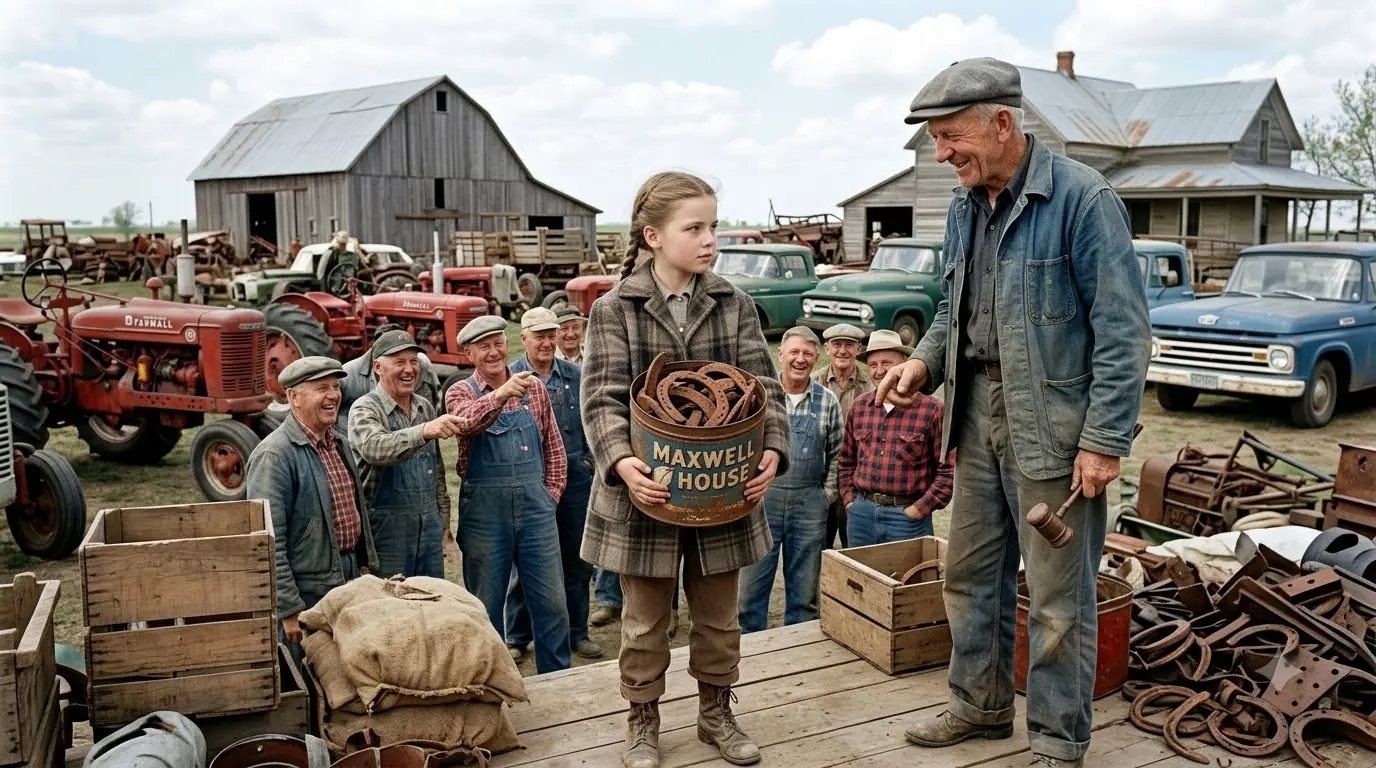
The auctioneer had nearly skipped the horseshoes altogether because they looked too worthless to bother selling. They were jammed together inside a large Maxwell House coffee can, brown with corrosion, some still carrying bent nails, others cracked or worn thin where years of contact with hard ground had eaten into the iron. He lifted the can by its wire handle, felt the weight pull against his arm, and called out to the crowd, "Somebody want this? It's heavy." Most of the men barely looked until a small hand rose from between two adults near the back.
Della stepped forward wearing the thick brown-and-gray wool coat she used for cold mornings around the farm. Her light-brown hair had been braided neatly away from her face, and she kept her eyes fixed on the can as if the auctioneer were holding something far more interesting than scrap. In her coat pocket she had thirty-five cents, two dimes, a nickel, and two pennies, money that represented nearly everything she could spend without asking her father. When the auctioneer accepted the coins and pushed the can toward her, the men around the truck began laughing in earnest.
One farmer pointed at the tangled horseshoes and asked whether she planned to start her own junkyard. Another joked that the can probably weighed more than the girl carrying it, and the laughter traveled through the group because nobody saw cruelty in what they were doing. To them, Della had made the kind of harmless mistake children made when they did not yet understand money. She stood there with both hands locked around the can and looked at the men without smiling.
"Thirty-five cents for that pile?" one of them said, still laughing. "Girl, you bought the worst thing at the whole sale." Della tightened her fingers around the dented metal rim and answered with the seriousness of someone much older. "You see rust because you don't know what you're looking at."
That only made them laugh harder. The auctioneer moved on to the next lot, the men turned their attention toward a piece of farm machinery, and within minutes Della's strange purchase became another story to tell over coffee. She carried the heavy can back to her family's truck and kept it in her lap during the ride home because she did not want the horseshoes bouncing around loose in the bed. By sundown, people in Pratt were already talking about Harlan Pruitt's youngest daughter spending her allowance on scrap iron.
Within days the story had reached the feed store on Main Street, the co-op beside Highway 54, the diner near the grain elevator, and the church parking lot on Sunday morning. People told it affectionately because the image was easy to remember: a little girl in a wool coat struggling beneath a coffee can full of useless horseshoes while grown farmers laughed around her. Nobody considered what she might know that they did not. They assumed the story ended the moment Della carried the can away.
It did not end there because Della had grown up inside a shop where almost nothing was considered useless. Four miles east of Pratt, her family farm covered 320 acres of dry-land wheat ground that had been in the Pruitt family since her grandfather broke native grass in 1923. The land was broad, flat, and exposed enough that weather could be seen approaching long before it arrived. It was a place where mistakes could not be hidden by optimism, because a poor decision eventually appeared in the soil, the crop, the machinery, or the bank account.
Della's father, Harlan Pruitt, was not a man who spent many words explaining himself. He was smaller than some of the farmers around him, rarely raised his voice, and had no interest in impressing people with what he owned. What fascinated Della was that he could repair almost anything that entered his shop, often without buying the replacement parts other men assumed were necessary. She spent much of her childhood watching him and trying to understand how he saw possibilities inside objects that looked finished to everyone else.
Harlan had inherited that habit from his own father and turned it into a philosophy that governed almost every decision on the farm. He did not buy new when old could be repaired, did not pay another man for work he could learn himself, and disliked debt with a seriousness that bordered on suspicion. To him, borrowing money meant allowing somebody outside the farm to gain a claim on the decisions made inside it. He preferred slower progress if slower progress meant the result belonged completely to him.
Behind the house stood his concrete-block shop, forty feet long and twenty feet wide, with a corrugated metal roof and a wood stove fired with hedgewood during the cold months. A thick oak workbench ran along the north wall, built from boards Harlan had milled from a tree brought down in a 1944 windstorm. Tools hung above it in carefully arranged groups, not because Harlan cared about appearance, but because he believed a man should know exactly where his tools were when something failed. Della learned their locations before she was old enough to use half of them.
The forge in the southeast corner had been purchased secondhand from a retiring blacksmith in Kingman in 1938. The post vise had come from an estate sale in 1941, and the drill press had once belonged to a Wichita machine shop before Harlan hauled it home wrapped in burlap. Every machine had a previous life, every hammer seemed to carry somebody else's hand marks, and every useful object in the shop had survived because someone refused to throw it away. Harlan told those histories to Della as naturally as other fathers told stories at bedtime.
The lesson that mattered most was never delivered as a formal lesson. Harlan simply showed his daughter that condition and value were not the same thing, and that age did not automatically mean uselessness. Rust could be removed, broken parts could sometimes be rebuilt, old steel could be reheated, reshaped, and given another purpose. The difference between scrap and material, he taught her, often depended entirely on the knowledge of the person looking at it.
Horseshoes were one of the best examples. Harlan showed Della how the weight, width, nail holes, heel shape, wear pattern, and quality of iron could tell a story about the horse that had worn each shoe and the person who had made it. A properly made horseshoe was not a crude semicircle of metal but a working object shaped for a specific animal, terrain, and task. While other people associated horseshoes with luck, Harlan looked at them and saw skilled metalwork.
Della began looking the same way. The coffee can she bought at nine did not remain an isolated childhood curiosity because she started watching for unwanted horseshoes at other liquidation sales, estate auctions, and farm clearances throughout the county. If an auctioneer bundled them into miscellaneous lots because no one wanted to sort them, Della paid attention. She spent allowance money first, then later used money earned helping neighbors during harvest.
By twelve she had developed a system for sorting what she bought. Shoes were separated by size, condition, weight, nail-hole pattern, and the character of the iron, then placed into coffee cans or stacked in designated sections along an east-wall shelf her father built for her. She did not collect them as decorations and never treated them as lucky charms. She was building an inventory of material without yet needing to explain to anyone what that inventory might become.
By sixteen, more than two hundred horseshoes had accumulated in the shop. Some were good enough to reshape, others needed substantial work, and a number were useful only as raw stock, but Della knew the difference because she had spent years handling them. Nobody at the feed store knew about those shelves. They remembered only the nine-year-old girl who had once carried home a can of rust.
School presented Della with another possible future. She was capable enough that teachers encouraged her to consider college, and when she was seventeen a guidance counselor gave her information about Kansas State. She kept the brochure for two weeks and genuinely considered what leaving might mean. But while she thought about classrooms elsewhere, responsibility at home had already been moving toward her.