The tanker arrived just after seven on a Thursday morning.
Its polished silver tank caught the Kansas sunlight as it turned off the county road and rolled toward the south side of Nora Tillman’s cattle lot outside Pratt. Dust lifted beneath the tires, drifted across the driveway, and settled over the rows of pickups parked along the fence.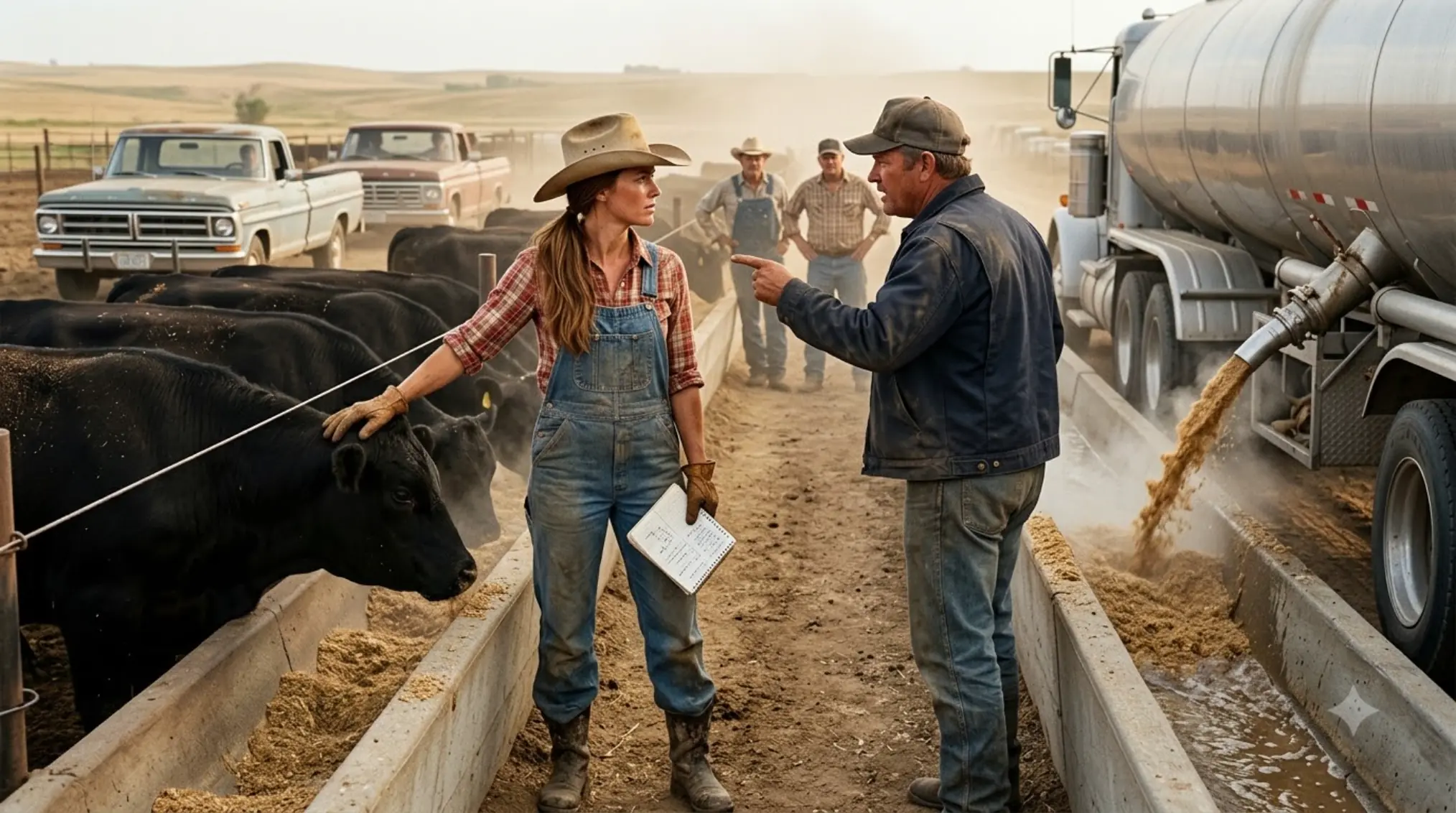
Nora had not invited the men standing beside those trucks.
They had invited themselves.
News traveled quickly in Pratt County, especially when the news involved a thirty-one-year-old unmarried woman feeding eighty cattle something most of the county considered industrial waste.
Nora stood in the narrow alley between the concrete feed trough and the first row of black cattle. She wore faded denim overalls over a red-and-cream plaid shirt, leather gloves, muddy boots, and an old tan cowboy hat that had belonged to her father.
In one hand she carried a notebook.
In the other she carried the numbers that everyone else had refused to calculate.
The tanker driver climbed down, connected the hose, and opened the valve.
Warm spent distillers mash began pouring into the forty-foot concrete trough Nora had built herself.
Steam rose from the thick mixture.
The cattle immediately noticed.
Several pushed closer to the feeding rail.
One of the men beside the pickups laughed.
Gerald Hess stood with his thumbs hooked through his belt. He was a capable cattleman in his forties, with more acreage than Nora and newer equipment than she owned.
He had heard about the distillery’s disposal problem months earlier.
He had rejected the mash.
Too wet.
Too difficult to store.
Too much work.
Now he watched Nora’s cattle crowd toward it.
“You’re really doing it,” he said.
Nora turned.
“Looks that way.”
Gerald walked toward the trough.
Behind him came Dale Tillman, Nora’s brother-in-law, along with several other local producers who had heard enough rumors to want to see the disaster for themselves.
Gerald pointed at the steaming mixture.
“That stuff was waste yesterday.”
Nora rested one gloved hand against the side of a steer.
“It was feed yesterday too.”
Dale laughed.
“You spent money building all this for something the distillery is trying to get rid of.”
Nora looked toward the silver tanker.
“They’re not charging me.”
Gerald frowned.
“What?”
“They’re paying me twelve dollars per delivery.”
The men became quieter.
Dale stared.
“You’re telling me they pay you to take this?”
“For now.”
“And you’re feeding it to cattle?”
Nora lifted her notebook.
“Along with ground corn, mineral premix, urea, and native grass.”
Gerald kicked lightly at the edge of the concrete bunk.
“When those animals lose condition, everybody in Pratt will remember this.”
Nora opened the notebook.
“Then remember today too.”
Gerald looked at her.
“My feed bill is already down sixty-three percent.”
No one laughed after that.
Not immediately.
But Nora knew laughter would return.
It always did when people saw the result before they understood the process.
To understand why Nora Tillman could stand beside a tanker full of distillery mash while experienced cattle producers told her she had lost her mind, you had to understand the man who had raised her.
Cleo Buell had never been wealthy.
But he hated waste with the intensity some people reserved for dishonesty.
He farmed 160 acres in Pratt County, raised a modest cow-calf herd, planted wheat, repaired his own equipment, and maintained a workshop behind the house with a level of precision that bordered on devotion.
The concrete floor had been poured in 1951.
Cleo had leveled it himself.
He was proud that the variation across the entire surface was less than an eighth of an inch.
Along the north wall stood a heavy oak workbench built from lumber cut from a tree that had fallen during the 1947 flood.
At one end sat an old Wilton vise.
Above it, tools hung in exact positions.
Wrenches.
Pliers.
Files.
Punches.
Hammers.
Cleo could find nearly any one of them in darkness.
Nora often did.
She began following him into the shop as a child.
When she was too short to reach an engine bay, Cleo gave her a wooden box to stand on.
When she asked why he repaired machines other men replaced, he never gave a speech about thrift.
He simply showed her the bill.
“This bearing costs four dollars,” he once told her.
“A new assembly costs forty-eight.”
Nora looked at the greasy metal part in his hand.
“So we replace the bearing.”
Cleo smiled.
“Now you’re farming.”
His philosophy appeared everywhere.
At the kitchen table.
Inside the tool cabinet.
In the ledger he kept in the drawer near the stove.
Every Sunday evening, Cleo recorded what the farm had earned and what it had spent.
Nora sat beside him.
Her brothers rarely did.
They were welcome.
They simply had other interests.
Nora wanted to know why one calf earned more than another.
Why feed prices mattered.
Why machinery depreciation appeared differently from fuel.
Why a farmer could have a good crop and still have a bad year.
Cleo taught her that farming was not merely producing something.
It was understanding what production cost.
Nora graduated from Pratt High School in 1961.
Kansas State offered her partial scholarship assistance to study animal science.
She intended to go.
Then Cleo injured his back.
Nora deferred enrollment for one year.
Then another.
Eventually she stopped calling it a deferral.
The farm needed someone who already understood it.
Her brothers had farms of their own.
Nora stayed.
When Cleo died in January 1969, Nora was twenty-five.
He left her the 160 acres.
Forty-one cattle.
A 1963 Ford tractor.
The workshop.
Every tool in it.
And $11,400 in savings.
Most importantly, he left no debt.
Nora understood that inheritance better than anyone.
The land mattered.
The money mattered.
But freedom from monthly payments mattered more.
She promised herself she would not give that freedom away casually.
For the next several years, Nora operated conservatively.
She raised cattle.
Repaired equipment.
Kept records.
Improved fencing.
Maintained pasture.
She did not expand merely because people told her expansion meant success.
Then, in early 1974, Gerald Hess mentioned something while they were standing at the Pratt County Co-op.
“The distillery over in Medicine Lodge is still trying to get rid of that mash.”
Nora looked at him.
“What mash?”
“Spent grain.”
Gerald shook his head.
“Wet as soup. Heavy. Spoils. They were hauling it to a hog place, but that operation shut down.”
“What are they paying?”
Gerald laughed.
“I don’t know. I told them no.”
Nora did not.
The following week she drove forty miles northeast to the Gypsum Hills Grain Distillery.
Operations manager Roy Cantrell met her beside the processing building.
Roy expected a short conversation.
Instead, Nora asked four questions.
“What’s the average moisture?”
“Sixty to seventy percent.”
“Delivery volume?”
“Eight to twelve thousand pounds per week.”
“Consistent?”
“Generally.”
“Protein analysis?”
Roy showed her available figures.
Nora studied them.
Then she asked the fourth question.
“What are you paying to dispose of it?”
Roy hesitated.
That hesitation interested Nora more than the answer.
She drove home and worked at the kitchen table for three evenings.
Yellow legal pad.
Calculator.
Cleo’s old ledger.
Commercial supplement cost.
Corn cost.
Mineral cost.
Estimated dry matter intake.
Protein.
Transportation.
Infrastructure.
Spoilage risk.
Labor.
She kept asking one question.
Could the value of the mash exceed the inconvenience of handling it?
By the third evening, the answer was clear.
Yes.
But only if she could build the handling system cheaply.
That was why Nora was standing at a farm liquidation auction several weeks later when the auctioneer reached a collection of things almost nobody wanted.
A grain auger with a seized motor.
A cracked chest freezer.
Two hundred feet of old black irrigation hose with grass growing through the coils.
The auctioneer bundled them together because selling them separately would take too long.
“Thirty dollars.”
A scrap dealer bid.
“Thirty-five.”
Nora raised her hand.
“Forty.”
Silence.
The scrap dealer looked at the hose.
Then lowered his hand.
“Sold.”
Dale was standing beside Nora.
He stared at her.
“What are you going to do with that junk?”
Nora looked toward the auctioneer.
“I’ll let you know.”
By the end of the week, half the county seemed to know Nora Tillman had spent money on broken equipment.
The story became more entertaining each time it was repeated.
Forty dollars became seventy-five.
Then one hundred.
Eventually people claimed she had spent two hundred dollars and needed to borrow a truck to haul everything home.
None of that mattered.
Nora was not buying junk.
She was buying components.
The black hose came first.
Eleven places had grass rooted through the coils.
Nora cut the vegetation out.
Nine damaged sections required simple cleanup.
Two required short splices using barbed fittings already sitting inside a coffee can in Cleo’s workshop.
By evening, the hose held pressure.
The auger required more work.
Nora rolled it onto the workshop floor and removed the motor.
Rust had seized the armature bearings.
Exactly what she had suspected.
She soaked the bearing housings in penetrating oil for two days.
Then she used the old hydraulic press in the corner to remove them.
New bearings from the NAPA store in Pratt cost $4.80.
When Nora reassembled the motor and powered it, the shaft turned cleanly.
She stood alone in the workshop listening to it run.
For a moment, she could almost hear Cleo.
Now you’re farming.
The freezer was never meant to remain a freezer.
Nora removed the cracked lid with a reciprocating saw.
She reinforced the opening with scrap angle iron.
Then she fabricated a hinged wooden cover.
The chest became storage for dry supplement.
Nora spent the next several weekends building.
A forty-foot concrete receiving trough ran along the south side of the feedlot.
She mixed and poured it herself.
She mounted the repaired auger on a fabricated steel frame.
Feed bunks were constructed from treated lumber and corrugated panels.
The irrigation hose carried mash toward a secondary feeding point.
The converted freezer held the dry ration components.
When Nora added every expense, the entire system cost $211.
The first Gypsum Hills tanker arrived on Thursday.
Then another came the next Thursday.
And another.
Nora measured everything.
Feed intake.
Weight gain.
Spoilage.
Labor.
Supplement usage.
Performance.
By summer, she had enough information to calculate the result.
Her feed costs had dropped approximately sixty-three percent compared with the previous year’s stocker program.
Not because the cattle ate less.
They did not.
They ate better.
The spent distillers grain provided concentrated nutrition while replacing a significant portion of the commercial feed Nora had been buying.
And the distillery was paying her twelve dollars each time she accepted a delivery.
Nora did not announce the numbers.
She used them.
Her stocking rate increased.
By the fall of 1974, she was running eighty-three head through the program.
Then the packer buyer arrived.
He walked through the cattle slowly.
He examined condition.
Muscle.
Finish.
Consistency.
After ten minutes, he stopped beside Nora.
“What are you feeding?”
“Native grass, dry supplement, and spent distillers grain.”
He looked toward the trough.
“From where?”
“Gypsum Hills.”
“The distillery?”
“Yes.”
He walked toward another animal.
Then another.
“I’ve been buying cattle around here eleven years.”
Nora waited.
“I haven’t seen this kind of consistent finish off a program like yours.”
She closed the gate behind him.
“Is that good or bad?”
He laughed.
“Can you do it again?”
Nora met his eyes.
“Every year.”
That mattered more than praise.
Anybody could have one successful season.
Nora wanted a system.
By 1976, she had expanded the feedlot to accommodate approximately 140 head.
She poured another concrete trough.
Sixty feet.
Again, she did much of the work herself.
Again, she paid cash.
Gypsum Hills no longer needed to pay Nora the disposal fee because she reliably accepted the full volume they needed removed.
Nora did not complain.
Free feed was enough.
Roy Cantrell described the arrangement as the cleanest solution the distillery had found since opening.
For Gypsum Hills, Nora solved a disposal problem.
For Nora, Gypsum Hills solved an input problem.
Neither side needed the other to lose.
That was what Nora appreciated most.
She began buying feeder calves from auctions in surrounding counties.
Pratt.
Stafford.
Barber.
She ran them through a carefully managed 120-to-150-day feeding program.
Her animals became known for consistency.
Buyers started calling her before the season.
Then something else happened.
Local families began asking whether they could buy beef directly.
Nora placed an intact chest freezer in the shop.
Then another.
By 1977, she was selling halves and quarters.
She put a simple hand-painted sign near the driveway.
BEEF.
No slogan.
No advertising campaign.
No radio spot.
People tried the meat.
They told neighbors.
Those neighbors told relatives.
By 1979, Nora had a waiting list extending into the following spring.
Meanwhile, her bank account kept growing.
The $11,400 Cleo had left her had become $47,200.
She still carried no operating loan.
No tractor loan.
No equipment note.
No mortgage.
Every expansion came from the previous year’s earnings.
Then the agricultural economy changed.
Interest rates climbed.
Land values weakened.
Commodity prices fell.
Across the Midwest, farmers who had expanded aggressively during the 1970s suddenly discovered that cheap borrowing had not remained cheap.
Loans reset.
Payments increased.
Equity disappeared.
In Pratt County, families who had farmed for generations began receiving calls from banks.
Gerald Hess was one of them.
He had purchased expensive machinery.
Then acreage.
Both financed.
When the economics turned against him, good farming could not repair the balance sheet fast enough.
In 1983, Gerald lost his operation.
Nora heard the news and sat silently at her kitchen table.
She felt no satisfaction.
Gerald had laughed at her mash system.
That did not mean he deserved to lose his land.
Nobody did.
But his foreclosure confirmed something Cleo had spent his life teaching.
A farm could produce well and still fail financially.
Nora’s expenses did not suddenly triple because interest rates increased.
She had no interest payment.
The distillery feed continued arriving.
The cattle continued eating.
Customers continued buying.
Then the 160-acre Hydrick farm along Nora’s northern fence came up for sale.
The family had lost it to the bank.
Nora had known them for years.
She hated the circumstances.
But she also knew the land.
The auction was scheduled for autumn.
Nora drove there in her father’s old truck.
It had more than 200,000 miles.
She maintained it herself.
She sat in the third row.
Dale stood near the back.
The auction opened around $420 per acre.
Four serious bidders remained.
A farming operation from Reno County.
Two Wichita investors.
Nora.
The price climbed.
Four hundred fifty.
Four hundred eighty.
Five hundred.
The Reno County bidder dropped.
Five hundred twenty.
Five hundred forty.
One Wichita investor stopped.
The final investor looked toward Nora.
She sat quietly.
Five hundred sixty.
Nora bid.
Five hundred eighty.
She bid again.
The investor studied her.
Then lowered his hand.
“Sold.”
The room shifted.
People whispered.
One hundred sixty acres.
$580 per acre.
Total price:
$92,800.
The auctioneer approached.
“Mrs. Tillman, we can arrange with the bank for the closing funds.”
Nora pulled out her checkbook.
“That won’t be necessary.”
The room became quieter.
She wrote:
$92,800.
A personal check.
No financing contingency.
No loan officer.
No bank approval.
Money already sitting in the account.
When she handed the check across the table, even the auctioneer stared at it longer than necessary.
Dale watched from the back of the room.
Eleven years earlier, he had laughed because Nora had spent forty dollars on a broken auger, a cracked freezer, and old irrigation hose.
Now she had just purchased 160 acres outright during one of the worst farm financial crises in recent memory.
Dale walked outside without saying anything.
The following week, he came to Nora’s house.
She answered the door.
He removed his cap.
“I owe you an apology.”
Nora leaned against the frame.
“For what?”
“The auction.”
“Which one?”
Dale smiled weakly.
“Exactly.”
Nora waited.
“I told everybody you bought junk back in ’74.”
“You weren’t the only one.”
“I thought you didn’t know what you were doing.”
Nora nodded.
“I know.”
“And you never corrected me.”
“You didn’t ask.”
Dale looked toward the feedlot.
Black cattle stood along the bunks.
The tanker had delivered that morning.
“You really didn’t care what we thought, did you?”
Nora considered it.
“I cared.”
Dale looked surprised.
“I just cared more whether the numbers worked.”
She opened the door wider.
“Coffee?”
Dale stepped inside.
By the mid-1980s, Nora operated 320 acres.
The original farm.
The Hydrick land.
Her feeding system continued evolving.
The direct-sale customer list eventually exceeded two hundred families across several counties.
Some customers drove from Hutchinson.
Others came from Wichita.
Nora still did not advertise.
She did not need to.
Consistency advertised for her.
Her niece Cassie began spending summers at the farm when she was fourteen.
On the first morning, Cassie expected Nora to teach her to drive the tractor.
Instead, Nora took her into Cleo’s old workshop.
“Why are we in here?”
Nora pointed toward the drill press.
“You’ll learn that first.”
Cassie frowned.
“I came to farm.”
“You are farming.”
It was Cleo all over again.
Cassie learned how to repair.
Then fabricate.
Then calculate.
Then keep records.
Before Nora allowed her to manage cattle purchases, Cassie had to understand the cost of every major feed input.
Before she could plan production, she had to maintain a ledger.
Eventually, Cassie managed the dry supplement mixing program.
Then the direct-sale records.
Customer names.
Processing dates.
Margins.
Inventory.
Nora watched her niece write numbers inside a composition notebook that looked remarkably similar to Cleo’s old ledger.
The continuity pleased her more than she admitted.
In 1991, Nora was invited to speak at a Pratt County Farm Bureau meeting about alternative feed ingredients.
Forty-three farmers attended.
Most were men.
Several had known Nora since she was a girl.
Nora stood in front of the room without prepared notes.
She did not tell them she had been smarter.
She did not tell them they should have listened.
Instead she explained the arithmetic.
“A distillery had something it needed to remove.”
She paused.
“I needed protein.”
Several men nodded.
“Everybody looked at the mash and asked whether it was convenient.”
Nora shook her head.
“That was the wrong question.”
Someone near the back asked, “What was the right one?”
Nora answered.
“Is it nutritious?”
Silence.
“And if it is, can I build the infrastructure to handle it for less than I’ll spend buying replacement feed over the life of the system?”
She looked across the room.
“My first system cost $211.”
Several people murmured.
“That decision changed my operation more than any land purchase I ever made.”
Gerald Hess was sitting near the side wall.
After losing his farm, he had eventually started again on rented ground.
Slowly.
Carefully.
When the meeting ended, he approached Nora.
“I should’ve listened to you in ’74.”
Nora smiled.
“I never told you what I was doing.”
Gerald considered that.
“No.”
He nodded.
“I suppose that was the problem.”
Nora shook his hand.
There was no triumph in it.
Only recognition.
People often misunderstood innovation because they saw the unusual component rather than the system around it.
They saw wet mash.
Nora saw protein.
They saw a broken auger.
Nora saw material movement.
They saw a cracked freezer.
Nora saw dry-feed storage.
They saw irrigation hose filled with grass.
Nora saw distribution.
They saw forty dollars disappearing.
Nora saw the final three components of a plan she had already calculated.
And decades later, when people asked what made Nora Tillman successful, some expected a clever secret.
There was none.
No hidden inheritance.
No miraculous market timing.
No billionaire investor.
No government rescue.
No extraordinary piece of equipment.
Just arithmetic.
Repair skills.
Discipline.
Patience.
And an unwillingness to pay retail for a solution she could build herself.
The old auger remained on the farm long after Nora could have afforded a new one.
Its paint faded.
Repairs accumulated.
Bearings were replaced again.
The frame Nora had welded in 1974 showed rust around several joints.
Cassie once asked why Nora did not replace it.
“You have money now.”
Nora laughed.
“That’s not a reason to spend it.”
“But the new ones are faster.”
“Do we need faster?”
Cassie thought.
“No.”
“Then what problem are we solving?”
Cassie smiled.
Nora pointed at her.
“Exactly.”
Years later, the cattle operation barely resembled the modest program Nora had started.
More acreage.
Better handling equipment.
Larger customer base.
Improved fencing.
Refined feeding procedures.
Yet the logic remained unchanged.
Build around what you can control.
Never confuse expensive with effective.
Know your costs.
Do not borrow merely because somebody is willing to lend.
And never dismiss something simply because another person calls it waste.
One evening, Nora stood beside the feedlot as another tanker finished unloading.
The sun was low over the Kansas fields.
Black cattle fed calmly along the bunks.
Cassie stood nearby with the ledger.
“Delivery logged,” she said.
Nora nodded.
“How much supplement left?”
“Enough through Monday.”
“Corn?”
“Fine.”
“Mineral?”
“Need two bags next week.”
Nora smiled.
Cassie closed the notebook.
“What?”
“Nothing.”
“You’re smiling.”
Nora looked toward the workshop.
For a moment she imagined Cleo inside.
The old Wilton vise.
The oak workbench.
Tools hanging exactly where they belonged.
The concrete floor he had been absurdly proud of.
“He would’ve liked this,” Nora said.
“Your dad?”
“Yes.”
Cassie looked at the tanker.
“The cattle?”
Nora shook her head.
“The system.”
Cassie smiled.
That answer made sense.
The tanker pulled away.
Dust rose behind it.
Nora walked to the concrete trough and rested one hand on the edge.
The first section she had poured in 1974 was worn smooth in places.
She remembered mixing the concrete herself.
She remembered Dale laughing about the auction junk.
She remembered Gerald predicting failure.
She remembered the packer buyer asking whether she could repeat the results.
She remembered the silent auction room when she wrote the $92,800 check.
But none of those memories felt like revenge.
They felt like measurements.
Evidence collected across years.
Proof that the principles Cleo had taught her were sound.
The distance between what something costs to buy and what it costs to make can determine whether a farmer survives.
Nora had spent her life living inside that distance.
She turned something another business paid to remove into the foundation of a profitable feeding program.
She turned $40 worth of unwanted equipment into pieces of a $211 system.
That system helped reduce feed costs by sixty-three percent.
Lower costs gave her room to grow.
Cash flow gave her room to remain debt-free.
Remaining debt-free gave her resilience when the farm economy collapsed.
Resilience gave her the ability to buy neighboring land when opportunity appeared.
And none of it began with a grand plan to become wealthy.
It began with a better question.
Everyone else had asked:
Why would anyone want this waste?
Nora had asked:
What is it actually worth if I know how to use it?
That difference built the farm.
It built the customer list.
It built the savings.
It bought the neighboring acreage.
And it preserved something even more important.
Independence.
Nora looked across the cattle lot.
Cassie had already gone inside to update the records.
The cattle continued eating.
The old auger continued turning.
The system was not glamorous.
It never had been.
That was part of its beauty.
Years earlier, people had laughed because they saw broken machinery and distillery waste.
Nora had never needed them to stop laughing.
She only needed the numbers to remain true.
And eventually, they did something laughter could never do.
They cleared.