“I have four thousand, two hundred and sixteen dollars,” Clara Holt said, putting a dented shoebox on the auctioneer’s counter. “And I want the deed.”
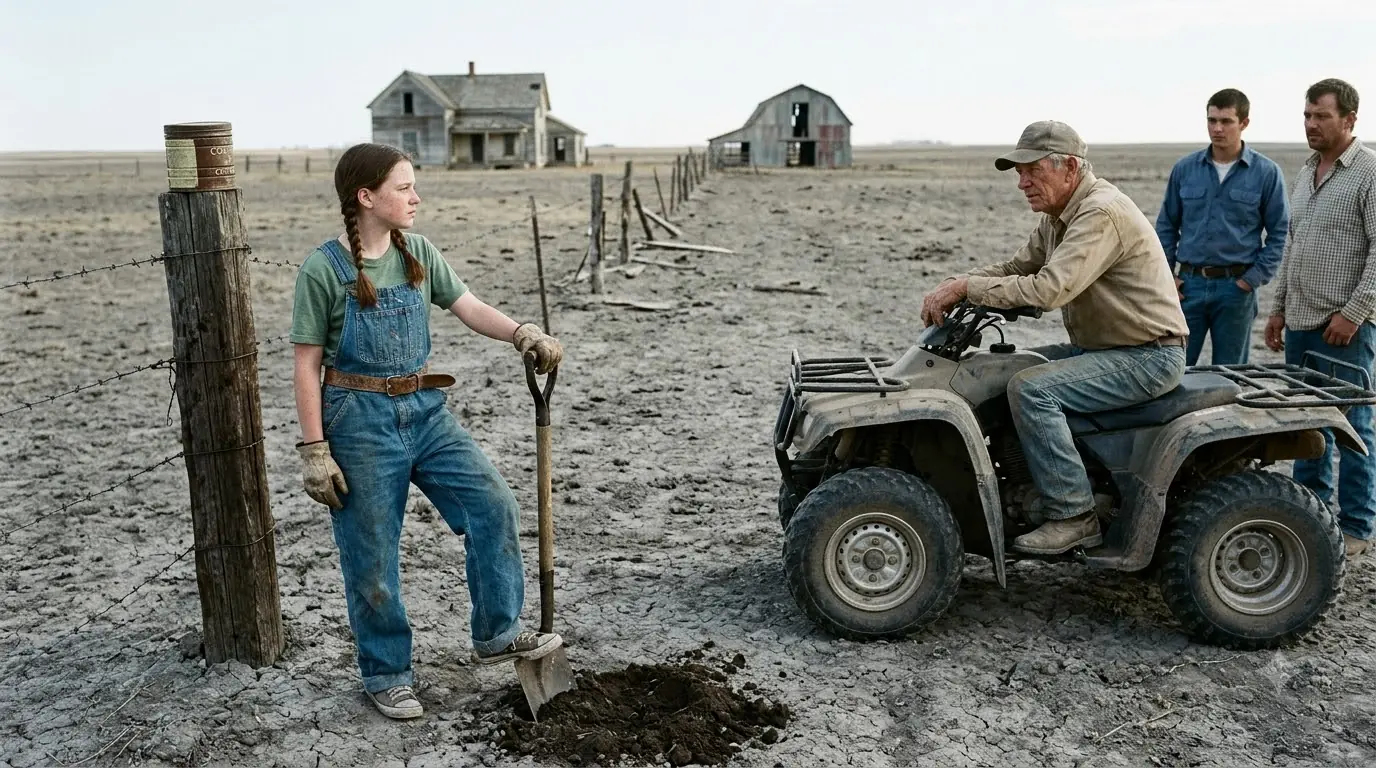
For a moment nobody in the Red Oak Hollow auction house spoke. The room smelled of dust, damp hats, and the burnt coffee that had been sitting on a warmer since sunrise. Men who knew one another well enough to borrow tractors without writing anything down turned to see who had interrupted the bidding. What they saw was a girl barely five feet tall, fourteen years old, with two dark braids over the bib of overalls too large for her. The belt holding those overalls at her waist had belonged to her grandfather. Her sneakers were scuffed white along the toes, and her fingers, wrapped around the shoebox, were reddened where she had spent spring mornings digging and hauling crates for extra money.
At the front, the auctioneer adjusted his glasses. “Are you here with your daddy, little lady?”
Clara did not smile. Her grandfather, the closest thing she had known to a father for ten years, had been buried six months earlier. Her mother was standing against the wall near the exit with her purse pressed hard to her ribs, a silent witness to a decision she had spent three weeks trying to prevent.
“I’m here with my mother,” Clara said. “I want Blackwell’s Ridge.”
Old Gerald Pritchard laughed from the back row. The two Miller brothers laughed with him. Someone slapped a knee. Others joined because laughter was easy and because everyone in the room knew Blackwell’s Ridge: forty acres of gray, exhausted ground behind a sagging gate, broken fence posts, and a farmhouse whose roof had lost so many shingles that birds no longer bothered testing the timbers. A property the county had been trying to unload for eleven years, after successive owners lost money and abandoned their attempts to make it productive.
The auctioneer’s smile changed from indulgence to discomfort. He looked toward Clara’s mother. “Ma’am, there are legal details here. Are you prepared to talk to the clerk?”
Her mother pushed away from the wall. She looked as tired as she had after a double shift at the hospital in Tulsa. “We already talked to the clerk,” she said. “The bid will be handled in the form the county requires. I’m here to supervise it.”
That silenced one question, not the laughter. Pritchard leaned forward, elbows on his knees. “Girl, that farm has swallowed more money than you can count.”
Clara’s fingers tightened on the box. Inside were birthday checks, payment from mowing lawns, egg money, the wages from a miserable summer detasseling corn in heat that blistered her neck, and coins she had rolled in paper tubes on the kitchen table. She knew exactly how much there was. She had counted it so often that the number no longer seemed like money but like a promise she had made to someone who could not come to the auction.
“I can count it,” she said, opening the box.