“Your dad has a stroke, and suddenly you're a farmer?”
Wade Mercer said it loudly enough for the two neighboring farmers beside his pickup to hear. Both men laughed, the uncomfortable, automatic kind of laugh people gave Wade when he was holding court in somebody else's yard.
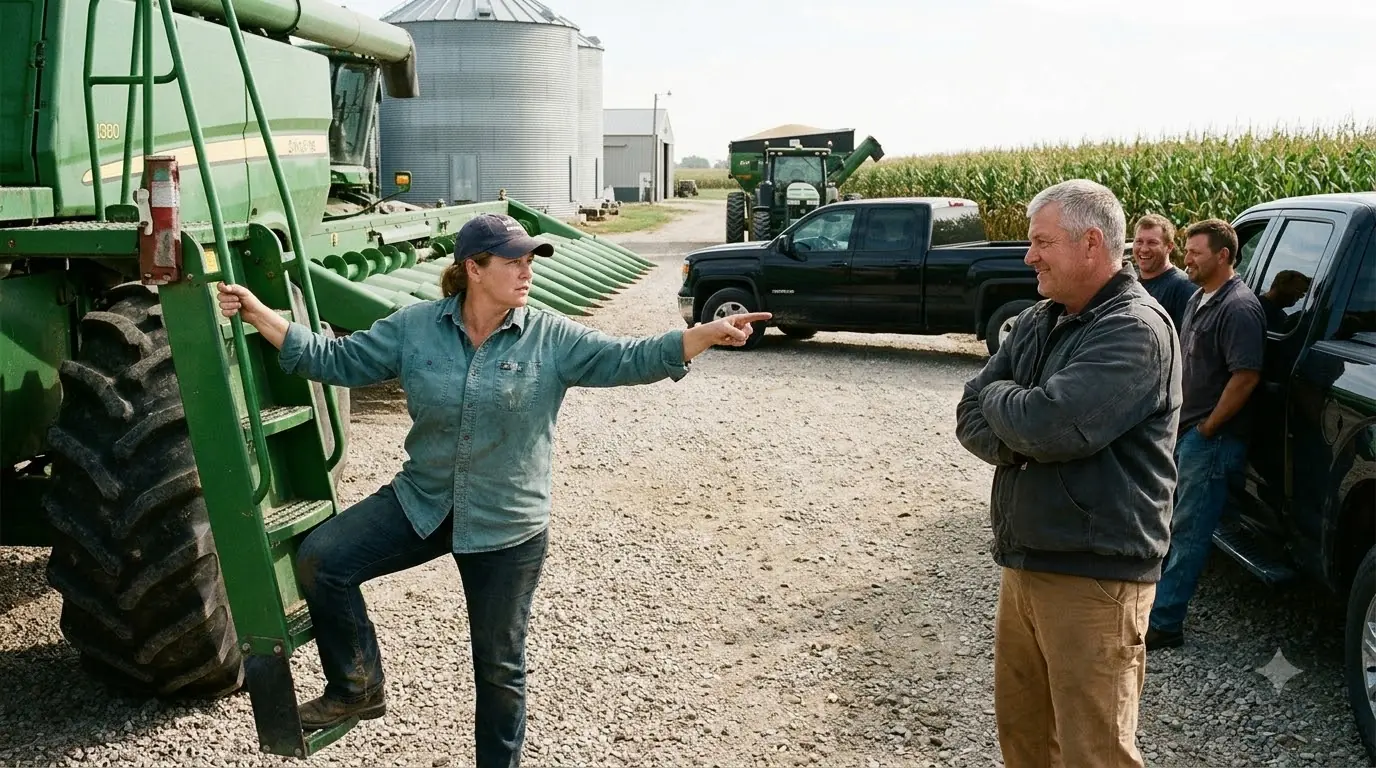
Claire Bennett stopped with one boot on the lowest rung of the combine ladder. Behind her, the machine's sixteen-row header stretched across the gravel like a wall of steel. Her father's faded navy cap shaded her eyes, but it could not hide the way the insult landed.
“I've run this farm for eight years,” she said.
Wade folded his arms. At fifty-five, he had spent enough years buying grain and arranging custom harvest jobs to mistake knowing everybody's business for having a right to direct it. “Then let's see you save it.”
“Move your truck. You're in my way.”
A tractor horn blasted from behind him. Wade turned and found the grain cart waiting, its driver holding position because the black pickup blocked the only practical passage between the bins and the south field. The other farmers stopped laughing.
Wade moved eventually. He made a production of backing the pickup away, as if Claire's insistence had been an unnecessary inconvenience instead of a request to clear her own lane.
Minutes later, Claire drove the combine into sixteen standing rows. The corn disappeared beneath the header in an orderly wave; behind the machine, a broad harvested strip opened through the field. She watched the instruments, listened for the rhythm she knew, and kept going. At the entrance, Wade watched with the smug expression of a man waiting for a machine to fail.
Then his phone rang.
He looked at the screen. Whatever he saw wiped the smile from his face.
Claire did not see the caller. She was already turning her attention to the next stretch of corn, where an ordinary-looking darker patch concealed a problem nobody in the yard had been willing to discuss.
Three weeks earlier, her father had asked her to bring a ledger to the hospital.
It was a battered green notebook with pencil marks in the margins and a list of field numbers on its inside cover. Claire found it beneath a stack of sale receipts on the office desk, precisely where her father had told her it would be. She had not been surprised that he remembered the location. Even after the stroke left his speech slow and his right hand unreliable, Henry Bennett could recall where a particular document sat among forty years of accumulated paper.
She found him sitting beside the window, a blanket over his knees. He was seventy-two and angry about needing help to open a bottle of water.
“You don't have to come every morning,” he told her, working hard to pronounce the words.
“I know.” She placed the notebook on the table. “I came because you invited me.”
“Liar.”
His smile was crooked but unmistakable. Claire kissed his forehead and opened the ledger before he could ask whether the north field had dried enough for machinery.