The first bird came down like a verdict.
Its shadow crossed the bull's shoulders before anyone heard its wings, a dark blade sliding over skin so crowded with ticks that the hide seemed to move on its own. The enormous Beefmaster stood beside the water trough, head low, eyes half closed. Three days earlier he had been pushed through a livestock auction in Beeville, Texas, under lights that made every swelling and parasite plain. Now he was standing in Claire Garza's south pasture, and the people watching him had begun to suspect that she had paid a thousand dollars for the privilege of watching an animal die.
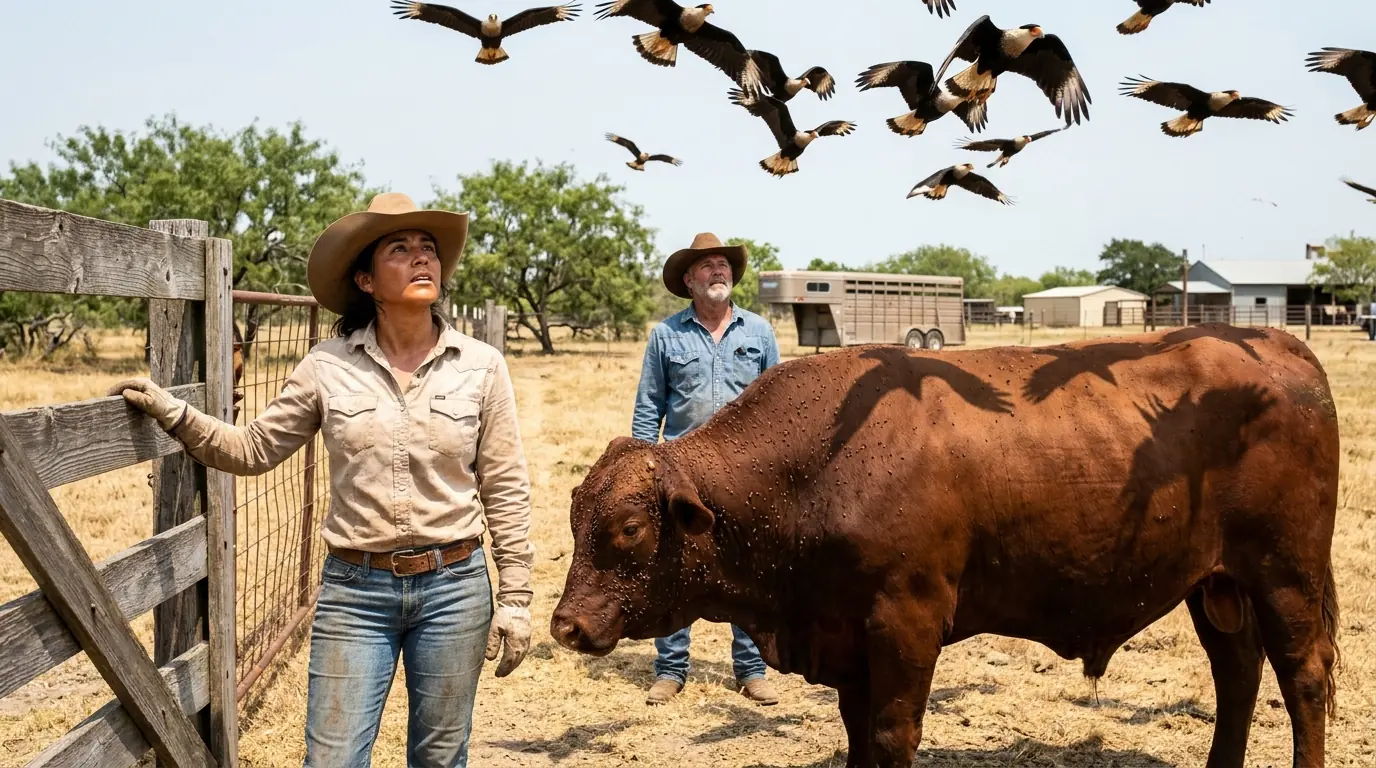
The crested caracara landed on the ground seven feet from his forelegs. It walked forward in the odd, deliberate way of a bird accustomed to having the earth make room for it. Its dark cap and pale neck caught the morning light. The ranch hand beside Claire made a small sound, almost a laugh, but it disappeared when the bull lifted his head.
Then another caracara landed on the fence. A third settled on the dead limb of a mesquite. Wings crossed the sun. One bird hopped up onto the bull's back and lowered its hooked beak toward a cluster of parasites. It pulled once, raised its head, and swallowed. A second bird came down behind it.
“Claire,” Mateo whispered. “Look up.”
The sky above the pasture seemed to be breaking into moving pieces. Birds circled high above the mesquite line, their wings black against the blue, and more were descending toward the animal who could barely stand. For one heartbeat Claire felt exactly what the men at the auction had promised she would feel: terror at the magnitude of her own decision.
She had wanted the birds to come. She had remembered her grandfather saying they might. She had not imagined what their arrival would look like when the bull was this weak—or how quickly hope could turn into another kind of danger.
“Keep everybody back,” she said.
Mateo took a step toward the pasture gate. “Shouldn't we get him away from them?”
“Not until we know what they're doing.”
A bird snapped at a tick. Another shifted its feet on the animal's broad back. The bull trembled but did not bolt. Claire watched the movement of his ribs, the way his knees held his weight, the shallow rise and fall of a life that had somehow not surrendered. Her phone was already in her hand. She called the veterinarian again, and when he answered she said the four words she had been afraid to use for three days.
“I need you now.”
Three days earlier, no one at the auction had been speaking softly.
The auction barn outside Beeville was an old building with a newer roof, its concrete floor scarred by generations of hooves. In the holding pens, cattle moved restlessly against pipe rails while men in sweat-darkened shirts compared weights, feed prices, and the weather they hoped would arrive. A few buyers sat in the stands with notebooks on their knees. Others leaned at the rail, saving their bids for an animal worth hauling home.