“You spent your last dollar dumping fish into a dead cotton ditch?”
The neighboring farmer shouted from the seat of his aging green tractor as hundreds of silver tilapia spilled from the back of an old Ford pickup. The fish struck the muddy irrigation water in a flashing wave, disappeared beneath the surface, and sent ripples racing between the exhausted cotton fields. Beside the truck, twenty-four-year-old Della Marsh kept both hands on the metal release gate without looking at him.
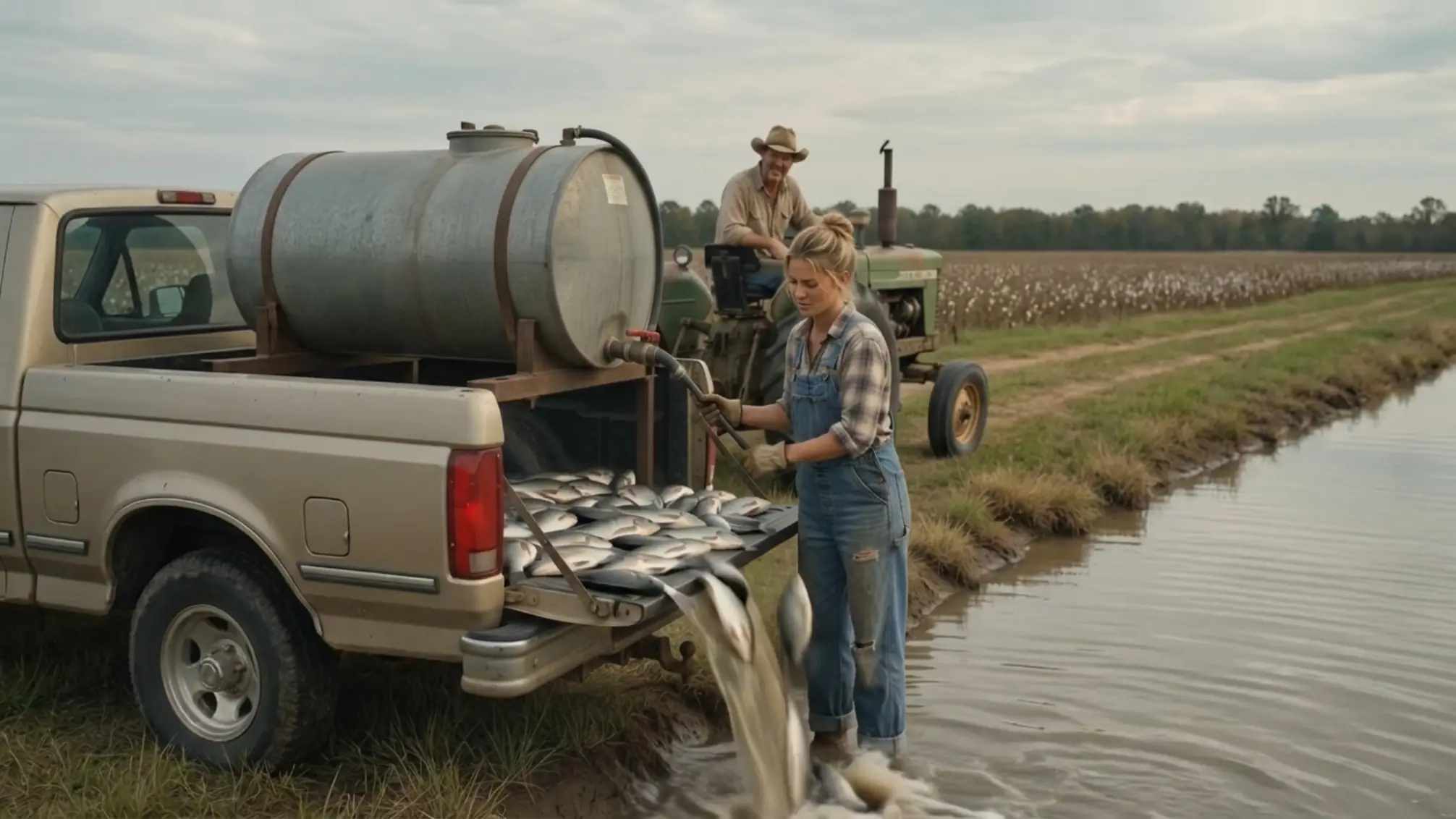
“No,” she answered. “I spent it replacing what men like you poisoned.”
The farmer’s expression hardened.
His name was Walter Patterson, a forty-five-year-old white American who owned the land bordering hers. He had known Della since she was a barefoot child following her father through the cotton rows. He did not consider himself cruel, but like most farmers in the county, he believed hardship had rules, and Della was violating every one of them.
Walter pointed toward her pale, compacted fields.
“When that crop fails, the bank will take every acre you own.”
Della opened the final tank.
“Then keep watching,” she said. “Your soil will die before mine does.”
The last fish poured into the ditch.
Walter stared at her for several seconds before turning his tractor toward home. By sunset, he had told two men at the feed store. By the following morning, nearly every farmer in that part of Mississippi knew that the young Marsh woman had spent the remains of her father’s life-insurance money on fish.
Not fertilizer.
Not seed.
Fish.
The summer of 1971 had been dry enough to split fence posts. Heat settled over the Mississippi Delta before breakfast and remained long after sundown, pressing against houses, barns, and human tempers with equal force. Cotton leaves curled at the edges, tractors overheated in the fields, and men at the county cooperative spoke about debt with the guarded voices of people discussing an illness they all shared.
Della had inherited three hundred acres of that worry.
Her father’s farm included a cracked farmhouse porch, a leaning barn, a Massey Ferguson tractor that coughed smoke whenever it climbed a slope, and soil that had produced less cotton every season for nearly a decade. The land was so depleted that rain struck the surface and ran away instead of sinking into it. When Della lifted a handful, it crumbled through her fingers like gray powder.
Her father had died believing he had failed her.
During his final winter, he apologized repeatedly from a narrow bed beside the farmhouse window. He spoke about the mortgage, the declining yields, and the chemical bills he had refused to increase. Della told him none of that mattered, but he looked toward the fields as though he could still hear them asking for something he had not learned how to give.
After the funeral, the bank manager visited.
He sat at her kitchen table wearing a gray suit too heavy for Mississippi heat and opened a folder filled with numbers. The farm was not yet in foreclosure, he explained, but it was close. Della needed a profitable harvest within two seasons or she would have to sell part of the acreage.
“There are programs for young operators,” he said. “We can finance fertilizer, improved seed, equipment repairs.”
“How much debt?”
He gave her a number.
It was more money than her father had earned during his final three years combined.
Della closed the folder.
“I’ll think about it.”
“You don’t have much time.”
“I know.”
The manager left believing fear would eventually bring her to his office.
Instead, Della went into her father’s study.
The room smelled of tobacco, dust, and the machine oil he rubbed into his work boots. On the desk sat a stack of leather-bound journals containing thirty years of observations. Her father had recorded rainfall, planting dates, soil color, insects, ditch-water temperatures, root depth, and every mistake he believed he had made.
He had not written like a scientist.
He had written like a man listening to a conversation no one else noticed.
One entry from 1968 had been underlined twice.
The land doesn’t need a whip. It needs a meal.
Della read that sentence until the afternoon light faded.
Her father distrusted the increasingly aggressive chemical programs promoted by fertilizer companies. He had watched neighboring farms inject more nitrogen every year while their soil grew harder and their debts grew larger. The cotton surged green for a few months, then demanded an even heavier application the next season.
He called it borrowing strength from the future.
On another page, he had sketched a pond connected to an irrigation channel. Fish were drawn inside the pond, and arrows showed water moving from the fish into a field before circulating back again.
Beneath the drawing, he wrote:
Could the water itself be the fertilizer?
Della remembered walking the ditches with him as a teenager.
He would crouch beside the stagnant water and point to the algae, insects, and small wild fish trapped in the muddy pools. He believed life was present but disorganized. The water sat too still, the soil received too little organic matter, and the microorganisms beneath the cotton rows had slowly starved.
Her father had seen the idea.
He simply had not lived long enough to test it.
Della decided she would.
She spent two weeks studying every agricultural bulletin she could find about fish waste, pond fertility, bacteria, and water circulation. She learned that fish released ammonia. Beneficial bacteria could convert that ammonia into forms of nitrogen plants could absorb.
The process was natural.
The challenge was keeping the water oxygenated enough for the bacteria and fish to survive.
Della used nearly all the insurance money to purchase a small electric circulation pump, repair several broken ditch gates, and buy live tilapia from a coastal supplier. Tilapia were hardy, reproduced quickly, and tolerated warmer water better than many other fish.
The fish merchant thought she misunderstood his business.
“You want how many pounds cleaned?”
“I don’t want them cleaned.”
He stared at her.
“I need them alive.”
“For a pond?”
“For cotton.”
He laughed until he realized she was serious.
Two hours later, workers filled the transport tanks in her truck. Hundreds of young tilapia churned beneath the surface, their bodies flashing like loose coins whenever sunlight struck the water. Della drove home slowly, afraid that one broken strap or hard turn could destroy the only experiment she could afford.
Walter Patterson saw her releasing them.
His prediction reached the county cooperative before she finished securing the empty tanks.
Men leaned against feed sacks and laughed about the Marsh fish farm. Someone suggested she hang fishing poles beside the cotton rows. Another said grief had finally broken her mind.
Della did not respond.
She installed the small pump at the far end of the ditch network and ran electrical cable from the barn. The pump pulled water from the lowest channel and returned it near the primary headgate, creating a slow continuous current through the farm.
At first, nothing seemed to change.
The fish disappeared beneath the brown water. The fields remained pale. The old tractor continued breaking down, and the bank continued sending letters.
Della worked from before sunrise until after dark.
She repaired the tractor herself because she could not afford a mechanic. She patched her overalls, canned vegetables from the garden, and slept with her father’s journals beside the bed. Every expense was written down, including fuel, seed, electricity, and fish feed during the first weeks.
The official criticism arrived one month later.
County agricultural agent Harold Henderson drove onto the farm in a clean government sedan. He was a fifty-year-old white American with polished glasses, carefully parted hair, and a university degree he mentioned within the first five minutes of nearly every conversation.
He carried a clipboard toward the main ditch.
Several tilapia moved near the surface.
“Miss Marsh,” he began, “I understand you’re attempting an unconventional soil-replenishment program.”
“I’m circulating fish water through the irrigation network.”
“I can see that.”
His tone made the sentence sound childish.
Harold examined the field and shook his head.
“Your soil requires approximately eighty pounds of nitrogen per acre for a commercially viable cotton crop. These fish cannot possibly supply that.”
“They aren’t the entire system.”
“They produce waste.”
“The bacteria convert it.”
He gave a sharp laugh.
“We are discussing commercial agriculture, not a school biology project.”
Della folded her arms.
“My father believed the soil organisms were dormant.”
“Your father was not an agronomist.”
“He knew this land.”
“He also left it severely depleted.”
The words struck harder than Harold realized.
Della’s eyes narrowed.
Harold softened his voice, pretending concern.
“I am trying to help you. I can arrange a loan for anhydrous ammonia. If we move quickly, there may still be time to protect your planting season.”
“Thank you.”
He smiled, believing she had surrendered.
“But I’m continuing with the fish.”
His smile disappeared.
“A fool’s errand.”
Della looked toward the ditch.
“Then you won’t have to worry about it for long.”
Harold wrote something on his clipboard.
Months later, he used her farm as an example during the annual county agricultural meeting. He described how emotional attachment and inadequate scientific training could cause farmers to reject proven methods. The audience laughed when he mentioned the tilapia.
Della was not present.
She was lying beside an irrigation gate at midnight, clearing weeds from a clogged pump intake while mosquitoes covered her arms.
The following spring, fertilizer salesman Raymond Thorne arrived.
Raymond represented one of the largest agricultural chemical companies in the region. His car shone like black glass, and his polished shoes collected dust the moment he stepped onto the farm road. Unlike Harold, he did not begin with mockery.
He began with sympathy.
“I heard about your father,” he said. “He was a respected man.”
Della waited.
“And what you’re doing here, trying to save the farm alone—that takes courage.”
“What are you selling?”
Raymond paused.
Then he smiled.
“A full season of our premium nitrogen blend. No payment until after harvest.”
“I’m not interested.”
“You haven’t heard the terms.”
“I heard the word payment.”
“This could save your land.”
Della looked toward the chemically bright cotton fields beyond the fence.
“My father taught me that debt is a storm. It may wait, but it always comes to collect.”
Raymond’s friendly expression tightened.
“Your father’s methods are why this farm is failing.”
Della faced him.
“My father’s refusal to borrow from men like you is why I still own it.”
He stepped closer.
“You are gambling everything on ditch water and fish waste.”
“Yes.”
“When the plants come up yellow and the bank takes this place, remember that I offered you the right solution.”
Della pointed toward his car.
“You offered me your solution.”
Raymond left behind a cloud of dust.
That evening, doubt finally reached her.
The young cotton plants looked fragile beneath the heat. Walter Patterson’s fields across the fence stood taller and greener after a heavy chemical application. His irrigation pumps ran day and night, and the sound carried across the darkness like distant machinery from another world.
Della sat alone at the kitchen table.
The bank papers were inside a drawer.
One signature could purchase fertilizer, repair the tractor, and temporarily remove the fear that woke her before dawn. She imagined walking into town the next morning and admitting the experiment had failed.
Then she opened her father’s journal.
Could the water itself be the fertilizer?
His handwriting trembled slightly near the end of the sentence.
Della pressed her palm against the page.
“I’m still listening,” she whispered.
The next morning, she returned to the ditches.
The first year produced no miracle.
Her cotton survived, but the yield remained low. She sold barely enough to cover taxes and seed. Walter did not say he had warned her, but his expression did it for him whenever they met near the fence.
The second year was harder.
A July heat wave lowered the ditch water and threatened the fish. Della built shade screens from old lumber and feed sacks, ran the circulation pump at night, and transferred part of the tilapia population into a deeper holding pond.
Several hundred fish died.
She buried them in a trench near the poorest section of the field and cried where no neighbor could see her.
For three days, she considered quitting.
Then rain arrived.
The ditches refilled, the surviving fish reproduced, and the cotton near the burial trench grew darker than the plants surrounding it. Della collected soil from the area and compared it to samples from untreated rows.
The difference was slight but real.
The soil receiving fish-rich water held together better when squeezed. It smelled earthy rather than dusty. Tiny roots spread through it instead of turning away from hard layers.
By the third year, Della began finding earthworms.
She carried the first one into the farmhouse in her palm as though she had discovered gold. Her father had written that earthworms once appeared after every spring rain, but she had not seen one since childhood.
The cotton grew a deeper green.
Her yield remained just below the county average, yet her expenses were far lower because she purchased no chemical fertilizer. After paying bills, she earned a small profit.
The farm finished in the black for the first time in more than a decade.
Della mailed soil samples to the state university without identifying the source. When the analysis arrived, her hands shook as she opened it.
Organic matter had risen from approximately half a percent to one and a half percent. Available nitrogen was moderate but stable. The report noted unusually strong microbial activity.
The land was waking up.
Della placed the report inside her father’s journal.
She did not show anyone.
Years four and five transformed quiet improvement into visible proof.
The soil darkened near the irrigation channels first, then farther into the fields as Della adjusted the gates and extended the circulation network. The tilapia population became self-sustaining. She harvested some fish for food and sold the excess locally, using the money to maintain the pump.
Her irrigation water no longer smelled stagnant.
It smelled like a healthy pond.
During the fifth year, a regional drought struck Mississippi. Fertilizer costs had risen, and farmers applied heavier concentrations in hopes of forcing growth from dry ground. The chemicals accumulated near the surface, increasing salt levels and damaging roots.
Walter Patterson’s cotton began wilting.
He irrigated more often, but his soil had become too compacted to hold water. Much of it evaporated or ran into drainage channels.
Della’s fields remained green.
Years of increasing organic matter had changed the structure of her soil. It absorbed water slowly, stored moisture around the roots, and allowed the cotton to survive longer between irrigations.
Walter stopped his tractor beside the fence one afternoon.
“What are you adding?”
“Nothing from a bag.”
“You have to be adding something.”
Della nodded toward the ditches.
“The same fish you laughed at.”
Walter looked across her field.
The humor had left his face.
At harvest, the county gin posted the numbers.
The average yield was approximately 1.8 bales per acre.
Della Marsh produced 2.2.
Twenty percent above the county average.
Without chemical fertilizer.
Without large loans.
Without the advice every expert insisted she needed.
The men at the cooperative gathered around the posted figures and checked them repeatedly. Some claimed a measurement error. Others suggested the drought had created unusual conditions favoring her land.
Harold Henderson requested an inspection.
He arrived with two university researchers and walked the farm in silence. They tested the soil, measured water nutrients, examined the ditch ecology, and studied the cotton roots.
One researcher lifted a handful of dark soil.
“This is extraordinary.”
Harold looked uncomfortable.
“It’s one season.”
Della answered from behind him.
“It’s the fifth.”
He turned.
“You should have submitted this through the extension office.”
“You called it a fool’s errand.”
“I was working with the available science.”
“You were working with certainty.”
Harold removed his glasses.
“I may have underestimated the microbial contribution.”
Della gave him the same patient expression he once used on her.
“You underestimated the farm.”
Two years later, Raymond Thorne returned.
His car was older. Dust covered his shoes, and the confident polish had vanished from his face. Rising energy prices had made synthetic fertilizer more expensive, while farmers trapped in debt searched desperately for alternatives.
He found Della inside the barn repairing the cotton picker.
“I owe you an apology,” he said.
She continued tightening the bearing.
“I came here seven years ago and treated you like a fool.”
“You did.”
“I was wrong.”
“Yes.”
He waited for forgiveness.
Della offered none.
Raymond walked toward the open barn doors and looked across the dark, productive fields.
“How did you know?”
“I didn’t.”
He turned.
“My father suspected the land was still alive. I decided to test whether he was right.”
Raymond moved closer.
“My company would pay you for the system.”
“It isn’t for sale.”
“We could take it nationwide. Pumps, starter fish, nutrient programs, consulting packages. You could become wealthy.”
Della wiped grease from her hands.
“You still don’t understand.”
“I understand opportunity.”
“That’s the problem.”
His expression hardened.
“This method could help thousands of farmers.”
“Then teach them to observe their own land.”
“We need a product.”
“No. You need something you can own.”
Raymond stared at her.
Della looked toward the irrigation water moving steadily through the fields.
“The moment you put life into a bag and promise every farm the same result, you will repeat the mistake that damaged this soil. This works because it is a relationship, not a recipe.”
“You’re refusing progress.”
“I’m refusing another salesman.”
Raymond left without another offer.
In the early 1980s, high interest rates and farm debt began destroying families across the region. Walter Patterson was among the first of Della’s neighbors to lose control of his land. Years of chemical dependence had reduced his margins until one failed season became impossible to survive.
He came to Della’s farmhouse holding his hat in both hands.
“The bank takes it next month.”
She invited him inside.
“I want you to buy it.”
Della said nothing.
Walter looked toward the window.
“I laughed when you put those fish in the ditch.”
“I remember.”
“You were right.”
His voice broke.
“All this time, you were right.”
Della purchased his farm for a fair price, more than the bank would have allowed him to keep after foreclosure. She gave Walter enough time to leave with dignity and offered him seasonal work whenever he wanted it.
Then she began healing his land.
She extended the ditch network, introduced descendants of the original tilapia, planted cover crops, and reduced compaction one section at a time. The process took years.
The soil did not forgive quickly.
But it remembered how.
Over the next three decades, Della acquired four more neighboring farms from families crushed by the same debt-heavy model. She never purchased land cheaply from desperate owners. She paid what she believed allowed them to begin again somewhere else.
Her operation grew from three hundred acres to nearly two thousand.
People began calling her the Fish Lady.
Researchers came from universities. Farmers traveled across state lines to walk her ditches and study the soil. Della showed them everything without charging a consulting fee.
She always began with the same instruction.
“Stop asking what I put into the land.”
Then she would hand them a fistful of dark soil.
“Ask what the land has been missing.”
Decades later, Della walked beside the irrigation channels with silver hair beneath an old farm hat. Her hands remained strong, and her boots were still muddy. Tilapia moved through the water, descendants of the fish she had carried home in 1971.
A young grandnephew followed her.
She did not lecture him.
She showed him how to test the water, crumble the soil, recognize healthy roots, and notice the insects returning after rain. When he asked for the secret, she smiled.
“The secret is that there isn’t one.”
In the farmhouse study, her father’s journals remained on the desk.
Beside them stood a second stack twice as tall, filled with Della’s handwriting. Fifty years of rainfall records, nutrient tests, crop yields, water temperatures, mistakes, improvements, and observations waited for the next generation.
Her father had left her a question.
She had answered it with a lifetime.
The men with university degrees, polished shoes, and chemical contracts looked at her farm and saw a machine. To them, soil was an empty container. Fertilizer entered, cotton emerged, and debt filled whatever space remained between them.
Della saw something else.
She saw a living system that had been starved.
The tilapia were never magic. They were one part of a cycle connecting water, bacteria, nutrients, roots, and soil. Their waste fed microorganisms, circulation brought oxygen, and the living water slowly restored what years of force had removed.
The miracle was not the fish.
It was patience.
Walter Patterson had warned that the bank would take every acre she owned. Instead, her land eventually saved his.
Harold Henderson called the experiment foolish because it did not appear in his pamphlets. Years later, university researchers studied the fields he declared impossible.
Raymond Thorne tried to sell her debt, then returned hoping to buy the idea that defeated his product.
Della refused them all for the same reason.
She had not inherited a factory.
She had inherited a wounded living thing.
And because one young American farm girl trusted her father’s quiet observations more than the loud certainty of every man around her, that exhausted Mississippi soil finally remembered how to feed itself—and then fed generations after her.