The sound of a metal tray striking the floor echoed through the packed mess hall at Fort Bragg.
Two hundred pairs of eyes turned toward a small female recruit bending to collect the scattered utensils. She stood perhaps five feet four inches tall, thin inside a stiff new uniform, with brown hair pulled into a regulation bun.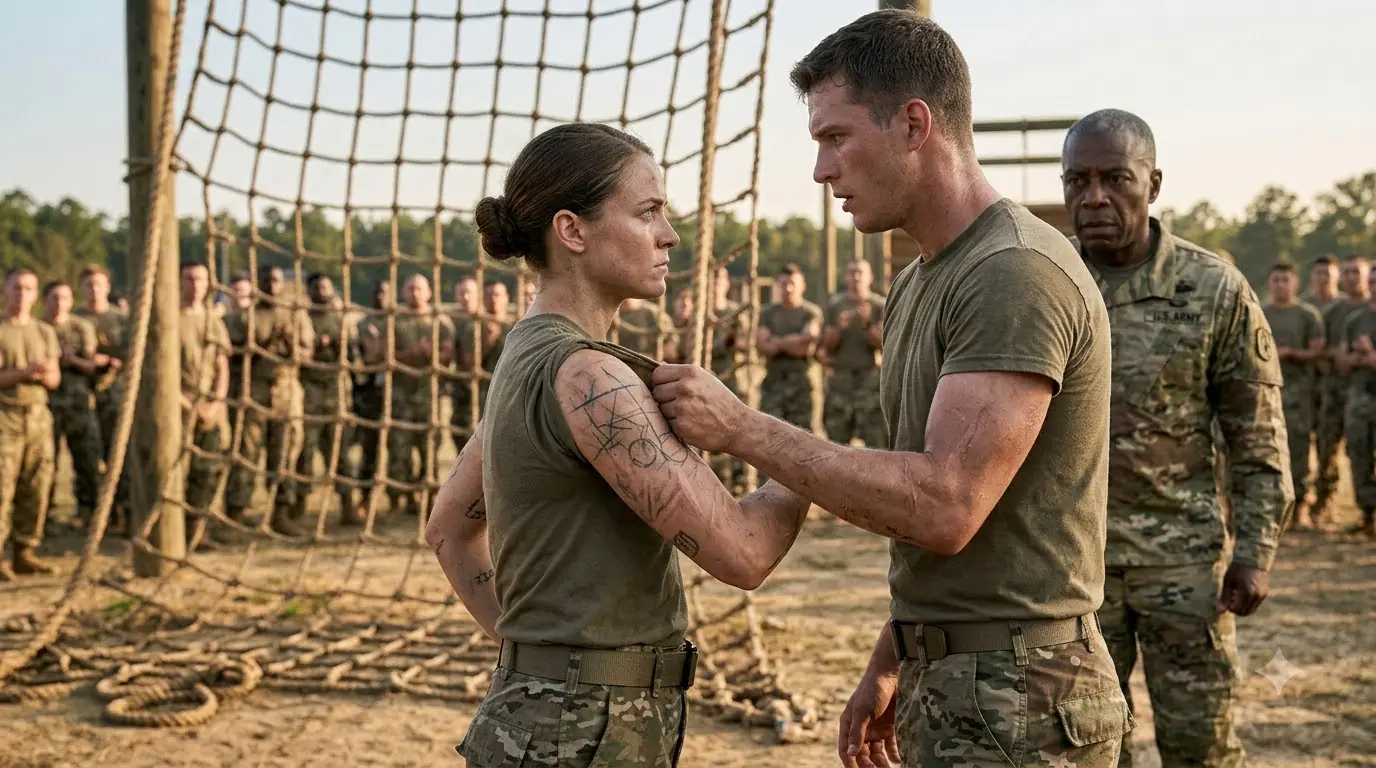
It was not her size that made everyone stare.
It was the scars.
They began near her neck and continued down her right arm. Long trails of pale pink and silver-white tissue crossed her skin, some thick as rope and others branching like tree roots.
Under the harsh fluorescent lights of the mess hall, the marks seemed almost to glow.
“Look at that,” a voice boomed from the corner table where several confident male recruits sat. “Frankenstein’s bride just joined the Army.”
Laughter erupted.
It was not quiet laughter. It was loud, careless, and cruel enough to fill the entire cafeteria.
The woman’s name tag read REEVES.
She did not look up. She placed the tray back onto the counter, although her hands trembled slightly.
The server behind the line avoided her eyes and quickly spooned food onto her plate.
“Seriously, what happened?” another recruit called. “Did you lose a fight with a lawn mower?”
More laughter followed.
Several recruits looked uncomfortable. A few shook their heads, but nobody challenged the voices from the corner.
Reeves accepted her tray and turned around.
Her shoulders were narrow, and her head remained lowered. Every part of her posture seemed to say the same thing.
Do not look at me.
Do not notice me.
A drill sergeant seated three tables away glanced up from his meal. He observed the exchange but did not intervene.
Nobody in that room understood that within the next twenty minutes, the cafeteria would become the starting point of a story told and retold at Fort Bragg for years.
Nobody knew that the scars carried a history even the hardest drill sergeants had never endured.
They were about to discover how completely they had misjudged her.
Reeves found a table in the far corner and sat alone.
The fluorescent lights hummed above her. Conversations resumed throughout the room, but glances continued sliding toward her table.
Whispers followed.
Fingers pointed.
She kept her eyes down and ate methodically, every movement precise despite the attention surrounding her.
At the corner table, Marcus Caldwell leaned back in his chair.
He stood six feet two inches tall and possessed the build of a college quarterback. As the son of a colonel, Marcus carried himself as though he already owned every room he entered.
“I give her three days before she drops out,” he said. “She looks like she would cry if somebody raised their voice.”
His friends laughed.
David Park, a technically gifted recruit with wire-rimmed glasses, nodded.
“She is probably here because somebody needed to fill a quota. There is no chance she makes it through all eight weeks.”
Jessica “JJ” Torres, athletic and sharp-featured, came from a West Point family and spoke with the confidence of someone raised around military tradition.
“She looks like she survived a blender accident,” JJ said with a smirk. “What makes anybody think she can handle combat?”
Rodriguez, stocky and aggressive, struck the table with one fist.
“Fifty dollars says she quits before Friday.”
Marcus stood.
His chair scraped loudly across the floor.
“Let us find out.”
He crossed the mess hall toward Reeves’s table, and his group followed.
The surrounding conversations faded as recruits sensed the confrontation developing.
Drill Sergeant Haynes, a hardened infantry veteran in his mid-thirties, watched from his table but remained seated.
Marcus stopped in front of Reeves and towered over her.
“This section is for real soldiers, sweetheart. Maybe you should try the children’s table.”
Reeves raised her eyes for exactly one second.
They were cold, clear blue and almost completely empty of visible emotion.
Then she returned her attention to the plate.
Her lack of response irritated Marcus more than any insult could have.
David stepped forward.
“He is talking to you. It is rude not to answer.”
Reeves remained silent.
JJ laughed sharply.
“Maybe she does not speak English. Or maybe those scars go deeper than her skin.”
She tapped one finger against her temple.
“Brain damage.”
Several recruits at nearby tables shifted uncomfortably.
Private Tommy Chen, barely eighteen and still carrying a boyish face, rose halfway from his chair.
“Leave her alone.”
Marcus turned toward him.
“Are you her boyfriend?”
Tommy froze.
“You both look like you need your mothers to fight your battles.”
Tommy’s face turned red, but he slowly sat again.
Reeves placed her fork down.
The movement was slow and deliberate.
She folded her napkin into a perfect square, aligning all four corners with exact precision.
There was something unusual in the control of her hands.
It did not match the vulnerability Marcus believed he saw.
The precision appeared automatic, almost like muscle memory.
Marcus leaned over the table and placed both hands against the surface.
“Seriously, what is the story? Car crash? Laboratory explosion?”
He studied her scars.
“Everyone wants to know what made you look like an extra from a horror film.”
Reeves stood and lifted her tray.
Beside Marcus, she looked even smaller, barely reaching his shoulder.
For a moment, everyone expected her to hurry away.
Instead, she looked directly into Marcus’s eyes.
She held his gaze for three full seconds.
Then she spoke in a low and even voice.
“Tomorrow. Zero six hundred. Shooting range.”
Marcus blinked.
“What?”
“You want to know whether I belong here?”
Her tone contained no anger and no boastfulness.
“Tomorrow. Shooting range. Zero six hundred.”
A grin spread across Marcus’s face.
“So she does speak.”
He turned toward the rest of the mess hall and raised his voice.
“Spread the word. Tomorrow, we get a show.”
He pointed toward Reeves.
“Scarface thinks she can shoot.”
Laughter and whistles moved through the room.
Telephones appeared. Messages began spreading before Reeves even reached the exit.
Within minutes, most of the company would know.
Reeves walked past Marcus and continued toward the door.
Despite the mockery, her posture had changed.
Her shoulders were straight, her head was raised, and her stride was measured.
She did not hurry.
She did not shrink.
Every movement was economical and controlled, almost practiced.
Private Sarah Mitchell watched Reeves leave from a table near the center of the room.
Before enlisting, Sarah had worked as an emergency medical technician. She recognized trauma when she saw it.
Something about the pattern of Reeves’s scars did not resemble an ordinary accident.
Sarah narrowed her eyes and continued watching.
Rodriguez slapped Marcus across the back.
“Fifty dollars says she does not even appear tomorrow.”
David lifted his phone.
“I am recording the whole thing. This will be hilarious.”
Drill Sergeant Haynes shook his head as Sergeant Ko Tanaka entered the mess hall.
“It is going to be a long eight weeks for that recruit,” Haynes muttered.
Tanaka was a sharp-eyed drill sergeant in her early thirties.
She watched Reeves disappear through the doorway.
“Maybe,” Tanaka said. “Maybe not.”
Haynes glanced at her.
“You see something I do not?”
“Did you notice the way she moved?”
Haynes shrugged.
“She probably watched too many military films before arriving.”
Tanaka continued watching the empty doorway.
A crease formed between her brows.
Something in Reeves’s posture had triggered recognition.
The automatic straightening of the shoulders when attention focused on her.
The measured efficiency of every movement.
The way her eyes had scanned the room in controlled sweeps, quietly cataloging exits, people, and potential threats.
Those behaviors did not come from a short civilian preparation course.
They appeared deeply ingrained.
They had come from somewhere else.
Night settled over the base.
Inside the women’s barracks, Reeves lay on her bunk staring at the ceiling.
The other recruits whispered throughout the room.
She heard her surname repeatedly, followed by speculation and cruel jokes.
Reeves did not react.
She controlled her breathing.
In for four counts.
Hold for four.
Out for four.
It was a technique she had learned long ago for managing stress and remaining present.
Sarah Mitchell occupied a bunk two spaces away.
She watched Reeves through the weak light entering from the windows.
It was the controlled alertness of someone standing watch.
Sarah had seen the same posture in trauma patients who could not completely relax even inside safe environments.
The body remembered danger long after the mind tried to forget.
“Are you all right?” Sarah whispered quietly enough that only Reeves could hear.
There was a pause.
“I am fine.”
“I do not know your story, and I am not asking you to tell me.”
Sarah shifted onto one elbow.
“But if you ever need somebody to speak with, I am here. I worked as an EMT. I have seen a great deal.”
Reeves turned her head slightly.
“Thank you. I am good.”
Sarah nodded and allowed the conversation to end.
She remembered the interaction.
Sometimes people needed help before they knew how to request it.
Across the base inside the men’s barracks, Marcus also remained awake.
His conscience, which he had successfully ignored during the confrontation, began troubling him.
His father had taught him better.
Colonel Caldwell had always emphasized discipline, respect, and treating fellow soldiers as brothers and sisters regardless of their circumstances.
Marcus had ignored all of it.
He had been performing for an audience, establishing his place inside the social hierarchy of training.
He selected someone who appeared weak and isolated, then used her vulnerability to gain attention.
The realization made him uncomfortable.
Marcus pushed it aside.
Reeves had accepted the challenge.
The following morning, he would defeat her on the range, prove his point, and the entire matter would disappear.
A small voice inside his mind asked a question he did not want to hear.
What if she does not fail?
What if you are wrong?
Marcus turned over, pulled the pillow across his head, and tried to sleep.
The following morning arrived cold and misty.
At 0545, the shooting range on the eastern edge of the training grounds remained surrounded by fog, safety barriers, and low berms.
By 0550, more than thirty recruits had gathered.
Word of the challenge had spread through the barracks.
Marcus and his group arrived at 0555, confident and laughing.
Rodriguez carried a thermos of coffee.
“This is better than television.”
David had his telephone ready.
“This is going everywhere.”
JJ stretched beside them.
“I almost feel sorry for her. She is going to humiliate herself in front of everybody.”
“Do not feel sorry for her,” Marcus said. “She accepted the challenge.”
He looked toward the empty range entrance.
“Maybe this will teach her to understand her limits.”
At 0558, Reeves had not appeared.
Rodriguez smiled.
“She changed her mind.”
A voice came from behind them.
“I am here.”
They turned.
Reeves stood ten feet away.
Nobody had heard her approach.
She wore standard training fatigues, with her hair pulled back tightly and no makeup on her face.
In the weak morning light, the scars appeared even more pronounced, creating a map of violence across her skin.
Her stance caught the attention of Corporal James.
James was the range instructor, a veteran with two deployments behind him. He had heard about the challenge and arrived expecting to end the spectacle after one short demonstration.
Reeves did not stand like an inexperienced recruit.
Her feet were shoulder-width apart. Her hands rested behind her back in parade rest, and her weight leaned slightly forward.
It was a stance normally developed through months or years of service.
“All right,” James called. “Everyone behind the safety line.”
The recruits moved behind the red boundary.
“Reeves, front and center.”
They formed a gallery with phones raised and smiles waiting.
Marcus deliberately chose the position nearest the front.
James gestured toward the equipment table.
“We will begin with stationary targets at fifty meters.”
Reeves approached the table.
A standard training carbine lay there disassembled for cleaning.
James had expected to explain the assembly procedure.
Before he could finish speaking, Reeves’s hands moved.
Her movements were fast, fluid, and automatic.
She checked the components, assembled the weapon with practiced precision, verified its condition, and placed it into a safe position in twelve seconds.
James stared.
“Wait.”
Reeves looked at him.
“Do it again.”
Without being asked for further explanation, she disassembled the weapon.
The second sequence was even smoother.
Then she reassembled it without looking down, working almost entirely by touch.
A murmur spread through the recruits.
That was not beginner speed.
It was the speed of someone who had handled equipment in darkness, cold, and high-pressure conditions.
David lowered his telephone slightly.
“That is faster than regulation time.”
He studied Reeves.
“Who taught you?”
She did not answer.
Reeves loaded the training magazine with the same controlled rhythm, each movement practiced and efficient.
“Range is live,” James called. “Commence firing.”
Reeves raised the weapon.
Her stance shifted forward. The stock rested firmly against her shoulder, her breathing slowed, and the barrel remained completely steady.
She fired forty rounds in controlled pairs.
Sharp reports echoed across the range.
Several spectators flinched.
Reeves did not.
She maintained the same breathing rhythm, firing on the exhale and resetting between each pair with almost no unnecessary movement.
When the magazine was empty, she made the weapon safe, placed it on the table, and stepped back.
The entire sequence had been precise.
James walked downrange.
His pace slowed as he approached the target.
When he removed the paper, disbelief and respect appeared across his face.
Every round had struck within a grouping approximately the size of a baseball at fifty meters.
It was a perfect score under the attention of more than thirty spectators.
James returned carrying the target.
He reached for his radio.
“Sergeant Tanaka, you need to come to the range.”
The first crack appeared in Marcus’s confidence.
His smile faded.
“Beginner’s luck.”
JJ quickly nodded.
“Use moving targets. Make it more difficult.”
James looked at Reeves.
“Are you willing to continue?”
She nodded once.
There was no celebration or boasting.
She simply accepted the next challenge.
Sergeant Tanaka arrived as the moving-target system was prepared.
James handed her the first target sheet.
Tanaka studied the grouping in silence.
Her eyes moved from the paper to Reeves.
This was not merely good shooting for a recruit.
It was perfect.
That level of precision came from hundreds of hours of training, far beyond ordinary qualification.
The moving-target exercise used silhouettes appearing at random intervals and distances.
A standard qualification required ten hits from fifteen targets. Strong shooters reached twelve or thirteen. Experts often reached fourteen.
“Ready on the line,” James called. “Engage the targets as they appear.”
Reeves took her position.
Her breathing remained steady.
Her stance was balanced, with a slight forward lean.
Tanaka recognized it immediately.
This was not recreational range posture.
It was not even standard qualification posture.
It was the posture of somebody trained to remain mobile under pressure.
The first target appeared at thirty meters on the left.
Reeves reacted in less than one second.
Her weapon rose, two controlled shots sounded, and the target dropped.
Another silhouette appeared at forty-five meters on the right.
She pivoted smoothly and engaged it.
Two targets rose at different distances.
Reeves addressed the nearer one first, then shifted to the farther silhouette without losing balance or rhythm.
Both targets fell within seconds.
Her transitions caught the attention of everyone watching.
There was no jerking or excessive correction.
Her movements flowed from one point to the next as though she had practiced the sequence thousands of times.
A close target appeared suddenly.
Reeves did not rush.
She maintained the same rhythm and struck it cleanly.
Three more silhouettes appeared in rapid succession.
She moved through them methodically.
Six controlled shots.
Three targets down.
The watching recruits became completely silent.
This was no longer entertainment.
It was a demonstration of mastery none of them could match.
Fifteen targets appeared.
Reeves struck all fifteen.
There were no misses, visible hesitation, or signs of panic.
Sergeant Tanaka spoke quietly to James.
“That is not basic-training shooting.”
James nodded.
“She reacts as though the targets can react against her.”
“She is prioritizing threats in real time,” Tanaka said. “That comes from experience.”
James looked at Reeves.
“Who is she?”
“I do not know,” Tanaka replied. “But I intend to find out.”
Tommy Chen stared from the gallery.
“Who is this woman?”
David continued recording, but his expression had changed.
The anticipation of watching Reeves fail had become genuine confusion.
What he saw did not fit the story he had created about her.
Marcus remained silent.
His jaw tightened.
The person he selected as a weak target had just displayed skills far beyond his own.
Rodriguez leaned toward him.
“Maybe we should stop.”
Marcus’s pride would not allow it.
Thirty people were watching and waiting for his response.
“The range is one thing,” he said. “Somebody can get lucky with a weapon.”
He looked toward the others.
“Let us see her in hand-to-hand training. That is where real soldiers are made.”
JJ seized on the idea.
“Exactly. Shooting is mechanics. Let us see whether she can fight.”
The new challenge spread through the spectators.
By 0700, news would reach every part of the base.
Reeves heard them.
She made the weapon safe, placed it on the table, and walked away.
Her gait remained measured, controlled, and economical.
Everything about her suggested training that had become instinct.
Sarah Mitchell joined Reeves as she left the range.
“That was impressive.”
“It was adequate.”
Sarah looked at her.
“Adequate? You produced an expert score while thirty people watched and wanted you to fail.”
Reeves kept walking.
“They will escalate.”
“Why?”
“They need to prove I am not what I appear to be.”
“And what is that?”
“Weak. Vulnerable. An acceptable target.”
Reeves stopped.
She looked directly at Sarah for the first time.
“I have endured worse than mockery. I will endure this.”
“I believe you,” Sarah said. “But you do not have to endure it alone. Not everyone here is like Marcus and his friends.”
Something passed briefly across Reeves’s face.
It might have been gratitude or surprise that kindness remained available.
“Thank you.”
Sarah watched her continue toward the barracks.
She became more certain that Maya Reeves carried a history deeper than anyone around her understood.
By 1400, the story had spread farther.
More than sixty recruits gathered around the hand-to-hand training pit, a square of packed earth bordered by safety mats.
The event was not part of the official schedule.
It had become entertainment.
The drill sergeants should have stopped it.
Even they were curious.
The mysterious recruit who handled firearms like an experienced soldier was about to be tested in physical combat.
Reeves entered the pit and removed her outer jacket.
More scars became visible along her forearms.
Some resembled old burn patterns. Others were narrow surgical lines suggesting fragments had once been removed from beneath the skin.
A few were irregular and poorly healed, the kind of wounds treated under difficult conditions rather than inside a modern hospital.
Sarah stood near the front beside Tommy.
“Those are not ordinary accident scars,” she whispered. “Look at the pattern.”
Tommy followed her gaze.
“What do you think they are?”
“Fragmentation wounds.”
His eyes widened.
“You mean combat?”
Sarah nodded.
“Exactly like combat injuries.”
Whispers began spreading through the crowd.
Several recruits searched for information on their phones but found nothing matching Maya Reeves.
Marcus was already inside the pit.
He rolled his shoulders and shadowboxed to warm up.
Marcus had almost sixty pounds on Reeves and had been a state champion wrestler for two consecutive years.
The contest should have ended quickly.
He needed it to end quickly.
His social standing had been damaged at the shooting range, and he believed defeating Reeves physically would restore it.
Drill Sergeant Haynes entered as referee.
He remained skeptical despite the morning’s display.
“Keep it controlled,” he said. “Reeves, you can stop at any time. There is no shame in knowing your limits.”
The condescension in his voice was unmistakable.
Haynes expected Marcus to overwhelm her through size and strength.
He looked between them.
“Ready?”
Neither moved.
“Begin.”
Marcus lunged forward.
He attempted to drive through Reeves and take her to the ground using his weight.
She stepped aside with minimal movement.
There was no panic and no wasted energy.
Her feet moved in short, exact steps that preserved balance and distance.
Marcus reached for her arm.
Reeves turned with his momentum and slipped free before he established control.
Frustrated, Marcus came forward again.
This time, Reeves did not retreat.
She entered his reach, delivered one controlled strike that disrupted his breathing, then used a precisely placed defensive movement against his leg.
Marcus dropped to one knee.
Eight seconds had passed.
The entire exchange lasted eight seconds from the beginning of the contest to Marcus kneeling in the dirt.
The crowd erupted.
Dozens of phones captured the moment from different angles.
Shouts of disbelief moved through the spectators.
This outcome had not been expected.
Drill Sergeant Haynes stared.
“Where did you learn that?”
Reeves extended one hand toward Marcus.
She helped him stand.
There was no gloating or triumph in her expression.
Only the calm professionalism of somebody who understood that defeating an opponent did not require humiliating him.
Marcus accepted her hand.
His face burned with embarrassment.
The physical discomfort would fade quickly.
The damage to his pride would remain.
Private Diaz, who had been Marcus’s friend since the first day of training, approached hesitantly.
“That was impressive.”
He glanced toward the mess hall buildings.
“I am sorry about what happened yesterday. I should not have laughed.”
Reeves nodded but did not speak.
She retrieved her jacket and began walking away.
JJ called after her.
“Fine. She can fight.”
Her voice carried a desperate edge.
“That does not mean she can lead or think tactically. Fighting is muscle memory. Strategy requires intelligence.”
David immediately supported the idea, searching for another area in which he could claim superiority.
“Tomorrow’s tactical planning exercise. Let us see whether her judgment matches her reflexes.”
The crowd murmured.
The spectacle had become addictive.
Everyone wanted to know what other secrets the scarred recruit carried.
Reeves paused at the edge of the pit and looked over one shoulder.
For a moment, something colder appeared in her blue eyes.
Not anger.
Calculation.
It was the expression of a chess player seeing ten moves ahead while realizing the opponent did not understand the game.
She left without answering.
Sergeant Tanaka followed and caught up to her beyond the crowd.
“Reeves, medical bay. Now.”
A medical examination after physical training was standard policy.
It also gave Tanaka the opportunity to investigate.
The pieces did not fit together.
A new recruit possessed combat-level shooting ability, advanced hand-to-hand skills, scarring consistent with battlefield injuries, and military bearing developed over years rather than weeks.
Something was wrong with the official story.
The medical bay was quiet and smelled of antiseptic and clean bandages.
Medic Stevens, a calm man in his thirties, motioned for Reeves to sit on the examination table.
“This is routine. Any pain from the match?”
“No, sir.”
Stevens checked her pulse, blood pressure, joints, and range of motion.
His attention kept returning to the scars along her arms and neck.
The visible wounds suggested that many more existed beneath the uniform.
“These injuries are old,” he said carefully. “May I ask how you received them?”
“I would rather not discuss it.”
“This is for your medical record, not gossip.”
Stevens examined a deep scar across her forearm without touching it unnecessarily.
The tissue had healed in several layers.
“These patterns are consistent with combat trauma. Fragmentation and blast injuries.”
He looked directly at her.
“What unit did you serve with?”
Reeves’s expression remained neutral.
Something closed behind her eyes.
“I did not serve in a unit, sir.”
Stevens entered notes into the file.
He did not believe her, but he also did not continue pressing.
Years of military medicine had taught him that some people carried information protected by classification and memories too painful for casual discussion.
He marked the file for further review.
Injury patterns consistent with combat trauma. Recommend evaluation. Possible prior-service discrepancy.
After Reeves left, Stevens copied the relevant section and sent it to Sergeant Tanaka.
His message contained one sentence.
Something is not right.
Tanaka went directly to her office and closed the door.
She entered the military personnel database and searched for Maya Reeves, female, age twenty-seven.
Several records appeared.
Maya Reeves in logistics.
Maya Reeves in signals.
Maya Reeves in administrative services.
One result carried a red restricted-access notice.
CLASSIFIED. SPECIAL ACCESS REQUIRED.
Tanaka attempted to open it.
Permission denied.
The system required clearance above a drill sergeant’s level.
The coding suggested special operations or intelligence compartmentalization.
Tanaka called the personnel security office at division headquarters.
“I need clearance verification on a recruit assigned to Company B, Third Battalion. Maya Reeves.”
The voice on the other end sounded bored.
“You will need to submit a formal request. Review could require forty-eight to seventy-two hours.”
“Make it faster. Her skills and injuries do not match the official record.”
“I can mark it as a priority, but I cannot promise anything sooner.”
Tanaka ended the call in frustration.
She opened the restricted screen again and stared at the red classification banner.
What was a special-access record doing inside her basic-training company?
That evening, the barracks common area felt different.
Recruits repeatedly glanced toward Reeves.
She sat alone and methodically cleaned a training rifle that did not require cleaning.
The movements appeared almost meditative.
She inspected each component and reassembled the equipment with quiet mechanical precision.
The ritual seemed less about maintenance than control.
Tommy Chen approached carefully.
“Where did you serve before coming here?”
Reeves did not look up.
“I did not.”
“Those movements and the shooting cannot be beginner-level training.”
“No prior service.”
Her tone ended the conversation.
Tommy retreated, confused but unwilling to continue questioning someone who clearly wanted privacy.
Across the room, Sarah pretended to read a field manual while observing Reeves.
She did not believe the denial.
Sarah had seen enough trauma patients to recognize the signs.
Hyperawareness.
Eyes tracking everyone entering the room.
Constant threat assessment.
Controlled breathing.
A repetitive maintenance ritual keeping the hands occupied and the mind focused on something manageable.
These resembled coping techniques taught to people living with severe combat trauma.
Sarah decided to keep watching and offer support when the moment was right.
Sometimes the strongest people stood nearest to collapse, held together only by discipline and determination.
At lights out, Reeves lay on her bunk fully dressed, with her boots positioned beside the bed for rapid movement.
Old habits from a life nobody in the barracks understood.
She stared at the ceiling and controlled her breathing as memories pressed against the darkness.
Elsewhere in the building, Marcus remained awake.
Shame and confusion kept him from sleeping.
Another challenge waited the following morning.
For the first time, he wondered whether Reeves was truly the person being tested.
Perhaps the test had always been for him.
The base settled into its nighttime rhythm.
Guard patrols moved between buildings.
Security lights cast long shadows.
At the center of it all, a soldier with secrets prepared for whatever came next.
The tactical-planning exercise began at 0700 the next morning.
Captain Reynolds, the company commander, supervised the classroom session.
He was a stern man in his early forties with the bearing of someone changed by combat but not defeated by it.
“Today’s scenario is the establishment of a defensive perimeter in hostile territory,” Reynolds announced. “The principles involved can determine whether personnel return home.”
He divided the class into teams of five.
“Each team will receive a terrain map, threat assessment, and resource list. Your mission is to design a patrol base capable of surviving contact for seventy-two hours while awaiting extraction.”
Reynolds checked the clock.
“You have ninety minutes. Begin.”
Whether by coincidence or by design, Reeves was assigned to Marcus, David, JJ, and Rodriguez.
They were forced to cooperate with the person they had spent days antagonizing.
David immediately assumed control.
He spread the map across the table.
“We establish the position according to the field manual.”
He pointed to several locations.
“Primary observation here. Additional observation posts on the high ground. Supplies in the center for equal access. Rest areas arranged in shifts for constant security.”
The plan was competent enough for a classroom exercise.
It followed standard doctrine and would earn a passing grade.
It was also conventional and predictable, filled with weaknesses a skilled opponent could exploit.
Reeves studied the map without speaking.
For thirty seconds, her eyes followed contour lines, elevation markings, and terrain details everyone else had overlooked.
She allowed David to finish.
Then she pointed toward a ridge.
“That high ground is a problem.”
David studied the area.
“It is six hundred meters away. We would see anyone approaching.”
“Not necessarily at night.”
Reeves’s voice remained quiet.
“An opposing force using thermal observation from that elevation could monitor the entire position. They could identify movement patterns and exposed personnel before anyone here realized they were being observed.”
JJ dismissed the concern.
“Standard doctrine says the distance gives us response time.”
“Standard doctrine assumes the enemy behaves in a standard way.”
Reeves moved her finger toward a dry riverbed.
“This appears to provide natural protection, but it is a flash-flood route during the wet season. One storm could remove the primary escape path and trap the unit beneath the ridge.”
She indicated another depression.
“Prevailing winds would likely collect loose sand there. Vehicles could lose mobility and become fixed targets.”
Marcus stared at her.
“How do you know about thermal systems, flooding patterns, and desert terrain? None of that is part of basic training.”
Reeves did not answer.
Her finger moved to the center of David’s plan.
“Placing all ammunition and critical supplies together creates a single failure point. One accurate attack could destroy the resources and injure everyone nearby.”
Her analysis was precise and detailed.
It extended far beyond classroom knowledge.
This sounded like the thinking of someone who had seen poor planning cost lives rather than grades.
Captain Reynolds had been moving among the teams.
He stopped beside their table.
The other groups had presented variations of the same conventional plan.
This one had become different.
“Reeves, come to the front.”
The classroom grew quiet.
She stood, moved toward the front, and came to attention with parade-ground precision.
The movement appeared automatic.
Reynolds studied her face.
“That analysis of terrain and observation threats. Where did you learn to think that way?”
“It seemed logical, sir. Basic tactical principles applied to the terrain.”
“No.”
Reynolds’s eyes narrowed.
“That was not beginner intuition. That was advanced analysis.”
He looked at her more closely.
“You seem familiar. Have we met at another installation?”
There was a pause so brief that most of the class missed it.
Sarah did not.
Fear appeared in Reeves’s eyes for a fraction of a second and disappeared immediately.
“No, sir. I believe I would remember meeting a company commander.”
Reynolds did not appear convinced.
His instincts told him something remained hidden.
Without evidence, he allowed it to pass.
“Return to your team. Incorporate all of her recommendations.”
As Reeves walked back, Rodriguez leaned toward David.
“What if she is part of an intelligence unit?”
David’s expression changed.
“Or an investigative group testing how recruits respond to someone with her background.”
He looked at his phone.
“I uploaded the video from the mess hall.”
JJ turned pale.
“What if this entire situation is an evaluation and we are failing?”
Marcus said nothing.
His father was a colonel with access to people who might answer questions.
Marcus began considering whether to make an unofficial inquiry.
The team redesigned its plan.
They moved observation and defensive positions to address the ridge, separated critical supplies, and identified alternate routes that avoided the flood channel.
When they presented the revised plan, Reynolds nodded.
“That position has a reasonable chance of surviving contact.”
He looked at Reeves.
“Did you make all these corrections?”
“The team made them, sir. I only identified potential problems.”
A faint smile appeared on Reynolds’s face.
“Leadership through influence rather than command. Well done.”
He continued to the next group.
That afternoon, the entire company reported to the obstacle course for its weekly evaluation.
The event was formal enough to attract visiting officers.
Among them was Major General Frank Morrison, a two-star general conducting an inspection of Fort Bragg’s training facilities.
He stood near the viewing platform with an aide and several staff officers.
Morrison had begun his career as a lieutenant in special operations.
He knew what trained soldiers looked like and enjoyed watching recruits change from civilians into disciplined service members.
Two hundred recruits formed near the starting point.
The Fort Bragg obstacle course was known for exhausting both bodies and confidence.
It included a thirty-foot cargo net, balance beams over water, walls requiring strength and cooperation, rope crossings, and muddy pits.
Most recruits completed the course in ten to twelve minutes.
A strong time was under nine minutes.
Only exceptional athletes broke eight.
Marcus stretched with unnecessary drama.
He desperately wanted to regain the status he believed he had lost during the previous two days.
His friends gathered around him.
Marcus raised his voice so the company could hear.
“One final challenge, Reeves.”
The recruits turned.
“Beat my time on the obstacle course, and we are finished. We leave you alone and admit you earned your place.”
He paused.
“If you lose, you admit publicly that you do not belong here.”
The challenge had been issued in front of two hundred witnesses and several officers.
Reeves looked at him.
Fatigue showed around her eyes.
A week of isolation, harassment, challenges, and constant vigilance had begun wearing down even her discipline.
Maintaining the story she had been ordered to live under was exhausting.
Still, Reeves nodded once.
Marcus ran first.
He was strong, athletic, and motivated by the need to reestablish control.
The walls were easy for him because of his reach and upper-body strength.
He crossed the balance obstacles confidently and completed the rope sections using raw power.
Near the end, his breathing became heavy, but he crossed the finish line in eight minutes and forty-five seconds.
It was an excellent time.
The crowd cheered.
After recovering, Marcus returned toward the starting area.
“Your turn, Scarface.”
He smiled.
“Try not to cry if you fall.”
Reeves approached the line.
She drew one deep breath.
Held it for four counts.
Released it for four.
It was a centering technique, preparing her mentally as well as physically.
“Begin,” Haynes called.
The stopwatch started.
Reeves ran.
Her pace was not frantic.
It was smooth, efficient, and calculated to preserve energy throughout the course.
At the first wall, she used a controlled technique that relied on coordination rather than wasted strength.
She crossed the rope obstacle and landed in a rolling movement.
It was not the kind of athletic roll usually taught for a training course.
She came to her feet balanced, alert, and prepared to move again immediately.
Several officers noticed.
General Morrison’s attention sharpened.
He recognized the movement from advanced training and operational footage.
It was tactical instinct, not a recreational obstacle-course technique.
Reeves crossed the balance beam near running speed.
Most recruits extended their arms and tested every step.
Her core remained steady, and her arms barely moved.
She carried herself like someone who had crossed damaged structures and narrow surfaces where falling meant far more than wet clothing.
At six minutes, she was ahead of Marcus’s pace.
The crowd became louder.
Phones rose throughout the training area.
Then Reeves reached the thirty-foot cargo net.
The ropes were still wet from an earlier rain.
She climbed quickly, placing her hands and feet with automatic precision.
Two-thirds of the way up, one foot slipped.
She caught herself immediately.
The reflex prevented a fall, but the mistake cost momentum.
Her arms began shaking.
The accumulated fatigue of the week had found her.
Marcus saw the opening.
“You are choking,” he shouted. “Just like you would in real combat.”
Rodriguez joined him.
“Give up, Scarface. You do not belong here.”
JJ called from below.
“Everyone can see you are about to fail.”
Reeves remained suspended for one moment.
Her arms trembled.
For the first time that week, genuine uncertainty crossed her face.
The exhaustion was not only physical.
It was the accumulated weight of constantly proving herself to people who had decided she was inferior before knowing anything about her.
The isolation.
The mockery.
The need for perfect control.
Reeves continued climbing.
She reached the top through determination and began descending the other side.
Her movement became slower and more mechanical.
Marcus positioned himself near the exit.
He blocked her path with his larger body.
“Too slow. You are finished.”
Reeves dropped the final six feet.
She landed in a crouch, absorbed the impact, and stood.
The stopwatch read eight minutes and fifty-eight seconds.
She had missed Marcus’s time by thirteen seconds after slipping and completing the course while exhausted.
Marcus was not interested in the closeness of the result.
He seized Reeves by the shoulder and turned her with unnecessary force.
“Admit it. You are not made for this.”
Fabric tore.
The sound crossed the training field like a gunshot.
Every conversation stopped.
Two hundred people froze.
Marcus’s grip had caught the shoulder seam of Reeves’s uniform shirt.
The material tore across her shoulder blade and exposed the skin beneath.
A tattoo appeared.
The black ink was professional military work.
A skull rested above crossed rifles.
Above the symbol were two words in sharp stencil lettering.
GHOST 7.
Below it was another word.
NIGHTFALL.
A series of smaller numbers appeared beneath the name.
Coordinates.
A location and memory carved permanently into skin already marked by violence.
For three seconds, the entire field remained silent.
Even the wind seemed to stop.
Then Private Diaz gasped.
“Oh, my God.”
Fifty yards away, General Morrison stopped in the middle of a conversation.
His head turned sharply toward the obstacle course.
He saw Reeves.
He saw the tattoo.
The color left his face.
Morrison knew the insignia.
He knew what Ghost 7 meant.
He knew what Operation Nightfall had cost.
Sergeant Tanaka covered her mouth.
“No.”
Her voice was almost inaudible.
“That unit was…”
She could not finish.
Marcus still held part of Reeves’s torn shirt.
He looked around in confusion as every face turned toward them with shock.
“What is it?”
General Morrison began walking.
His stride was measured and purposeful, with command authority radiating from every movement.
The crowd separated without being told.
Officers came to attention as he passed.
Recruits who did not recognize his rank still understood power when they saw it.
Morrison stopped three feet from Reeves.
His face was controlled by decades of discipline.
Sarah whispered to Tommy.
“Ghost Unit 7. Operation Nightfall.”
Tommy searched quickly on his phone.
“The Kandahar mission?”
“The massacre,” Sarah said.
Morrison came to attention.
He raised his hand in the slowest and most deliberate salute many people there had ever seen.
Every eye followed the movement.
“Staff Sergeant Maya Reeves,” Morrison announced.
His voice crossed the field.
“Ghost Unit 7. Operation Nightfall.”
Each sentence landed like a hammer.
“Sole survivor.”
The recruits stared.
“Fourteen killed in action.”
Maya did not move.
“Seventy-two hours isolated behind hostile lines while critically wounded.”
Morrison continued holding the salute.
“Silver Star for conspicuous gallantry.”
The silence deepened.
“Purple Heart for wounds received in action.”
Several officers lowered their eyes.
“Bronze Star with Valor Device for heroic achievement.”
The field erupted into confusion.
Marcus released Maya’s shoulder as though the cloth had burned him.
He stumbled backward.
His face changed from red to white.
His mouth opened, but no words came.
The confidence of the colonel’s son collapsed into horror.
He had mocked a decorated war veteran.
He had tormented someone whose service exceeded anything he had yet imagined accomplishing.
JJ covered her mouth with both hands.
Tears formed immediately.
She understood the scars now.
Every mark crossing Maya’s skin had come from real violence.
The kind that killed fourteen people and left one survivor standing through skill, chance, and refusal to surrender.
David lowered his phone.
His hands shook.
“I recorded everything.”
He stared at the screen.
“I posted it.”
He could not finish.
He had turned someone’s trauma into entertainment and distributed it for attention.
Rodriguez sat down in the dirt and covered his face.
For an entire week, he had mocked someone who survived a nightmare he only understood through films.
The shame became unbearable.
Drill Sergeant Haynes came to attention so sharply that his heels struck together.
He saluted.
His face revealed deep humiliation.
Haynes had dismissed Maya as weak because of her appearance. He allowed the harassment to continue beneath his supervision and failed his responsibility to protect every recruit.
Sergeant Tanaka saluted with tears running down her face.
“Ma’am, we did not know.”
Her voice broke.
“We had no idea.”
Captain Reynolds came forward and rendered a formal salute.
“Staff Sergeant, it is an honor to share this field with you.”
The recruits reacted in waves.
Some came immediately to attention.
Others remained frozen, unable to process the reversal.
Dozens of phones were still recording.
Tommy read from the public report on his screen.
“Operation Nightfall, August 12, 2023. Ghost Unit 7 deployed for a high-value extraction in Kandahar Province.”
His voice shook.
“Ambushed by a larger force. Sustained combat for nine hours. Fourteen killed. One survivor. Multiple decorations for valor. Further details classified.”
Tommy looked up.
“She is a legend.”
Sarah allowed herself a small and sorrowful smile.
“I knew the scars were not from an accident.”
Corporal James spoke quietly to another instructor.
“We spent the week testing a combat veteran as though she had never handled equipment.”
He watched Maya.
“She has lived through things we may never encounter.”
Medic Stevens stood near the back.
The medical evidence finally made sense.
The scarring.
The blast patterns.
The wounds across Maya’s back that he had seen only briefly during the examination.
She had survived three days of isolation while her team died around her.
Fort Bragg had allowed recruits to mock her for the evidence of that survival.
Private Anderson, a young female recruit, looked at Maya as though the impossible had become real.
A woman could endure this.
A woman could survive and return.
Sergeant Major Price stood at the edge of the gathering.
He had been at Fort Bragg when the classified casualty report arrived.
Fifteen deployed.
One returned.
Fourteen flag-draped coffins.
One survivor who spent eighteen months in medical rehabilitation.
It had been one of the worst special-operations losses in years.
The atmosphere of the field transformed.
The obstacle course was no longer a place for competition and social hierarchy.
It became almost sacred ground.
The location where truth finally broke through assumption.
Phones captured General Morrison’s extended salute, Maya’s torn shirt, the exposed insignia, and the recruits standing in shock around her.
The footage would be viewed millions of times.
It would be analyzed by military communities, discussed in leadership courses, and remembered as the moment Maya Reeves’s hidden history became public.
Morrison held the salute for ten full seconds, longer than regulation required.
The extended gesture made its own statement.
Then he lowered his hand.
“At ease, Staff Sergeant.”
Maya’s shoulders relaxed slightly.
Her discipline remained automatic even inside the emotional chaos.
“Why are you here?” Morrison asked.
His voice softened.
“Why are you repeating basic training after everything you have already done?”
For the first time, most recruits heard Maya speak more than a few sentences.
“I received a medical discharge following the mission, sir.”
She kept her voice steady.
“Post-traumatic stress diagnosis. Eighteen months of rehabilitation and therapy.”
Morrison listened.
“I requested reinstatement last month after the medical board cleared me.”
“They made you repeat basic training?”
His disbelief was clear.
“Regulations require requalification when a medical discharge exceeds twelve months, regardless of previous rank or service record.”
There was no bitterness in Maya’s voice.
“The system has no specific provision for my circumstances.”
Morrison turned toward Marcus and his group.
Respect disappeared from his expression and was replaced by condemnation.
“Do you understand what you have been doing?”
None of them answered.
“This soldier lost fourteen brothers and sisters during a single operation.”
His voice hardened.
“She spent days wounded and isolated, continuing to resist under conditions most people cannot imagine.”
Morrison looked from Marcus to JJ, David, and Rodriguez.
“She earned decorations for valor that most service members will never witness being awarded.”
He gestured toward Maya’s scars.
“You mocked the injuries she received while serving this country.”
Marcus attempted to speak.
Nothing came out.
Tears appeared on his face.
The full weight of his behavior became too heavy.
He dropped to his knees in the dirt.
JJ openly sobbed.
“I am sorry.”
She struggled for breath.
“We did not know. We could not have known.”
JJ looked toward Maya.
“But that is not an excuse. We should have treated her with decency no matter who she was.”
“That is exactly the point,” Morrison said.
His command voice cut through the field.
“You did not know, and you treated her with contempt anyway.”
The recruits listened.
“You based your judgment entirely on appearance and assumption.”
Morrison looked at the exposed scars.
“Every mark you mocked represents survival. Each scar records a moment when she could have died and continued fighting.”
Sergeant Tanaka stepped forward carrying a folder she had retrieved from her office.
“Sir, I requested a clearance review after her abilities appeared inconsistent with the file.”
She held it out.
“The record returned classified with special-access restrictions. I could not view it.”
Morrison nodded.
“Ghost operations are compartmented at the highest levels.”
He looked toward the recruits.
“She could not have told you the truth even if she wanted to. The mission remains classified. The methods remain classified.”
Maya pulled the torn uniform fabric over the tattoo.
She tried to return to the anonymity she had maintained.
It was too late.
Two hundred people had seen the insignia.
Hundreds of recordings were already spreading.
The secret could not be recovered.
“Staff Sergeant Reeves, walk with me,” Morrison said.
His tone made the instruction clear without sounding cruel.
Then he addressed the crowd.
“Everyone else, return to duty.”
Morrison and Maya walked toward the edge of the field.
His aide remained far enough away to protect their privacy.
When they were beyond the crowd, Morrison’s formal posture softened.
“You do not have to remain in this course.”
Maya looked at him.
“I can make calls today. Advanced leadership instruction, special-operations preparation, instructor duty at any of several schools.”
He shook his head.
“You have already proven yourself more times than anyone should have to.”
Maya’s answer was immediate.
“No, sir.”
“Why?”
“I need to complete it properly.”
Her voice broke slightly.
“I need to begin again.”
Morrison waited.
“I need to prove to myself that I can still be a soldier.”
The vulnerability was the first she had openly shown during the entire week.
“Not only a survivor. Not only the person who returned.”
She swallowed.
“I need to know I can still serve instead of simply exist.”
Morrison studied her.
He recognized the expression of someone who required purpose more than protection.
“Then finish your eight weeks.”
Maya’s eyes remained on him.
“Complete the course the proper way.”
He raised one finger.
“But hear me clearly. If anyone causes you trouble from this point forward, they answer directly to me.”
Morrison continued.
“My personal number will be added to your emergency contact information. Use it if you require support.”
“Thank you, sir.”
Maya glanced toward the distant crowd.
“I believe the trouble has ended.”
“Perhaps.”
Morrison looked toward the phones still raised across the field.
“But the attention has only begun. This will spread. National coverage is likely.”
He studied her face.
“Can you manage that?”
“I managed seventy-two hours in hell, sir.”
A faint smile touched her mouth.
“I can manage public attention.”
Morrison smiled for the first time.
“Fair point.”
He became serious again.
“Your team would be proud of you.”
Maya’s composure tightened.
“You survived when they did not. You continued fighting when most people would have surrendered.”
His voice lowered.
“They died so you could have a future. Do not waste that future by surrendering now.”
One tear moved down Maya’s cheek through dust and sweat.
It was the first emotion she had allowed anyone to see.
“I hope they would be proud.”
Her voice became quieter.
“Some days, that hope is the only thing keeping me moving.”
Morrison saluted again.
“It is an honor to serve in the same Army as you, Staff Sergeant.”
He held her gaze.
“Welcome home.”
Maya returned the salute with perfect form.
The gesture carried more meaning than a mechanical movement ever could.
Morrison walked away.
Maya remained alone at the edge of the field, but only briefly.
Tommy Chen approached first.
He hesitated, then came to attention.
“Ma’am, I wanted to say that what you did was incredible.”
He looked down.
“I am sorry I did not stand up for you more strongly in the mess hall.”
Sarah Mitchell came next.
“I recognized the signs of trauma. I knew those scars were not ordinary injuries.”
She appeared ashamed.
“I should have offered support more directly.”
Private Anderson followed.
Emotion made it difficult for her to speak.
“You are my hero.”
Maya looked at her.
“Everything I thought was impossible, you proved was possible.”
Anderson wiped her eyes.
“I want to become strong like you.”
One by one, recruits approached.
Some apologized for their silence.
Some requested permission to shake Maya’s hand.
Others stood quietly because the moment seemed larger than language.
Maya accepted every gesture with reserved grace.
She did not speak much, conserving energy, but appreciation appeared inside her eyes.
The recognition arrived too late to prevent the pain.
It arrived nonetheless.
Marcus approached last.
The others had already returned to their duties.
Maya stood alone, watching the sun lower across Fort Bragg.
Marcus came to attention and saluted.
They nominally held the same rank inside the course, but his gesture acknowledged the truth of her experience.
“Ma’am, there is nothing I can say that makes this right.”
His voice shook.
“No apology is enough for what I did, what I said, or the way I treated you.”
Maya returned the salute.
She studied his face and saw genuine remorse rather than fear of punishment.
“You were ignorant,” she said.
Marcus lowered his eyes.
“Cruelty produced by ignorance and the need to establish social dominance is a common pattern in groups.”
“That does not excuse it.”
“No.”
Maya’s tone remained calm.
“But it explains it. Explanation is not justification.”
She paused.
“It is a starting point for change.”
Marcus looked up.
“The question is whether you learn from this and become better.”
He waited.
“That determines whether your cruelty remains meaningless or becomes the reason you grow.”
“I want to learn.”
His voice was sincere.
“I want to become better.”
Marcus hesitated.
“Would you consider teaching me actual tactics and the things basic training does not cover?”
He swallowed.
“I know I have not earned the request.”
Maya studied him for several seconds.
“Report at 0500 tomorrow.”
Marcus blinked.
“Bring your group.”
Relief crossed his face with almost painful intensity.
“Thank you, ma’am. You will not regret it.”
“I had better not.”
Marcus left.
Maya walked toward the cargo net.
She looked up at the thirty feet of rope that had torn her shirt and exposed the secret.
She expected to feel anger or violation.
Instead, she felt lighter.
The weight of secrecy had shifted.
She no longer needed to perform weakness or pretend to be someone she was not.
Sergeant Tanaka found her there as darkness began falling.
“You handled today well.”
Maya continued looking upward.
“I did not have much choice.”
“You always have choices.”
Tanaka moved beside her.
“You chose not to retaliate when they harassed you. You chose not to destroy their careers. You chose to teach rather than punish.”
Maya glanced toward her.
“Those were choices, and they were good ones.”
Maya pulled the torn fabric more securely across her shoulder.
“Will there be consequences for the security breach?”
“General Morrison is handling it. The classification is under review.”
Tanaka looked toward the empty field.
“Considering the circumstances, serious punishment is unlikely. Sometimes truth emerges despite regulations.”
They stood in silence as stars appeared above the base.
Tanaka spoke again.
“I read what is publicly available about Operation Nightfall.”
Maya’s expression became still.
“I cannot imagine what you endured.”
Maya said nothing.
“But I am glad you are still here.”
Tanaka’s voice softened.
“Still fighting. Still teaching.”
Maya looked into the darkness.
“Some days, I wonder whether I should be.”
“Those days are exactly why you should remain.”
Tanaka turned toward her.
“You understand how fragile life is and what poor decisions can cost. That perspective saves lives.”
Tanaka returned toward the office buildings.
Maya remained alone with the night.
By evening, recordings had spread beyond Fort Bragg.
The videos moved rapidly between platforms.
Military forums filled with discussion.
News organizations picked up the story.
Before midnight, Ghost Unit 7 was trending nationwide.
Maya’s phone remained inside her locker.
It filled with calls and messages.
Some came from relatives of her former teammates.
Some came from reporters requesting interviews.
Others came from military leaders offering support and new assignments.
Maya ignored all of them.
She lay on her bunk while the barracks remained unusually quiet around her.
The other recruits gave her space.
They understood that a person praised as a hero might need solitude more than celebration.
The following day would bring new problems.
Media attention.
Official inquiries.
The complications of sudden public recognition.
For that night, Maya only breathed.
Slowly.
Steadily.
For once, she allowed herself to exist without performing for anyone.
The next four weeks transformed the company.
Maya became a legend at Fort Bragg.
More importantly, she became a teacher.
At 0500 the following morning, an unofficial training group formed.
Marcus, JJ, David, Rodriguez, and several other motivated recruits reported before official physical training.
Maya taught them advanced principles of movement, observation, teamwork, and decision-making under pressure.
She showed them how to read terrain beyond what appeared on a map.
She taught them to identify cover, concealment, approaches, and routes of escape.
The instruction remained demanding.
Maya accepted no excuses and pushed the group harder than the drill sergeants did.
She was also patient.
She explained the reasons behind each principle and reminded them that many of those lessons had been paid for by people who never returned home.
“In combat, there is not always time to think through every action,” she told them during one session.
Her voice carried the weight of experience.
“Training must become deep enough that good decisions remain available even when fear takes control.”
She looked across the group.
“That is why we repeat the fundamentals until they become instinct.”
During a water break, JJ asked the question everyone had been avoiding.
“How do you remain calm when everything becomes chaos and people are dying?”
Maya considered the answer carefully.
“You accept that you might not survive.”
The group became silent.
“When you truly accept that possibility, fear becomes manageable.”
She looked toward JJ.
“It does not disappear. It never disappears.”
Maya continued.
“But it can be controlled enough for you to function instead of freezing.”
The early training sessions built trust faster than any official program.
The recruits learned to cover one another’s weaknesses and strengthen one another’s abilities.
Slowly, resentment gave way to forgiveness.
Shared purpose replaced old hostility.
By the sixth week, the group operated like a genuine team.
They moved together, anticipated one another, and communicated with increasing discipline.
Marcus, once Maya’s primary antagonist, became one of her strongest defenders.
Whenever anyone questioned why a decorated veteran had been placed in basic training, he explained the regulations and then made clear that her presence benefited every recruit.
Sergeant Tanaka observed the sessions from a distance.
She reported regularly to Captain Reynolds.
“She is turning them into a cohesive unit,” Tanaka said. “That is real leadership, not something performed for attention.”
Reynolds nodded.
“She is a natural instructor.”
He watched Maya correct a recruit without humiliating him.
“A combat veteran who survived impossible conditions and returned to serve again.”
Reynolds folded his arms.
“We need people like her teaching.”
The eighth week arrived.
Final evaluations tested every major skill covered throughout the course.
Physical fitness.
Weapons qualification.
Tactical judgment.
Land navigation.
First aid.
It was the culmination of two months intended to transform civilians into soldiers.
Maya achieved the highest overall scores in the company’s recorded history.
She completed weapons qualification perfectly.
She broke the obstacle-course record by a full minute.
Her written scores and physical evaluations reached the maximum level.
Maya took little satisfaction in the individual results.
That had never been the point.
Marcus’s group placed within the top ten percent collectively.
Their improvement was remarkable compared with where they began.
After the scores were posted, Marcus found Maya during evening formation.
“We could not have done this without you.”
“You performed the work,” Maya replied. “I only showed you a direction.”
“No.”
Marcus shook his head.
“You showed us what strength actually looks like.”
He glanced toward the others.
“We arrived thinking we understood soldiers because of family names, athletic ability, or confidence.”
Marcus met her eyes.
“We were children pretending. You showed us reality.”
Graduation day arrived with ceremony and formality.
General Morrison returned specifically to present awards.
Several other senior officers accompanied him, drawn by the story of the recruit whose identity had changed the entire training cycle.
The company formed in dress uniforms.
Families filled the seating area.
Official cameras recorded the ceremony.
Morrison stepped to the podium.
“Today, we recognize those who completed basic training.”
His voice crossed the field.
“More importantly, we recognize transformation.”
He surveyed the company.
“The change from civilian habits into military discipline. The growth of character under pressure.”
Morrison paused.
“Some transformations are more dramatic than others.”
He called names and presented certificates.
When he reached Maya, he stopped deliberately.
“Staff Sergeant Maya Reeves.”
Maya stepped forward.
“Highest overall evaluation scores in company history.”
Morrison continued.
“Recipient of the Distinguished Graduate Award for leadership, character, and extraordinary contribution to unit cohesion.”
Applause erupted.
It was sustained and genuine.
Maya accepted the certificate and shook Morrison’s hand.
As she began stepping away, she stopped.
Then she did something unexpected.
She looked toward Marcus, JJ, David, and Rodriguez and motioned for them to join her.
Morrison raised one eyebrow but allowed it.
The four recruits came onto the stage, uncertain.
Maya faced the audience.
“These four made serious mistakes at the beginning of training.”
The crowd quieted.
“They were cruel. They participated in harassment and failed to represent the values they came here to learn.”
Marcus stared straight ahead.
“But they learned.”
Maya’s voice remained clear.
“They acknowledged what they did. They worked harder than anyone to change.”
She looked toward them.
“Growth deserves recognition. A willingness to confront failure and become better matters more than pretending never to have failed.”
Maya asked them to remain beside her for the official photograph.
The image captured five soldiers.
Four former antagonists and the person they once tormented.
They now stood together through mutual respect and shared purpose.
The photograph became a symbol of redemption rather than perfection.
After the ceremony, Morrison spoke with Maya privately.
“That was generous.”
“They changed, sir.”
“More than they deserved.”
“Growth should be recognized.”
Maya held the certificate at her side.
“Otherwise, there is little reason for people to admit failure honestly.”
Morrison studied her.
“Spoken like a leader.”
He reached into his coat and removed a small case.
“This is for you.”
Maya opened it.
Inside rested an instructor badge.
It represented official authorization to teach advanced courses at Fort Bragg.
“You have something invaluable to offer the next generation,” Morrison said. “Experience that cannot be created inside a classroom.”
He looked directly at her.
“Will you accept an instructor assignment?”
Maya stared at the badge.
She thought about the eighteen months following Operation Nightfall.
Therapy sessions.
Nightmares.
Medication.
The question of whether she could ever again become a soldier rather than remain a survivor haunted by the dead.
“Yes, sir.”
Her fingers closed around the case.
“I accept.”
“Report Monday to the Advanced Combat Training Center.”
Morrison smiled.
“You will work with special-operations candidates and teach the principles that kept you alive.”
His expression became serious.
“Help the next generation survive what you survived.”
Something shifted inside Maya.
Purpose.
Direction.
A reason to continue that extended beyond survival and obligation.
She possessed knowledge paid for through loss.
Perhaps it could prevent future losses.
The graduation reception filled the base community center.
Families mingled with soldiers while pride and relief mixed with exhaustion.
Tommy introduced Maya to his parents.
They thanked her for supporting their son.
Sarah Mitchell’s partner drove from Virginia specifically to meet the woman Sarah had described throughout the eight-week course.
Private Anderson brought her mother, a small woman with fierce eyes.
“Mom, this is Staff Sergeant Reeves.”
Anderson looked proudly at Maya.
“She is the reason I am applying for Ranger School next year.”
Anderson’s mother hugged Maya without asking permission.
Tears ran down her face.
“Thank you for showing my daughter what is possible.”
Maya stood still inside the embrace.
“Thank you for surviving when others could not.”
Colonel Caldwell approached with Marcus.
His expression was considerably more restrained.
He knew every detail of his son’s behavior.
“Staff Sergeant, my son tells me you showed him more grace than he deserved.”
“He learned, sir.”
Maya glanced toward Marcus.
“That is what matters.”
“The Army needs soldiers who learn from mistakes,” she continued. “Not soldiers who pretend they never make them.”
Colonel Caldwell studied her and extended his hand.
“The Army needs more people like you.”
Maya accepted the handshake.
“Thank you for your service. And thank you for teaching my son something I apparently failed to instill properly.”
As the reception ended and families departed, Maya stepped outside for air.
The North Carolina night was warm and humid.
Crickets sounded from the trees beyond the parking area.
Maya stood alone and allowed the weight of eight weeks to settle and lift at the same time.
Sergeant Tanaka found her carrying two bottles.
“I thought you might need one.”
She handed Maya a cold nonalcoholic beer.
“You are technically still under training restrictions, but at least it is cold.”
Maya smiled faintly.
“Thank you.”
“You did well, Reeves.”
Tanaka opened her bottle.
“Better than well. You changed people during this cycle.”
Maya looked through the community-center windows toward Marcus and the others.
“They changed themselves. I simply did not give up on them.”
“That is leadership.”
Tanaka leaned against the railing.
“Refusing to abandon people even after they give you every reason.”
She drank quietly.
“I read what I could about Nightfall.”
Maya’s expression became distant.
“The public record is limited, but there was enough to understand the loss.”
Tanaka shook her head.
“I cannot imagine what you survived.”
Maya remained silent.
“But I am glad you are here.”
Tanaka continued.
“Still serving. Still teaching.”
She looked toward the building.
“Some days, I wonder whether I make any difference as a drill sergeant.”
“You do.”
Maya’s answer came without hesitation.
“Every instructor shapes the next generation. You simply do not always see the result immediately.”
The two women stood together in silence.
Finally, Tanaka raised her bottle.
“To survival.”
Maya lifted hers.
“To growth.”
“Second chances.”
“To moving forward.”
The bottles touched lightly.
Tanaka returned inside.
Maya tilted her head toward the emerging stars and allowed herself one quiet moment.
Monday would bring new challenges.
Teaching special-operations candidates meant confronting her own trauma.
She would revisit the decisions and instincts that kept her alive while fourteen others died.
For that night, she had earned rest.
Maya thought about her team.
Fourteen faces she would never forget.
Fourteen voices that existed only inside memory.
Fourteen families permanently changed.
The burden of being the only survivor would never completely disappear.
Perhaps she could transform the weight into something useful.
Turn guilt into instruction.
Make certain their sacrifice helped future soldiers return home.
That night, Maya moved into a small instructor apartment on base.
The rooms were private and quiet.
She unpacked with military precision, placing her few belongings in exact locations.
Several photographs went onto the desk.
One held her attention.
Ghost Unit 7.
Fifteen people stood together in full operational gear, smiling toward the camera before deployment.
The photograph had been taken three days before Operation Nightfall.
Three days before everything collapsed.
Three days before fourteen of them died and one survived to carry every memory.
Maya touched the image.
She whispered their names one at a time.
It was a private ritual.
“Ghost 7 Alpha, Jordan Martinez.”
Her finger moved across his face.
“You made the best coffee in any war zone. You would be proud of what I am doing.”
She continued.
“Ghost 7 Bravo, Sarah Kim. You wanted to become a teacher after the Army.”
Maya’s voice tightened.
“I am teaching for both of us now.”
She continued through all fourteen names.
Each memory received a sentence.
Each person received a promise that she would live fully enough to honor the life they had lost.
Her phone vibrated on the desk.
Unknown number.
Maya stared at it.
Her hand remained above the screen for several seconds.
Then she answered.
“Reeves.”
The voice on the line was digitally masked and carried no identifiable gender.
“Ghost 7, secure connection active. We have a situation.”
Maya’s breathing stopped for one moment.
“I am not active. I am assigned as an instructor.”
“Do you remember the asset from Nightfall?”
Her hand tightened around the phone.
“He is alive.”
Maya became completely still.
“He is talking. He claims to possess evidence explaining what happened.”
The voice continued.
“Who compromised the operation. Why fourteen soldiers died.”
Maya looked toward the photograph.
“We require Ghost Unit expertise to verify his claims and extract him safely.”
The voice lowered.
“You are the only remaining person who knows the protocols. You are also the only person he trusts.”
Maya gripped the edge of the desk until her knuckles turned white.
“When and where?”
“0600 tomorrow. Helicopter pickup at the Fort Bragg airfield. Full briefing during transport.”
The speaker paused.
“This is voluntary.”
“I will be there.”
Maya’s voice became hard and controlled.
“For my team.”
She looked again at the fourteen faces.
“They deserve justice. They deserve the truth about why they died.”
“Acknowledged, Ghost 7. Transmission ends.”
The connection went silent.
Maya placed the phone down carefully.
She stared at the photograph.
Fifteen people smiling before a mission.
None of them knew betrayal waited inside the operation.
None knew someone had deliberately guided them into a kill zone.
Maya stood and crossed toward the closet.
She removed equipment untouched for eighteen months.
Combat boots.
Tactical clothing.
A jacket carrying the Ghost Unit insignia.
The skull and crossed rifles that had once remained hidden beneath torn fabric now represented her openly.
The following morning might bring answers.
It might bring more questions.
It might bring death.
Maya would meet it standing.
She would fight and refuse to surrender because that was what soldiers did.
It was what her team deserved.
Maya looked at her reflection in the window.
Behind it, inside the shifting darkness and light, she could almost see all fourteen teammates.
Always present.
Always watching.
Always reminding her why she continued.
Some missions never ended.
Some soldiers never quit.
Some stories were still being written.
Maya Reeves’s story had been forged through fire, loss, and impossible survival.
It was far from over.